| Citation: | PAN Wen-qi, LI Jun-xiang, YANG Ran, et al. Analysis and Decoupling of Phasemeter Noise Based on a Physics-Informed Residual Network[J]. Chinese Optics. doi: 10.3724/CO.2026-0081

|
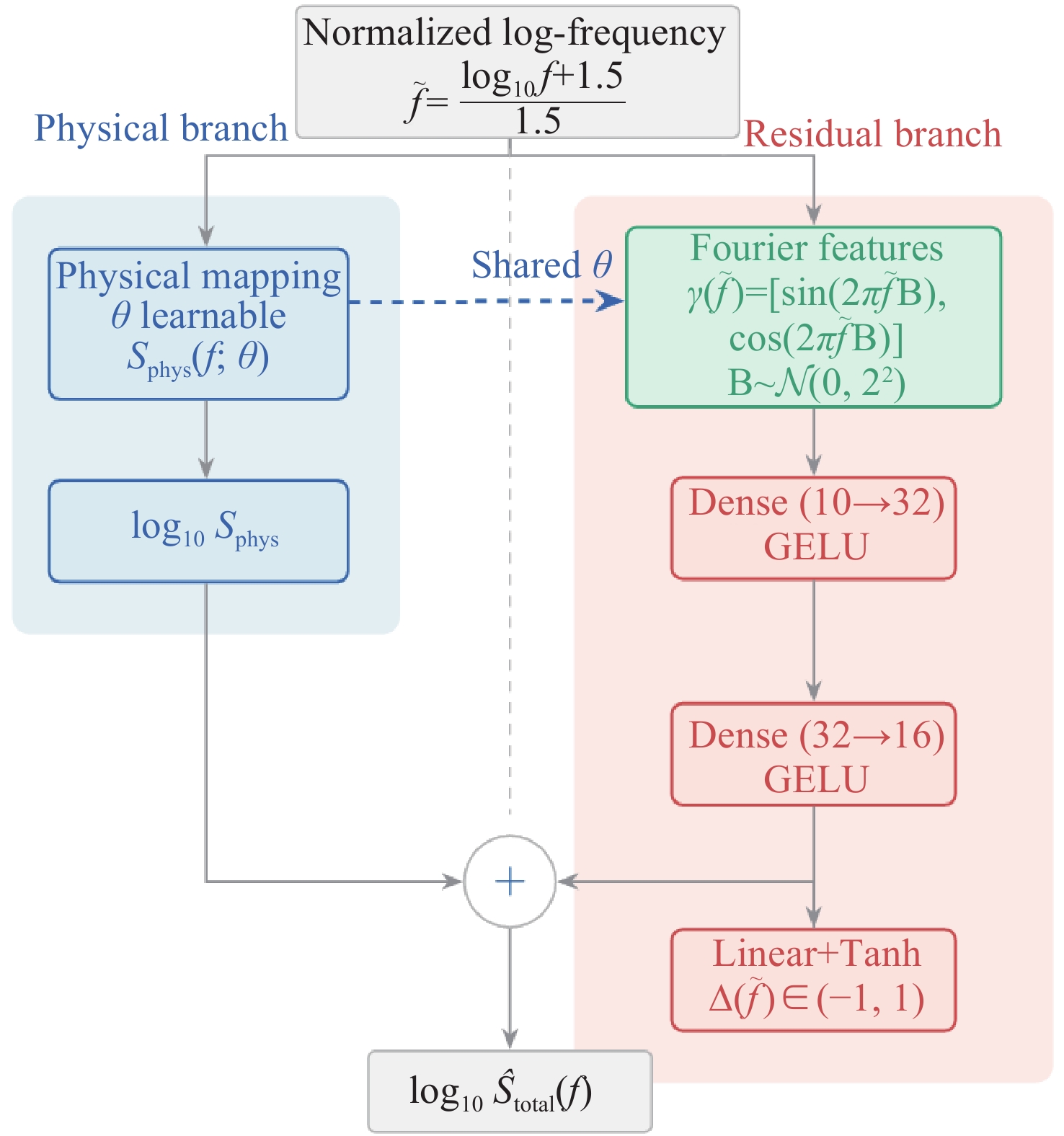
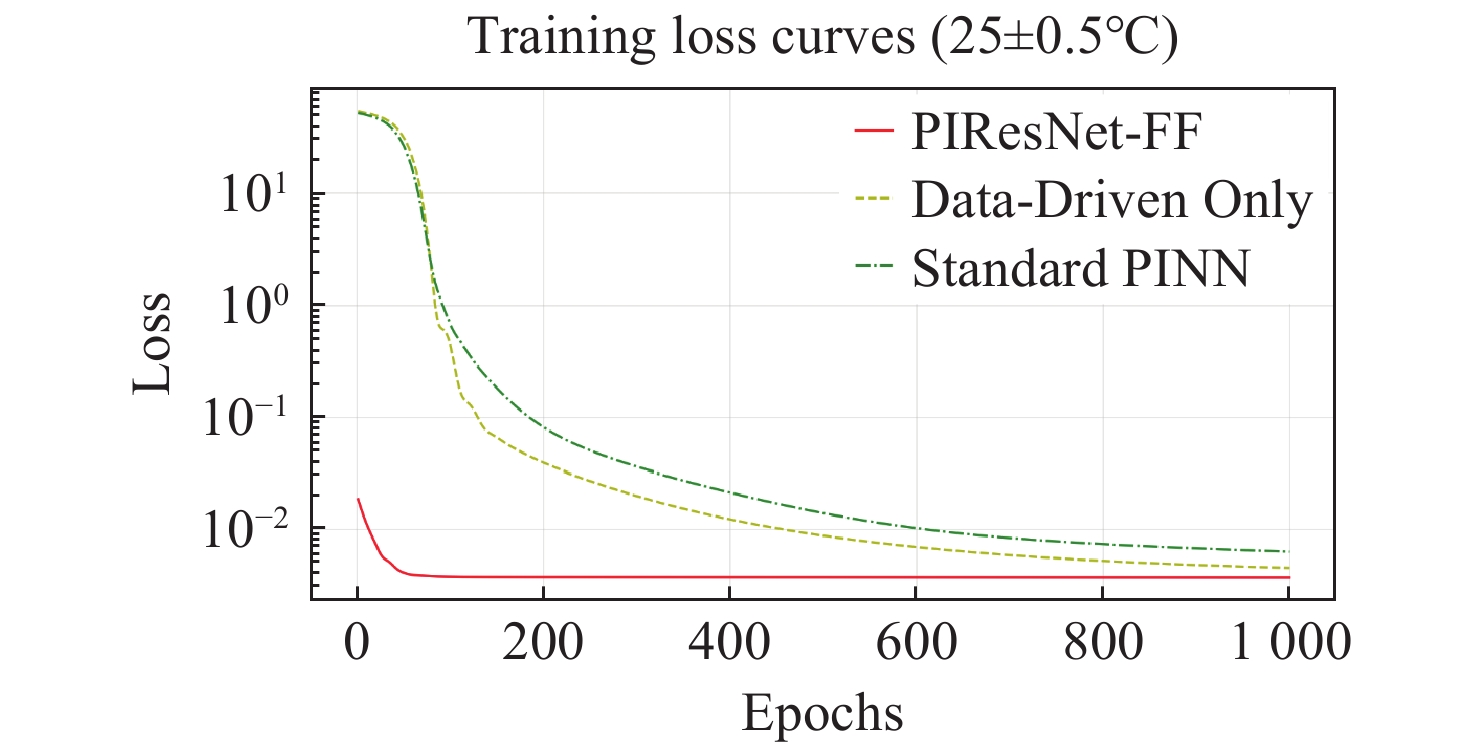
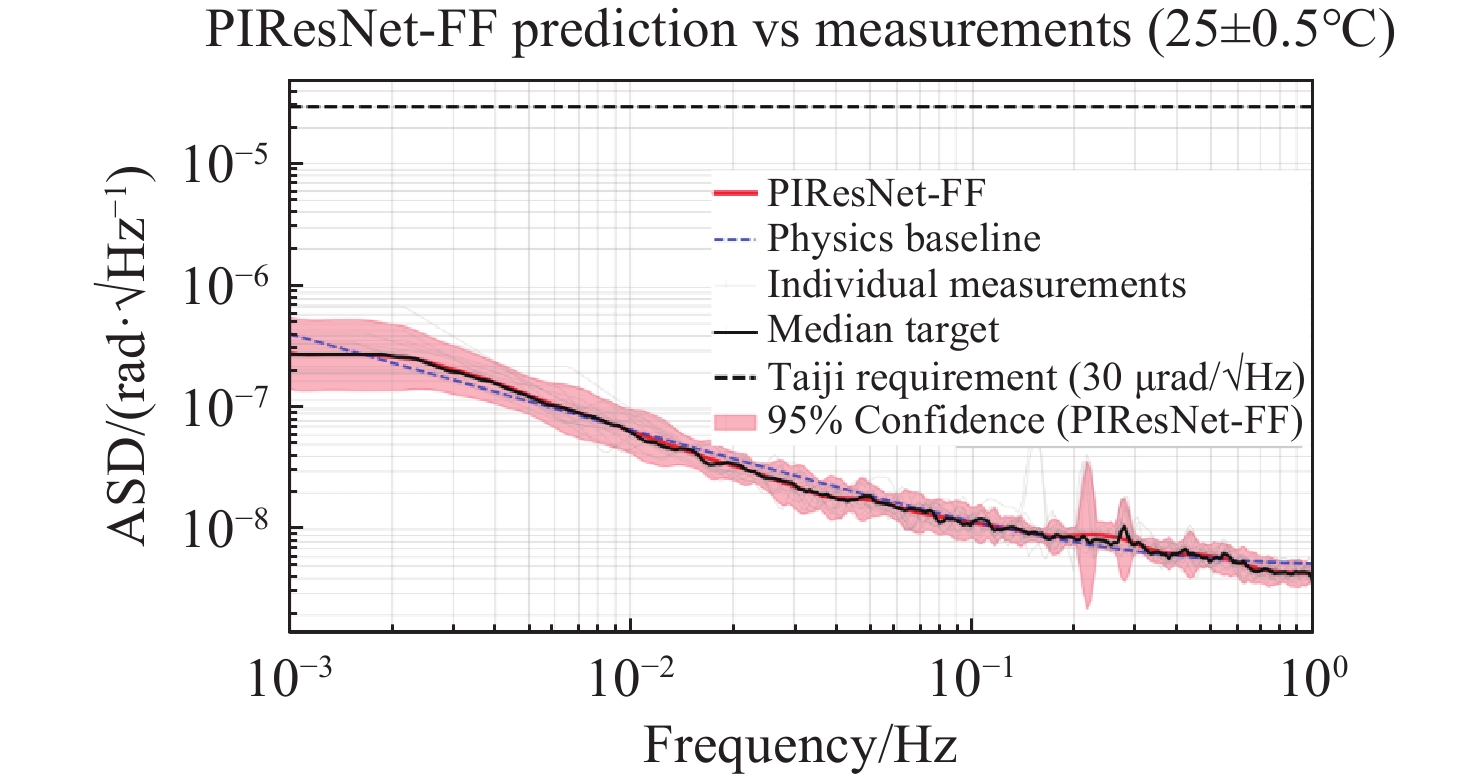
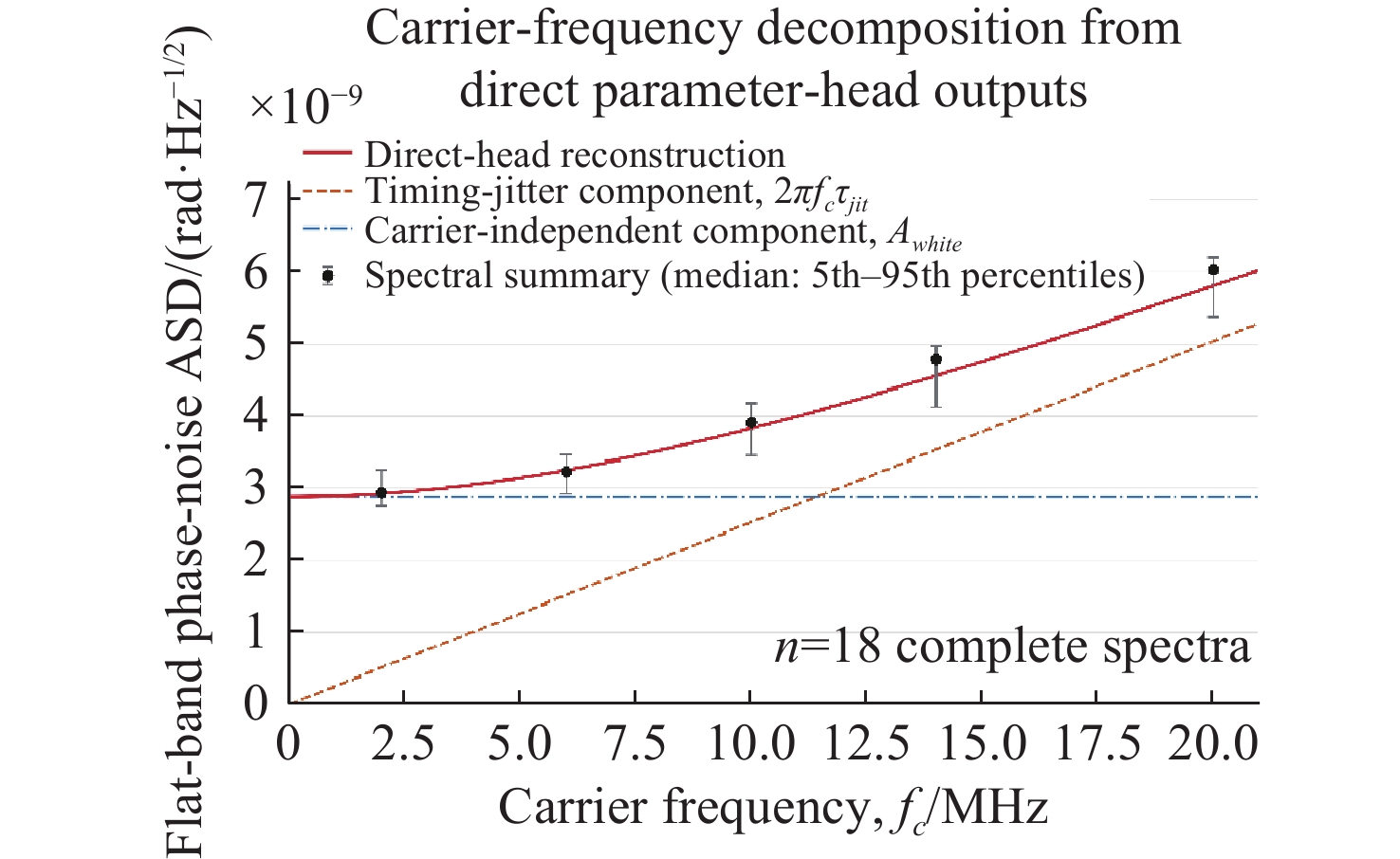
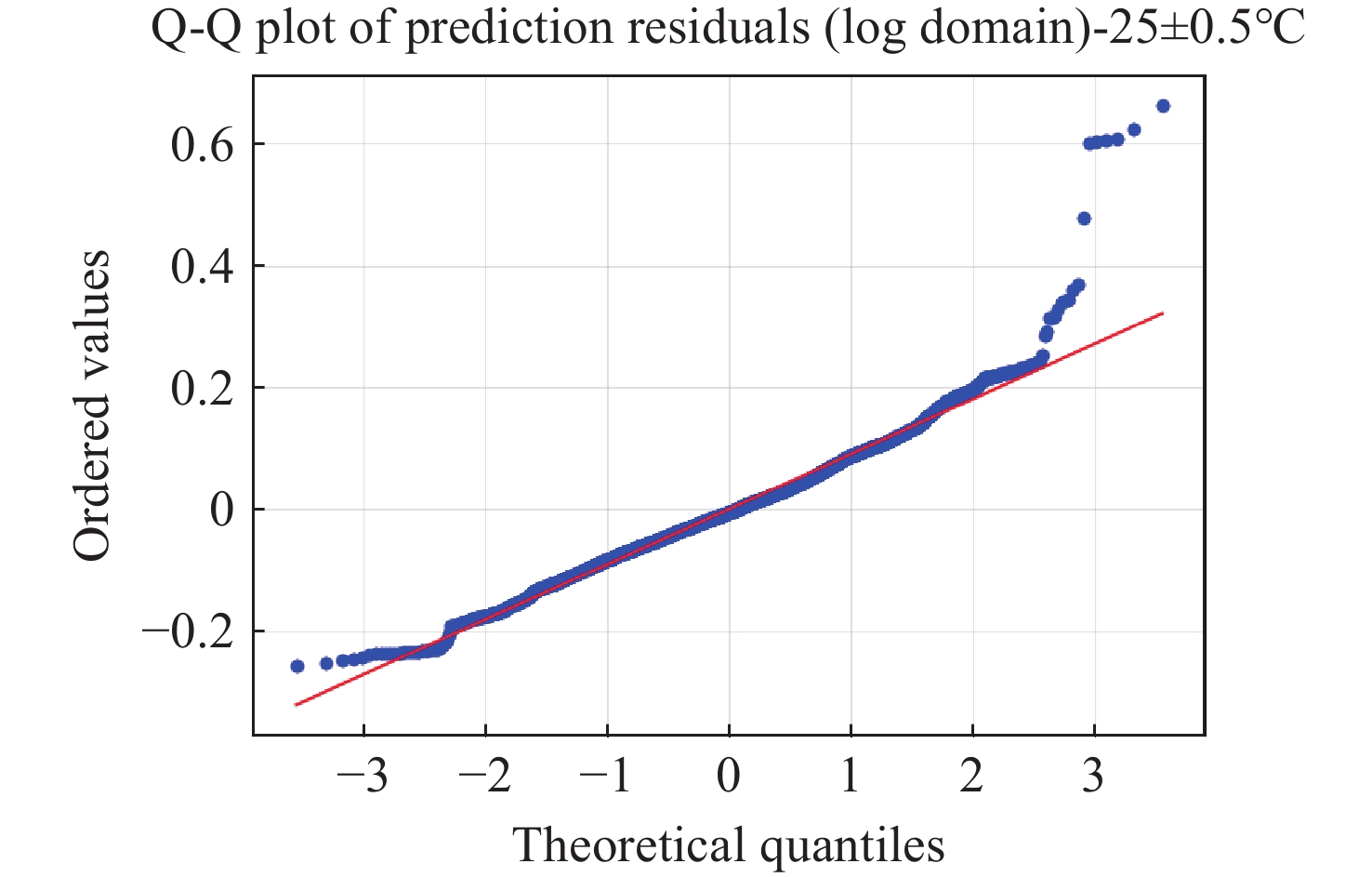
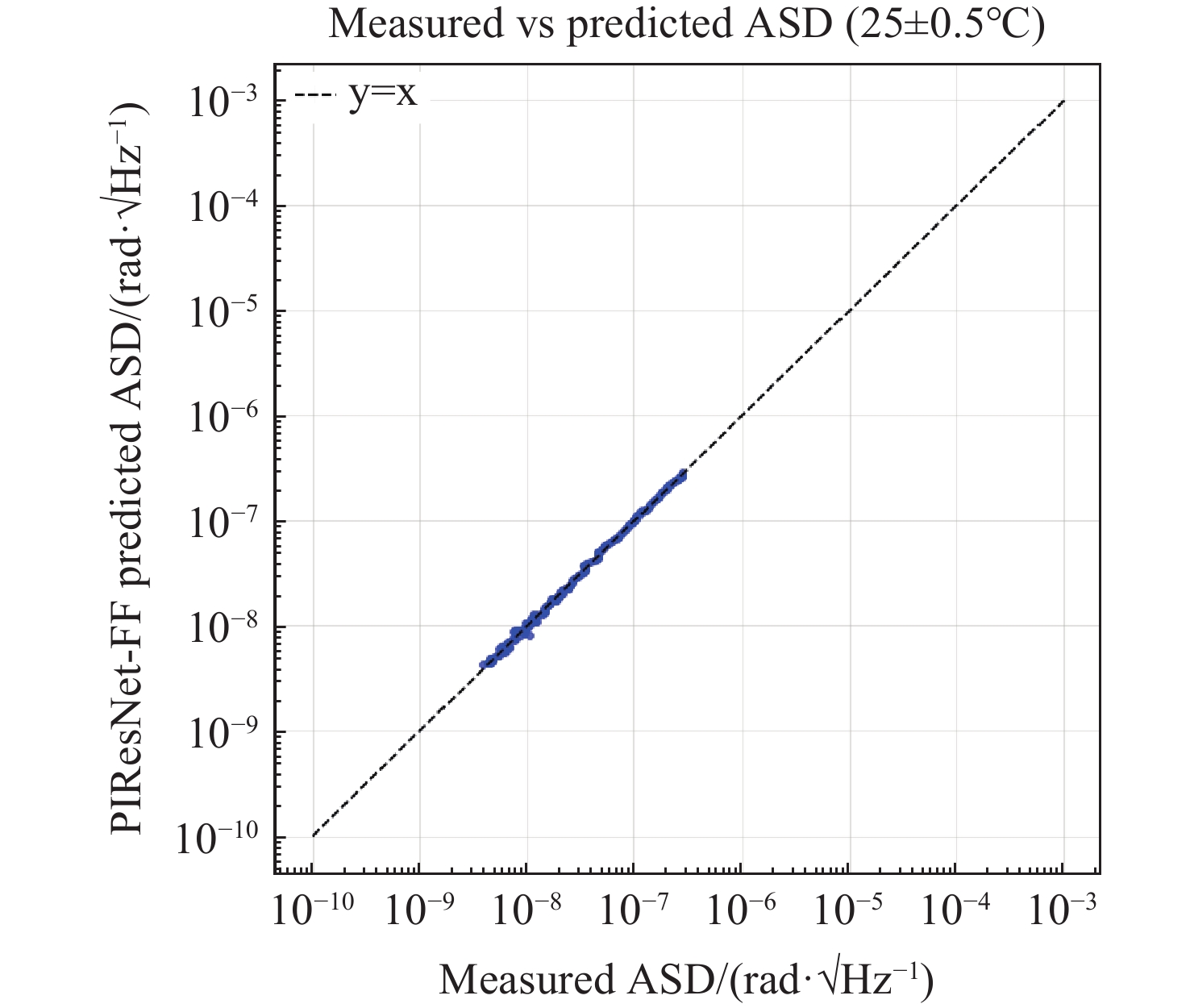
High-precision phasemeters are core payloads in space laser interferometry and gravitational-wave detection systems, and their low-frequency phase-noise performance directly limits the achievable measurement sensitivity. To address the limited capability of purely analytical physical models in describing hardware-induced nonlinear disturbances, as well as the spectral bias and lack of physical interpretability of purely data-driven deep networks, this study proposes a Physics-Informed Residual Network with Fourier Features (PIResNet-FF). The proposed network adopts a dual-branch architecture, in which a physics branch embedding deterministic noise equations provides the global spectral baseline, while a Fourier-feature-enhanced residual branch compensates for local spectral distortions. A two-stage optimization strategy is employed to jointly learn the physical parameters and residual corrections. Experimental results show that PIResNet-FF achieves a mean absolute percentage error of 3.52% in amplitude spectral density modeling, outperforming the classical physical model, a standard physics-informed neural network, and a purely data-driven network. Multi-carrier control experiments are further introduced to exploit the different carrier-frequency responses of clock-jitter noise and equivalent white noise, thereby providing additional independent physical constraints for parameter estimation and improving the structural identifiability of the two flat-noise components under single-carrier conditions. Under different reference-clock conditions, the clock-related equivalent parameter estimated by the model exhibits a response consistent with the relative change in reference-clock stability, providing supplementary experimental support for the identification of the clock-related noise component. The proposed method provides a useful approach for noise-spectrum modeling, conditional equivalent parameter estimation, and noise analysis of high-precision phasemeters.

| [1] |
罗子人, 张敏, 靳刚, 等. 中国空间引力波探测“太极计划”及“太极1号”在轨测试[J]. 深空探测学报, 2020, 7(1): 3-10. doi: 10.15982/j.issn.2095-7777.2020.20191230001
LUO Z R, ZHANG M, JIN G, et al. Introduction of Chinese space-borne gravitational wave detection program “Taiji” and “Taiji-1” satellite mission[J]. Journal of Deep Space Exploration, 2020, 7(1): 3-10. (in Chinese). doi: 10.15982/j.issn.2095-7777.2020.20191230001
|
| [2] |
罗俊, 艾凌皓, 艾艳丽, 等. 天琴计划简介[J]. 中山大学学报(自然科学版), 2021, 60(1-2): 1-19. doi: 10.13471/j.cnki.acta.snus.2020.12.23.2020B154
LUO J, AI L H, AI Y L, et al. A brief introduction to the TianQin project[J]. Acta Scientiarum Naturalium Universitatis Sunyatseni, 2021, 60(1-2): 1-19. (in Chinese). doi: 10.13471/j.cnki.acta.snus.2020.12.23.2020B154
|
| [3] |
高瑞弘, 刘河山, 罗子人, 等. 太极计划激光指向调控方案介绍[J]. 中国光学, 2019, 12(3): 425-431. doi: 10.3788/CO.20191203.0425
GAO R H, LIU H SH, LUO Z R, et al. Introduction of laser pointing scheme in the Taiji program[J]. Chinese Optics, 2019, 12(3): 425-431. (in Chinese). doi: 10.3788/CO.20191203.0425
|
| [4] |
DANZMANN K, The LISA Study Team. LISA: laser interferometer space antenna for gravitational wave measurements[J]. Classical and Quantum Gravity, 1996, 13(11A): A247-A250. doi: 10.1088/0264-9381/13/11a/033
|
| [5] |
罗子人, 白姗, 边星, 等. 空间激光干涉引力波探测[J]. 力学进展, 2013, 43(4): 415-447.
LUO Z R, BAI SH, BIAN X, et al. Gravitational wave detection by space laser interferometry[J]. Advances in Mechanics, 2013, 43(4): 415-447. (in Chinese).
|
| [6] |
韩爽. 空间引力波探测相位计测试系统设计与实现[D]. 长春: 中国科学院大学(中国科学院长春光学精密机械与物理研究所), 2022.
HAN SH. Design and implementation of phasemeter test system for space gravitational wave detection[D]. Changchun: University of Chinese Academy of Sciences (Changchun Institute of Optics, Fine Mechanics and Physics, Chinese Academy of Sciences), 2022. (in Chinese).
|
| [7] |
YANG R, LIU H SH, LUO Z R. Optimization design of decimation filter for the phasemeter in the space gravitational wave detection[J]. IEEE Transactions on Instrumentation and Measurement, 2024, 73: 7006508. doi: 10.1109/tim.2024.3453345
|
| [8] |
LIU H SH, WANG J, TAO W, et al. Recent development of the laser interferometer for Taiji space gravitational wave detection[J]. Research, 2026, 9: 1252. doi: 10.34133/research.1252
|
| [9] |
GERBERDING O, SHEARD B, BYKOV I, et al. Phasemeter core for intersatellite laser heterodyne interferometry: modelling, simulations and experiments[J]. Classical and Quantum Gravity, 2013, 30(23): 235029. doi: 10.1088/0264-9381/30/23/235029
|
| [10] |
GERBERDING O, DIEKMANN C, KULLMANN J, et al. Readout for intersatellite laser interferometry: measuring low frequency phase fluctuations of high-frequency signals with microradian precision[J]. Review of Scientific Instruments, 2015, 86(7): 074501. doi: 10.1063/1.4927071
|
| [11] |
BODE C H. Noise in the LISA phasemeter[D]. Hannover: Leibniz Universität Hannover, 2024, doi: 10.15488/17997.
|
| [12] |
YAO W L, SUN CH Y, LIANG X D, et al. Research on ADPLL for high-precision phase measurement[J]. Symmetry, 2025, 17(9): 1487. doi: 10.3390/sym17091487
|
| [13] |
CHEN H K, WANG P P, SHAO CH G. Subtracting and monitoring tilt-to-length noise under high differential wavefront sensing noise using convolutional neural networks and time delay interferometry[J]. The Astrophysical Journal, 2026, 998(2): 237. doi: 10.3847/1538-4357/ae1c46
|
| [14] |
XU Y X, WANG H, DU M H, et al. Gravitational wave signal denoising and merger time prediction with a deep neural network[J]. Physical Review D, 2025, 111(6): 063037. doi: 10.1103/PhysRevD.111.063037
|
| [15] |
RAISSI M, PERDIKARIS P, KARNIADAKIS G E. Physics-informed neural networks: a deep learning framework for solving forward and inverse problems involving nonlinear partial differential equations[J]. Journal of Computational Physics, 2019, 378: 686-707. doi: 10.1016/j.jcp.2018.10.045
|
| [16] |
KIM K M, LEE J. Memristor noise modeling based on physics-informed neural networks: circuit simulator application[J]. Journal of the Semiconductor & Display Technology, 2025, 24(1): 25-31.
|
| [17] |
KIM K, LEE J. Stochastic memristor modeling framework based on physics-informed neural networks[J]. Applied Sciences, 2024, 14(20): 9484. doi: 10.3390/app14209484
|
| [18] |
LEE J. Physics-informed neural network for high frequency noise performance in quasi-ballistic MOSFETs[J]. Electronics, 2021, 10(18): 2219. doi: 10.3390/electronics10182219
|
| [19] |
KIM H, KANG P. naPINN: noise-adaptive physics-informed neural networks for recovering physics from corrupted measurement[EB/OL]. (2026-06-01)[2026-09-01]. https://arxiv.org/abs/2602.02547.
|
| [20] |
HOU B Y, BAI Y L, JING X T, et al. Fourier feature-enhanced multi-layer residual stacking network: a novel multiscale modeling approach for physics-informed neural networks[J]. Neural Networks, 2026, 195: 108247. doi: 10.1016/j.neunet.2025.108247
|
| [21] |
HE K M, ZHANG X Y, REN SH Q, et al. Deep residual learning for image recognition[C]//Proceedings of the 2016 IEEE Conference on Computer Vision and Pattern Recognition, IEEE, 2016: 770-778.
|
| [22] |
TANCIK M, SRINIVASAN P P, MILDENHALL B, et al. Fourier features let networks learn high frequency functions in low dimensional domains[C]//Proceedings of the 34th International Conference on Neural Information Processing Systems, Curran Associates Inc., 2020: 632.
|
| [23] |
BASRI R, JACOBS D, KASTEN Y, et al. The convergence rate of neural networks for learned functions of different frequencies[C]//Proceedings of the 33rd International Conference on Neural Information Processing Systems, Curran Associates Inc., 2019: 428.
|
| [24] |
WANG S F, WANG H W, PERDIKARIS P. On the eigenvector bias of Fourier feature networks: from regression to solving multi-scale PDEs with physics-informed neural networks[J]. Computer Methods in Applied Mechanics and Engineering, 2021, 384: 113938. doi: 10.1016/j.cma.2021.113938
|
| [25] |
SONG CH, WANG Y H. Simulating seismic multifrequency wavefields with the Fourier feature physics-informed neural network[J]. Geophysical Journal International, 2023, 232(3): 1503-1514. doi: 10.1093/gji/ggac399
|
| [26] |
BISCHOF R, KRAUS M A. Multi-objective loss balancing for physics-informed deep learning[J]. Computer Methods in Applied Mechanics and Engineering, 2025, 439: 117914. doi: 10.1016/j.cma.2025.117914
|
| [27] |
HELDMANN F, BERKHAHN S, EHRHARDT M, et al. PINN training using biobjective optimization: the trade-off between data loss and residual loss[J]. Journal of Computational Physics, 2023, 488: 112211. doi: 10.1016/j.jcp.2023.112211
|
| [28] |
DAVINI D, SAMINENI B, THOMAS B, et al. Using physics-informed regularization to improve extrapolation capabilities of neural networks[C]//Fourth Workshop on Machine Learning and the Physical Sciences, 2021. (查阅网上资料, 未找到本条文献出版社信息, 请确认).
|
| [29] |
MCDOWELL E J, CUI X Q, YAQOOB Z, et al. A generalized noise variance analysis model and its application to the characterization of
|
Figures(11) / Tables(5)





 DownLoad: