| Citation: | LIU Ye, SHI Xing-jian, YANG Wen-zhe, YANG Zhong-guang, CAI Zhi-ming, LI Hua-wang. Magnetic sensor configuration optimization for gravitational-wave detection spacecraft[J]. Chinese Optics, 2026, 19(5): 1226-1242. doi: 10.3724/CO.2026-0074

|
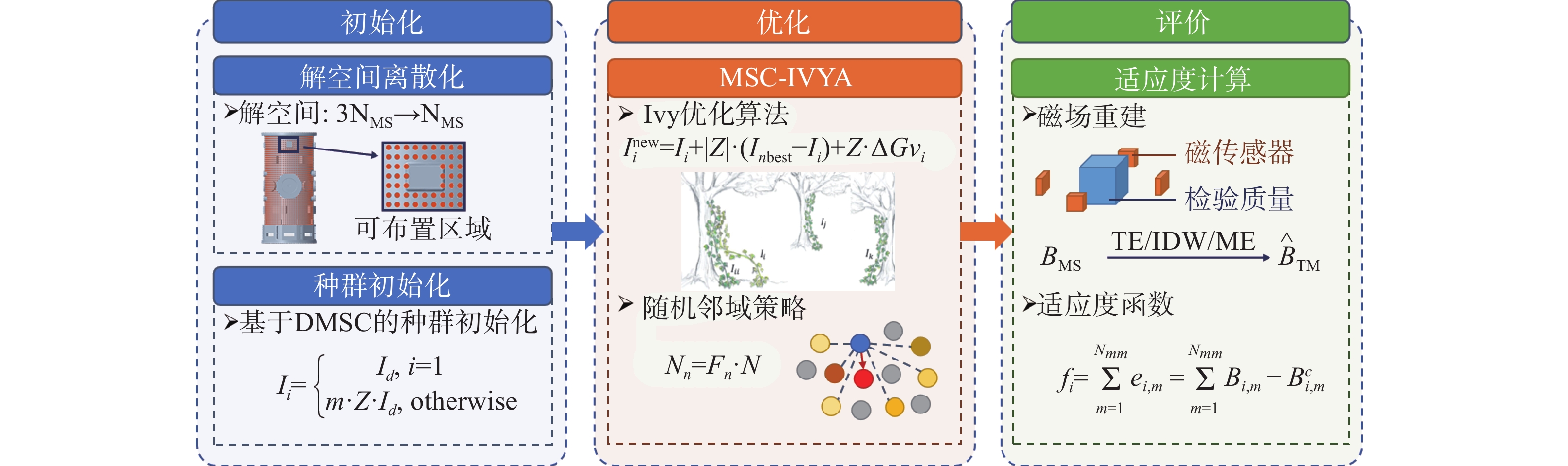
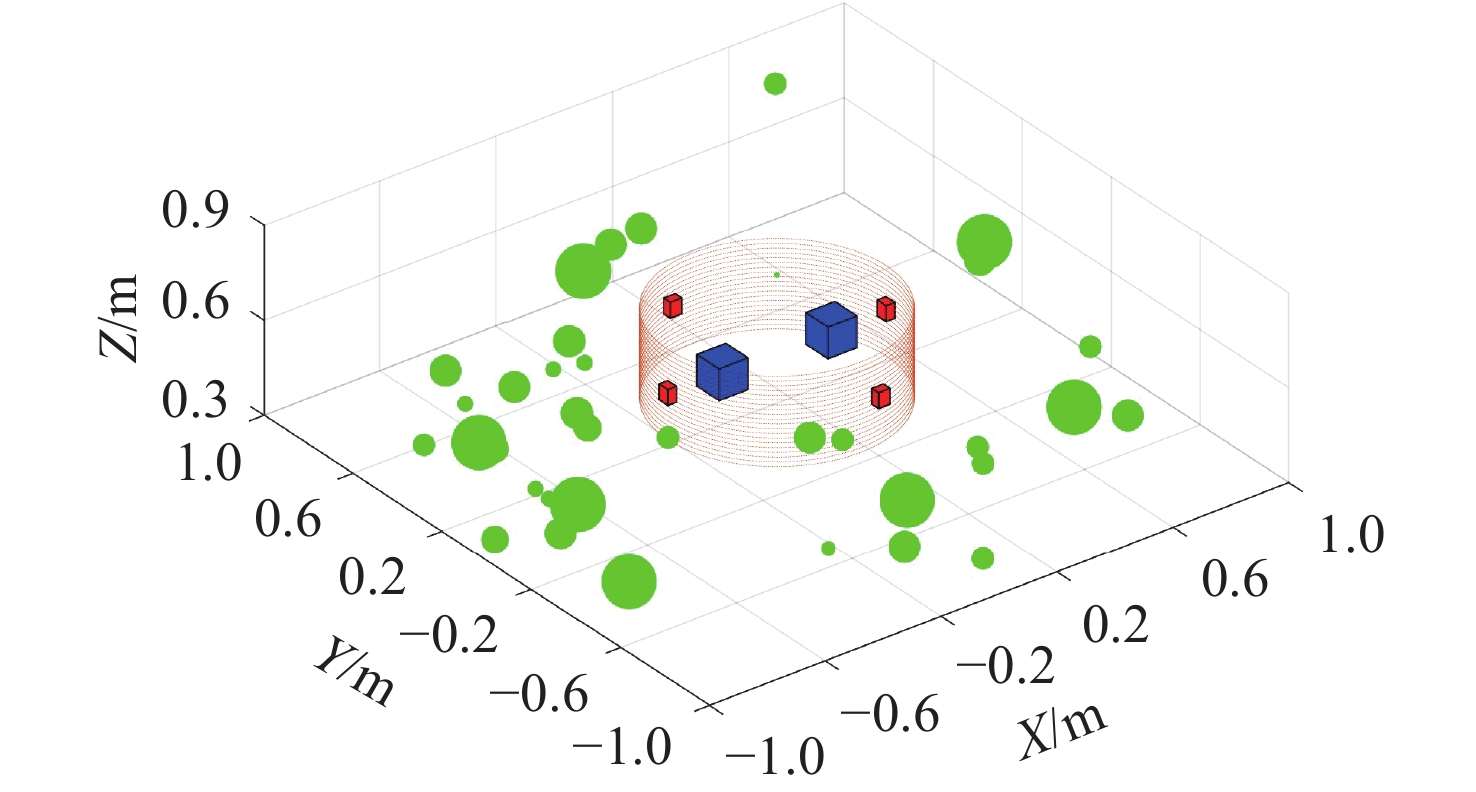
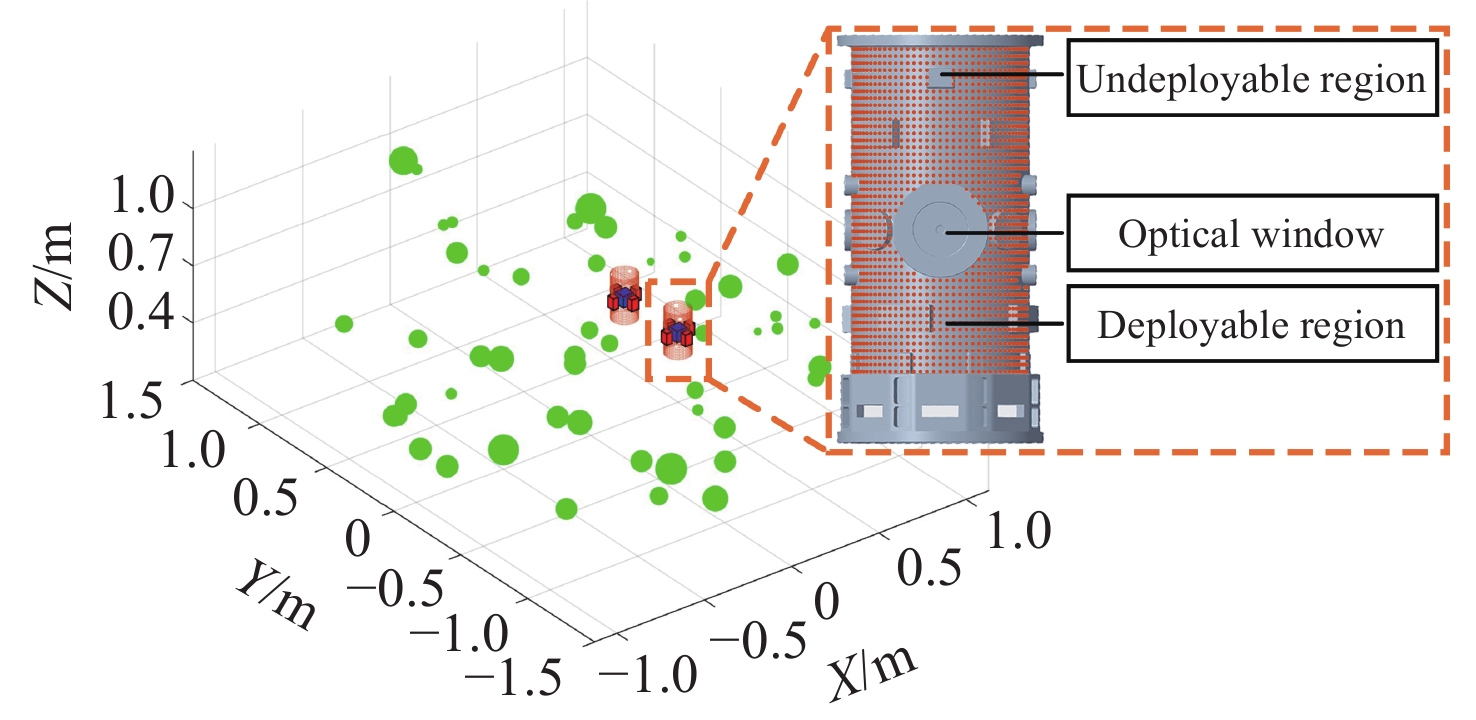
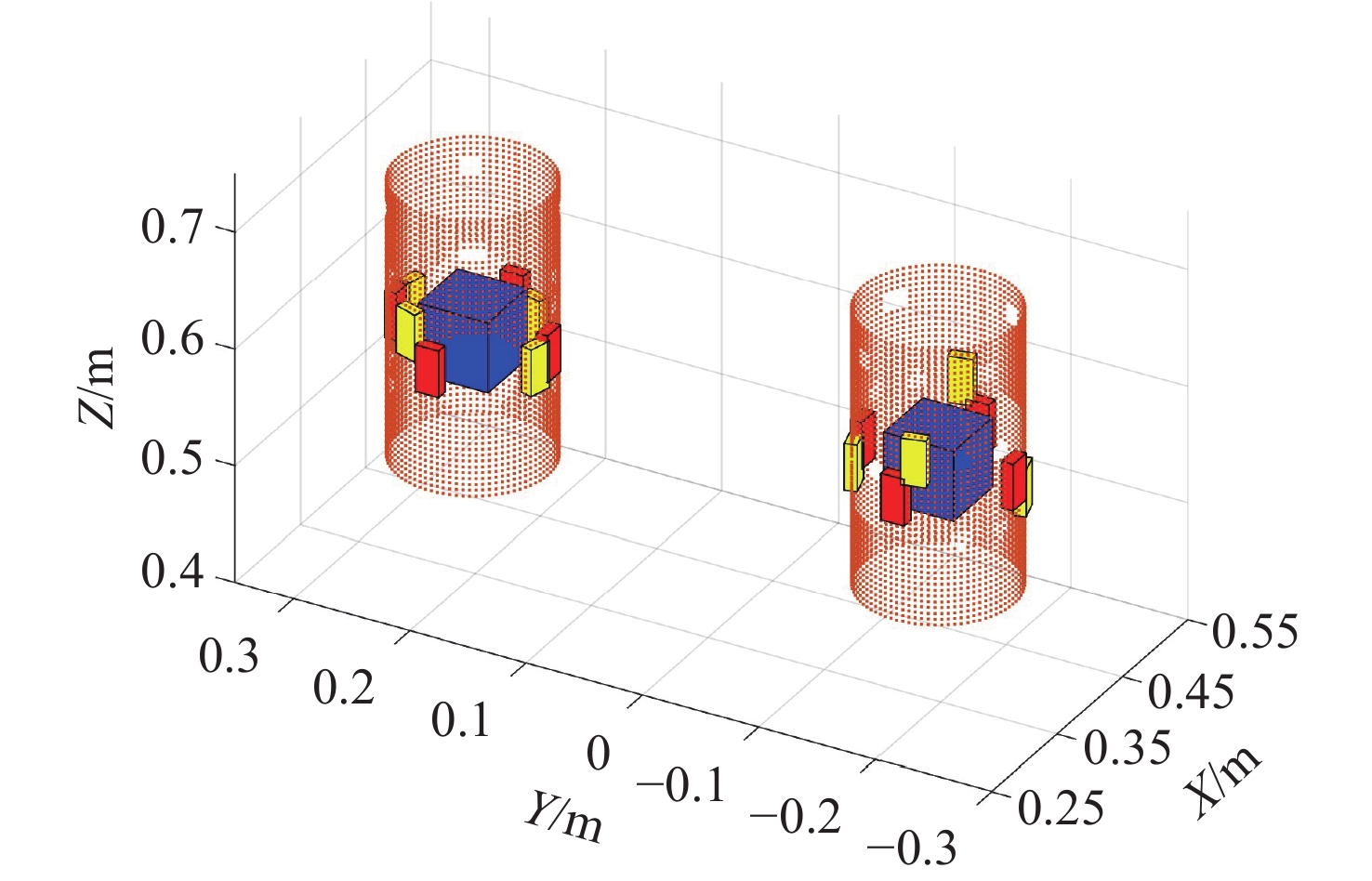
The magnetic field near the test masses (TM) in space-based gravitational-wave detection spacecraft cannot be measured in situ, and the accuracy of magnetic field reconstruction is strongly affected by the arrangement of magnetic sensors. To address these problems, we investigate a magnetic sensor configuration optimization method under constrained installation conditions, aiming to improve the magnetic field reconstruction accuracy at the test mass locations. The magnetic sensor placement problem was formulated as a discrete combinatorial optimization problem. An improved IVY algorithm-based magnetic sensor configuration optimization method, termed MSC-IVYA, was proposed. The method integrates feasible installation region discretization, default-configuration-based population initialization, dynamic neighborhood updating, and a cumulative fitness function designed for multiple random magnetic source models, thereby enabling efficient search under installation constraints. Simulation evaluations were conducted on two representative space-based gravitational-wave detectors, LISA Pathfinder and Taiji-2, using three magnetic field reconstruction methods: inverse distance weighting (IDW), Taylor expansion (TE), and multipole expansion (ME). For LISA Pathfinder, under the default configuration, the average relative errors of TM1 were 593.74%, 508.04%, and 516.50% using IDW, ME, and TE, respectively. After optimization with MSC-IVYA, these errors were reduced to 390.39%, 357.55%, and 363.89%, respectively. In the Taiji-2 case, MSC-IVYA also achieved consistent improvement. For TM1, the reconstruction errors using IDW and ME decreased from 72.14% and 77.27% to 32.55% and 47.25%, respectively. For TM2, the errors using ME and TE decreased from 97.17% and 112.14% to 74.27% and 80.76%, respectively. Magnetic sensor configuration is an important design variable affecting the magnetic field reconstruction performance at the test mass locations. The proposed MSC-IVYA method can consistently improve magnetic field reconstruction accuracy under different mission conditions. It is particularly suitable for engineering scenarios with a limited number of magnetic sensors and constrained installation regions, and provides methodological support for the design of magnetic diagnostic systems in space-based gravitational-wave detection spacecraft.

| [1] |
ABBOTT B P, ABBOTT R, ABBOTT T D, et al. Observation of gravitational waves from a binary black hole merger[J]. Physical Review Letters, 2016, 116(6): 061102. doi: 10.1103/PhysRevLett.116.061102
|
| [2] |
XIAO G Z, KUANG T F, HE Y T, et al. Giant enhancement of nonlinear harmonics of an optical-tweezer phonon laser[J]. eLight, 2024, 4(1): 17. doi: 10.1186/s43593-024-00064-8
|
| [3] |
GAO L, ZHENG L A, LU B, et al. Generation of squeezed vacuum state in the millihertz frequency band[J]. Light: Science & Applications, 2024, 13(1): 294.
|
| [4] |
WANNER G. Space-based gravitational wave detection and how LISA Pathfinder successfully paved the way[J]. Nature Physics, 2019, 15(3): 200-202. doi: 10.1038/s41567-019-0462-3
|
| [5] |
LISA Pathfinder Collaboration. LISA Pathfinder: first steps to observing gravitational waves from space[J]. Journal of Physics: Conference Series, 2017, 840(1): 012001. doi: 10.1088/1742-6596/840/1/012001
|
| [6] |
DANZMANN K, RÜDIGER A. LISA technology—concept, status, prospects[J]. Classical and Quantum Gravity, 2003, 20(10): S1-S9. doi: 10.1088/0264-9381/20/10/301
|
| [7] |
LUO J, CHEN L SH, DUAN H Z, et al. TianQin: a space-borne gravitational wave detector[J]. Classical and Quantum Gravity, 2016, 33(3): 035010. doi: 10.1088/0264-9381/33/3/035010
|
| [8] |
MILYUKOV V K. TianQin space-based gravitational wave detector: key technologies and current state of implementation[J]. Astronomy Reports, 2020, 64(12): 1067-1077. doi: 10.1134/S1063772920120070
|
| [9] |
HU W R, WU Y L. The Taiji program in Space for gravitational wave physics and the nature of gravity[J]. National Science Review, 2017, 4(5): 685-686. doi: 10.1093/nsr/nwx116
|
| [10] |
MANCE D. Development of electronic system for sensing and actuation of test mass of the inertial sensor LISA[D]. Zurich: Fakultet Elektrotehnike, Strojarstva I Brodogradnje u Splitu, 2012.
|
| [11] |
ZHANG H Y, XU P, YE Z Q, et al. A systematic approach for inertial sensor calibration of gravity recovery satellites and its application to Taiji-1 mission[J]. Remote Sensing, 2023, 15(15): 3817. doi: 10.3390/rs15153817
|
| [12] |
ZHOU A N, CAI L, XIAO CH Y, et al. Non-gravitational force measurement and correction by a precision inertial sensor of TianQin-1 satellite[J]. Classical and Quantum Gravity, 2022, 39(11): 115005. doi: 10.1088/1361-6382/ac68c9
|
| [13] |
SUN ZH Y, LI P X, LI Z Q, et al. Analysis of the calculation method and evaluation of the magnetic acceleration noise of space inertial sensor[J]. Results in Physics, 2023, 53: 106955. doi: 10.1016/j.rinp.2023.106955
|
| [14] |
CAÑIZARES P, CONCHILLO A, GARCÍA-BERRO E, et al. The diagnostics subsystem on board LISA Pathfinder and LISA[J]. Classical and Quantum Gravity, 2009, 26(9): 094005. doi: 10.1088/0264-9381/26/9/094005
|
| [15] |
DIAZ-AGUILÓ M, GARCÍA-BERRO E, LOBO A. Theory and modelling of the magnetic field measurement in LISA PathFinder[J]. Classical and Quantum Gravity, 2010, 27(3): 035005. doi: 10.1088/0264-9381/27/3/035005
|
| [16] |
MATEOS I, RAMOS-CASTRO J, LOBO A. Low-frequency noise characterization of a magnetic field monitoring system using an anisotropic magnetoresistance[J]. Sensors and Actuators A: Physical, 2015, 235: 57-63. doi: 10.1016/j.sna.2015.09.021
|
| [17] |
MATEOS I, DÍAZ-AGUILÓ M, RAMOS-CASTRO J, et al. Interpolation of the magnetic field at the test masses in eLISA[J]. Classical and Quantum Gravity, 2015, 32(16): 165003. doi: 10.1088/0264-9381/32/16/165003
|
| [18] |
LIU B B, YANG ZH, QIANG L E, et al. Magnetic field recovery technique based on distance weighting multipole expansion method[J]. Europhysics Letters, 2023, 143(5): 59003. doi: 10.1209/0295-5075/acf51f
|
| [19] |
TROUGNOU L. ECSS space systems electromagnetic compatibility handbook[C]. 2012 ESA Workshop on Aerospace EMC, IEEE, 2012: 1-6.
|
| [20] |
TSATALAS S, VERGOS D, SPANTIDEAS S T, et al. A novel multi-magnetometer facility for on-ground characterization of spacecraft equipment[J]. Measurement, 2019, 146: 948-960. doi: 10.1016/j.measurement.2019.07.016
|
| [21] |
SPANTIDEAS S T, CAPSALIS C N. Validation of a source identification method for prediction of low-frequency magnetic fields in space missions[J]. IEEE Magnetics Letters, 2018, 9: 1300805.
|
| [22] |
XU L. A proportional differential control method for a time-delay system using the Taylor expansion approximation[J]. Applied Mathematics and Computation, 2014, 236: 391-399. doi: 10.1016/j.amc.2014.02.087
|
| [23] |
LU G Y, WONG D W. An adaptive inverse-distance weighting spatial interpolation technique[J]. Computers & Geosciences, 2008, 34(9): 1044-1055. doi: 10.1016/j.cageo.2007.07.010
|
| [24] |
ALAEE R, ROCKSTUHL C, FERNANDEZ-CORBATON I. An electromagnetic multipole expansion beyond the long-wavelength approximation[J]. Optics Communications, 2018, 407: 17-21. doi: 10.1016/j.optcom.2017.08.064
|
| [25] |
GHASEMI M, ZARE M, TROJOVSKÝ P, et al. Optimization based on the smart behavior of plants with its engineering applications: Ivy algorithm[J]. Knowledge-Based Systems, 2024, 295: 111850. doi: 10.1016/j.knosys.2024.111850
|
| [26] |
KENNEDY J, EBERHART R. Particle swarm optimization[C]. Proceedings of ICNN'95 - International Conference on Neural Networks, IEEE, 1995: 1942-1948.
|
| [27] |
刘野, 侍行剑, 蔡志鸣, 等. 多阶段偏差修正模型的检验质量磁场重建[J]. 中国光学(中英文), 2025, 18(3): 596-611.
LIU Y, SHI X J, CAI ZH M, et al. Magnetic field reconstruction at test mass using the multi-stage bias correction model[J]. Chinese Optics, 2025, 18(3): 596-611. (in Chinese).
|
| [28] |
MATEOS I, DIAZ-AGUILÓ M, GIBERT F, et al. Magnetic back action effect of magnetic sensors for eLISA/NGO[C]. Proceedings of the 9th LISA Symposium, ASP, 2013: 341.
|
Figures(8) / Tables(2)





 DownLoad: