| Citation: | LI Jun-xiang, PAN Wen-qi, QI Ke-qi, WANG Shao-xin, DONG Peng. Reconstruction of torsion pendulum ground vibration response via fourier feature network[J]. Chinese Optics. doi: 10.37188/CO.2026-0083

|
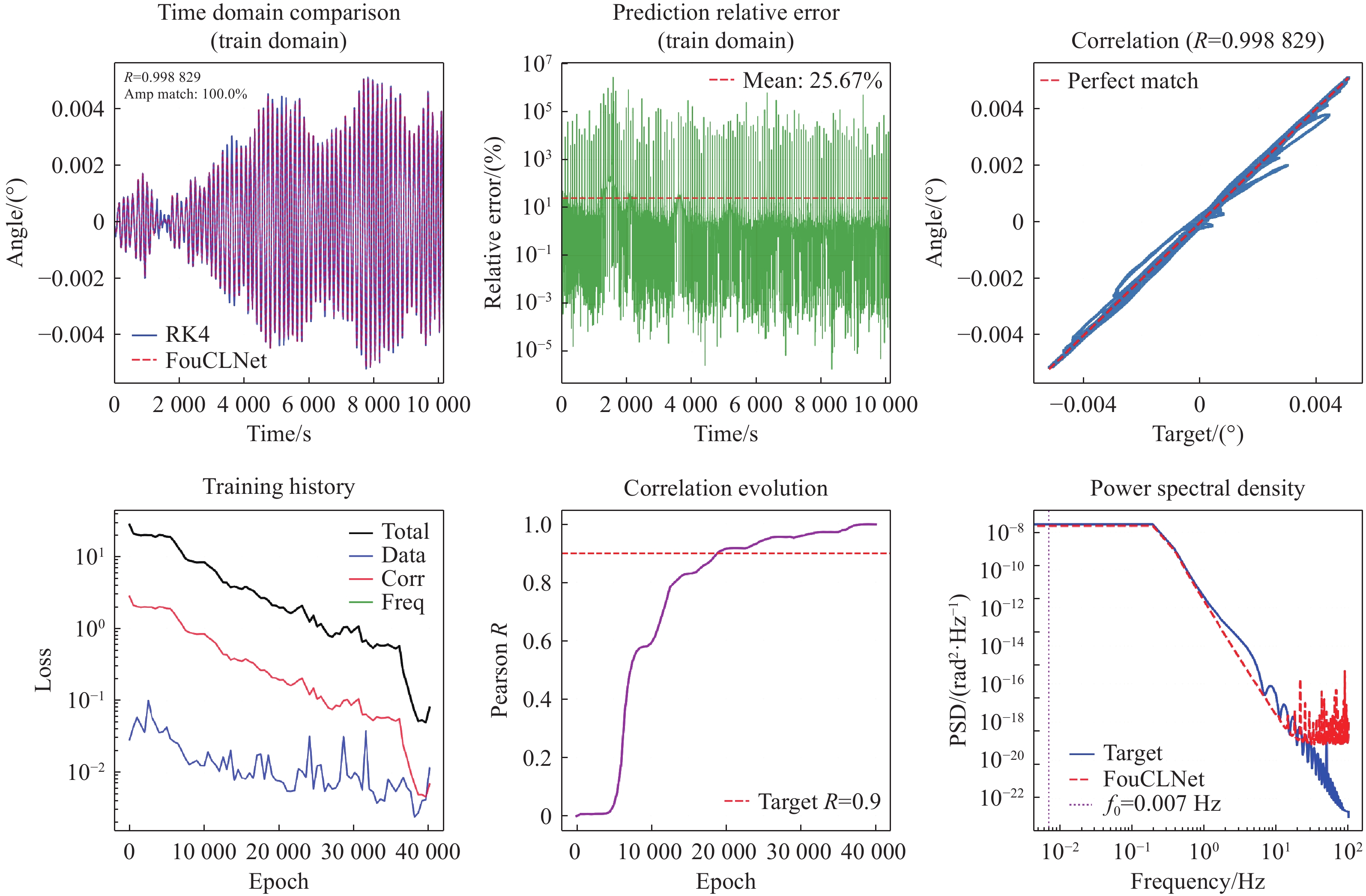
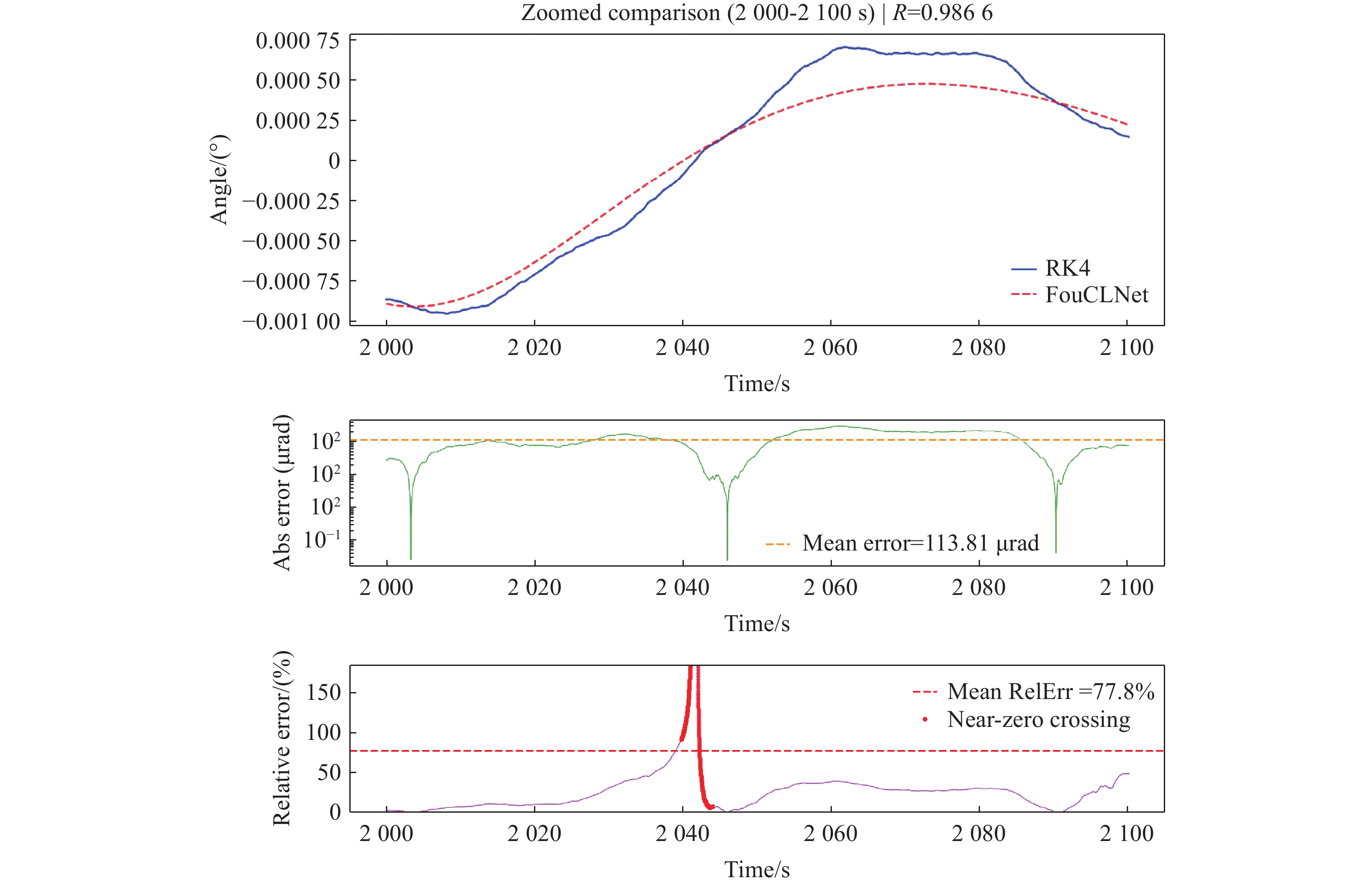
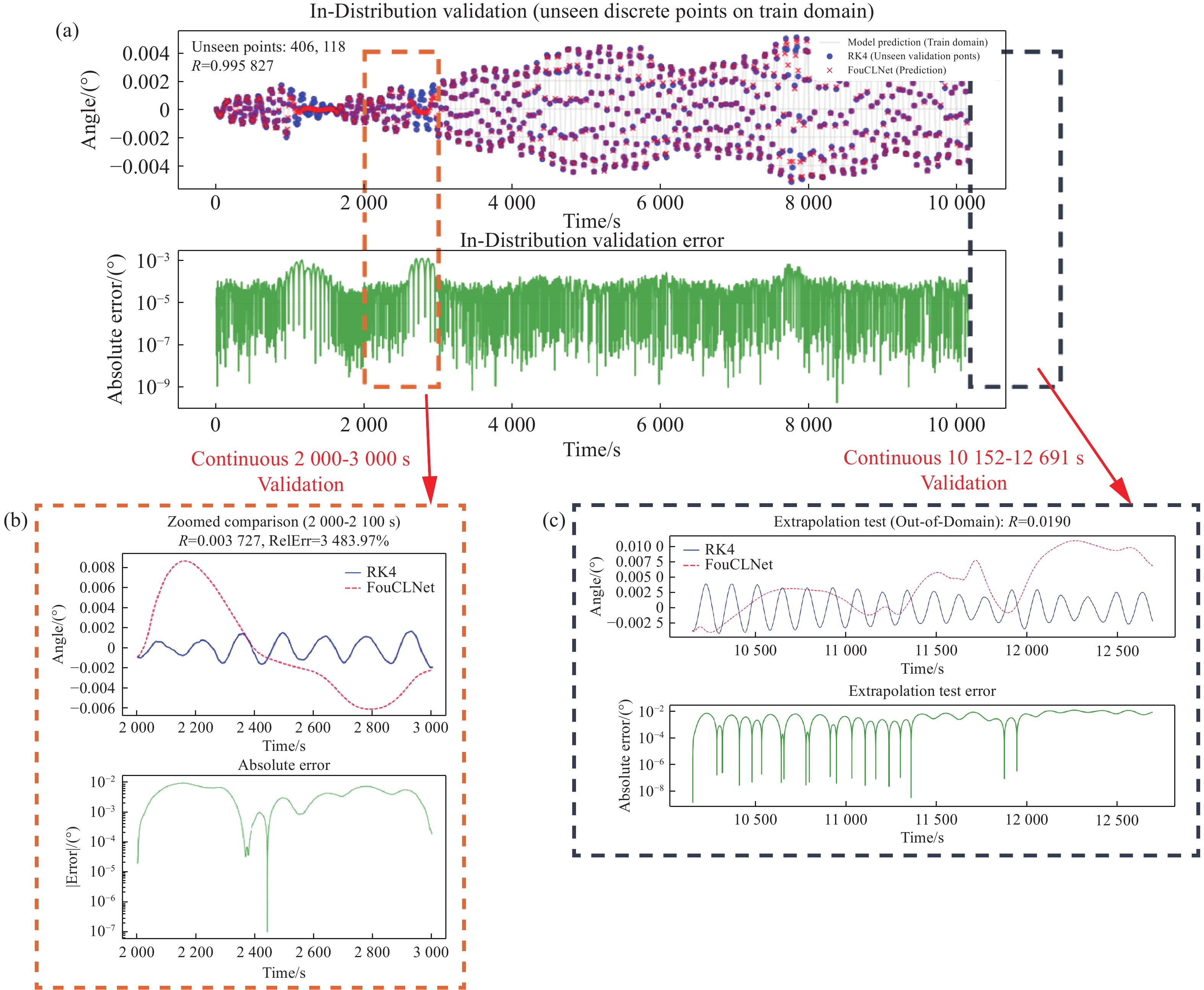
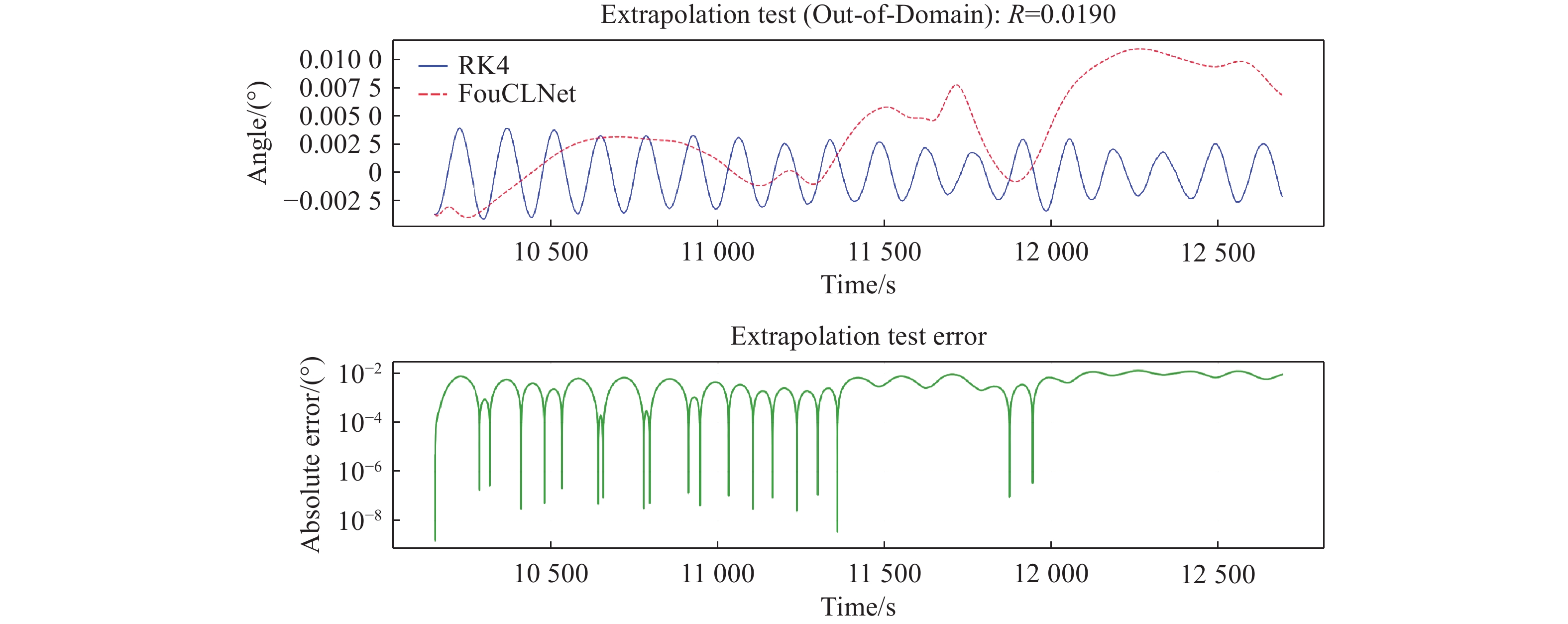
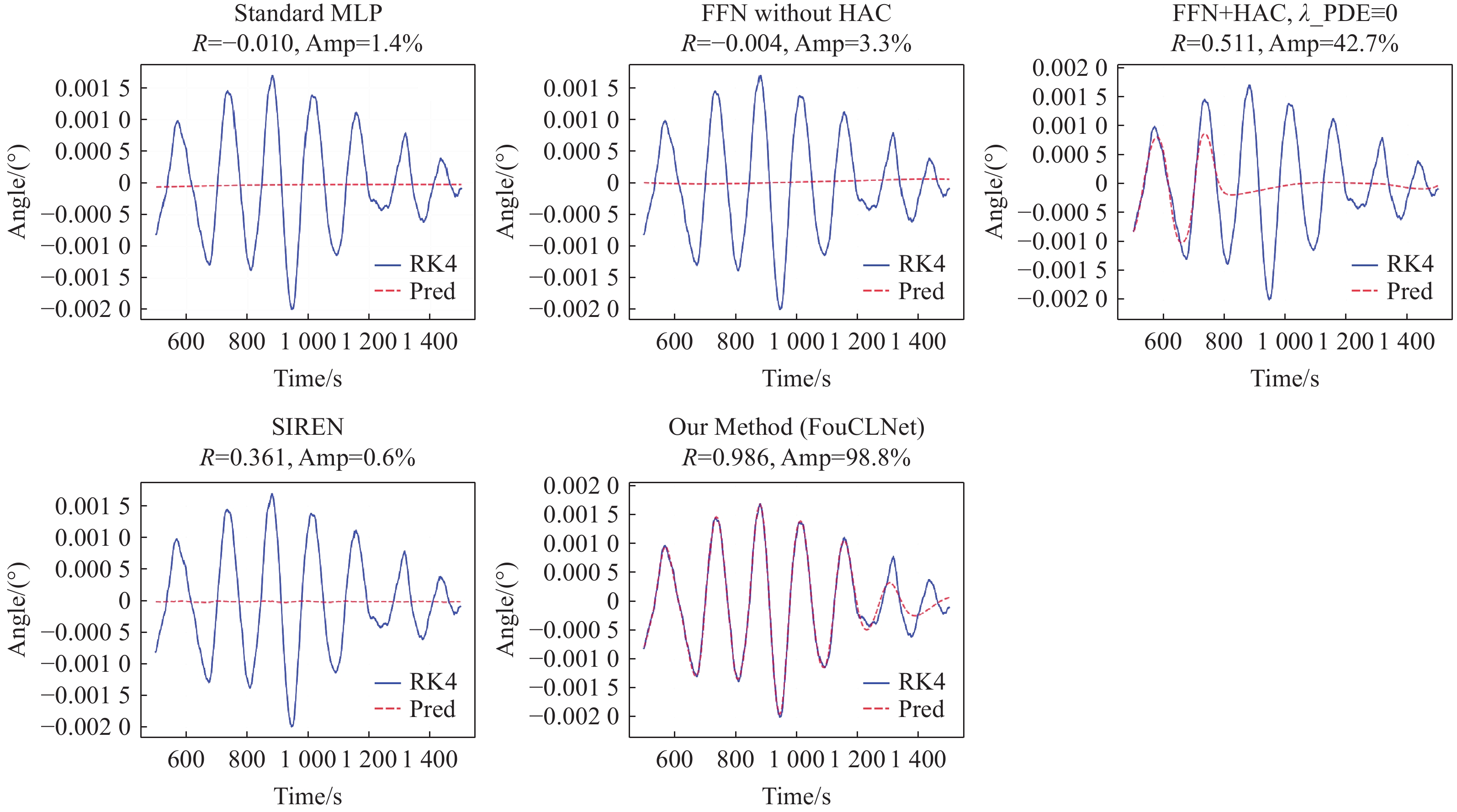
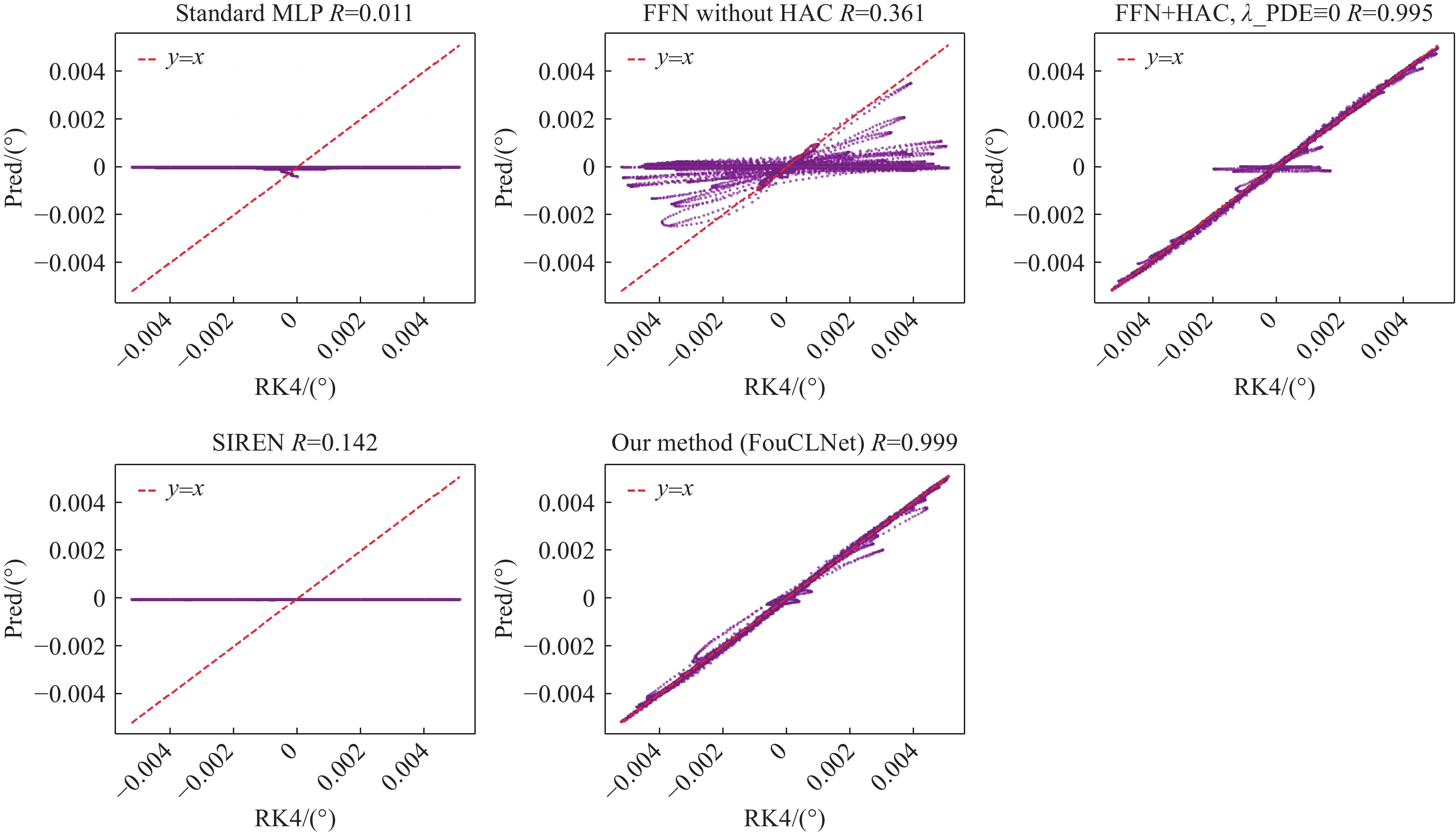
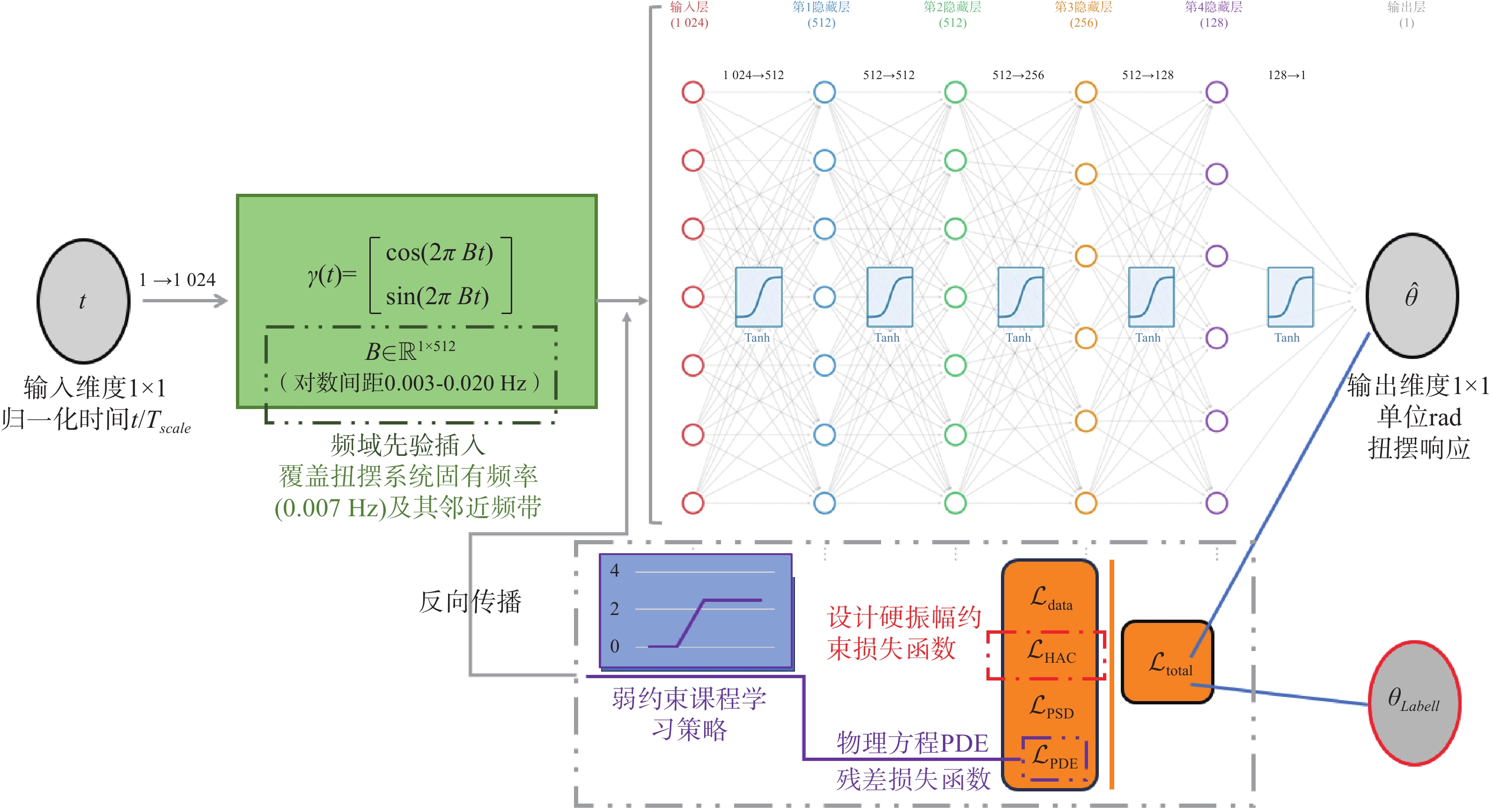
To address the signal reconstruction problem of high-Q torsion pendulum systems under ground seismic excitation in ordinary laboratory environments—pertinent to ground testing for space gravitational wave detection—a curriculum learning-driven Fourier feature network (FouCLNet) is proposed. Existing hardware isolation strategies impose stringent environmental requirements that are difficult to meet in ordinary ground laboratories. Traditional physics-informed neural networks suffer from spectral bias, gradient conflict, and an inherent tendency for outputs to decay toward zero in high-Q oscillatory systems. Log-spaced Fourier feature mapping is employed with frequency parameters uniformly distributed over the 0.003–0.02 Hz band to match the 0.007 Hz natural frequency of the pendulum. A four-layer fully connected network is constructed, and a hard amplitude constraint loss function is designed to prevent attenuation of micro-radian-scale signals. Through a three-stage curriculum learning strategy, weak physical constraints are progressively introduced with PDE residual weights annealed to the order of 1e-8. Using the torsional response under seismic noise excitation as the target physical quantity and fourth-order Runge-Kutta integration results as ground-truth labels, we randomly sample 80% of time points for training and 20% for in-distribution validation. Experimental results demonstrate that the proposed method achieves a correlation coefficient of

| [1] |
HU W R, WU Y L. The Taiji program in space for gravitational wave physics and the nature of gravity[J]. National Science Review, 2017, 4(5): 685-686. doi: 10.1093/nsr/nwx116
|
| [2] |
DANZMANN K. LISA - an ESA cornerstone mission for the detection and observation of gravitational waves[J]. Advances in Space Research, 2003, 32(7): 1233-1242. doi: 10.1016/s0273-1177(03)90323-1
|
| [3] |
罗子人, 白姗, 边星, 等. 空间激光干涉引力波探测[J]. 力学进展, 2013, 43(4): 415-447.
LUO Z R, BAI SH, BIAN X, et al. Gravitational wave detection by space laser interferometry[J]. Advances in Mechanics, 2013, 43(4): 415-447. (in Chinese).
|
| [4] |
LUO J, CHEN L SH, DUAN H Z, et al. TianQin: a space-borne gravitational wave detector[J]. Classical and Quantum Gravity, 2016, 33(3): 035010. doi: 10.1088/0264-9381/33/3/035010
|
| [5] |
李华东, 高志勇, 王智. 引力参考传感器地面测试扭摆研究进展[J]. 中国科学: 物理学 力学 天文学, 2024, 54(7): 270406.
LI H D, GAO ZH Y, WANG ZH. Research progress on torsion pendulum in ground testing of gravitational reference sensor: a review[J]. Scientia Sinica Physica, Mechanica & Astronomica, 2024, 54(7): 270406. (in Chinese).
|
| [6] |
HUELLER M, CAVALLERI A, DOLESI R, et al. Torsion pendulum facility for ground testing of gravitational sensors for LISA[J]. Classical and Quantum Gravity, 2002, 19(7): 1757-1765. doi: 10.1088/0264-9381/19/7/372
|
| [7] |
ZHOU Z B, LIU L, TU H B, et al. Seismic noise limit for ground-based performance measurements of an inertial sensor using a torsion balance[J]. Classical and Quantum Gravity, 2010, 27(17): 175012. doi: 10.1088/0264-9381/27/17/175012
|
| [8] |
TAN D Y, YIN H, ZHOU Z B. Seismic noise suppression for ground-based investigation of an inertial sensor by suspending the electrode cage[J]. Chinese Physics Letters, 2015, 32(9): 090401. doi: 10.1088/0256-307X/32/9/090401
|
| [9] |
TAN D Y, LIU L, HU M, et al. Seismic noise effect reduction improvement for ground-based investigation of space inertial sensor by suspending the electrode housing with an individual pendulum[J]. Classical and Quantum Gravity, 2022, 39(7): 075029. doi: 10.1088/1361-6382/ac5a12
|
| [10] |
TU H B, BAI Y Z, ZHOU Z B, et al. Performance measurements of an inertial sensor with a two-stage controlled torsion pendulum[J]. Classical and Quantum Gravity, 2010, 27(20): 205016. doi: 10.1088/0264-9381/27/20/205016
|
| [11] |
王继河, 孟云鹤, 宋佳凝, 等. 空间引力波探测系统数值与半物理仿真技术综述[J]. 中山大学学报(自然科学版), 2021, 60(S1): 233-238. doi: 10.13471/j.cnki.acta.snus.2020.11.10.2020B124
WANG J H, MENG Y H, SONG J N, et al. Review of numerical and hardware-in-the-loop simulation technology of space-borne gravitational wave detection system[J]. Acta Scientiarum Naturalium Universitatis Sunyatseni, 2021, 60(S1): 233-238. doi: 10.13471/j.cnki.acta.snus.2020.11.10.2020B124
|
| [12] |
KELLY I. LIGO seismic state characterization using machine learning techniques[R]. Pasadena: LIGO Technical Report, 2023.
|
| [13] |
REISSEL C, LAI D, DWIVEDI S, et al. Microseismic noise mitigation with machine learning for advanced LIGO[EB/OL]. (2025-11-24)[2026-05-30]. https://arxiv.org/abs/2511.19682. (查阅网上资料,不确定文献类型及格式是否正确,请确认).
|
| [14] |
RAISSI M, PERDIKARIS P, KARNIADAKIS G E. Physics-informed neural networks: a deep learning framework for solving forward and inverse problems involving nonlinear partial differential equations[J]. Journal of Computational Physics, 2019, 378: 686-707. doi: 10.1016/j.jcp.2018.10.045
|
| [15] |
KARNIADAKIS G E, KEVREKIDIS I G, LU L, et al. Physics-informed machine learning[J]. Nature Reviews Physics, 2021, 3(6): 422-440. doi: 10.1038/s42254-021-00314-5
|
| [16] |
KRISHNAPRIYAN A S, GHOLAMI A, ZHE SH D, et al. Characterizing possible failure modes in physics-informed neural networks[C]. Proceedings of the 35th International Conference on Neural Information Processing Systems, Curran Associates Inc. , 2021: 2033.
|
| [17] |
WANG S F, WANG H W, PERDIKARIS P. On the eigenvector bias of Fourier feature networks: from regression to solving multi-scale PDEs with physics-informed neural networks[J]. Computer Methods in Applied Mechanics and Engineering, 2021, 384: 113938. doi: 10.1016/j.cma.2021.113938
|
| [18] |
WANG S F, YU X L, PERDIKARIS P. When and why PINNs fail to train: a neural tangent kernel perspective[J]. Journal of Computational Physics, 2022, 449: 110768. doi: 10.1016/j.jcp.2021.110768
|
| [19] |
KHODAKARAMI S, OOMMEN V, DARYAKENARI N A, et al. Spectral bias in physics-informed and operator learning: analysis and mitigation guidelines[J]. Computer Methods in Applied Mechanics and Engineering, 2026, 461: 119156. doi: 10.1016/j.cma.2026.119156
|
| [20] |
RAHAMAN N, BARATIN A, ARPIT D, et al. On the spectral bias of neural networks[C]. Proceedings of the 36th International Conference on Machine Learning, PMLR, 2019: 5301-5310.
|
| [21] |
TANCIK M, SRINIVASAN P P, MILDENHALL B, et al. Fourier features let networks learn high frequency functions in low dimensional domains[C]. Proceedings of the 34th International Conference on Neural Information Processing Systems, Curran Associates Inc. , 2020: 632.
|
| [22] |
SITZMANN V, MARTEL J N P, BERGMAN A W, et al. Implicit neural representations with periodic activation functions[C]. Proceedings of the 34th International Conference on Neural Information Processing Systems, Curran Associates Inc. , 2020: 626.
|
| [23] |
MILDENHALL B, SRINIVASAN P P, TANCIK M, et al. NeRF: representing scenes as neural radiance fields for view synthesis[J]. Communications of the ACM, 2022, 65(1): 99-106. doi: 10.1145/3503250
|
| [24] |
CHEN H L, HUANG L ZH, LIU T R, et al. Fourier Imager Network (FIN): a deep neural network for hologram reconstruction with superior external generalization[J]. Light: Science & Applications, 2022, 11(1): 254, doi: 10.1038/s41377-022-00949-8.
|
| [25] |
曾晓强, 李磐, 董鹏, 等. 引力波探测中激光干涉量子噪声计算[J]. 中国光学(中英文), 2025, 18(3): 698-703. doi: 10.37188/CO.2024-0180
ZENG X Q, LI P, DONG P, et al. Calculation of laser interferometric quantum noise in gravitational wave detection[J]. Chinese Optics, 2025, 18(3): 698-703. doi: 10.37188/CO.2024-0180
|
| [26] |
叶磊巧, 杜明辉, 徐鹏, 等. 空间引力波探测“太极计划”星间姿态-光程耦合噪声迭代拟合与高精度抑制方法[J]. 中国光学(中英文), 2025, 18(3): 583-595. doi: 10.37188/CO.2025-0042
YE L Q, DU M H, XU P, et al. Iterative estimation and precision suppression of inter-spacecraft tilt-to-length coupling noise for the Taiji space gravitational wave detection mission[J]. Chinese Optics, 2025, 18(3): 583-595. doi: 10.37188/CO.2025-0042
|
| [27] |
方子若, 朱振才, 蔡志鸣, 等. 空间引力波探测航天器光学测距噪声链路指标优化[J]. 中国光学(中英文), 2025, 18(3): 568-582. doi: 10.37188/CO.2024-0185
FANG Z R, ZHU ZH C, CAI ZH M, et al. Optimization of optical metrology noise link metrics for space-based gravitational wave detection spacecraft[J]. Chinese Optics, 2025, 18(3): 568-582. doi: 10.37188/CO.2024-0185
|
| [28] |
王雷刚, 云恩学, 罗鑫, 等. 空间引力波探测中超低附加相噪频综研究[J]. 中国光学(中英文), 2025, 18(3): 661-671. doi: 10.37188/CO.2025-0015
WANG L G, YUN E X, LUO X, et al. Ultralow residual phase noise frequency synthesizer for space gravitational wave detection[J]. Chinese Optics, 2025, 18(3): 661-671. doi: 10.37188/CO.2025-0015
|
Figures(7) / Tables(5)




 DownLoad: