| Citation: | HAN Ze-yu, XU Da, NIU He-tong, LIU Qiong, GAO Li-li. Investigation into the competitive quenching mechanism of Cu2+ and Fe3+ on nitrogen-doped carbon dots based on a four-state kinetic model[J]. Chinese Optics. doi: 10.37188/CO.2026-0060

|
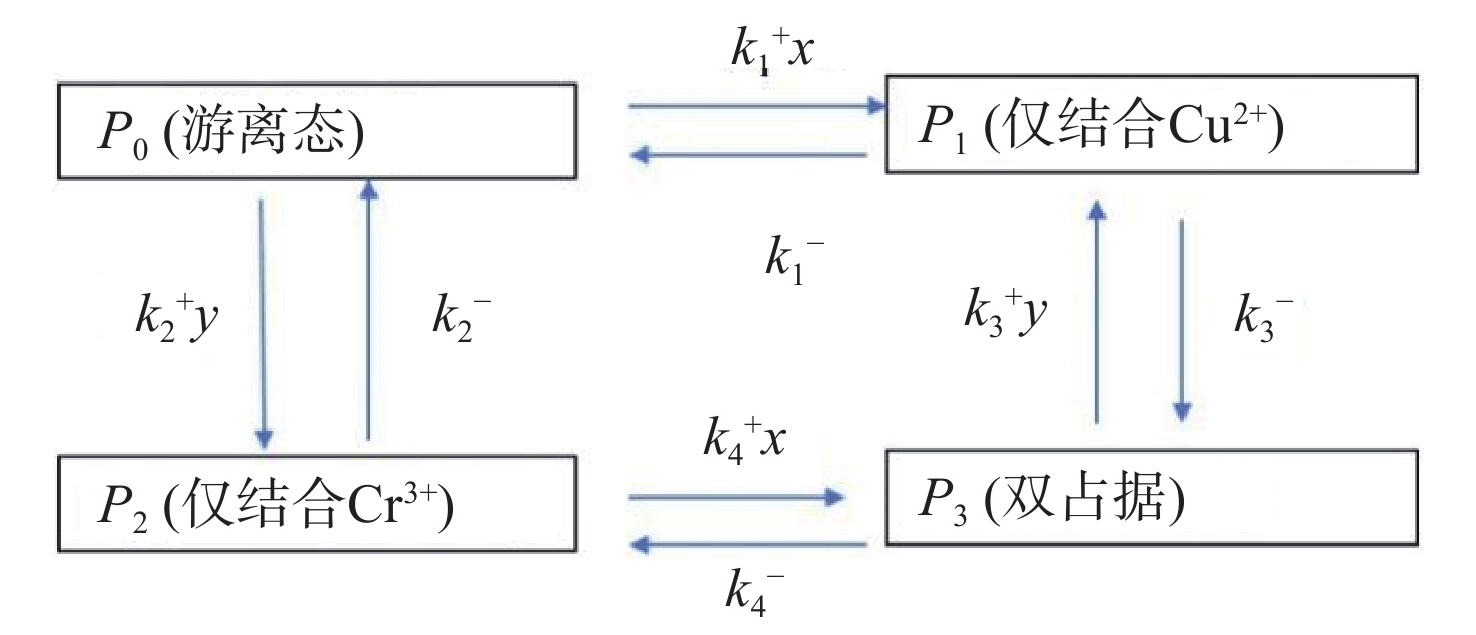
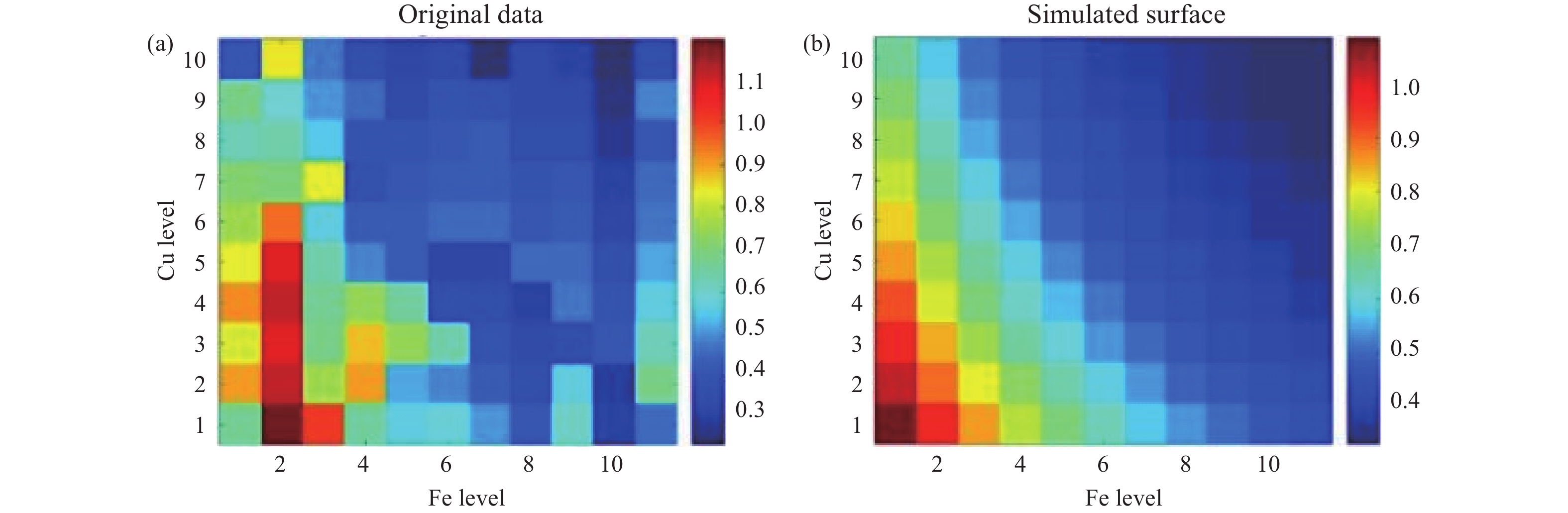
Due to the in-situ antagonism and site competition during multi-ion coexistence in real water environments, traditional linear sensing models often fail. In this study, nitrogen-doped carbon dots (N-CDs) synthesized via a one-step hydrothermal method were used as a platform to investigate the microscopic response mechanism in Cu2+ and Fe3+ coexisting systems by constructing a 2D cross-fluorescence response matrix. Firstly, the fluorescence quenching evolution under different interference backgrounds was experimentally observed. The results showed that under a high concentration Cu2+ background, the fluorescence response induced by Fe3+ exhibited significant nonlinear shifts and quenching stagnation, confirming the intense exclusive competition between the two ions at the nano-interface. Subsequently, to analyze this nonlinear process, a "four-state physical kinetic model" was constructed based on the principle of detailed balance, and a global response analytical expression containing the thermodynamic synergy factor (

| [1] |
SRIVASTAVA S K, PRATAP R, YADAV M, et al. Biogenic synthesis of highly stable multifluorescent, multifaceted carbon quantum dots as dual probe sensor for detection of heavy toxic metal ions-Fe3+and As3+in water and mouse fibroblast cell line NIH-3T3, and for live in-vivo imaging in mice[J]. Colloid Surf A-Physicochem Eng Asp, 2025, 723: 14.
|
| [2] |
ZHANG L, CAI Z L, LIU Y Q, et al. Fluorescent enhanced endogenous carbon dots derived from green tea residue for multiplex detection of heavy metal ions in food[J]. Front Sustain Food Syst, 2024, 8: 13.
|
| [3] |
YANG X, ZHANG L K, LU B, et al. The green synthesis of low-cost carbon quantum dots as eco-friendly probes in the detection of heavy metal ions[J]. J Mater Sci, 2026, 61(7): 4497-514. doi: 10.1007/s10853-026-12171-7
|
| [4] |
SHEN Y J, RONG M C, QU X D, et al. Graphene oxide-assisted synthesis of N, S Co-doped carbon quantum dots for fluorescence detection of multiple heavy metal ions[J]. Talanta, 2022, 241: 8.
|
| [5] |
LI S, LI L, TU H, et al. The development of carbon dots: From the perspective of materials chemistry [J]. 2021, 51: 188-207.
|
| [6] |
AI L, YANG Y, WANG B, et al. Insights into photoluminescence mechanisms of carbon dots: advances and perspectives [J]. 2021, 66(8): 839-56.
|
| [7] |
HE C, XU P, ZHANG X, et al. The synthetic strategies, photoluminescence mechanisms and promising applications of carbon dots: Current state and future perspective [J]. 2022, 186: 91-127.
|
| [8] |
SHABBIR H, CSAPó E, WOJNICKI M J I. Carbon quantum dots: the role of surface functional groups and proposed mechanisms for metal ion sensing [J]. 2023, 11(6): 262.
|
| [9] |
YARUR F, MACAIRAN J R, NACCACHE R. Ratiometric detection of heavy metal ions using fluorescent carbon dots[J]. Environmental Science-Nano, 2019, 6(4): 1121-30. doi: 10.1039/C8EN01418C
|
| [10] |
SUN Z, XING H H, QING M, et al. From the perspective of high-throughput recognition: Sulfur quantum dots-based multi-channel sensing platform for metal ions detection [J]. 2023, 452: 139594.
|
| [11] |
MOHANDOSS S, AHMAD N, VELU K S, et al. Synthesis of Photoluminescent Carbon Dots Using Hibiscus Tea Waste and Heteroatom Doping for Multi-Metal Ion Sensing: Applications in Cell imaging and Environmental Samples[J]. Chemosensors, 2023, 11(9): 14. doi: 10.3390/chemosensors11090474
|
| [12] |
ISSA M A, ABIDIN Z Z, SOBRI S, et al. Fluorescent recognition of Fe3+ in acidic environment by enhanced-quantum yield N-doped carbon dots: optimization of variables using central composite design [J]. 2020, 10(1): 11710.
|
| [13] |
RACHMINA R, HASAN M, SUHARTONO S, et al. Enhanced fluorescence and heavy metal ion sensing using nitrogen-doped carbon quantum dots synthesized from banana peel waste [J]. Results in Engineering, 2026.
|
| [14] |
SAHU G, CHAWRE Y, KUJUR A B, et al. Nitrogen Doped Carbon Quantum Dots as Fluorescence "Turn-Off-On" Sensor for Detection of Fe3+ Ions and Ascorbic Acid in Moringa oleifera and Citrus Lemon[J]. J Fluoresc, 2025, 35(8): 6581-93.
|
| [15] |
MOCCI F, DE VILLIERS ENGELBRECHT L, OLLA C, et al. Carbon nanodots from an in silico perspective [J]. 2022, 122(16): 13709-99.
|
| [16] |
MOHAMMADPOOR M J I C C. Machine learning-driven approaches for synthesizing carbon dots and their applications in photoelectrochemical sensors [J]. 2024, 159: 111859.
|
| [17] |
KURUKAVAK C K, TOK M, TOPRAK A, et al. Effect of Hetero-Atom Doping on the Structure and Optical Properties of Carbon Quantum Dots for the Sensitive Detection of Heavy Metal Ions[J]. Luminescence, 2025, 40(6): 12. doi: 10.1002/bio.70215
|
| [18] |
ZHANG Y, WANG Y, FENG X, et al. Effect of reaction temperature on structure and fluorescence properties of nitrogen-doped carbon dots [J]. 2016, 387: 1236-46.
|
| [19] |
PUNDI A, CHANG C J. Recent Advances in Synthesis, Modification, Characterization, and Applications of Carbon Dots[J]. Polymers, 2022, 14(11): 40.
|
| [20] |
ÐORĐEVIĆ L, ARCUDI F, CACIOPPO M, et al. A multifunctional chemical toolbox to engineer carbon dots for biomedical and energy applications [J]. 2022, 17(2): 112-30.
|
| [21] |
YAN F, JIANG Y, SUN X, et al. Surface modification and chemical functionalization of carbon dots: a review [J]. 2018, 185(9): 424.
|
| [22] |
NGOC N T B, HA V T H, ANH T N, et al. Rare emission peak shift unlocks detection of multiple heavy metal ions with dual emission carbon dots[J]. Microchem J, 2025, 218: 10.
|
| [23] |
YAO B, HUANG H, LIU Y, et al. Carbon Dots: A Small Conundrum[J]. Trends in Chemistry, 2019, 1(2): 235-46. doi: 10.1016/j.trechm.2019.02.003
|
| [24] |
SHI L, WANG B, LU S J M. Efficient bottom-up synthesis of graphene quantum dots at an atomically precise level [J]. 2023, 6(3): 728-60.
|
| [25] |
YADAV R, LAHARIYA V, SINGH A K, et al. Fluorometric sensing and nanomolar level detection of heavy metal ions using nitrogen doped carbon dots[J]. Emerg Mater, 2025, 8(1): 363-77. doi: 10.1007/s42247-024-00825-8
|
| [26] |
HU G K, PEI Z J, SHEN B, et al. Correlation between surface structure of carbon dots and selective detection of heavy metal ions[J]. Appl Phys A-Mater Sci Process, 2024, 130(2): 13. doi: 10.1007/s00339-023-07265-x
|
| [27] |
LI H, YAN X, KONG D, et al. Recent advances in carbon dots for bioimaging applications [J]. 2020, 5(2): 218-34.
|
| [28] |
WANG B, CAI H, WATERHOUSE G I, et al. Carbon dots in bioimaging, biosensing and therapeutics: a comprehensive review [J]. 2022, 2(6): 2200012.
|
| [29] |
KIM N, LEE J, GU M, et al. Modulating charge carriers in carbon dots toward efficient solar‐to‐energy conversion [J]. 2021, 3(4): 590-614.
|
| [30] |
WANG J, FU Y, GU Z, et al. Multifunctional carbon dots for biomedical applications: diagnosis, therapy, and theranostic [J]. 2024, 20(3): 2303773.
|
| [31] |
QIAN H. Cooperativity and specificity in enzyme kinetics: a single-molecule time-based perspective[J]. Biophys J, 2008, 95(1): 10-7. doi: 10.1529/biophysj.108.131771
|
Figures(7)





 DownLoad: