| Citation: | WANG Xin-yu, YANG Run, LIU He-shan. Design and experimental verification of automatic relocking technology for phasemeter in space laser interferometry[J]. Chinese Optics. doi: 10.37188/CO.2026-0033

|
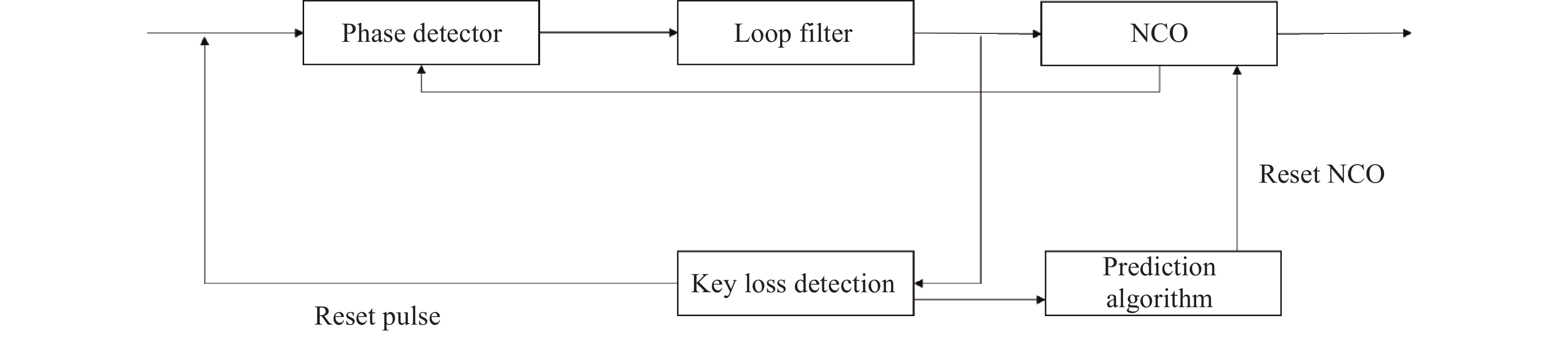
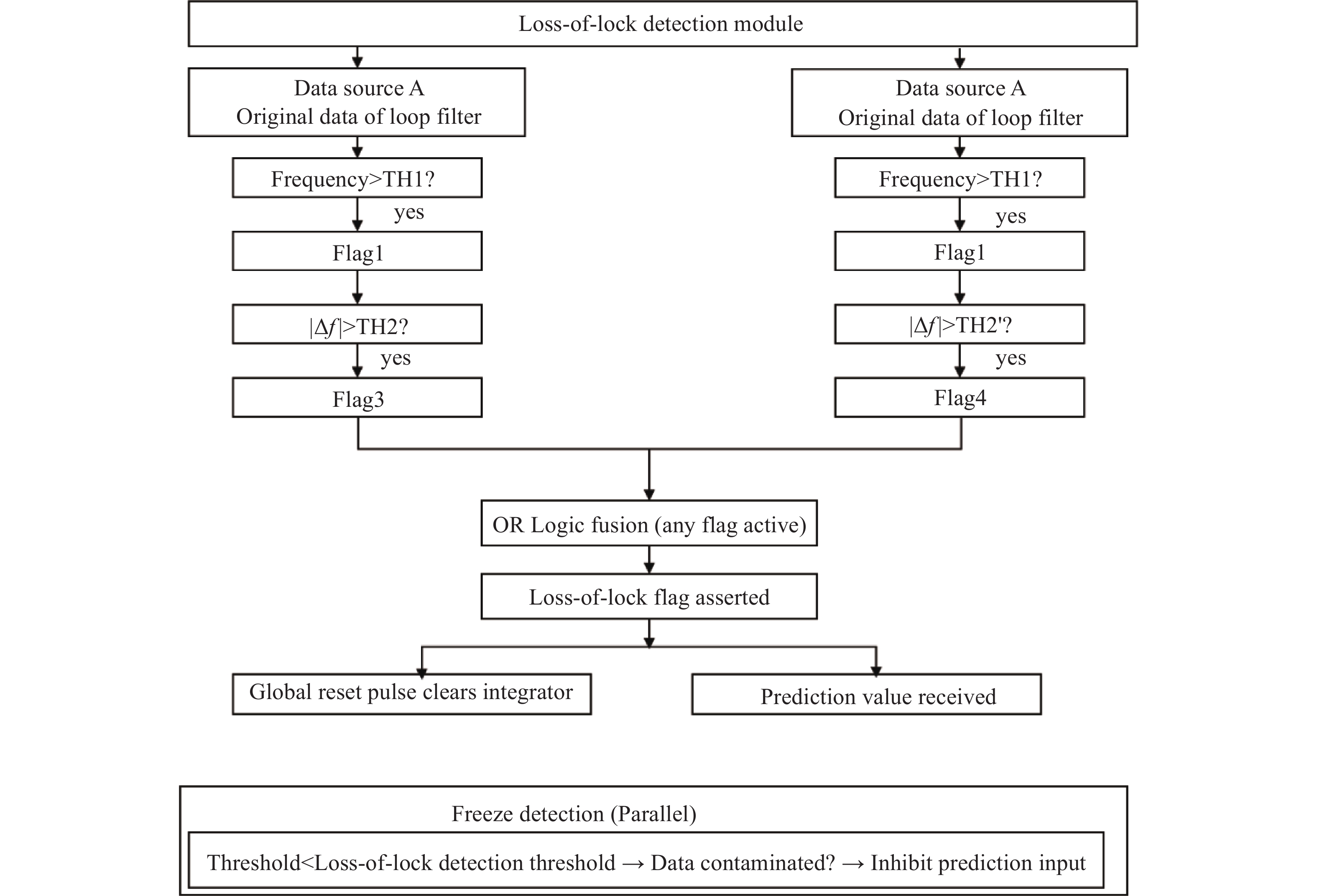
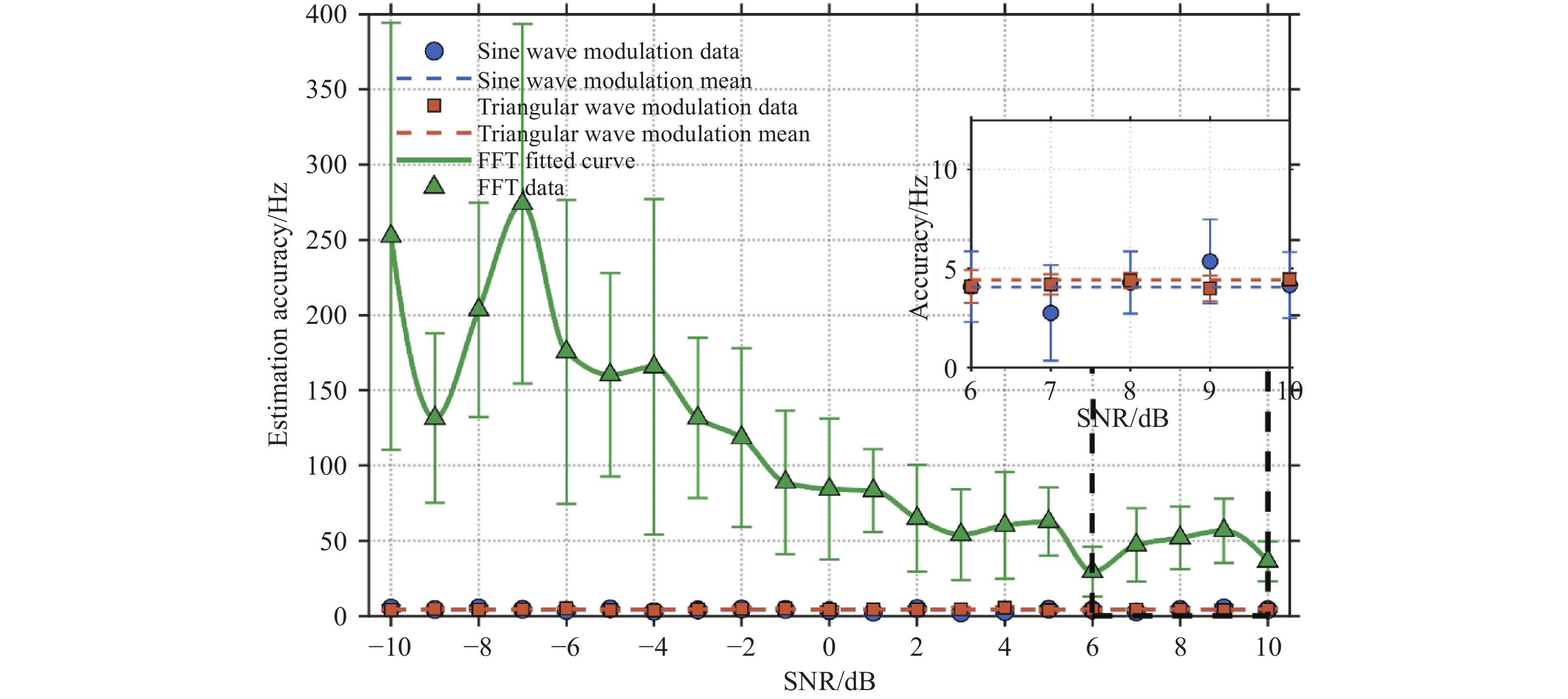
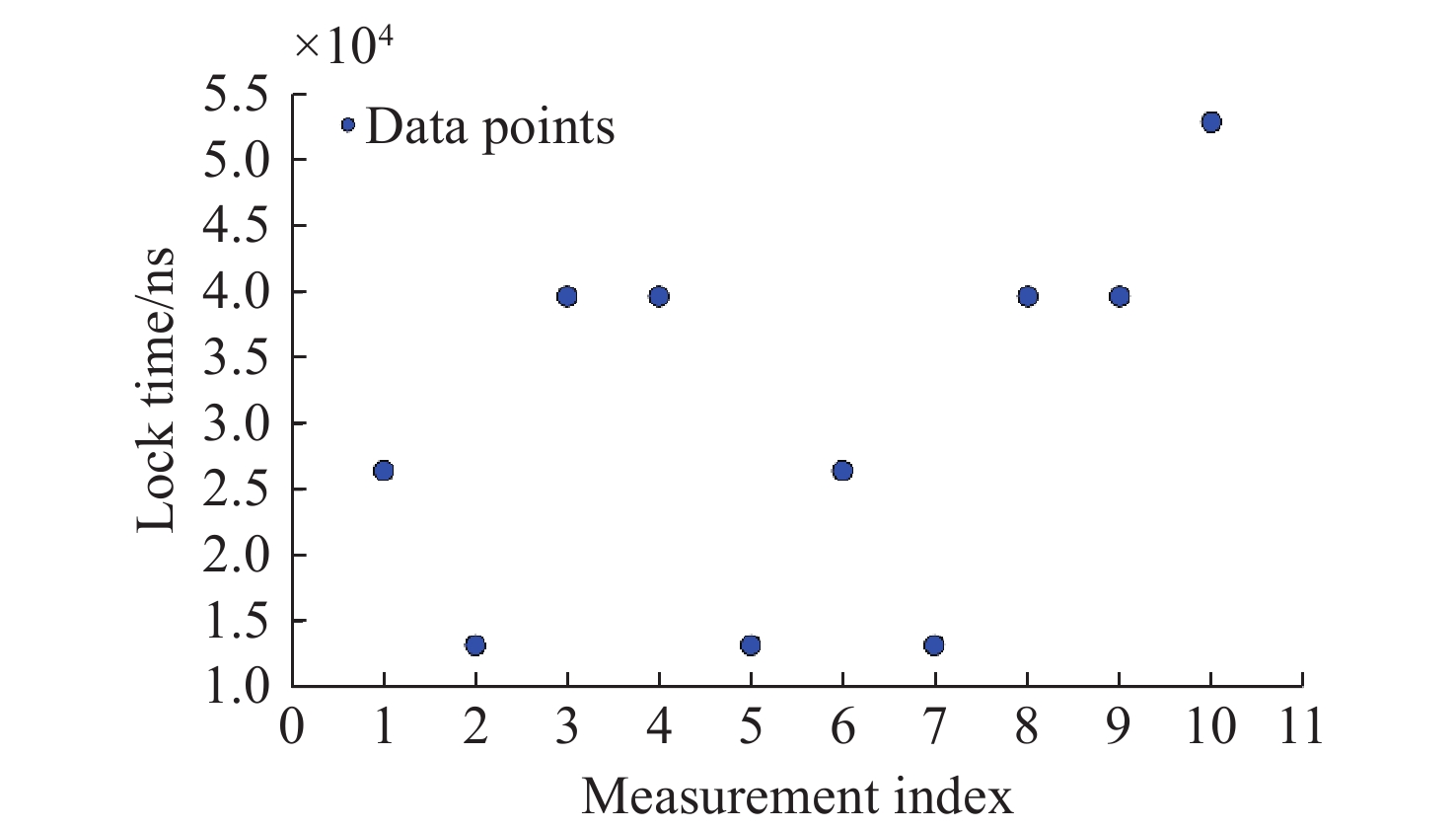
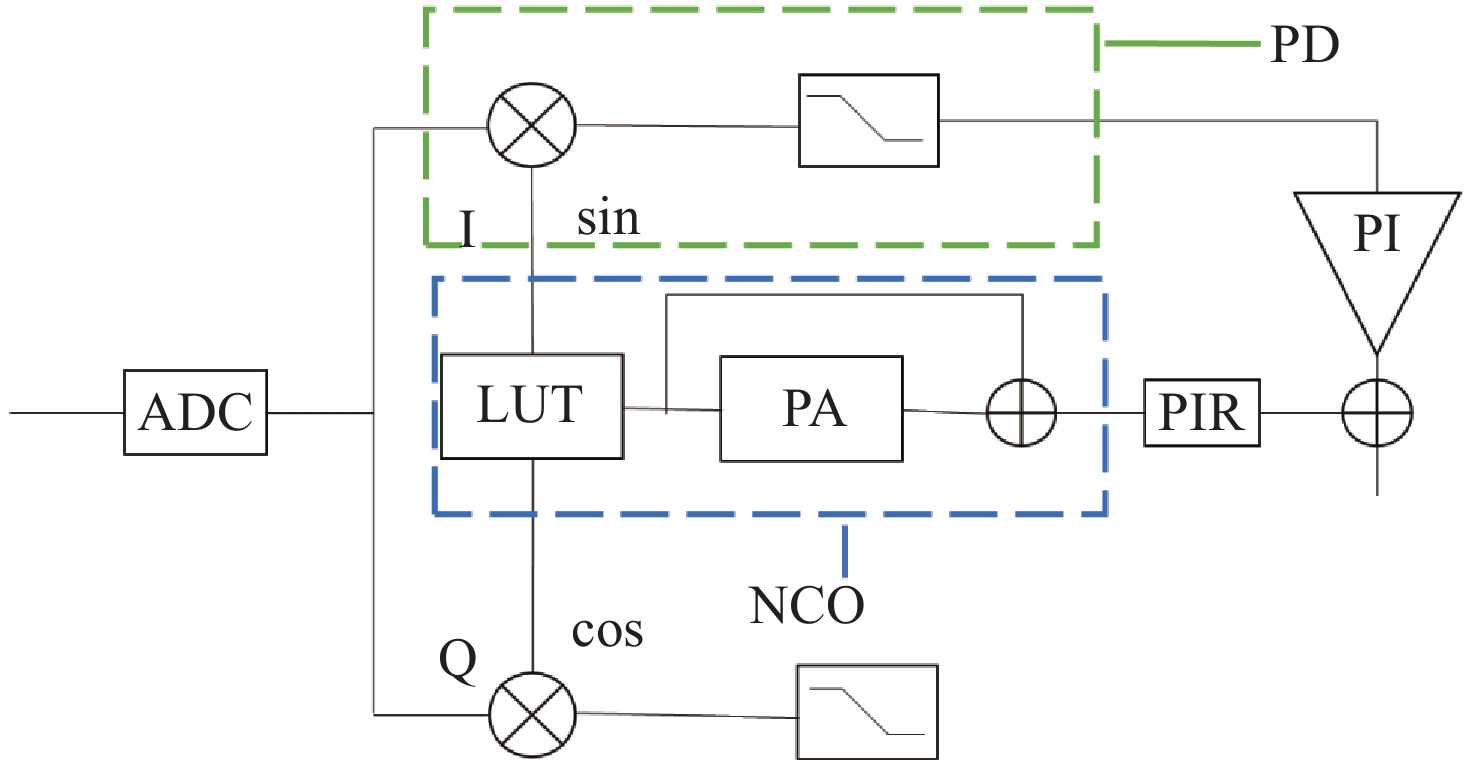
This paper studies the phase meter applied to space laser interferometry. The phase-locked loop will suffer from lock loss in actual operation. Researchers commonly adopt the FFT frequency measurement method to re-acquire the signal at the present stage. This method has obvious technical defects. Its frequency measurement accuracy is low at the order of 100 Hz, and the relocking time is long about 7 ms. This paper proposes an automatic relocking technique deployed in collaboration with FFT. This technique adopts a lock-loss detection strategy that combines instantaneous frequency values and frequency change rates. It selects two data sources to judge lock loss, including the original data of the loop filter and the down-sampled data of CIC. It clears the integration error through the reset operation after lock loss occurs, and it receives the predicted value output by the frequency prediction algorithm. The frequency prediction algorithm uses the waveform generation algorithm for periodic signals. It uses the second-order polynomial prediction algorithm for aperiodic signals. It also combines interpolation technology to generate the corresponding frequency predicted value. The automatic relocking technique and FFT are deployed in parallel, and they form a clear functional division. This technique performs frequency prediction based on the inherent regularity of the signal. It deals with lock-loss scenarios of all regular signals regardless of the lock-loss duration. It also realizes fast relocking of short-time irregular signals within 1 s. FFT is responsible for signal re-acquisition in irregular signal scenarios and long-time complex lock-loss scenarios. The two methods form a working mode with complementary advantages. Experimental verification results show that the algorithm proposed in this study has an average relocking time of 32 μs and a maximum relocking time of 60 μs in the scenario of regular signal lock loss. The performance is improved by two orders of magnitude compared with the FFT method. The relocking speed has no correlation with the lock-loss duration. It can still maintain the relocking speed at the order of tens of microseconds when the lock-loss duration reaches 10 s. The frequency estimation error is stably controlled below 10 Hz in the signal-to-noise ratio range from −10 dB to 10 dB. The system can still achieve stable locking even when the signal-to-noise ratio is as low as −10 dB. This architecture deployed in collaboration with FFT retains the wide-band acquisition capability of FFT. It significantly improves the fast relocking capability in regular signal scenarios. It provides high-precision, fast-response and high-stability phase measurement technical support for space gravitational wave detection missions.

| [1] |
LUO Z R, GUO Z K, JIN G, et al. A brief analysis to Taiji: science and technology[J]. Results in Physics, 2020, 16: 102918. doi: 10.1016/j.rinp.2019.102918
|
| [2] |
HU Y M, MEI J W, LUO J. Science prospects for space-borne gravitational-wave missions[J]. National Science Review, 2017, 4(5): 683-684. doi: 10.1093/nsr/nwx115
|
| [3] |
CAPRINI C, HEFFERNAN A, BRITO R, et al. Science of the LISA mission: a summary for the European Strategy for Particle Physics[J]. arXiv: 2507.05130, 2025. (查阅网上资料, 未能确认文献类型, 请确认).
|
| [4] |
BARKE S, BRAUSE N, BYKOV I, et al. LISA metrology system-final report[R]. European Space Agency, 2014. (查阅网上资料, 未找到出版信息, 请确认出版社信息并且补充出版地信息).
|
| [5] |
刘河山. 面向空间引力波探测的激光差分干涉相位计研究[D]. 北京: 中国科学院大学, 2015.
LIU H SH. Research on laser differential interferometric phasemeter for space gravitational wave detection[D]. Beijing: University of Chinese Academy of Sciences, 2015. (in Chinese)(查阅网上资料, 未找到对应的英文翻译, 请确认).
|
| [6] |
GONG Y G, LUO J, WANG B. Concepts and status of Chinese space gravitational wave detection projects[J]. Nature Astronomy, 2021, 5(9): 881-889. doi: 10.1038/s41550-021-01480-3
|
| [7] |
王娟, 齐克奇, 王少鑫, 等. 面向空间引力波探测的激光干涉技术研究进展及展望[J]. 中国科学: 物理学 力学 天文学, 2024, 54(7): 270405.
WANG J, QI K Q, WANG SH X, et al. Advance and prospect in the study of laser interferometry technology for space gravitational wave detection[J]. Scientia Sinica Physica, Mechanica & Astronomica, 2024, 54(7): 270405. (in Chinese).
|
| [8] |
ZHANG J F, YANG ZH, MA X SH, et al. Inter-spacecraft offset frequency setting strategy in the Taiji program[J]. Applied Optics, 2022, 61(3): 837-843. doi: 10.1364/AO.442583
|
| [9] |
ZHENG L, YANG SH T, ZHANG X F. Doppler effect in TianQin time-delay interferometry[J]. Physical Review D, 2023, 108(2): 022001. doi: 10.1103/PhysRevD.108.022001
|
| [10] |
刘河山, 王娟, 高瑞弘, 等. 太极二号干涉仪系统噪声与指标分解[J]. 空间科学学报, 2025, 45(4): 1047-1057. doi: 10.11728/cjss2025.04.2025-yg02
LIU H SH, WANG J, GAO R H, et al. Noise and index decomposition of Taiji-2 interferometer system[J]. Chinese Journal of Space Science, 2025, 45(4): 1047-1057. (in Chinese). doi: 10.11728/cjss2025.04.2025-yg02
|
| [11] |
LUO J, BAI SH J, BAI Y ZH, et al. Progress of the TianQin project[J]. Classical and Quantum Gravity, 2025, 42(17): 173001. doi: 10.1088/1361-6382/adda8a
|
| [12] |
GERBERDING O, SHEARD B, BYKOV I, et al. Phasemeter core for intersatellite laser heterodyne interferometry: modelling, simulations and experiments[J]. Classical and Quantum Gravity, 2013, 30(23): 235029. doi: 10.1088/0264-9381/30/23/235029
|
| [13] |
GERBERDING O, DIEKMANN C, KULLMANN J, et al. Readout for intersatellite laser interferometry: measuring low frequency phase fluctuations of high-frequency signals with microradian precision[J]. Review of Scientific Instruments, 2015, 86(7): 074501. doi: 10.1063/1.4927071
|
| [14] |
张强涛. 面向空间引力波探测的相位计优化研究[D]. 北京: 中国科学院国家空间科学中心, 2023.
ZHANG Q T. Optimization research of phasemeter for space gravitational wave detection[D]. Beijing: National Space Science Center, the Chinese Academy of Sciences, 2023. (in Chinese)(查阅网上资料, 未找到对应的英文翻译, 请确认).
|
| [15] |
张强涛, 刘河山, 罗子人. 面向空间激光干涉的多通道相位测量系统[J]. 中国光学(中英文), 2023, 16(5): 1089-1099.
ZHANG Q T, LIU H SH, LUO Z R. Multi-channel phase measurement system for the space laser interferometry[J]. Chinese Optics, 2023, 16(5): 1089-1099. (in Chinese).
|
| [16] |
ZHANG Q T, LIU H SH, DONG P, et al. Multi-frequency signal acquisition and phase measurement in space gravitational wave detection[J]. Review of Scientific Instruments, 2024, 95(5): 054501. doi: 10.1063/5.0198104
|
| [17] |
SAMBRIDGE C. Low-power phase tracking in inter-spacecraft laser interferometry[D]. Canberra: The Australian National University, 2025.
|
| [18] |
PIZZELLA A. LISA optical bench development: experimental investigation of differential-wavefront sensing for a spaceborne gravitational wave detector[D]. Hannover: Institutionelles Repositorium der Leibniz Unversität Hannover, 2025.
|
| [19] |
YANG R, LIU H SH, LUO Z R. Optimization design of decimation filter for the phasemeter in the space gravitational wave detection[J]. IEEE Transactions on Instrumentation and Measurement, 2024, 73: 7006508. doi: 10.1109/tim.2024.3453345
|
| [20] |
YANG R, LUO Z R, LIU H SH. Limitations and improvements in low-frequency performance of phasemeter for space gravitational wave detection[J]. Measurement, 2026, 260: 119825. doi: 10.1016/j.measurement.2025.119825
|
| [21] |
LIANG Y R. Note: a new method for directly reducing the sampling jitter noise of the digital phasemeter[J]. Review of Scientific Instruments, 2018, 89(3): 036106. doi: 10.1063/1.5011654
|
| [22] |
MING M, ZHANG J Y, DUAN H Z, et al. Study on TPD phasemeter to suppress low-frequency amplitude fluctuation and improve fast-acquiring range for GW detection[J]. Sensors, 2024, 24(11): 3434. doi: 10.3390/s24113434
|
| [23] |
FAN ZH, LI ZH, HUANG X Q, et al. Phasemeter based on second harmonic signal filter for space-based gravitational wave detection[J]. Chinese Physics B, 2026, 35(1): 010601. doi: 10.1088/1674-1056/ae1efe
|
| [24] |
LI H J, QI H X, PAN M ZH, et al. Automatic amplitude control for phasemeter of spaceborne laser interferometry[J]. AIP Advances, 2023, 13(3): 035206. doi: 10.1063/5.0130186
|
| [25] |
刘河山, 高瑞弘, 罗子人, 等. 空间引力波探测中的绝对距离测量及通信技术[J]. 中国光学, 2019, 12(3): 486-492. doi: 10.3788/co.20191203.0486
LIU H SH, GAO R H, LUO Z R, et al. Laser ranging and data communication for space gravitational wave detection[J]. Chinese Optics, 2019, 12(3): 486-492. (in Chinese). doi: 10.3788/co.20191203.0486
|
| [26] |
罗子人, 张敏, 靳刚. 激光干涉引力波空间阵列核心问题的综合讨论[J]. 科学通报, 2019, 64(24): 2468-2474.
LUO Z R, ZHANG M, JIN G. Overall discussion on the key problems of a space-borne laser interferometer gravitational wave antenna[J]. Chinese Science Bulletin, 2019, 64(24): 2468-2474. (in Chinese).
|
| [27] |
范习谦, 刘河山, 罗子人, 等. 基于MHz深度频率调制激光干涉的相位测量技术[J]. 中国光学(中英文), 2025, 18(3): 622-630.
FAN X Q, LIU H SH, LUO Z R, et al. Phase measurement technique based on MHz-lever depth frequency modulated laser interferometry[J]. Chinese Optics, 2025, 18(3): 622-630. (in Chinese).
|
| [28] |
张子恒, 范习谦, 靳刚, 等. 太极计划激光链路辅助功能方案设计及验证[J]. 中国激光, 2025, 52(11): 1106001. doi: 10.3788/CJL241483
ZHANG Z H, FAN X Q, JIN G, et al. Design and verification of a laser link auxiliary function scheme for the Taiji Program[J]. Chinese Journal of Lasers, 2025, 52(11): 1106001. (in Chinese). doi: 10.3788/CJL241483
|
| [29] |
HUANG X Q, WANG G F, YANG M L, et al. Study on picometer-level laser interferometer readout system in TianQin project[J]. Optics & Laser Technology, 2023, 161: 109185. doi: 10.1016/j.optlastec.2023.109185
|
| [30] |
YAMAMOTO K, TOMIO H, ZEHNDER C, et al. Alternative approach to time-delay interferometry with an optical frequency comb[J]. Physical Review Applied, 2026, doi: 10.1103/9cdp-rh4j.
|
Figures(6)




 DownLoad: