| Citation: | LIN Jun-hao, ZHANG Yun-fei, CHEN Shao-wei, ZHANG Guo-xun, XIE Hao. Unsupervised masked cycle-adversarial network for cellular virtual staining[J]. Chinese Optics, 2026, 19(4): 787-800. doi: 10.37188/CO.2026-0021

|
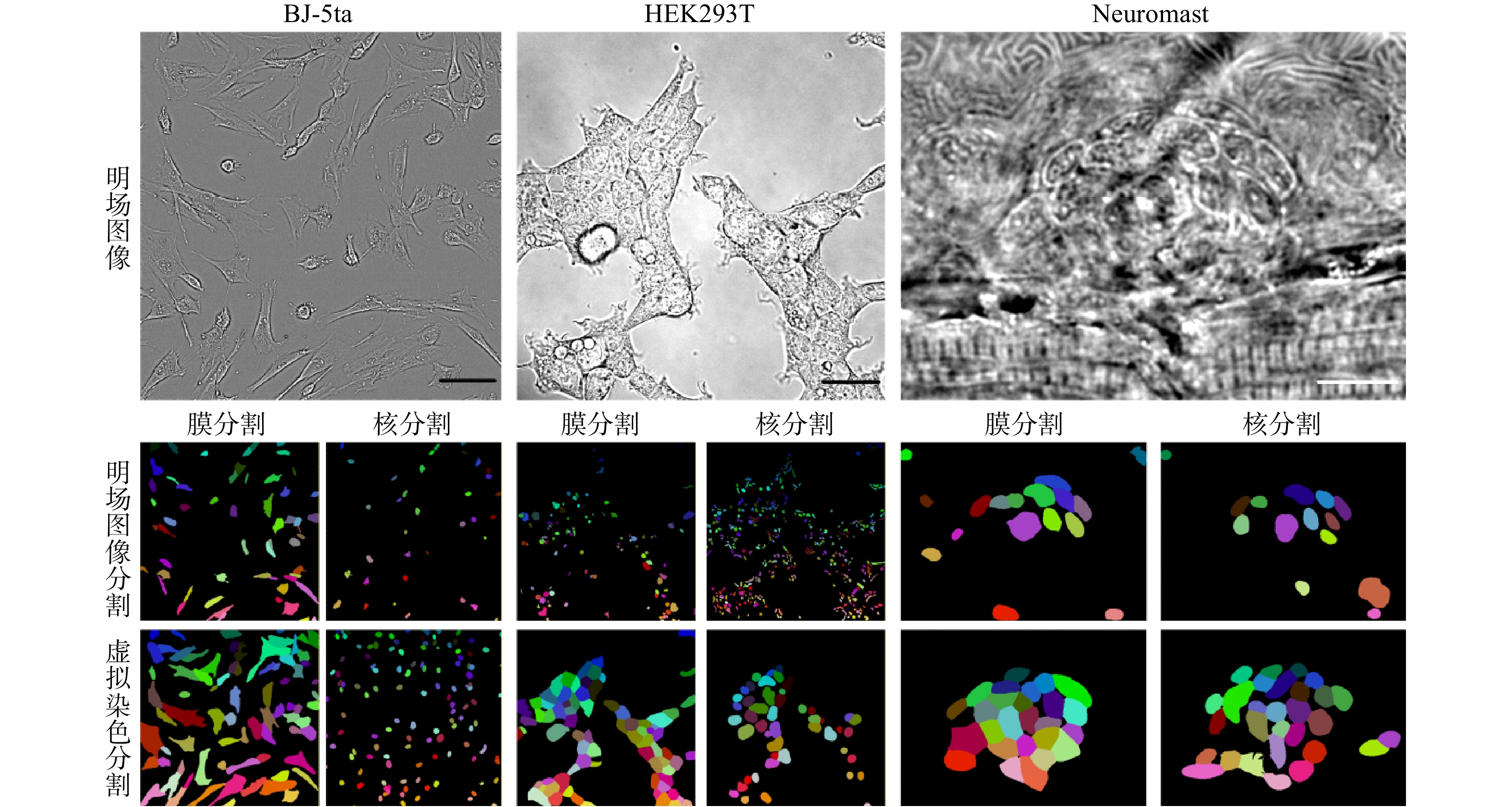
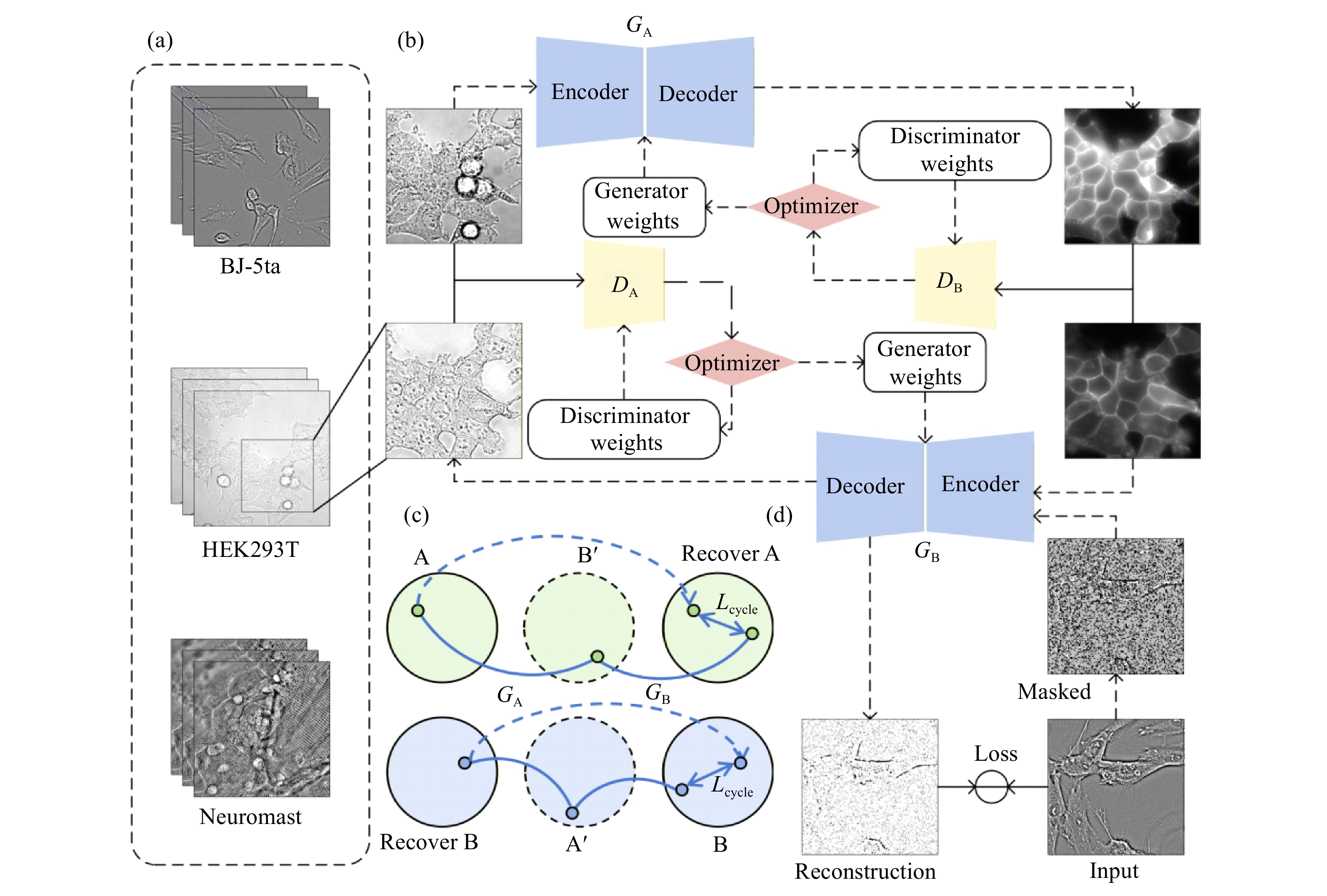
Virtual staining leverages deep learning to transform label-free images into fluorescence-specific images, markedly reducing the complexity and phototoxicity of live-cell imaging and enabling high-resolution, multi-channel, high-throughput, and long-term acquisition, which is of great significance for biomedical research. Existing methods mostly rely on supervised learning with paired data. To reduce the dependence of virtual staining on paired data and further improve the quality of generated images, we propose an unsupervised virtual staining framework, MVS-CycleGAN, which integrates a masked self-supervised mechanism. Without requiring paired images, MVS-CycleGAN introduces a random masked reconstruction task that occludes parts of the input and forces the network to complete the missing regions using semantic context. This design allows the model to capture both global morphology and local texture in the target domain, imposing effective semantic constraints and alleviating the semantic drift commonly observed in conventional unsupervised models during cross-domain translation. Experiments on three cell datasets demonstrate that MVS-CycleGAN consistently outperforms traditional approaches: FSIM reaches 0.784/0.565 on BJ-5ta membrane/nuclei, 0.854/0.830 on HEK293T, and 0.657/0.740 on Neuromast (corresponding improvements of 1.03%, 9.50%, 1.07%, 0.85%, 1.08%, and 5.56%, respectively). In addition, downstream segmentation experiments further confirm the effectiveness of the virtually stained images for quantitative analysis. These results indicate that the proposed method provides a feasible solution for extending virtual staining to diverse biomedical scenarios.

| [1] |
高歌, 郭晓光, 吴俊楠, 等. 用于单切片双模态光学关联成像的肾脏组织样本处理方法[J]. 中国光学(中英文), 2024, 17(5): 1227-1235.
GAO G, GUO X G, WU J N, et al. Methods for processing renal tissue samples for single-slice dual-mode optical correlation imaging[J]. Chinese Optics, 2024, 17(5): 1227-1235. (in Chinese).
|
| [2] |
王鹏, 周瑶, 赵宇轩, 等. 用于多尺度高分辨率三维成像的双环光片荧光显微技术[J]. 中国光学(中英文), 2022, 15(6): 1321-1331.
WANG P, ZHOU Y, ZHAO Y X, et al. Double-ring-modulated light sheet fluorescence microscopic technique for multi-scale high-resolution 3D imaging[J]. Chinese Optics, 2022, 15(6): 1321-1331. (in Chinese).
|
| [3] |
KUMAR A, MCNALLY K E, ZHANG Y X, et al. Multispectral live-cell imaging with uncompromised spatiotemporal resolution[J]. Nature Photonics, 2025, 19(10): 1146-1156. doi: 10.1038/s41566-025-01745-7
|
| [4] |
XIANG D, WANG ZH CH, ZHENG H W, et al. Organic small-molecule NIR-II fluorophores for tumor phototheranostics[J]. Light: Science & Applications, 2026, 15(1): 173.
|
| [5] |
CHRISTIANSEN E M, YANG S J, ANDO D M, et al. In silico labeling: predicting fluorescent labels in unlabeled images[J]. Cell, 2018, 173(3): 792-803. e19.
|
| [6] |
HOU Y W, WANG W Y, FU Y ZH, et al. Multi-resolution analysis enables fidelity-ensured deconvolution for fluorescence microscopy[J]. eLight, 2024, 4(1): 14. doi: 10.1186/s43593-024-00073-7
|
| [7] |
SHAKED N T, BOPPART S A, WANG L V, et al. Label-free biomedical optical imaging[J]. Nature Photonics, 2023, 17(12): 1031-1041. doi: 10.1038/s41566-023-01299-6
|
| [8] |
WANG Q, AKRAM A R, DORWARD D A, et al. Deep learning-based virtual H&E staining from label-free autofluorescence lifetime images[J]. npj Imaging, 2024, 2(1): 17. doi: 10.1038/s44303-024-00021-7
|
| [9] |
黄宇然, 张智敏, 董婉潔, 等. 多色虚拟荧光辐射差分显微成像[J]. 中国光学(中英文), 2022, 15(6): 1332-1338.
HUANG Y R, ZHANG ZH M, DONG W J, et al. Multi-color virtual fluorescence emission difference microscopy[J]. Chinese Optics, 2022, 15(6): 1332-1338. (in Chinese).
|
| [10] |
COMBS C A, SHROFF H. Fluorescence microscopy: a concise guide to current imaging methods[J]. Current Protocols in Neuroscience, 2017, 79: 2.1. 1-2.1. 25.
|
| [11] |
SEO J, SIM Y, KIM J, et al. PICASSO allows ultra-multiplexed fluorescence imaging of spatially overlapping proteins without reference spectra measurements[J]. Nature Communications, 2022, 13(1): 2475. doi: 10.1038/s41467-022-30168-z
|
| [12] |
PIRONE D, BIANCO V, MICCIO L, et al. Beyond fluorescence: advances in computational label-free full specificity in 3D quantitative phase microscopy[J]. Current Opinion in Biotechnology, 2024, 85: 103054. doi: 10.1016/j.copbio.2023.103054
|
| [13] |
YIN Z CH, HE B, YING Y ZH, et al. Fast and label-free 3D virtual H&E histology via active phase modulation-assisted dynamic full-field OCT[J]. npj Imaging, 2025, 3(1): 12. doi: 10.1038/s44303-025-00068-0
|
| [14] |
KREISS L, JIANG SH W, LI X, et al. Digital staining in optical microscopy using deep learning - a review[J]. PhotoniX, 2023, 4(1): 34. doi: 10.1186/s43074-023-00113-4
|
| [15] |
ZHANG Y J, HUANG L ZH, PILLAR N, et al. Pixel super-resolved virtual staining of label-free tissue using diffusion models[J]. Nature Communications, 2025, 16(1): 5016. doi: 10.1038/s41467-025-60387-z
|
| [16] |
ICHITA M, YAMAMICHI H, HIGAKI T. Virtual staining from bright-field microscopy for label-free quantitative analysis of plant cell structures[J]. Plant Molecular Biology, 2025, 115(1): 29. doi: 10.1007/s11103-025-01558-w
|
| [17] |
KAMATH V, BHAT V G, RAJU G, et al. Application of fluorescence lifetime imaging-integrated deep learning analysis for cancer research[J]. Light: Advanced Manufacturing, 2025, 6(3): 49. doi: 10.37188/lam.2025.049
|
| [18] |
OUNKOMOL C, SESHAMANI S, MALECKAR M M, et al. Label-free prediction of three-dimensional fluorescence images from transmitted-light microscopy[J]. Nature Methods, 2018, 15(11): 917-920. doi: 10.1038/s41592-018-0111-2
|
| [19] |
PARK E, MISRA S, HWANG D G, et al. Unsupervised inter-domain transformation for virtually stained high-resolution mid-infrared photoacoustic microscopy using explainable deep learning[J]. Nature Communications, 2024, 15(1): 10892. doi: 10.1038/s41467-024-55262-2
|
| [20] |
DAI W X, WONG I H M, WONG T T W. Exceeding the limit for microscopic image translation with a deep learning-based unified framework[J]. PNAS Nexus, 2024, 3(4): 133. doi: 10.1093/pnasnexus/pgae133
|
| [21] |
MA J B, LI W Q, LI J B, et al. Generative AI for misalignment-resistant virtual staining to accelerate histopathology workflows[J]. Nature Communications, 2026, 17(1): 4494. doi: 10.1038/s41467-026-71038-2
|
| [22] |
ZHU J Y, PARK T, ISOLA P, et al. Unpaired image-to-image translation using cycle-consistent adversarial networks[C]. Proceedings of the IEEE International Conference on Computer Vision, IEEE, 2017: 2242-2251.
|
| [23] |
LI X Y, ZHANG G X, QIAO H, et al. Unsupervised content-preserving transformation for optical microscopy[J]. Light: Science & Applications, 2021, 10(1): 44.
|
| [24] |
LIU Z W, HIRATA-MIYASAKI E, PRADEEP S, et al. Robust virtual staining of landmark organelles with Cytoland[J]. Nature Machine Intelligence, 2025, 7(6): 901-915. doi: 10.1038/s42256-025-01046-2
|
| [25] |
HE K M, CHEN X L, XIE S N, et al. Masked autoencoders are scalable vision learners[C]. Proceedings of the IEEE/CVF Conference on Computer Vision and Pattern Recognition, IEEE, 2022: 15979-15988.
|
| [26] |
PANG SH Y, XIANG J W, ZUO ZH Q, et al. Contrastive masked feature modeling for self-supervised representation learning of high-resolution remote sensing images[J]. Remote Sensing, 2026, 18(4): 626. doi: 10.3390/rs18040626
|
| [27] |
WANG ZH, BOVIK A C, SHEIKH H R, et al. Image quality assessment: from error visibility to structural similarity[J]. IEEE Transactions on Image Processing, 2004, 13(4): 600-612. doi: 10.1109/TIP.2003.819861
|
| [28] |
ZHANG L, ZHANG L, MOU X Q, et al. FSIM: a feature similarity index for image quality assessment[J]. IEEE Transactions on Image Processing, 2011, 20(8): 2378-2386. doi: 10.1109/TIP.2011.2109730
|
| [29] |
ZHANG R, ISOLA P, EFROS A A, et al. The unreasonable effectiveness of deep features as a perceptual metric[C]. Proceedings of the IEEE/CVF Conference on Computer Vision and Pattern Recognition, IEEE, 2018: 586-595.
|
| [30] |
SHEIKH H R, BOVIK A C, DE VECIANA G. An information fidelity criterion for image quality assessment using natural scene statistics[J]. IEEE Transactions on Image Processing, 2005, 14(12): 2117-2128. doi: 10.1109/TIP.2005.859389
|
Figures(6) / Tables(2)





 DownLoad: