| Citation: | CHEN Hai-tao, LI Qiang, GAO Zeng-hui. Evolution of the C-point dipole in oceanic turbulence[J]. Chinese Optics, 2026, 19(1): 60-68. doi: 10.37188/CO.2025-0107

|
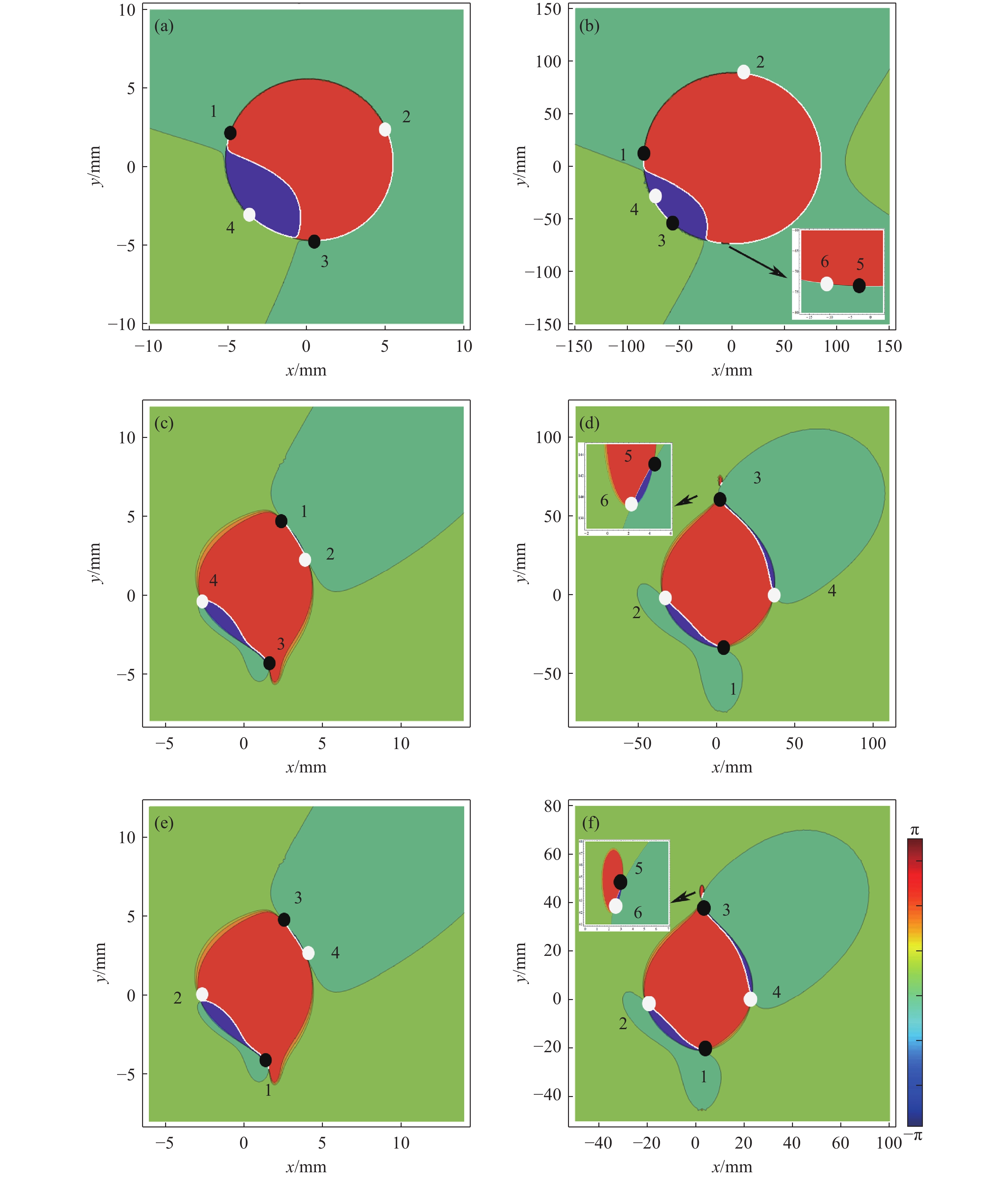
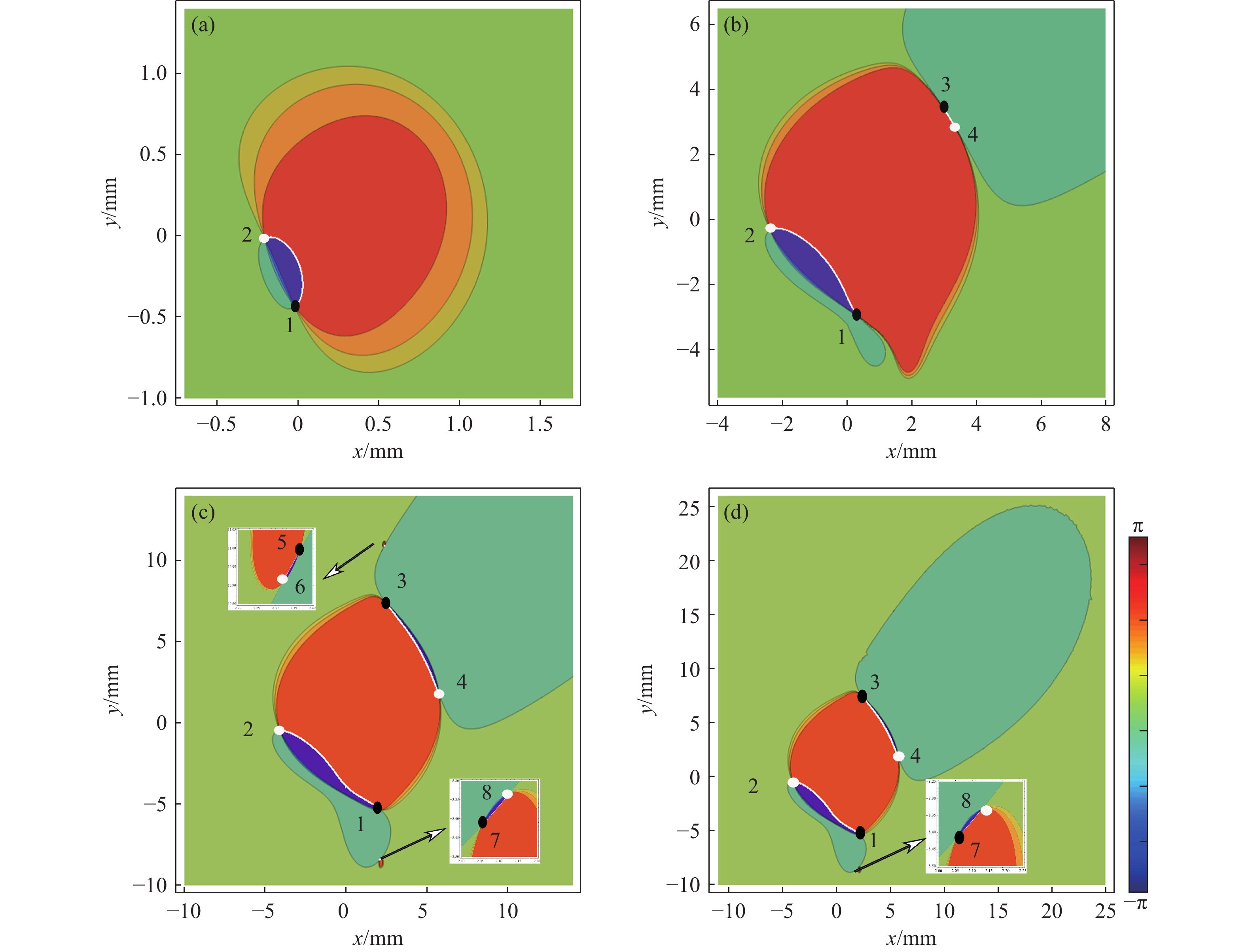
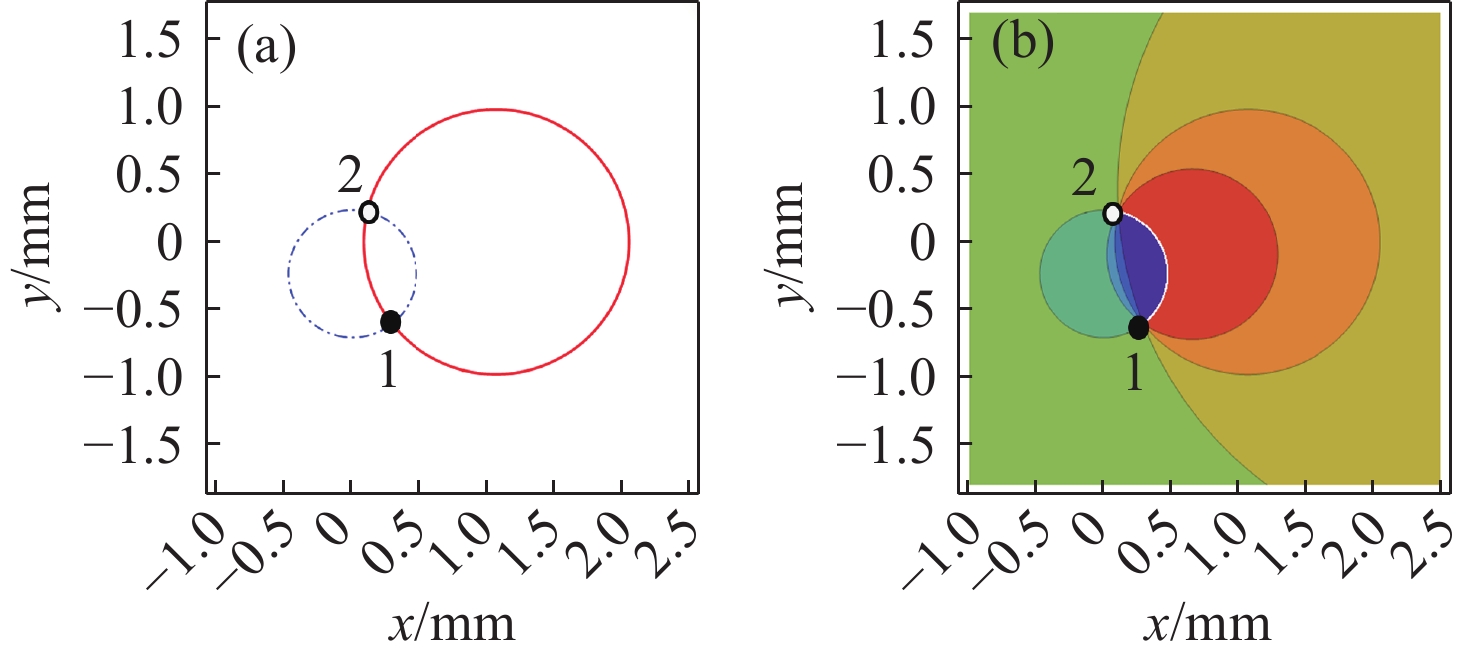
In order to find out performance of the C-point dipole nested in partially coherent stochastic vortex beam in oceanic turbulence, the Gaussian-Schell model vortex (GSMV) beam carrying a C-point dipole is constructed, which is used to research the evolution property of the C-point dipole in oceanic turbulence. According to the definition of the polarization singularities in partially coherent vector beams, the GSMV beam was constructed to realize a partially coherent beam carrying a pair of C-point dipoles with opposite topological charges. According to the extended Huygens–Fresnel principle, the formula of the cross-spectral density (CSD) for the GSMV beam propagating through oceanic turbulence is deduced by using of the integral formula. In accordance with the formula of the CSD derived above, the effects of propagation distance

| [1] |
NYE J F, HAJNAL J V. The wave structure of monochromatic electromagnetic radiation[J]. Proceedings of the Royal Society A: Mathematical, Physical and Engineering Sciences, 1987, 409(1836): 21-36.
|
| [2] |
BERRY M V, DENNIS M R. Polarization singularities in isotropic random vector waves[J]. Proceedings of the Royal Society A: Mathematical, Physical and Engineering Sciences, 2001, 457(2005): 141-155. doi: 10.1098/rspa.2000.0660
|
| [3] |
DENNIS M R, O'HOLLERAN K, PADGETT M J. Singular optics: optical vortices and polarization singularities[J]. Progress in Optics, 2009, 53: 293-363.
|
| [4] |
KOROTKOVA O, WOLF E. Generalized stokes parameters of random electromagnetic beams[J]. Optics Letters, 2005, 30(2): 198-200. doi: 10.1364/OL.30.000198
|
| [5] |
YAN H W, LÜ B D. Spectral Stokes singularities of stochastic electromagnetic beams[J]. Optics Letters, 2009, 34(13): 1933-1935. doi: 10.1364/OL.34.001933
|
| [6] |
YAN H W, LÜ B D. Propagation of spectral Stokes singularities of stochastic electromagnetic beams through atmospheric turbulence[J]. Applied Physics B, 2010, 99(4): 809-815. doi: 10.1007/s00340-009-3892-2
|
| [7] |
HUANG Y P, ZHANG B, GAO Z H, et al. Evolution behavior of Gaussian Schell-model vortex beams propagating through oceanic turbulence[J]. Optics Express, 2014, 22(15): 17723-17734. doi: 10.1364/OE.22.017723
|
| [8] |
XU J, ZHAO D M. Propagation of a stochastic electromagnetic vortex beam in the oceanic turbulence[J]. Optics & Laser Technology, 2014, 57: 189-193.
|
| [9] |
LIU D J, YIN H M, WANG G Q, et al. Propagation of partially coherent Lorentz–Gauss vortex beam through oceanic turbulence[J]. Applied Optics, 2017, 56(31): 8785-8792. doi: 10.1364/AO.56.008785
|
| [10] |
LI Y, ZHANG Y X, ZHU Y. Probability distribution of the orbital angular momentum mode of the ultrashort Laguerre-Gaussian pulsed beam propagation in oceanic turbulence[J]. Results in Physics, 2018, 11: 698-705. doi: 10.1016/j.rinp.2018.10.013
|
| [11] |
SUN CH, LV X, MA B B, et al. Statistical properties of partially coherent radially and azimuthally polarized rotating elliptical Gaussian beams in oceanic turbulence with anisotropy[J]. Optics Express, 2019, 27(8): A245-A256. doi: 10.1364/OE.27.00A245
|
| [12] |
LIU D J, WANG G Q, YIN H M, et al. Propagation properties of a partially coherent anomalous hollow vortex beam in underwater oceanic turbulence[J]. Optics Communications, 2019, 437: 346-354. doi: 10.1016/j.optcom.2019.01.006
|
| [13] |
WANG H, LI H, ZHOU Y L. Research on the influence of anisotropic ocean on the capacity of vortex Hankel–Bessel beam[J]. Optical Engineering, 2022, 61(4): 046102.
|
| [14] |
XU Y G, XU Q, LIU W L. Effect of oceanic turbulence on the propagation behavior of a radially polarized Laguerre–Gaussian Schell-model vortex beam[J]. Journal of the Optical Society of America A, 2023, 40(10): 1895-1907. doi: 10.1364/JOSAA.494951
|
| [15] |
WANG X G, CHEN M K, YUAN Q J, et al. Transmission characteristics of partially coherent pin-like optical vortex beams in oceanic turbulence[J]. Physica Scripta, 2024, 99(6): 065550. doi: 10.1088/1402-4896/ad497e
|
| [16] |
YE F, ZHANG J B, DENG D M, et al. Propagation properties of the rotating elliptical chirped Gaussian vortex beam in the oceanic turbulence[J]. Optics Communications, 2018, 426: 456-462. doi: 10.1016/j.optcom.2018.05.077
|
| [17] |
LI J H, ZENG J. Dynamic evolution of coherent vortex dipole in atmospheric turbulence[J]. Optics Communications, 2017, 383: 341-348. doi: 10.1016/j.optcom.2016.09.031
|
| [18] |
MEI Chao, CHENG Ke, YI Xiao-wen, FU Cai-ying, ZENG Ti-xian. Spatial correlation singularities and orbital angular momentum spectra of partially coherent beams with noncanonical vortex pairs[J]. Chinese Optics, 2025, 18(5): 1243-1254.
|
| [19] |
FREUND I. Polarization singularity indices in Gaussian laser beams[J]. Optics Communications, 2002, 201(4-6): 251-270. doi: 10.1016/S0030-4018(01)01725-4
|
| [20] |
FREUND I, MOKHUN A I, SOSKIN M S, et al. Stokes singularity relations[J]. Optics Letters, 2002, 27(7): 545-547. doi: 10.1364/OL.27.000545
|
| [21] |
罗敬, 陈兴达, 吕凝睿, 佟雅楠, 李静怡, 张晓辉, 董吉洪. 光学系统偏振特性影响抑制方法综述[J]. 中国光学(中英文), 2025, 18(5): 979-1015. doi: 10.37188/CO.2025-0066
LUO Jing, CHEN Xing-da, LV Ning-rui, TONG Ya-nan, LI Jing-yi, ZHANG Xiao-hui, DONG Ji-hong. A review of methods for suppressing the influence of polarization characteristics in optical systems[J]. Chinese Optics, 2025, 18(5): 979-1015. (in Chinese) doi: 10.37188/CO.2025-0066
|
| [22] |
FREUND I, SHVARTSMAN N. Wave-field phase singularities: the sign principle[J]. Physical Review A, 1994, 50(6): 5164-5172. doi: 10.1103/PhysRevA.50.5164
|
| [23] |
KOROTKOVA O, FARWELL N. Polarization changes in stochastic electromagnetic beams propagating in the oceanic turbulence[J]. Proceedings of SPIE, 2010, 7588: 75880S. doi: 10.1117/12.846740
|
| [24] |
KOROTKOVA O, FARWELL N, SHCHEPAKINA E. Light scintillation in oceanic turbulence[J]. Waves in Random and Complex Media, 2012, 22(2): 260-266. doi: 10.1080/17455030.2012.656731
|
| [25] |
GRADSHTEYN I S, RYZHIK I M. Table of Integrals, Series, and Products[M]. 7th ed. Burlington: Academic Press, 2007.
|
Figures(4)




 DownLoad: