



Design of a wide-temperature-range star camera and analysis of thermally induced aberrations and stray light
doi: 10.3724/CO.EN-2025-0048
-
摘要:
星相机作为航天器姿态测量、惯性基准建立与交会对接等任务中的关键部件,其亚角秒级高精度指向对光机结构紧凑设计与多物理场耦合分析提出严格要求。本文提出一种采用同轴四反光学结构的星相机,主镜与三镜采用一体化设计,系统有效口径64 mm,焦距195 mm,借助四片非球面反射镜实现±2.5°视场,物方数值孔径0.26。系统光学性能优异,MTF>0.7@40 lp/mm,接近衍射极限。80%能量集中分布于11 μm内,绝对畸变不超过0.1%。结构上使用Zerodur®微晶玻璃与4J32因瓦合金组合,结合无凸台主镜与轴向50 mm紧凑布局,实现优良的热不敏感特性。采用有限元分析提取36项泽尼克系数进行拟合的耦合计算方式,分析得到在−40 °C至60 °C范围内,主镜面形均方根误差变化小于6.19 nm,刚体位移控制在±0.5 μm/10 K,MTF衰减低于20%,80%能量圆直径波动小于5 μm。杂散光抑制采用带多级消光锥的轻量化遮光环,长遮光罩使点源透射比在30°离轴条件下达3×10⁻⁹,杂散光抑制能力提升两个数量级,满足10等星暗弱目标探测需求。系统经热真空试验验证,质心定位重复性为0.08个像素,为高精度航天光学载荷设计提供了重要参考。
Abstract:As a critical component for spacecraft attitude measurement, inertial reference establishment, and rendezvous and docking missions, the stringent requirement for sub-arcsecond-level pointing accuracy in star cameras demands a compact optical mechanism and an opto-mechanical-thermal (OMT) integrated design. This paper presents a star camera based on a coaxial quad-reflector optical configuration. The primary and tertiary mirrors share a common substrate, achieving an effective aperture of 64 mm and a focal length of 195 mm. The four aspheric mirrors provide a ±2.5° field of view with an objective numerical aperture of 0.26. The system exhibits outstanding optical performance, with an MTF exceeding 0.7@40 lp/mm, approaching the diffraction limit. 80% encircled energy diameter ≤ 11 μm, absolute distortion not exceeding 0.1%. The system employs Zerodur® glass ceramics and 4J32 Invar alloy, which coupled with a flangeless primary mirror and a compact 50 mm axial layout, ensure excellent thermal insensitivity. Coupled finite element analysis, using 36 Zernike polynomials, shows that within a temperature range of −40°C~60°C, the root mean square (RMS) surface error of the primary mirror remains below 6.19 nm. Rigid-body displacement is maintained within ±0.5 μm/10 K, MTF degradation remains below 20%, and the fluctuation of the 80% encircled energy diameter is less than 5 μm. Stray light suppression is achieved using a lightweight baffle ring with a multi-stage extinction cone. The extended baffle yields a Point source transmittance of 3×10⁻⁹ at 30° off-axis, improving stray light suppression by two orders of magnitude and enabling detection of faint 10th-magnitude stars. Thermal vacuum testing validated the system's performance, demonstrating a centroid positioning repeatability of 0.08 pixels and providing a valuable reference for the design of high-precision space optical payloads.
-
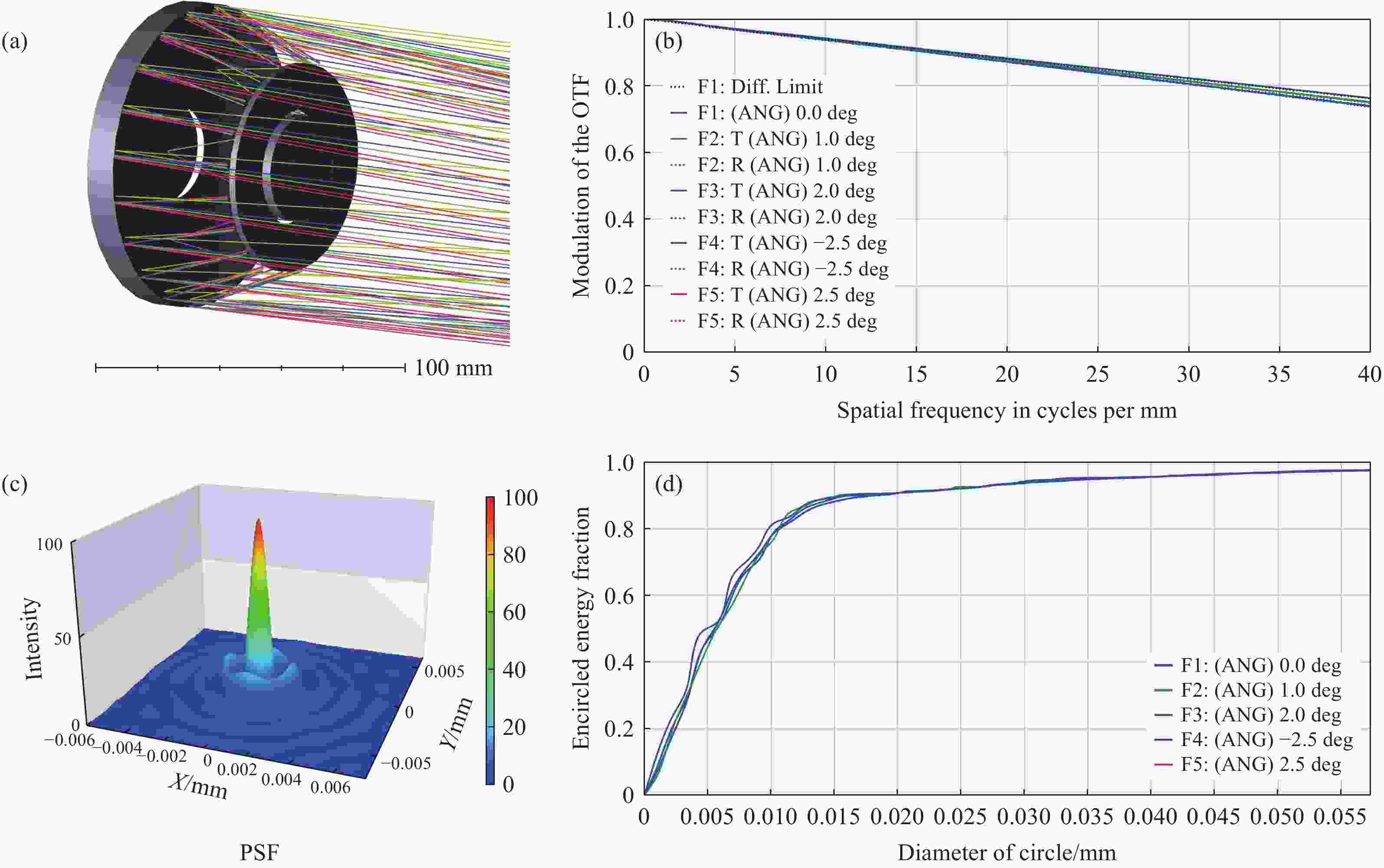
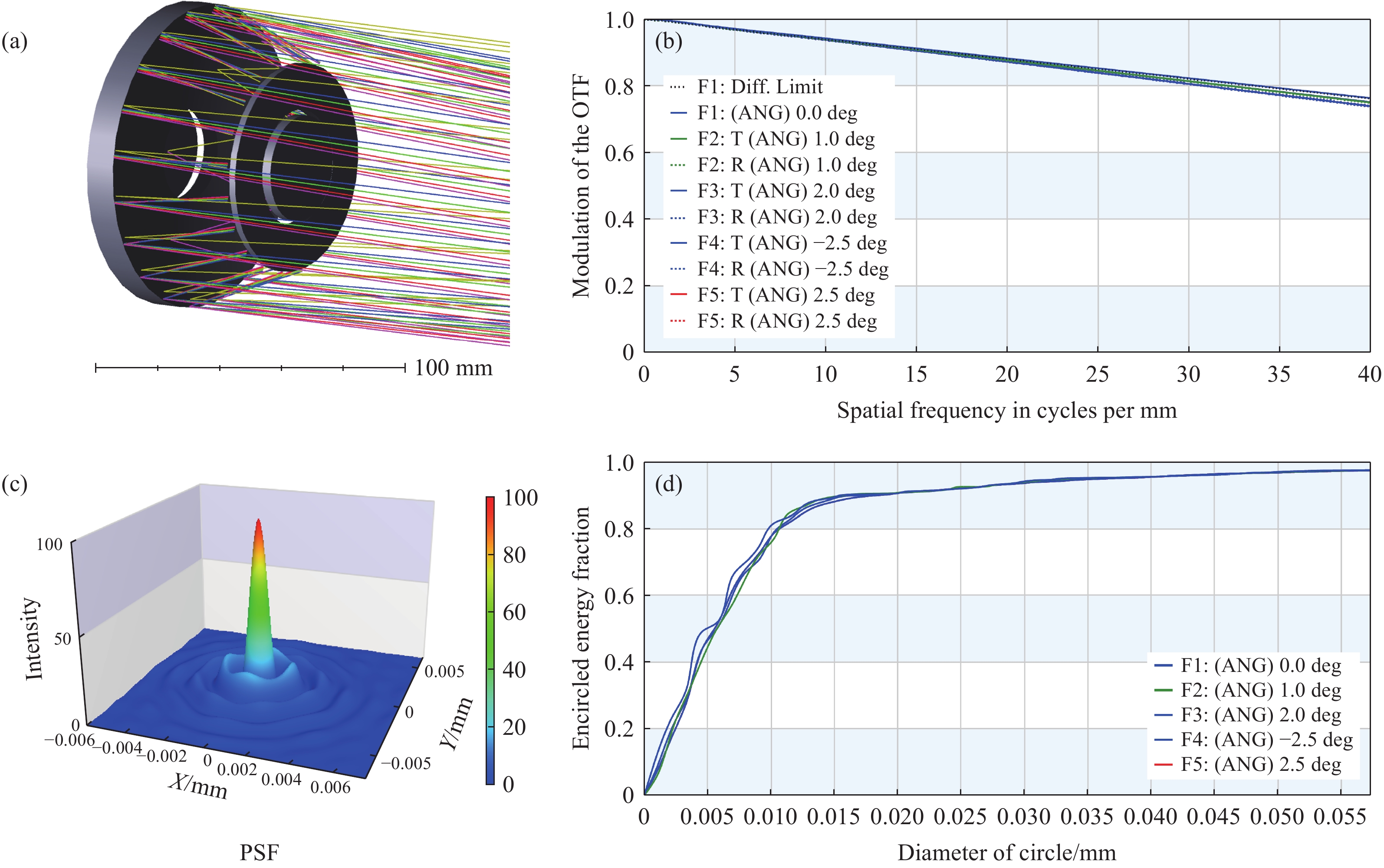
Figure 1. Optical design of coaxial quadruple-reflection star camera. (a) Schematic 3D model of the camera. (b) MTF diagram at 22°C. (c) PSF diagram at 22°C. (d) Diffraction ring energy distribution diagram at 22°C.
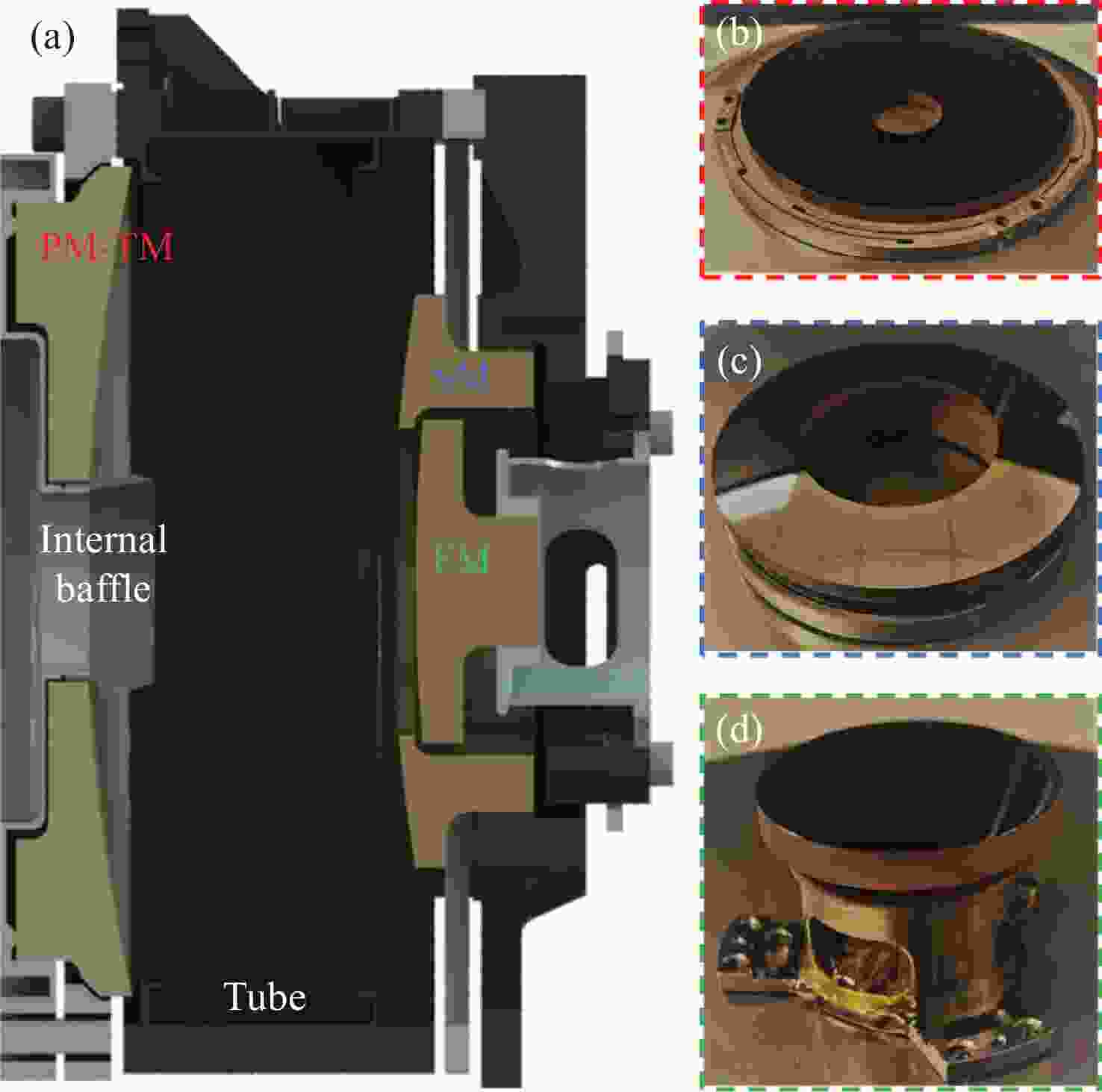
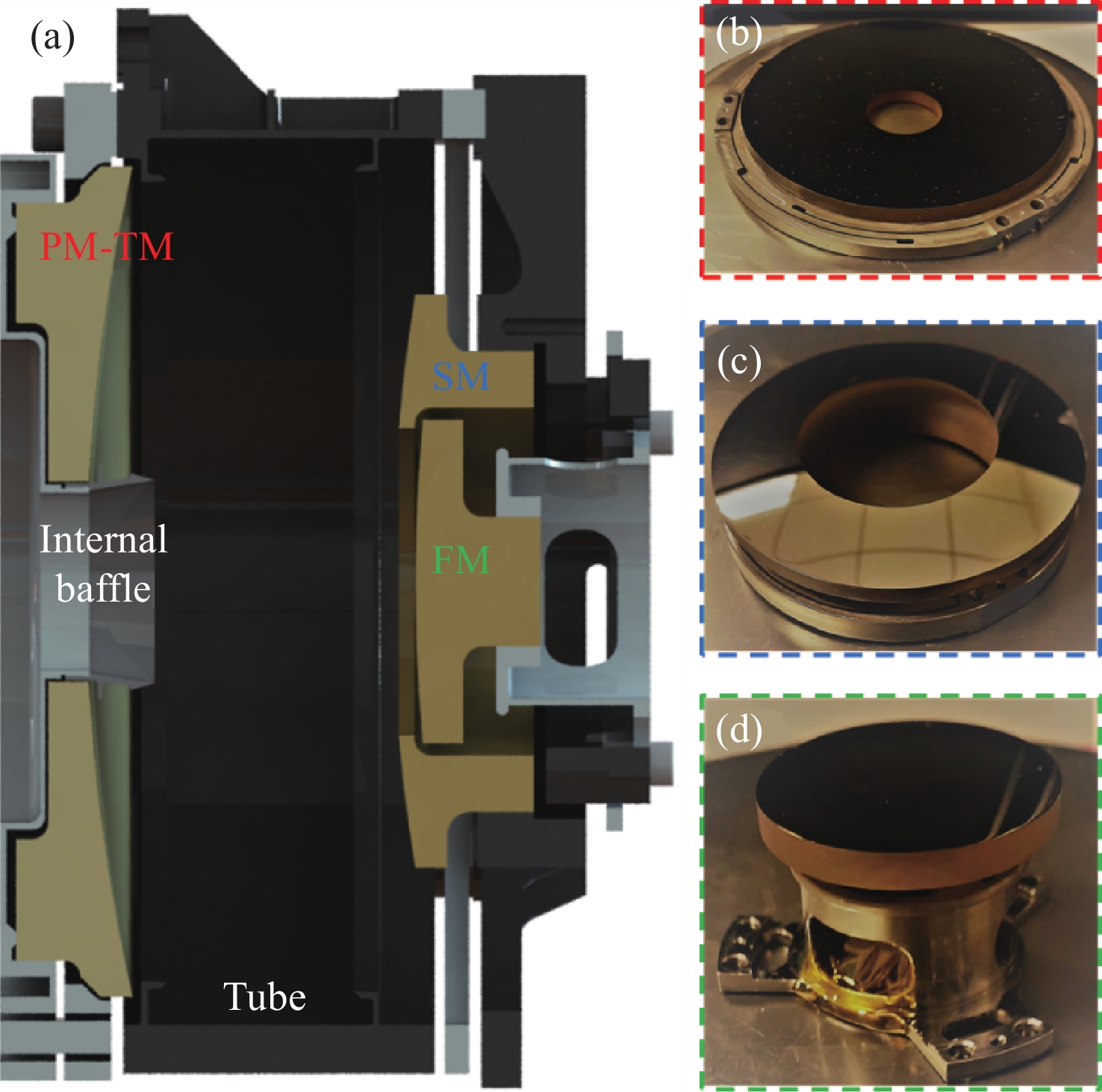
Figure 2. (a) structural profile. (b) primary three-mirror assembly. (c) secondary mirror assembly. (d) four-mirror assembly
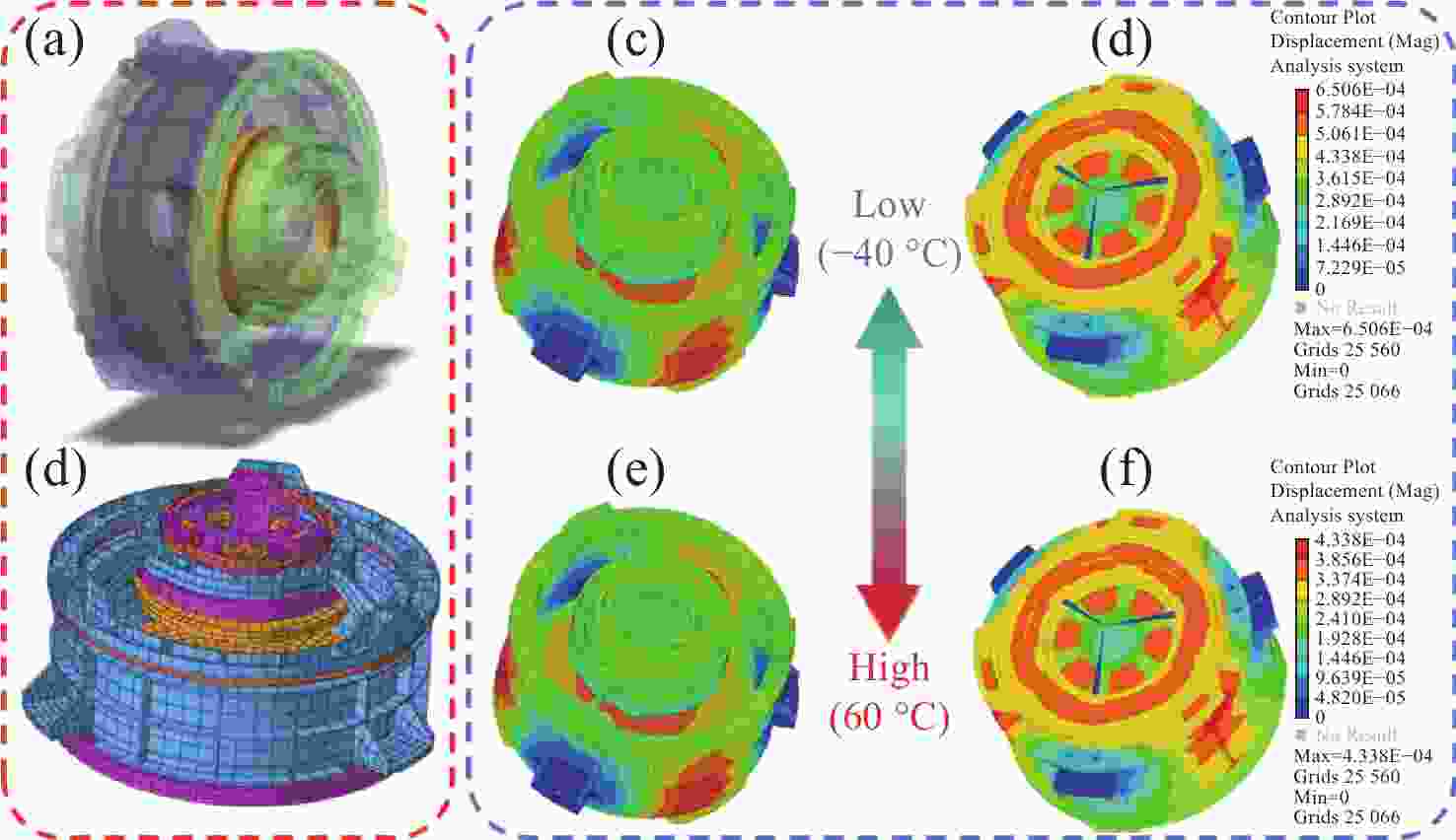
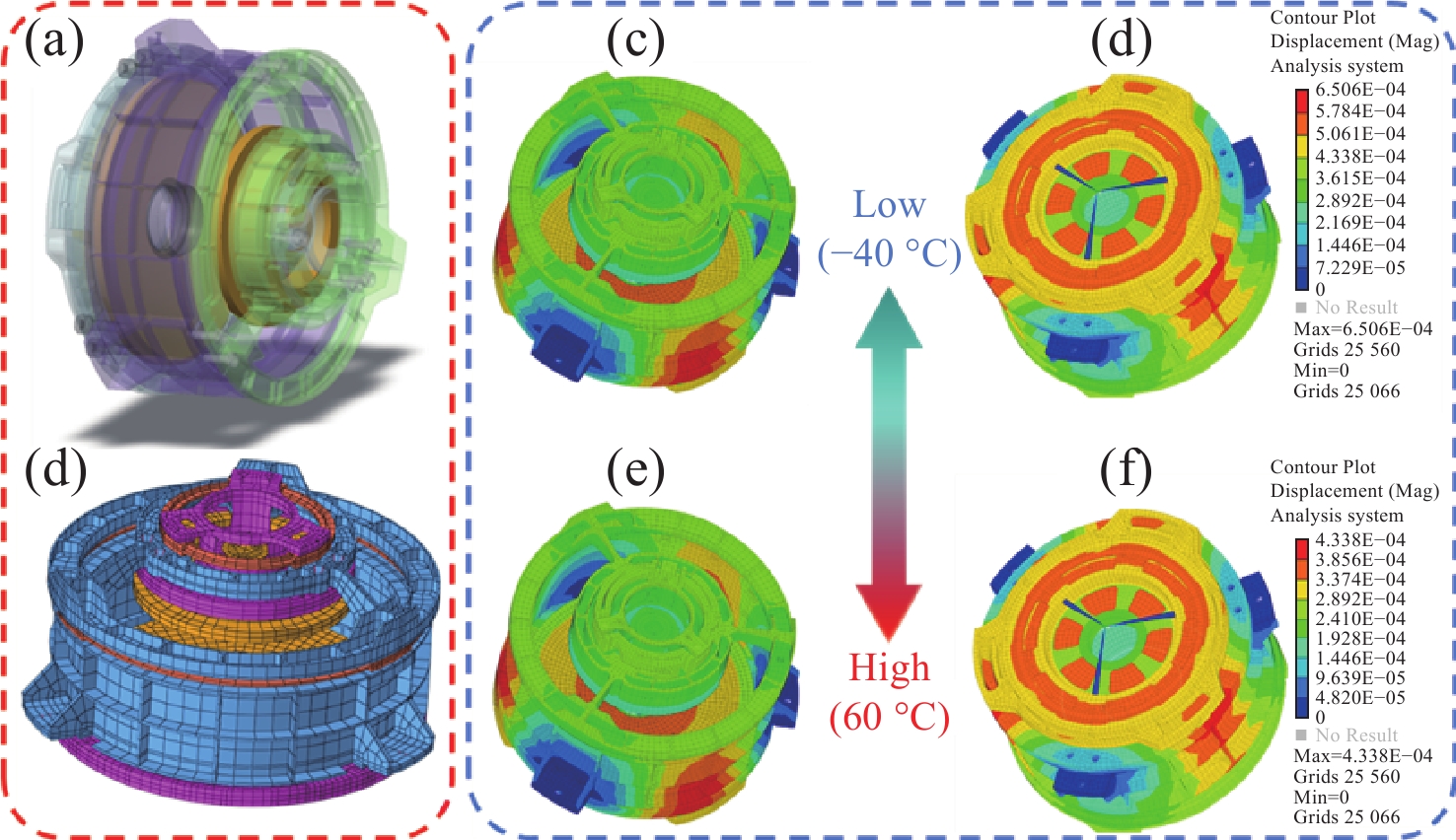
Figure 3. (a) 3D rendered perspective view of the system. (b) Finite element meshed model diagram. (c) Solid displacement contour map at -40°C for the forward incident direction. (d) Solid displacement contour map at -40°C for the reverse direction. (e) Solid displacement contour map at 60°C for the forward incident direction. (f) Solid displacement contour map at 60°C for the reverse direction.
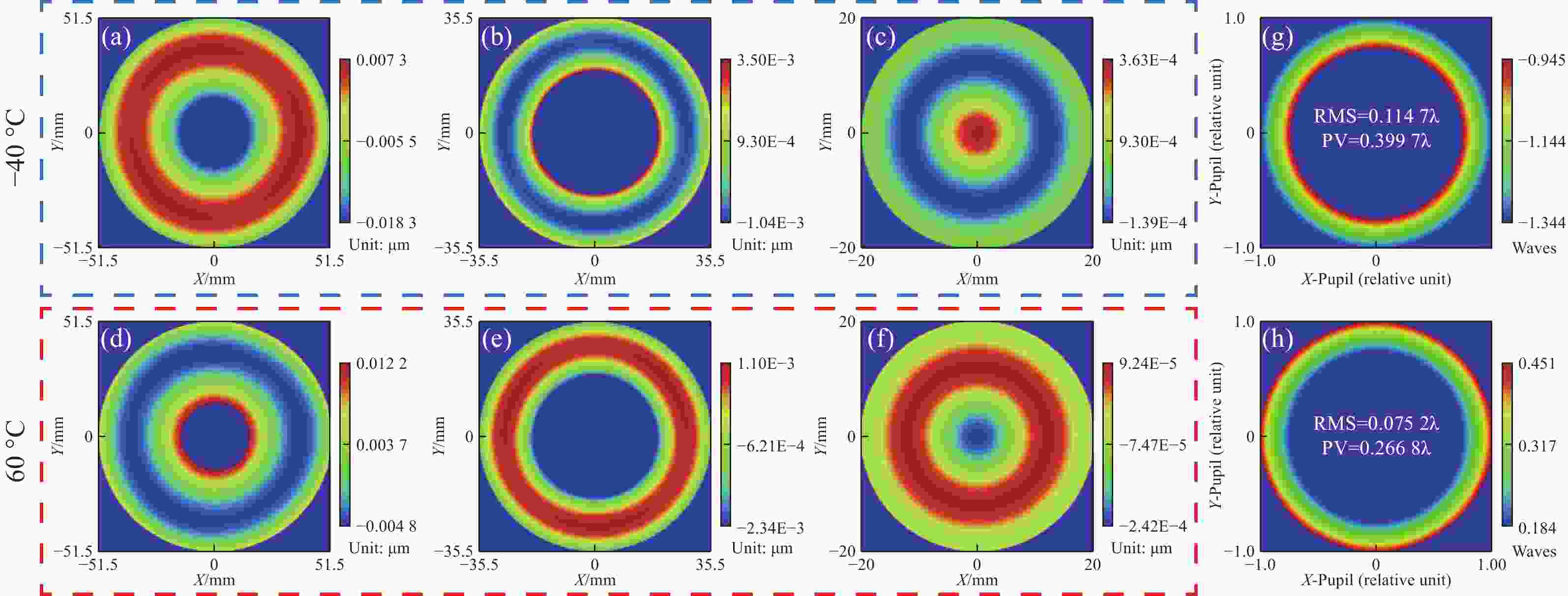
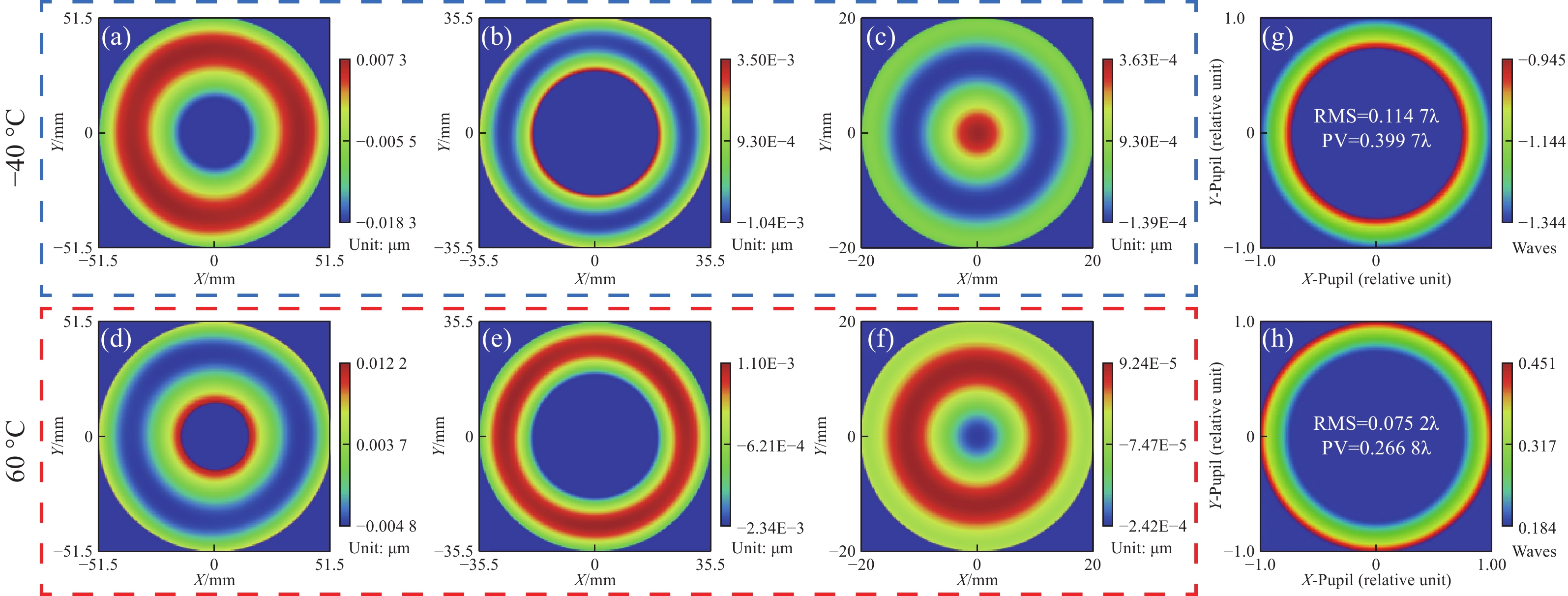
Figure 4. (a) PM-TM surface morphology at -40°C. (b) PM-TM surface morphology at 60°C. (c) SM surface morphology at -40°C. (d) SM surface morphology at 60°C. (e) FM surface morphology at -40°C. (f) FM surface morphology at 60°C. (g) Wavefront error map of the system at -40°C. (h) Wavefront error map of the system at 60°C.
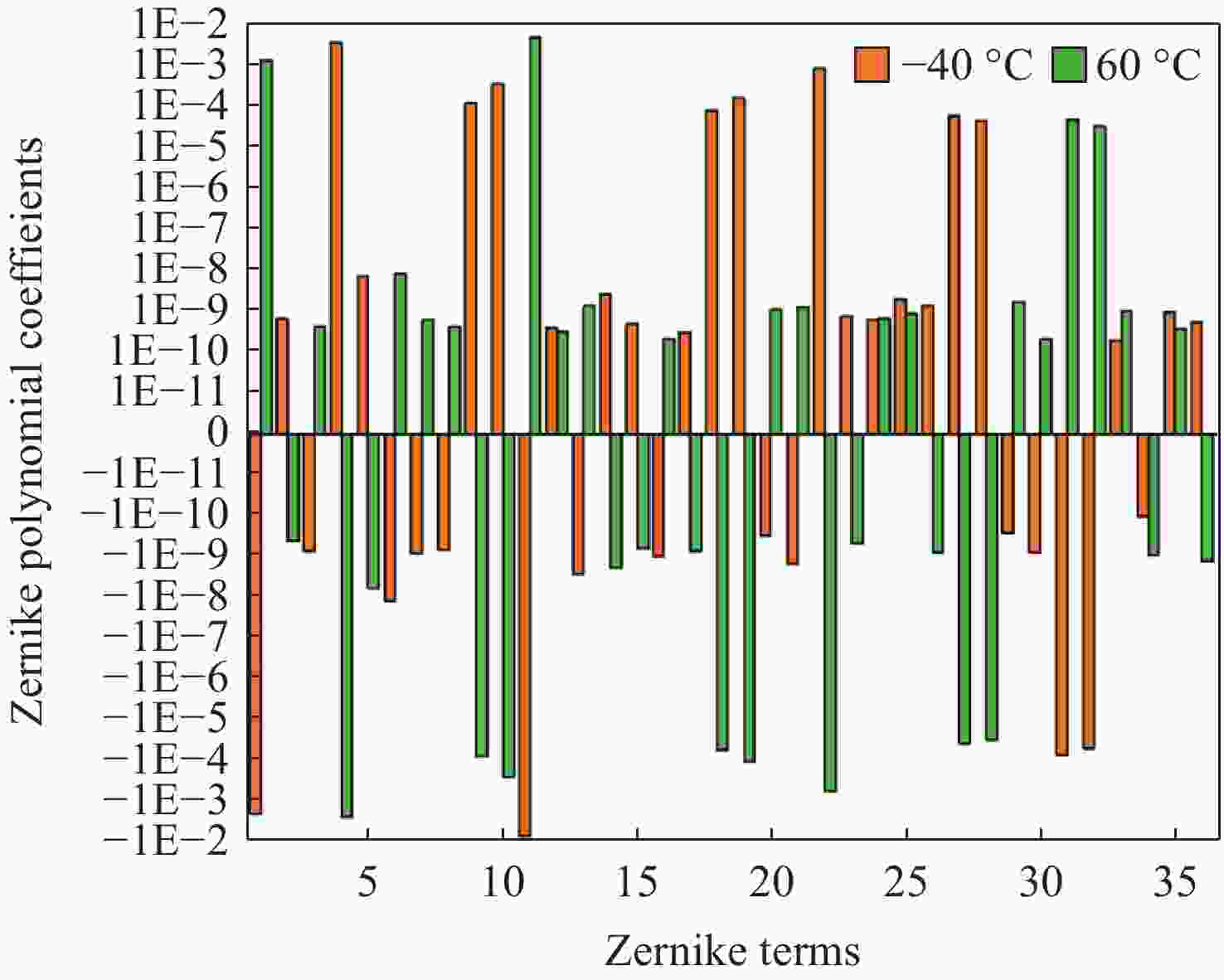
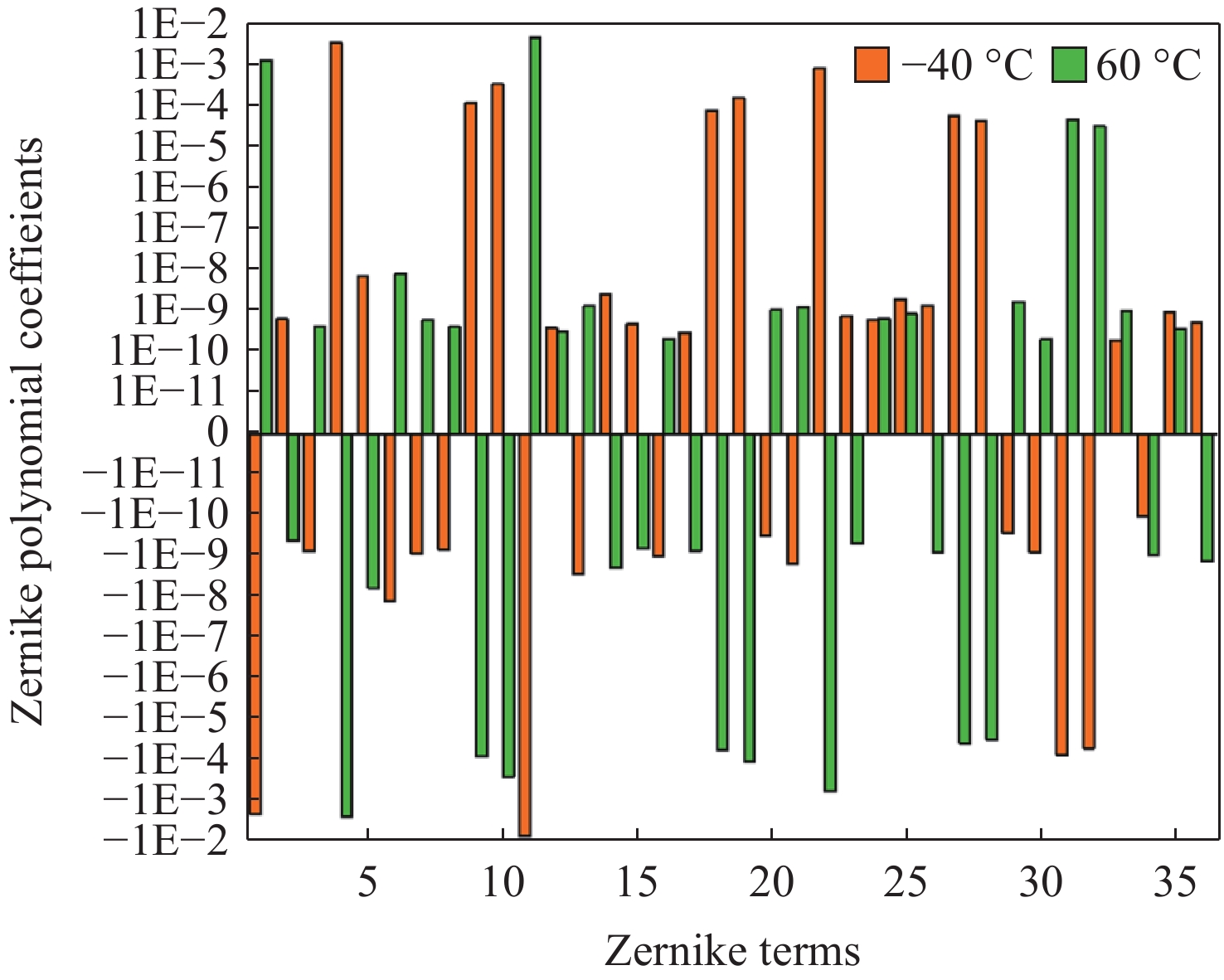
Figure 5. Zernike polynomial coefficients of the primary mirror (PM) at extreme temperatures
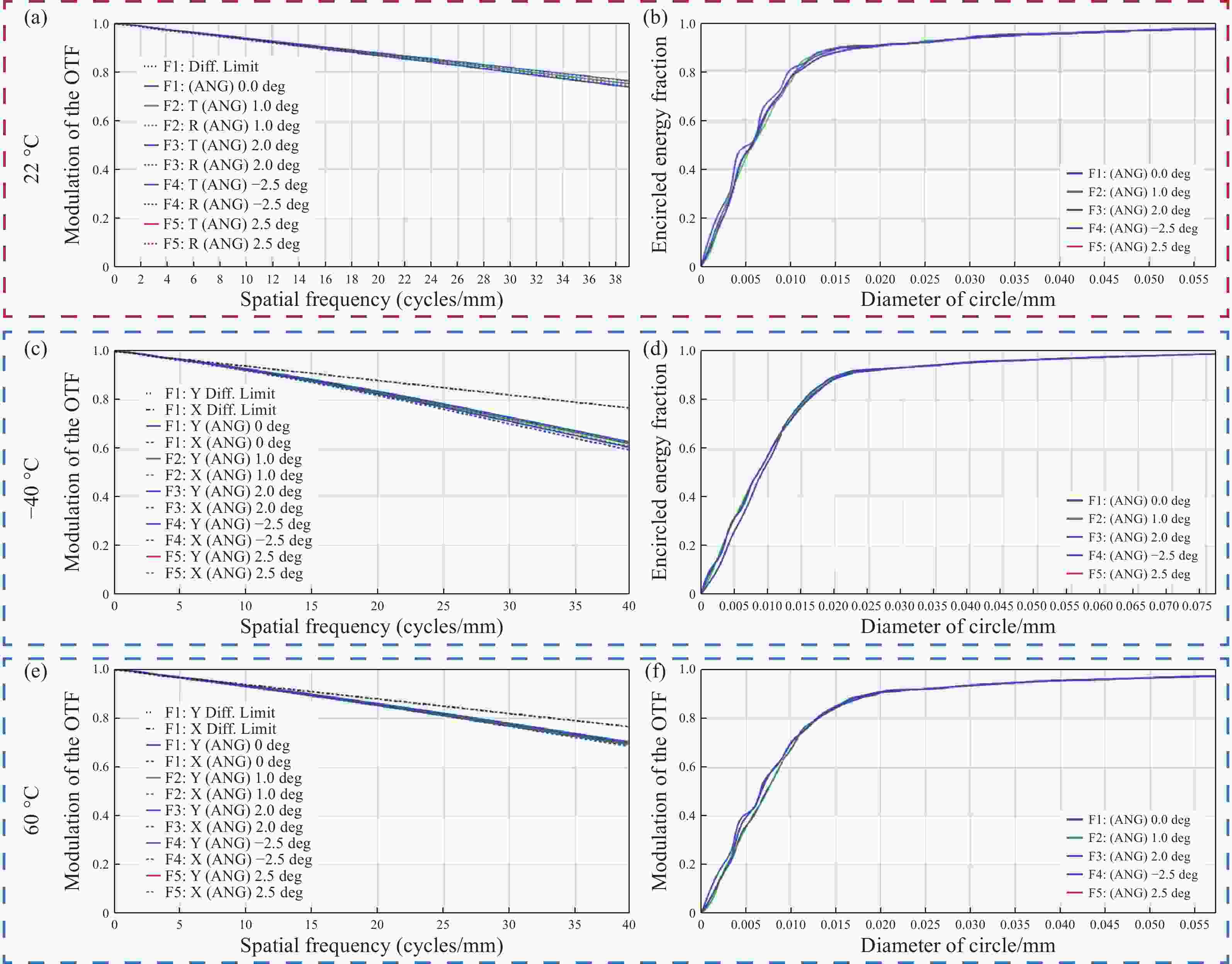
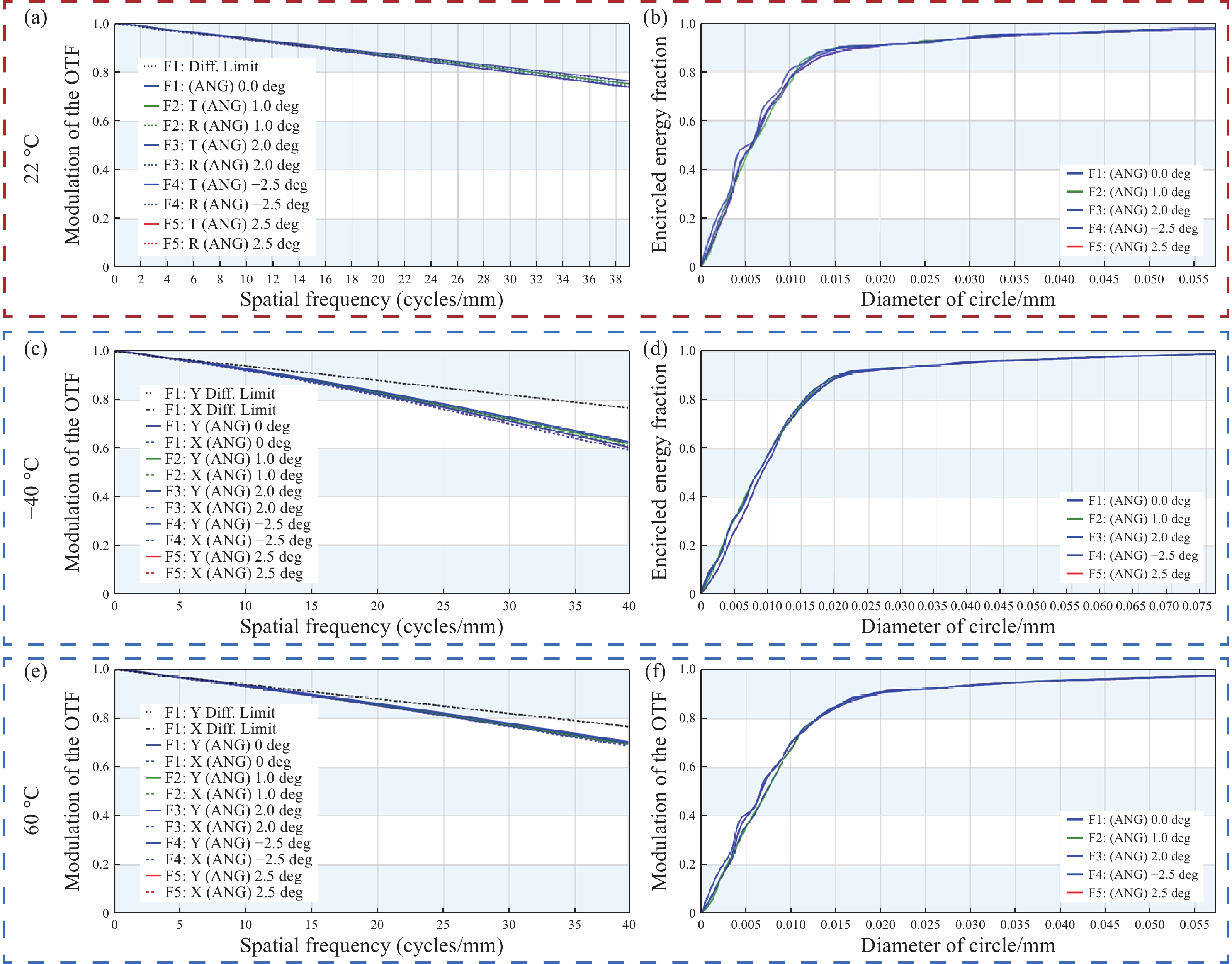
Figure 6. (a) MTF at 22°C. (b) encircled energy at 22°C. (c) MTF at −40°C. (d)encircled energy at −40°C. (e) MTF at 60°C. (f) encircled energy at 60°C.
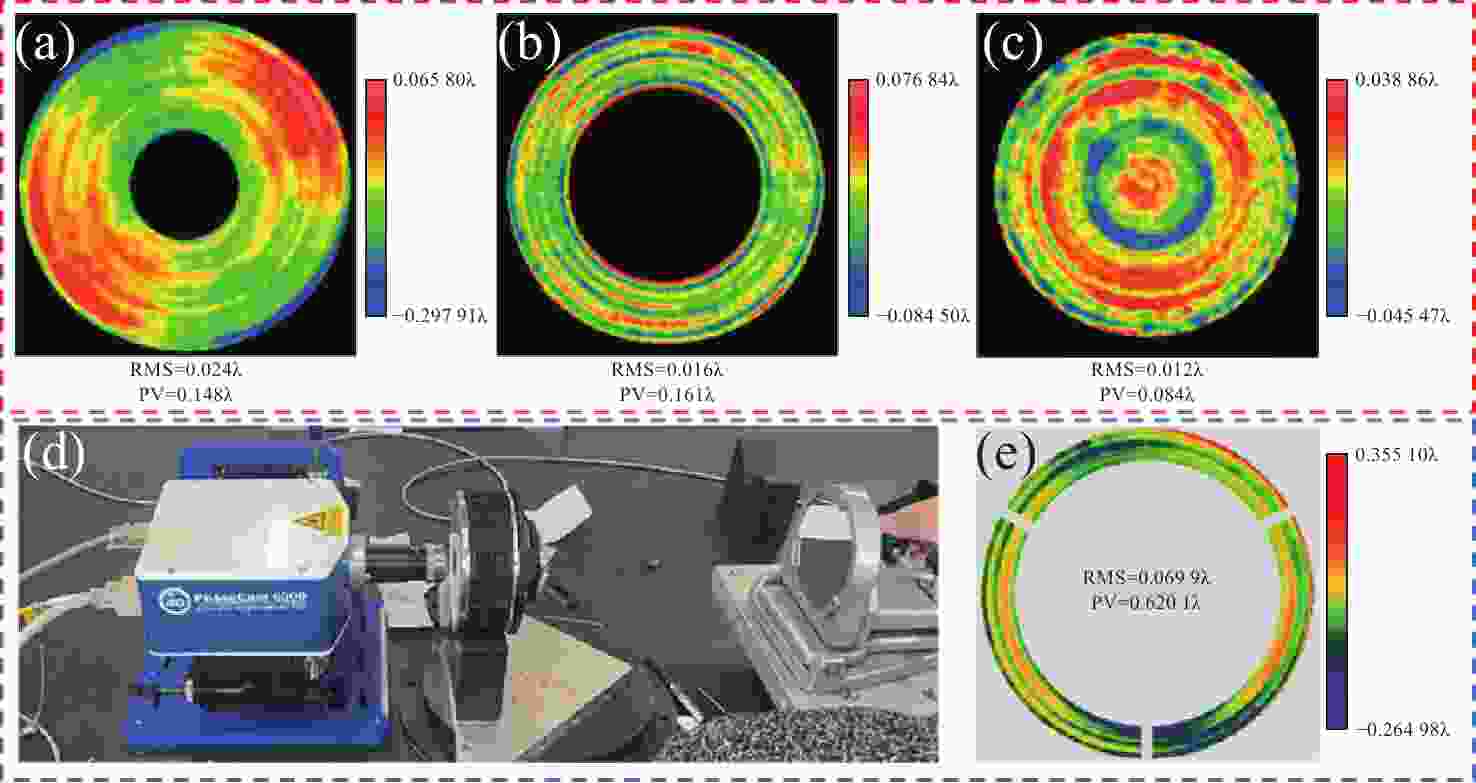
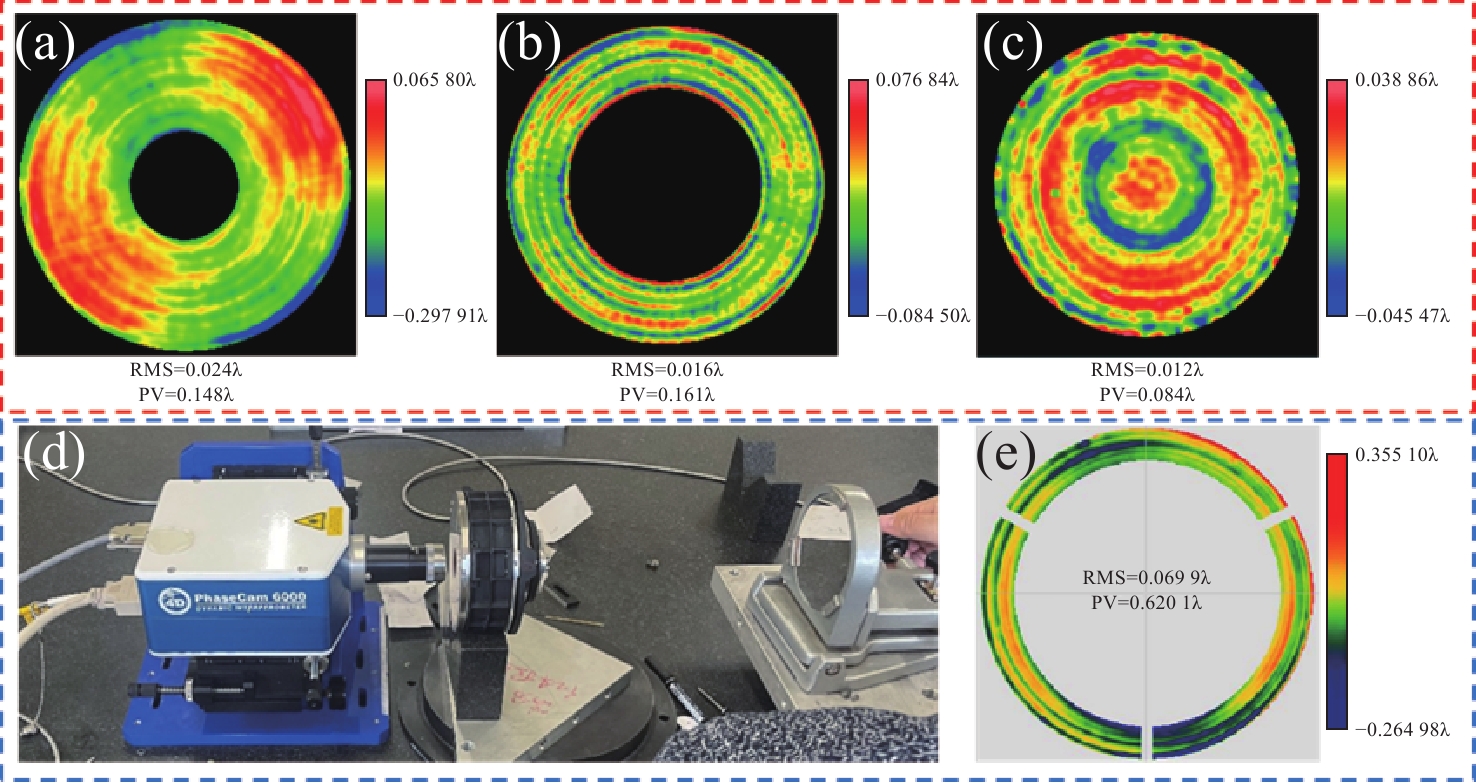
Figure 7. (a) PM-TM topography results. (b) SM topography results. (c) FM topography results. (d) 4D interferometer test platform setup. (e) Systematic wavefront error results.
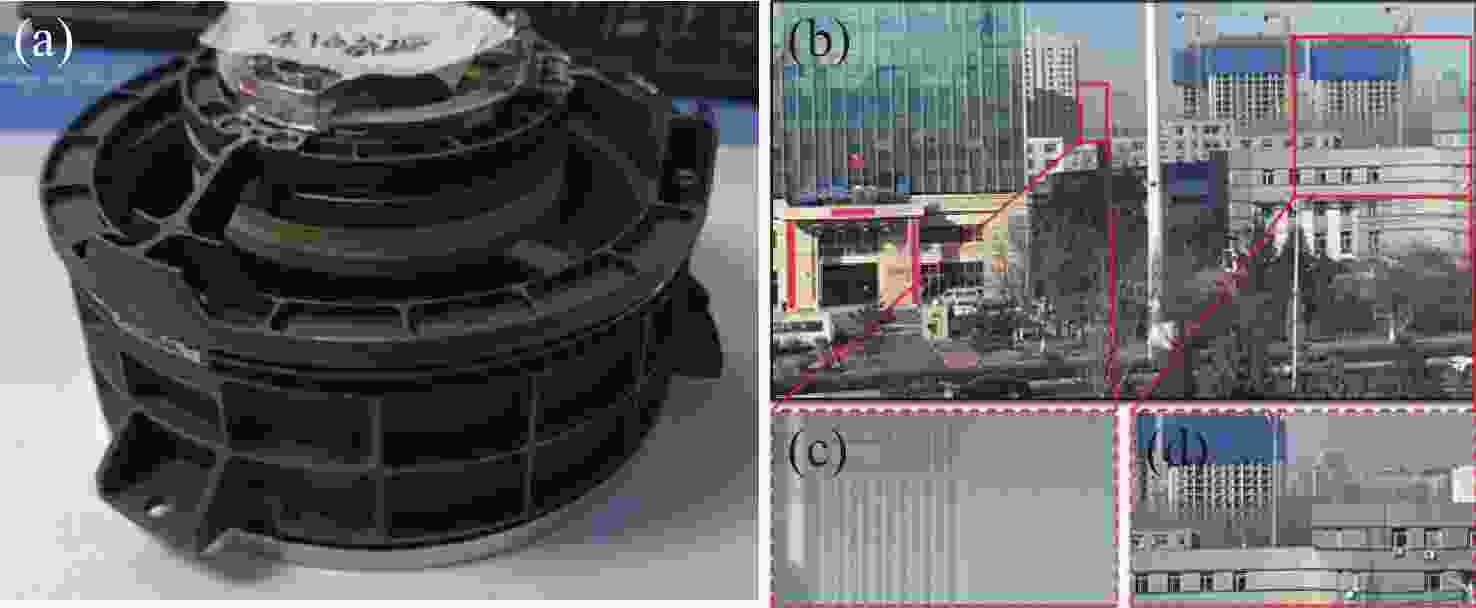
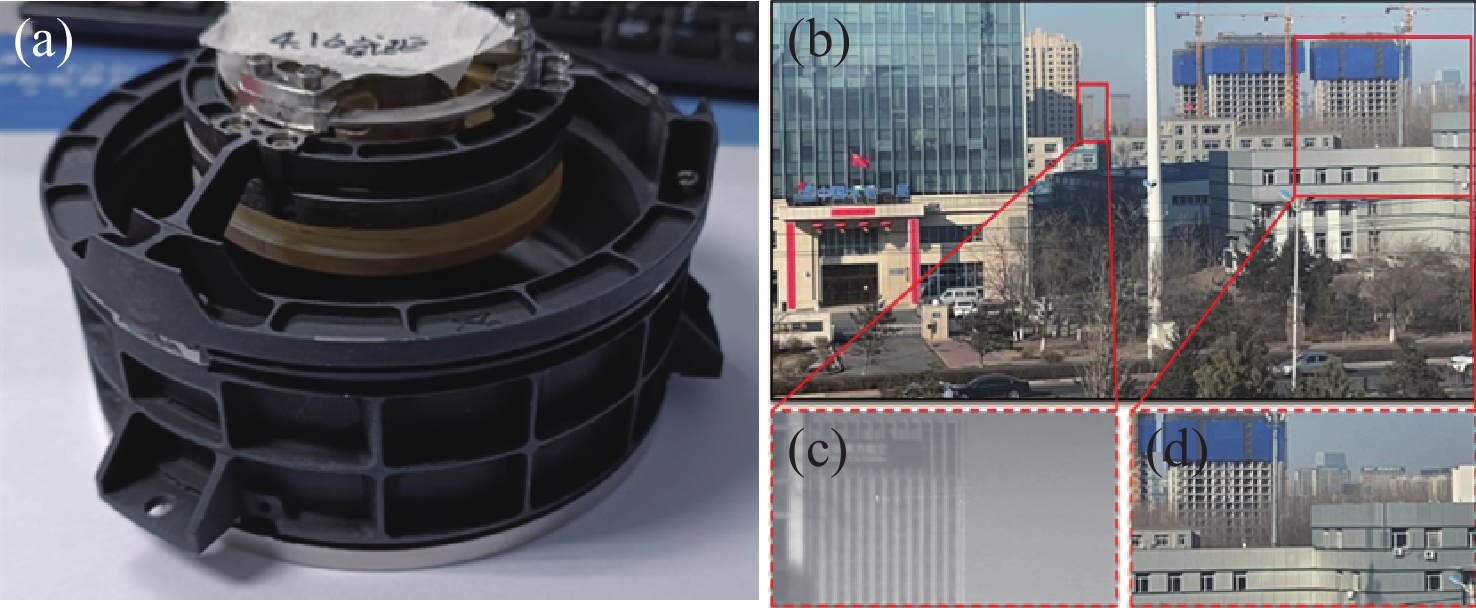
Figure 8. (a) Physical image of the system. (b) Full-frame image of the system's image plane. (c) Physical image at a straight-line distance of
4000 m. (d) Physical image at a straight-line distance of 300 m.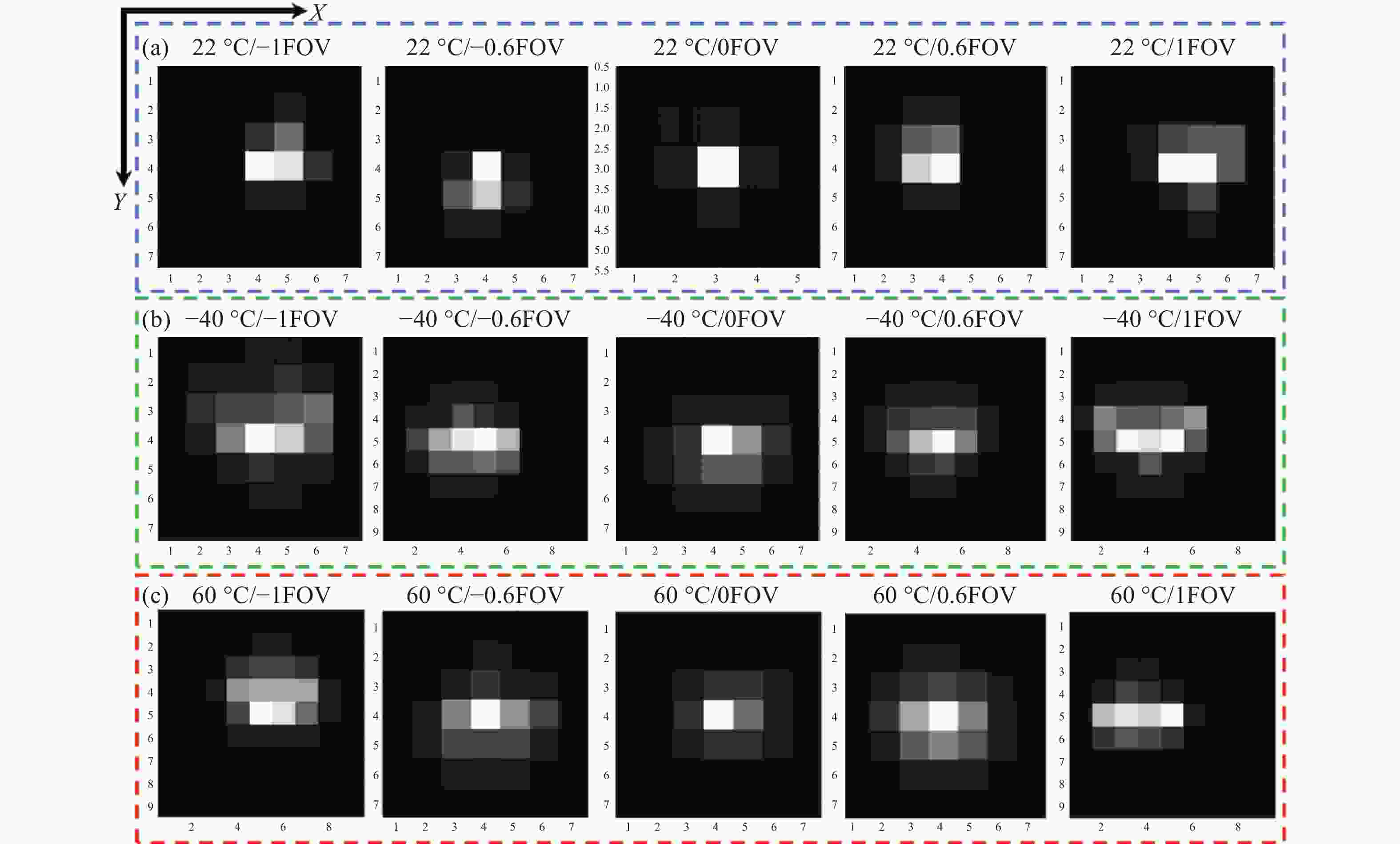
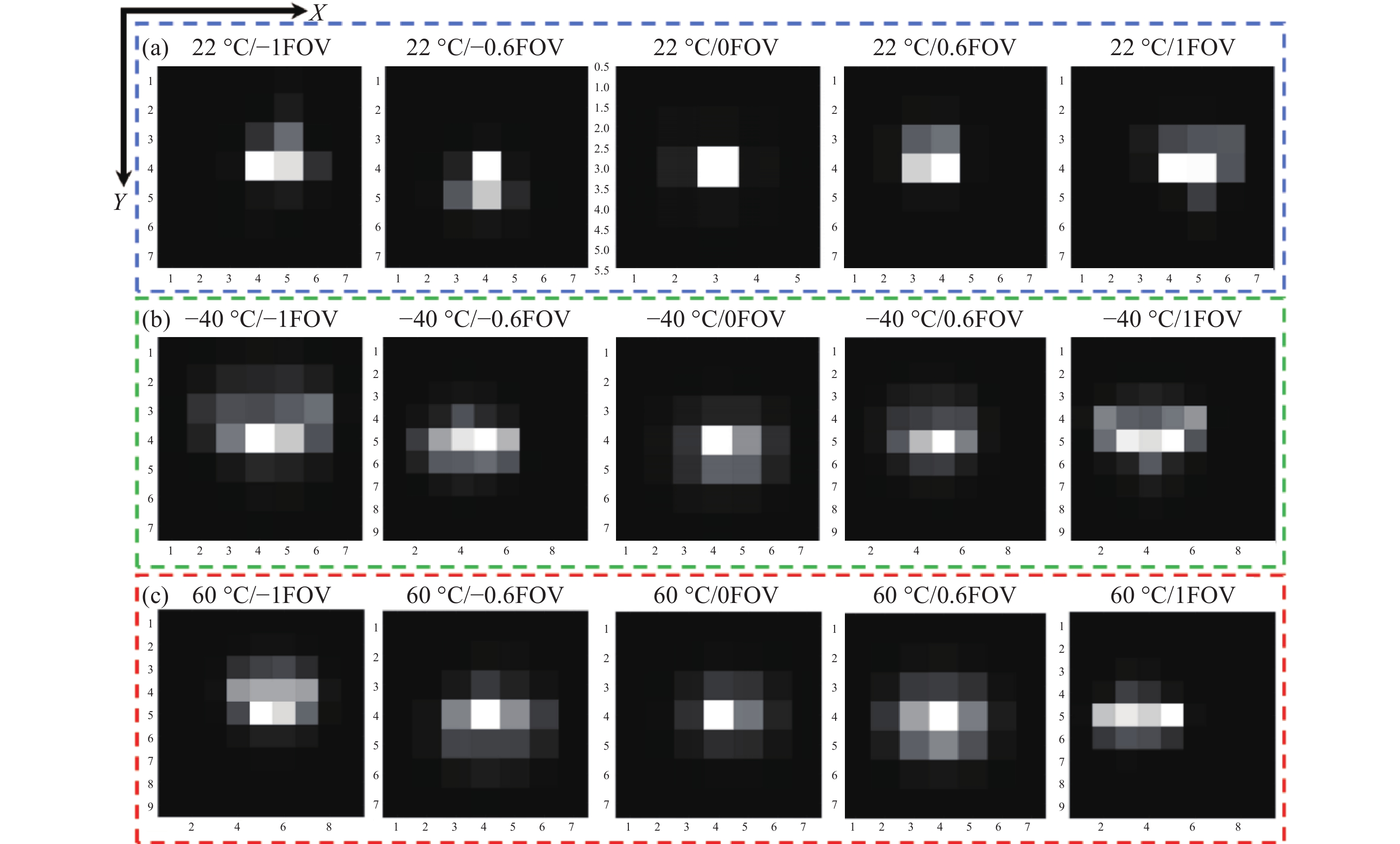
Figure 9. Normalized field-of-view star point test results under different temperature conditions. (a) Test results at 22°C, (b) Test results at −40°C, (c) Test results at 60°C.
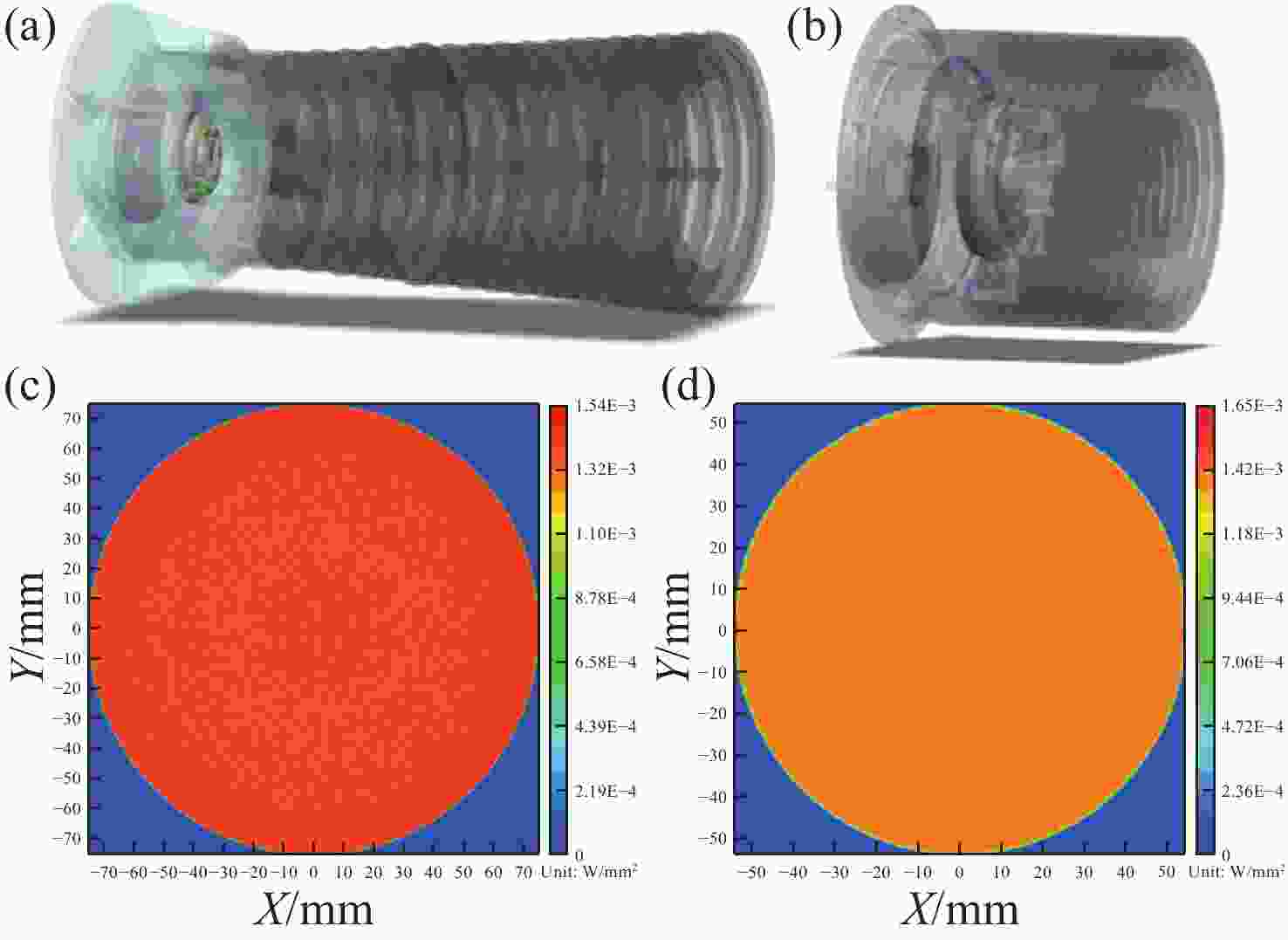
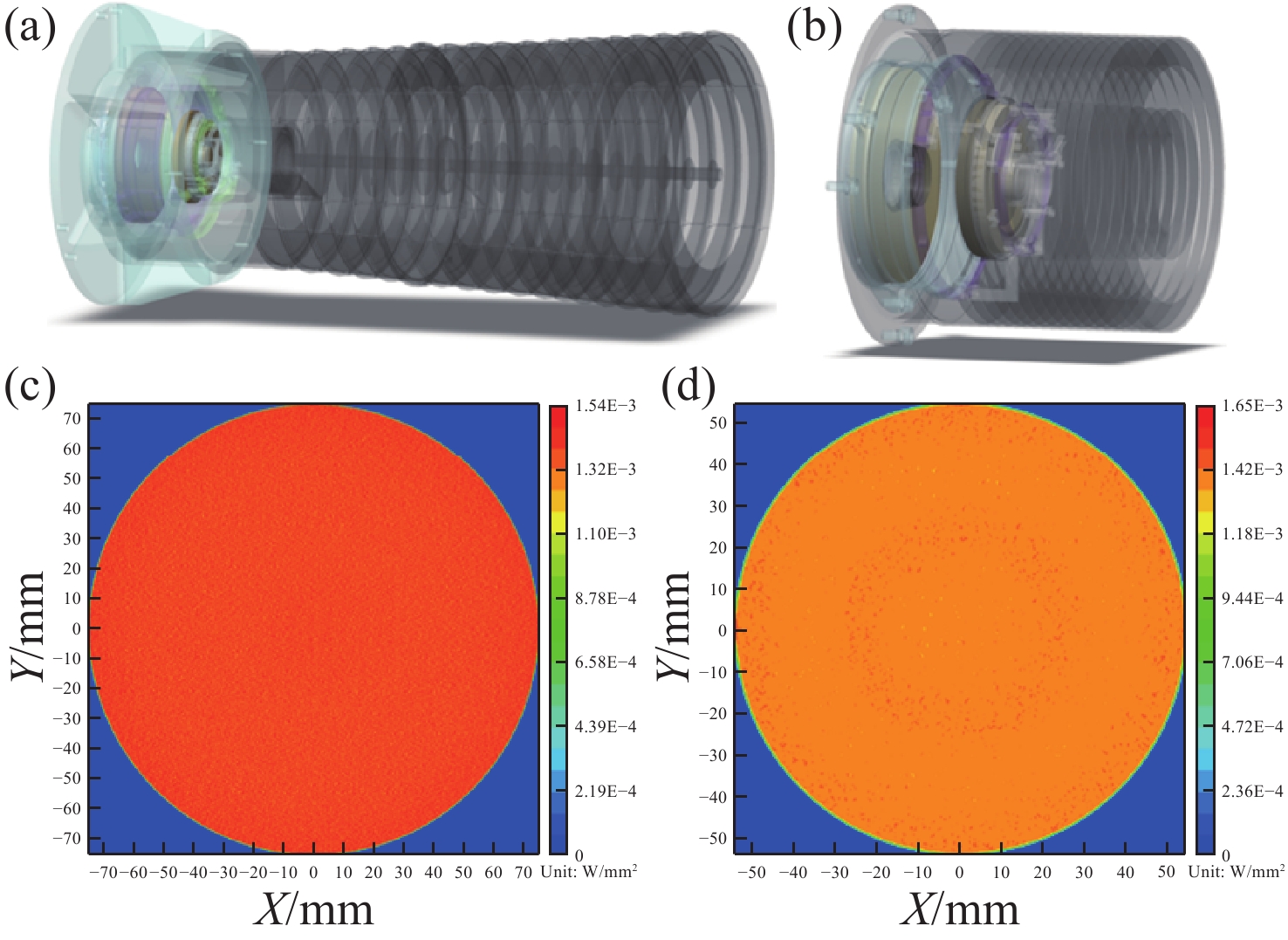
Figure 10. (a) Long baffle structural design. (b) Short baffle structural design. (c) Irradiance distribution results at the entrance pupil for the long baffle. (d) Irradiance distribution results at the entrance pupil for the short baffle.
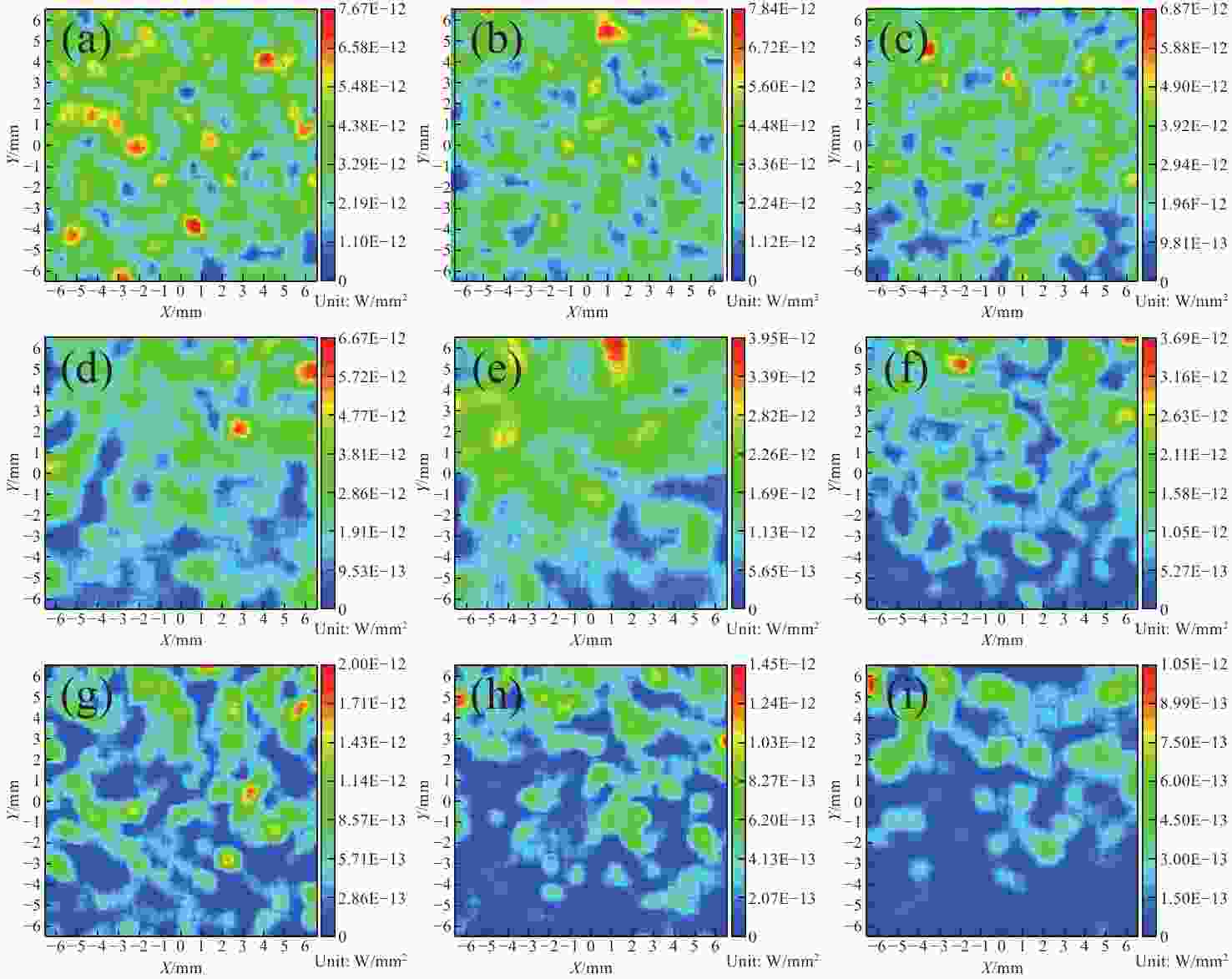
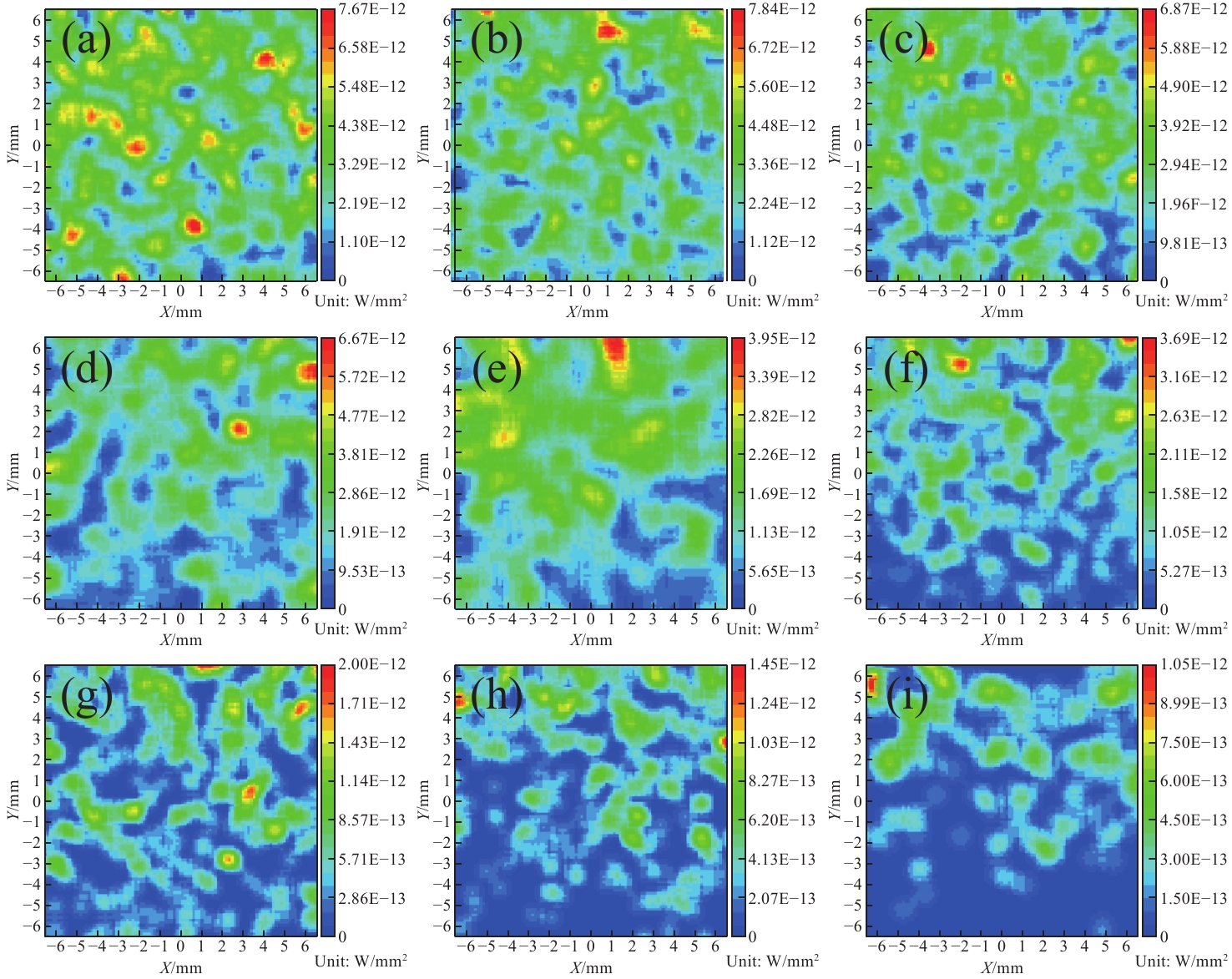
Figure 11. Image plane stray light distribution of the long baffle at different off-axis angles. (a) 30°, (b) 35°, (c) 40°. (d) 45°. (e) 50°. (f) 55°. (g) 60°. (h) 65°. (i) 70°.
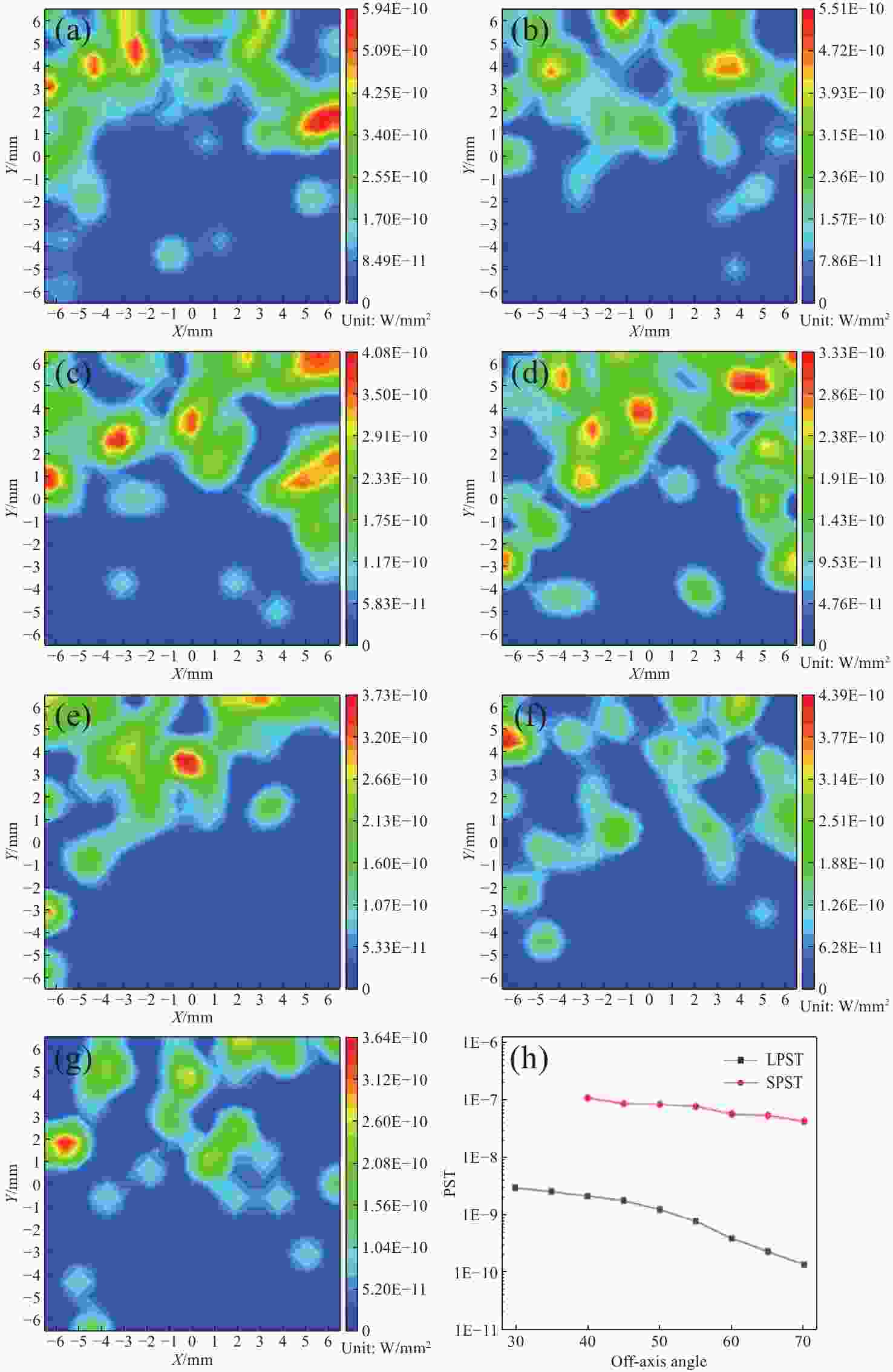
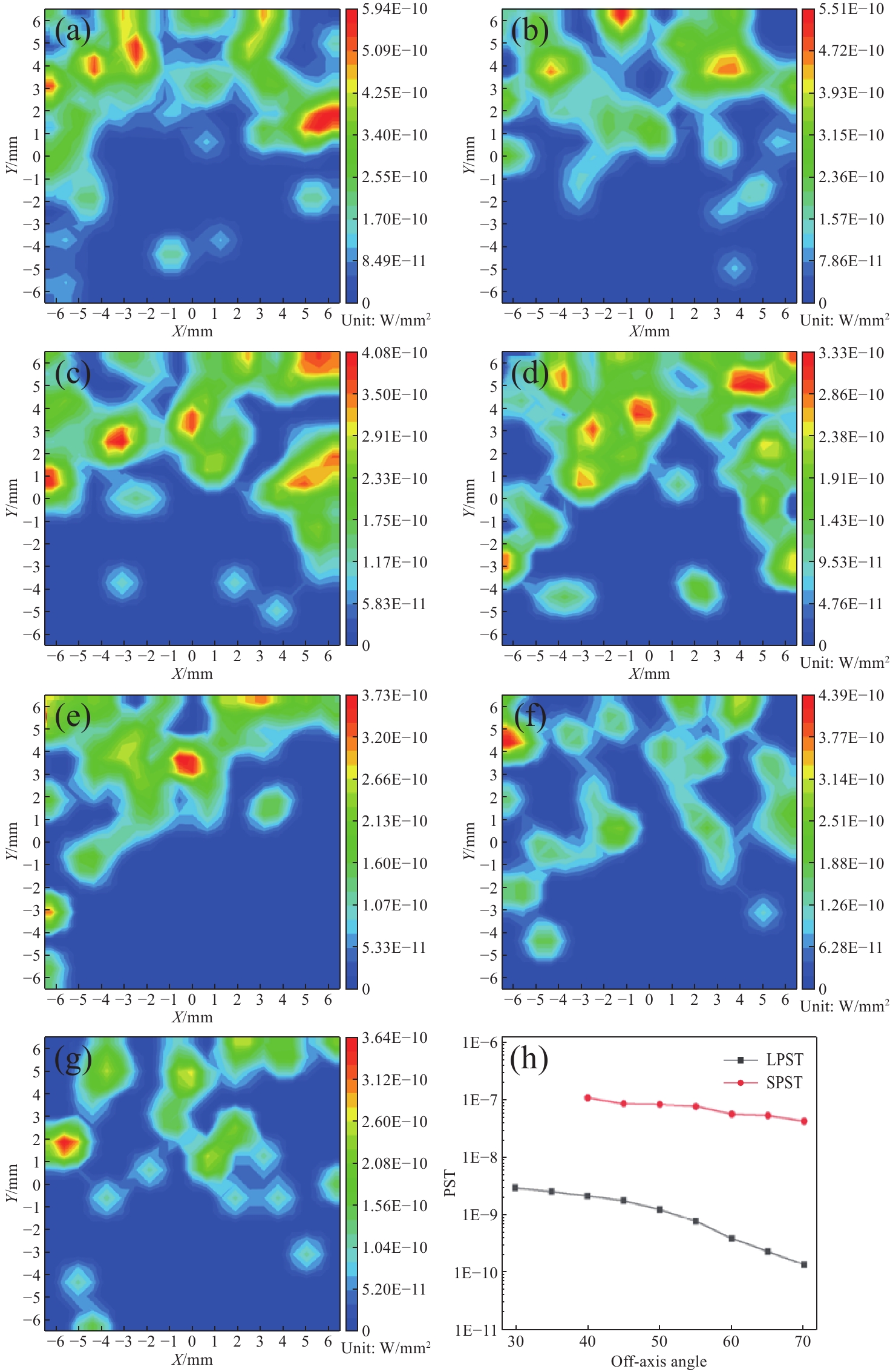
Figure 12. Image plane stray light distribution of the short baffle at different off-axis angles and PST curves for both designs. (a) 40°. (b) 45°. (c) 50°. (d) 55°. (e) 60°. (f) 65°. (g) 70°. (h) Comparison curve between LPST and SPST.
Table 1. Optical parameters of the star camera
Parameters Design Specifications Effective focal length 195 mm Field of view ±2. 5° Operating Waveband 400-1000nm Absolute Distortion ≤0.1% Energy concentration
(within 11 μm)≥80% Transmission function
(40 lp/mm)≥0.7 Operating Temperature −40~60 °C Equivalent entrance pupil diameter 64 mm Axial length 50 mm Pixel size 6.5μm  下载: 导出CSV
Table 2. Parameters of the star camera optical structure
Surface Diameter
(mm)Radius
(mm)Cone coefficient Interval from the previous surface(mm) obscuration ratio(%) Primary Mirror (Integrated with the third mirror) 102 −219.2 3.92 0 67% Secondary Mirror 68 −190.66 1.85 −38 - Fourth Mirror 35 −240 5.91 −41 -
下载: 导出CSV
Table 3. Star Camera Tolerance Allocation Table
Surface Tilt (″) Alignment Radial Tolerance (mm) Alignment Axial Deviation (mm) Radius Error (mm) Surface Figure Error (wave) Remarks Primary Mirror - - - 0.05 0.033 Primary mirror as reference Secondary Mirror 10 0.005 0.005 0.05 0.033 Fourth Mirror 10 0.005 0.005 0.05 0.033
下载: 导出CSV
Table 4. Material properties of the machine structure
component Material Density
(g/cm3)Modulus of elasticity
(GPa)Coefficient of thermal expansion
(10−6K−1)Mirrors Zerodur® 2.53 91 0.05 structural components Invar alloy 8.9 141 1.4
下载: 导出CSV
Table 5. Rigid body displacement data
Component Temperature
( °C)Tx
(mm)Ty
(mm)Tz
(mm)Rx
(mm)Ry
(mm)-Rz
(mm)ΔRoC
(mm)RMS
(mm)P-V
(mm)PM-TM −40 5.06E-10 2.99E-10 −5.42E-04 4.09E-12 −8.73E-13 −4.85E-07 −3.93E-03 6.19E-06 2.54E-05 PM-TM −20 3.37E-10 1.99E-10 −3.61E-04 2.73E-12 −6.23E-13 −3.23E-07 −2.62E-03 4.12E-06 1.69E-05 PM-TM 0 1.69E-10 9.96E-11 −1.81E-04 1.31E-12 −2.85E-13 −1.62E-07 −1.31E-03 2.06E-06 8.45E-06 PM-TM 40 −1.69E-10 −9.96E-11 1.81E-04 −1.31E-12 2.85E-13 1.62E-07 1.31E-03 2.06E-06 8.45E-06 PM-TM 60 −3.37E-10 −1.99E-10 3.61E-04 −2.73E-12 6.23E-13 3.23E-07 2.62E-03 4.12E-06 1.69E-05 SM −40 −1.43E-10 −1.61E-11 2.81E-04 −1.92E-12 1.34E-13 1.81E-08 2.90E-03 1.47E-06 5.09E-06 SM −20 −9.52E-11 −1.08E-11 1.88E-04 −1.21E-12 2.11E-13 1.21E-08 1.94E-03 9.77E-07 3.39E-06 SM 0 −4.76E-11 −5.42E-12 9.38E-05 −6.18E-13 8.43E-14 6.04E-09 9.68E-04 4.89E-07 1.70E-06 SM 40 4.76E-11 5.42E-12 −9.38E-05 6.18E-13 −8.43E-14 −6.04E-09 −9.68E-04 4.89E-07 1.70E-06 SM 60 9.52E-11 1.08E-11 −1.88E-04 1.21E-12 −2.11E-13 −1.21E-08 −1.94E-03 9.77E-07 3.39E-06 FM −40 −2.07E-10 −1.05E-10 2.51E-04 7.52E-12 −6.92E-12 1.45E-07 1.23E-03 1.14E-07 6.14E-07 FM −20 −1.38E-10 −7.00E-11 1.67E-04 4.98E-12 −4.58E-12 9.66E-08 8.19E-04 7.62E-08 4.10E-07 FM 0 −6.93E-11 −3.51E-11 8.37E-05 2.47E-12 −2.35E-12 4.83E-08 4.09E-04 3.81E-08 2.05E-07 FM 40 6.93E-11 3.51E-11 −8.37E-05 −2.47E-12 2.35E-12 −4.83E-08 −4.09E-04 3.81E-08 2.05E-07 FM 60 1.38E-10 7.00E-11 −1.67E-04 −4.98E-12 4.58E-12 −9.66E-08 −8.19E-04 7.62E-08 4.10E-07
下载: 导出CSV
-
[1] WANG W J, WEI X G, LI J, et al. Optical parameters optimization for all-time star sensor[J]. Sensors, 2019, 19(13): 2960. doi: 10.3390/s19132960 [2] HUANG D, WANG ZH F, GONG J Y, et al. On-orbit attitude planning for Earth observation imaging with star-based geometric calibration[J]. Science China Technological Sciences, 2025, 68(2): 1220602. doi: 10.1007/s11431-024-2786-6 [3] XU D D, WANG X F, ZHU J Q, et al. Overall design and hardware realization of space stargazing camera[J]. Journal of Physics: Conference Series, 2022, 2356(1): 012011. doi: 10.1088/1742-6596/2356/1/012011 [4] ZHANG X G, LIU Y M, DUAN H X, et al. Weak spatial target extraction based on small-field optical system[J]. Sensors, 2023, 23(14): 6315. doi: 10.3390/s23146315 [5] JIANG F, WANG L, DENG H X, et al. Thermal deformation analysis of a star camera to ensure its high attitude measurement accuracy in orbit[J]. Remote Sensing, 2024, 16(23): 4567. doi: 10.3390/rs16234567 [6] LI SH Q, WANG Y, ZHANG H, et al. Thermal analysis and validation of GF-4 remote sensing camera[J]. Journal of Thermal Science, 2020, 29(4): 992-1000. doi: 10.1007/s11630-020-1230-5 [7] LU P, GAO T, YANG T, et al. Precise thermal control of space star camera and laser altimeter[J]. Proceedings of SPIE, 2023, 12710: 127100H. [8] LI E Z, PAN Y, GU G CH, et al. Athermal design of a space camera using a single lens material over a wide temperature range[J]. Chinese Optics, 2025, 18(6): 1388-1398. (in Chinese). [9] CHEN L, LIU J H, BI SH W, et al. Design of space optical systems and analysis of their thermal stability[J]. Chinese Optics, 2026, 19(1): 151-163. (in Chinese). [10] LI ZH X, CHEN J, WU J J, et al. Opto-mechanical-thermal analysis of long-wave infrared meta/refractive optical systems[J]. Optics and Lasers in Engineering, 2026, 196: 109445. doi: 10.1016/j.optlaseng.2025.109445 [11] LIU Y Q, GAO T Y, HAN X. Optomechanical design and analysis of large aperture thermal insensitive star sensor[J]. Infrared Technology, 2024, 46(1): 31-35. (in Chinese). [12] XU L, ZHAO J K, XUE X, et al. PST research and measurement of lunar-based optical telescope stray light[J]. Infrared and Laser Engineering, 2014, 43(4): 1289-1295. (in Chinese). [13] ZHONG X, FENG J SH, LI Y J, et al. Stray light suppression design and test for the Jilin-1 GF04A satellite remote sensing camera[J]. Remote Sensing, 2025, 17(9): 1512. doi: 10.3390/rs17091512 [14] LIN J CH, SUN L W, CHEN B Y, et al. Stray light analysis of a coaxial two reflect mirror system and optimized design of inner photomask[J]. Chinese Journal of Lasers, 2013, 40(1): 0116001. (in Chinese). doi: 10.3788/CJL201340.0116001 [15] FEST E C. Stray Light Analysis and Control[M]. Washington: SPIE Press, 2013. [16] LÜ B, FENG R, KOU W, et al. Optical system design and stray light suppression of catadioptric space camera[J]. Chinese Optics, 2020, 13(4): 822-831. (in Chinese). [17] FUSE R, ENYA K, KAMEDA S, et al. Stray light analysis by ray tracing simulation for the wide-angle multiband camera OROCHI onboard the Martian Moons eXploration (MMX) spacecraft[J]. Advances in Space Research, 2022, 69(2): 1236-1248. doi: 10.1016/j.asr.2021.11.011 [18] SHI CH L, LI X P. Stray light analysis of catadioptric long-wavelength infrared optical system[J]. Procedia Computer Science, 2019, 147: 203-209. doi: 10.1016/j.procs.2019.01.223 [19] SUN M ZH, WANG T T, WANG Y CH, et al. Research development of high reflecting coating for large-diameter mirror[J]. Chinese Optics, 2016, 9(2): 203-212. (in Chinese). doi: 10.3788/CO.20160902.0203 [20] GU M. Advanced Optical Imaging Theory[M]. Berlin: Springer, 2000. [21] NIU K, TIAN CH. Zernike polynomials and their applications[J]. Journal of Optics, 2022, 24(12): 123001. doi: 10.1088/2040-8986/ac9e08 [22] HAN X, ZHANG J, GAO T Y, et al. Research on thermal integrated optomechanical analysis method of transmissive infrared optical systems[J]. Infrared Technology, 2018, 40(12): 1136-1141. (in Chinese). [23] DU W F, WANG Y Q, ZHENG X J, et al. Optical system design for wide-area spatial sensitizer[J]. Acta Photonica Sinica, 2024, 53(3): 0311001. (in Chinese). doi: 10.3788/gzxb20245303.0311001 [24] DUBOSE T B, GARDNER D F, WATNIK A T. Intensity-enhanced deep network wavefront reconstruction in Shack–Hartmann sensors[J]. Optics Letters, 2020, 45(7): 1699-1702. doi: 10.1364/OL.389895 [25] ZHANG ZH Y, GU ZH Y, SHEN F X, et al. Research on a lightweight 600-megapixel camera adapted for small unmanned aerial vehicle platforms[J]. Spacecraft Recovery & Remote Sensing, 2025, 46(5): 25-37. (in Chinese). doi: 10.3969/j.issn.1009-8518.2025.05.003 [26] LI Y Y, WEI X G, LI J, et al. Star identification of high dynamic star sensor under rolling shutter exposure mode[J]. IEEE Sensors Journal, 2023, 23(16): 18396-18412. doi: 10.1109/JSEN.2023.3289823 -

 下载:
下载:

计量
- 文章访问数: 4
- HTML全文浏览量: 2
- PDF下载量: 0
- 被引次数: 0
