



Design method for conformal optical systems based on plane-symmetric aberration theory
doi: 10.37188/CO.EN-2025-0044
-
摘要:
针对共形光学系统设计中理论指导不足、过度依赖试错优化的问题,本文提出一种基于平面对称系统像差理论的设计方法。通过建立全局面型参数与局域面型参数的转换关系,将现有像差理论拓展至共形系统,实现了各表面像差贡献的解析计算。基于该理论框架,构建了两步式设计策略:首先,通过分析整流罩外表面的像差贡献分布规律,选取像差贡献最小的万向节点位置作为系统初始结构;其次,在拱形校正器优化过程中,逐步引入与像差相关的自由曲面参数,并构建像差系数评价函数。为验证方法的有效性,对同一设计指标组合不同万向节点位置与优化方法,完成14组共形系统的对比设计。结果表明:采用本文方法设计的系统在42 lp/mm空间频率处全视场调制传递函数(MTF)优于0.4,成像质量接近衍射极限,性能达到传统设计方法的2.4倍。该方法为高性能共形光学系统设计提供了系统的理论指导。
Abstract:The design of conformal optical systems often suffers from insufficient theoretical guidance, resulting in repeated trial-and-error optimization. To address this, we introduce a design method based on aberration theory for plane-symmetric systems. By converting global surface parameters into local surface parameters, the aberration theory is generalized to conformal systems, enabling analytical calculation of each surface’s aberration contribution. Using this formulation, we propose a two-step design strategy. First, the optimal gimbal position is determined by minimizing the aberration contribution of the dome’s outer surface. Second, during arch-corrector optimization, freeform parameters associated with dominant aberrations are progressively introduced, and an aberration-coefficient-based merit function is employed. To validate the effectiveness of the proposed method, comparative designs of 14 conformal systems were completed for identical specifications across different gimbal positions and optimization approaches. Results demonstrate that the system designed using our method achieves a full-field modulation transfer function (MTF) exceeding 0.4 at a spatial frequency of 42 lp/mm, with imaging quality approaching the diffraction limit—representing a 2.4× improvement over conventional design methods. This approach provides systematic theoretical guidance for the design of high-performance conformal optical systems.
-
Key words:
- conformal optics /
- aberration theory /
- freeform optics
-
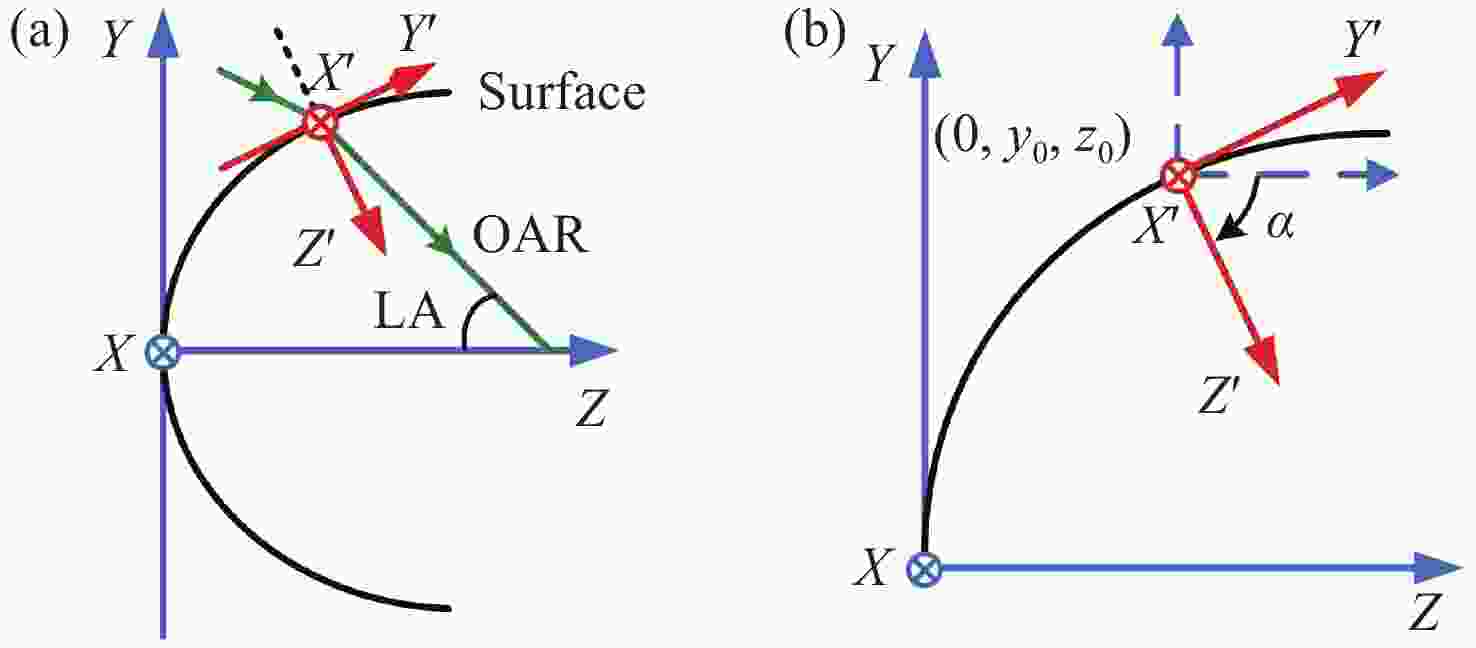
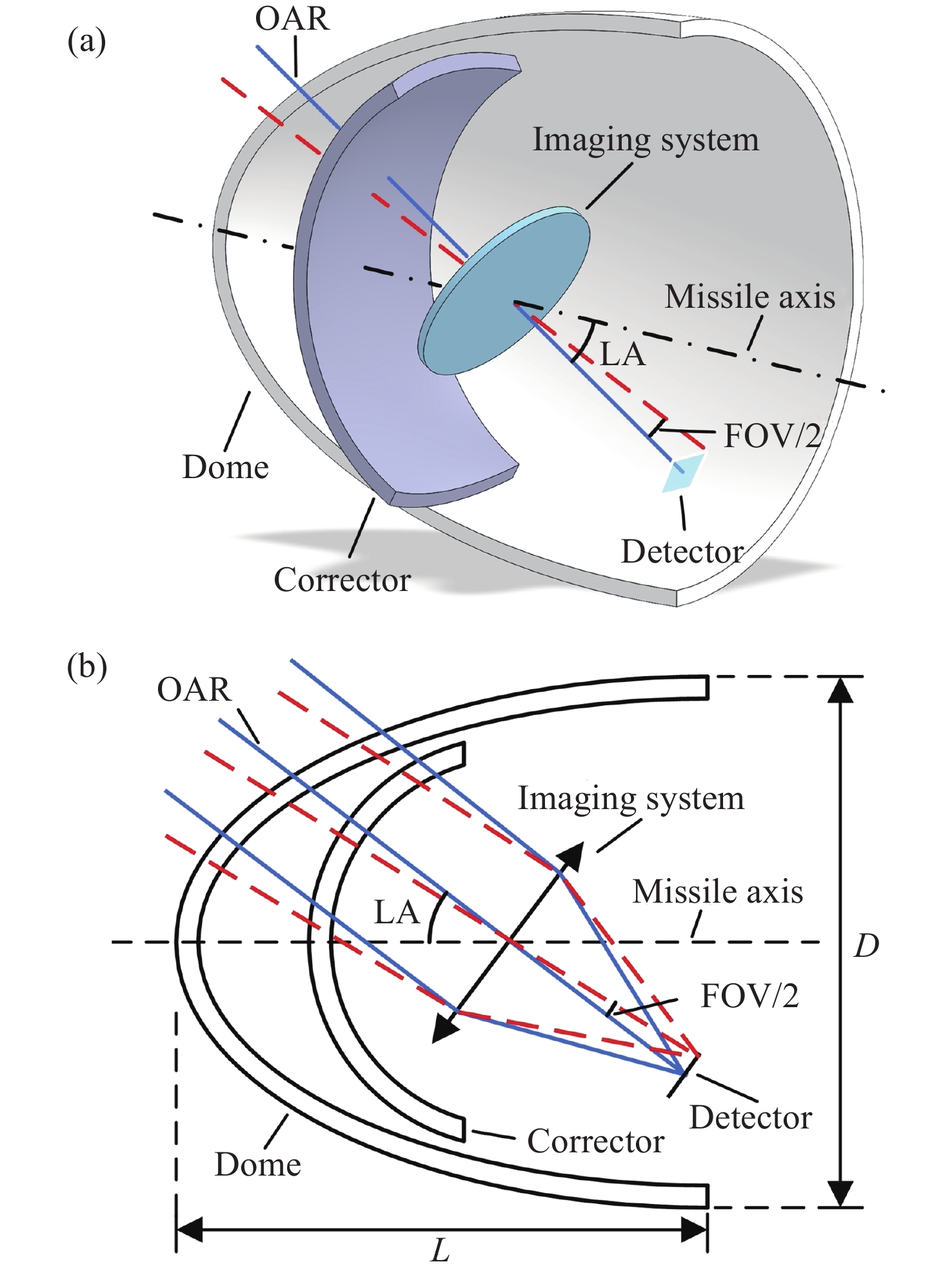
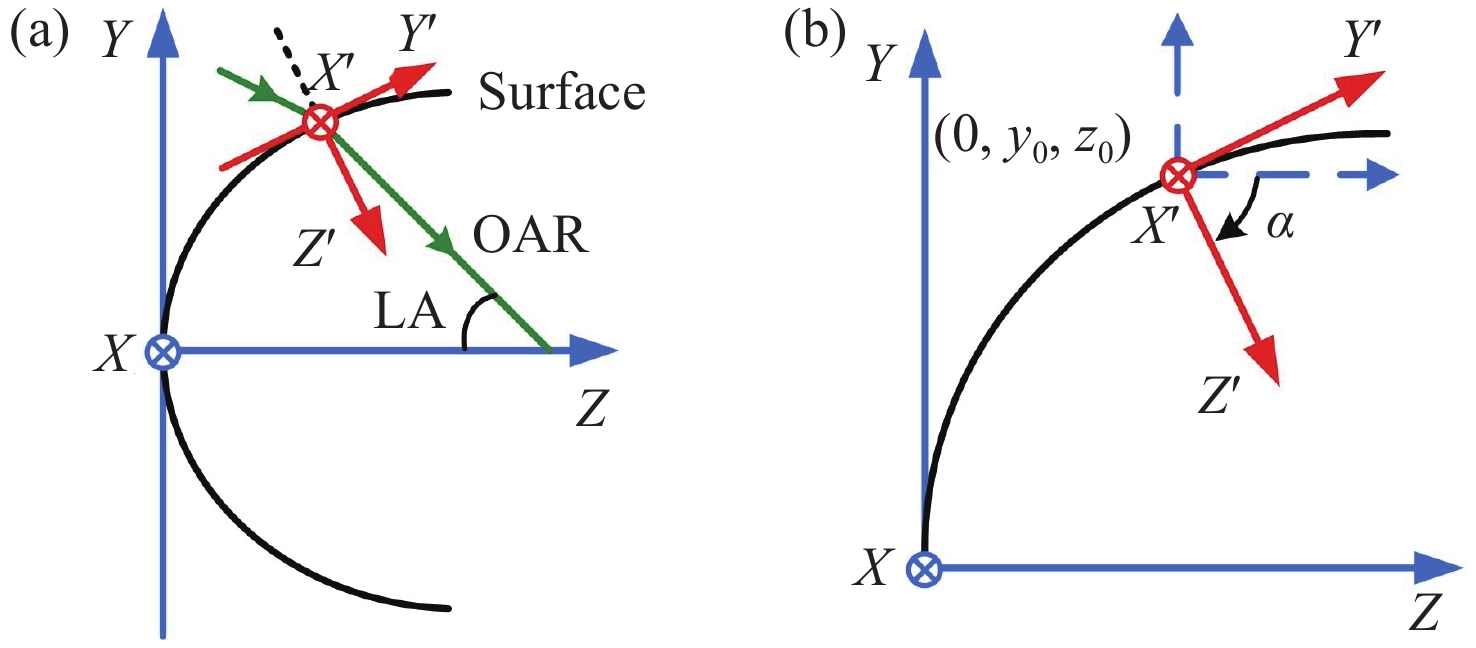
Figure 1. Global coordinate system (XYZ) and local coordinate system (X’Y’Z’). (a) Overall view. (b) Enlarged view
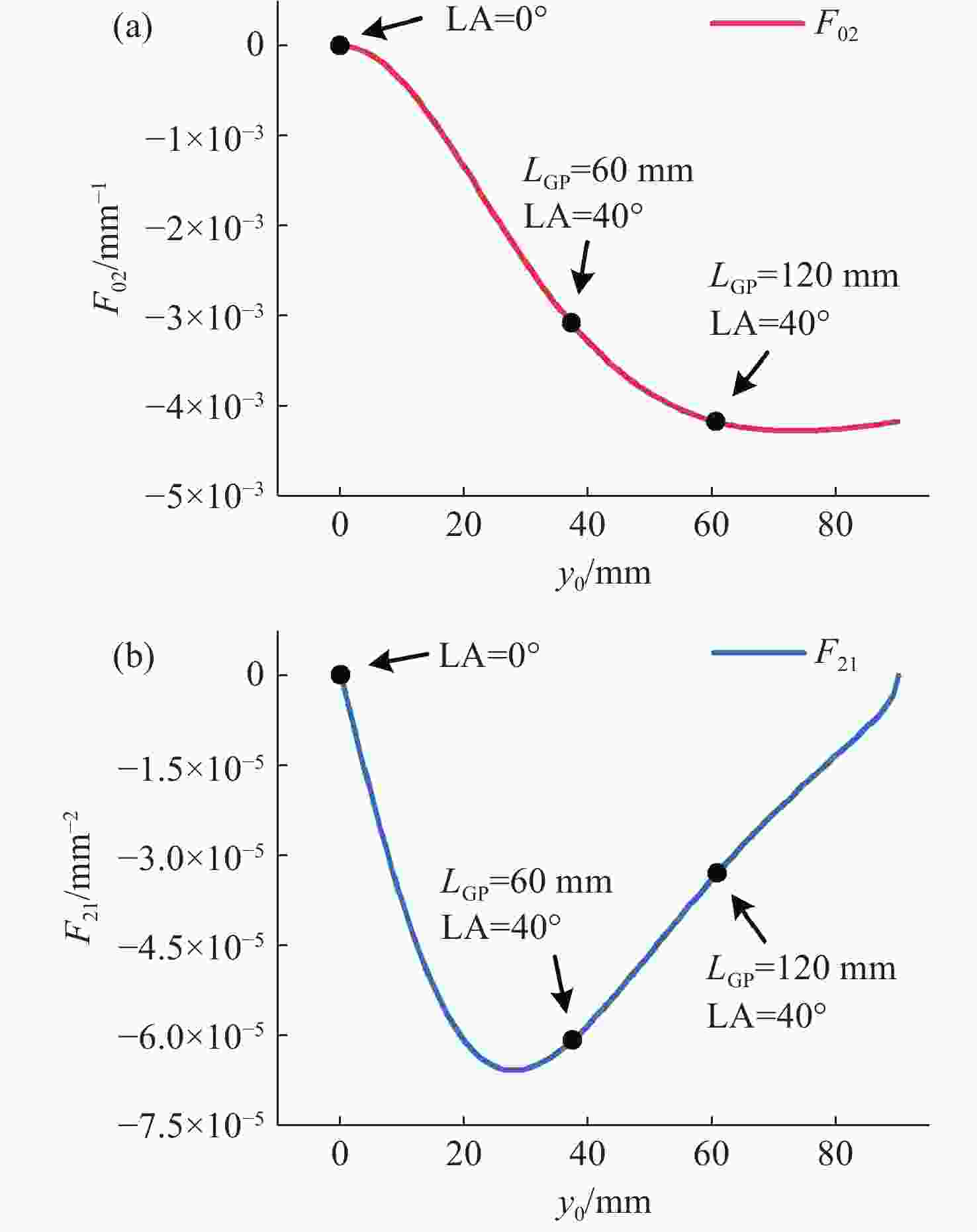
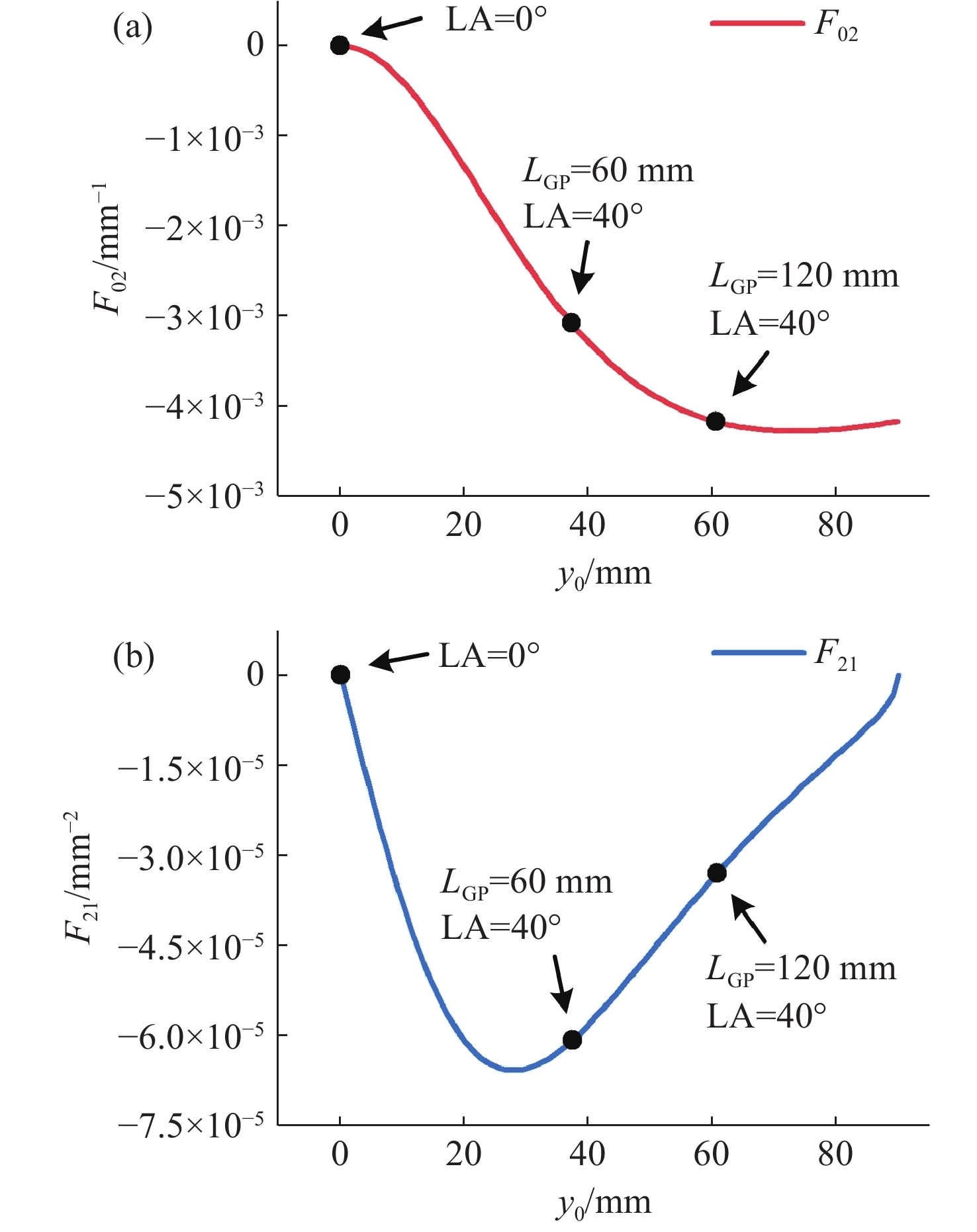
Figure 4. Local surface parameters of the dome’s outer surface. (a) Freeform parameter
$ {F}_{02} $ . (b) Freeform parameter$ {F}_{21} $ 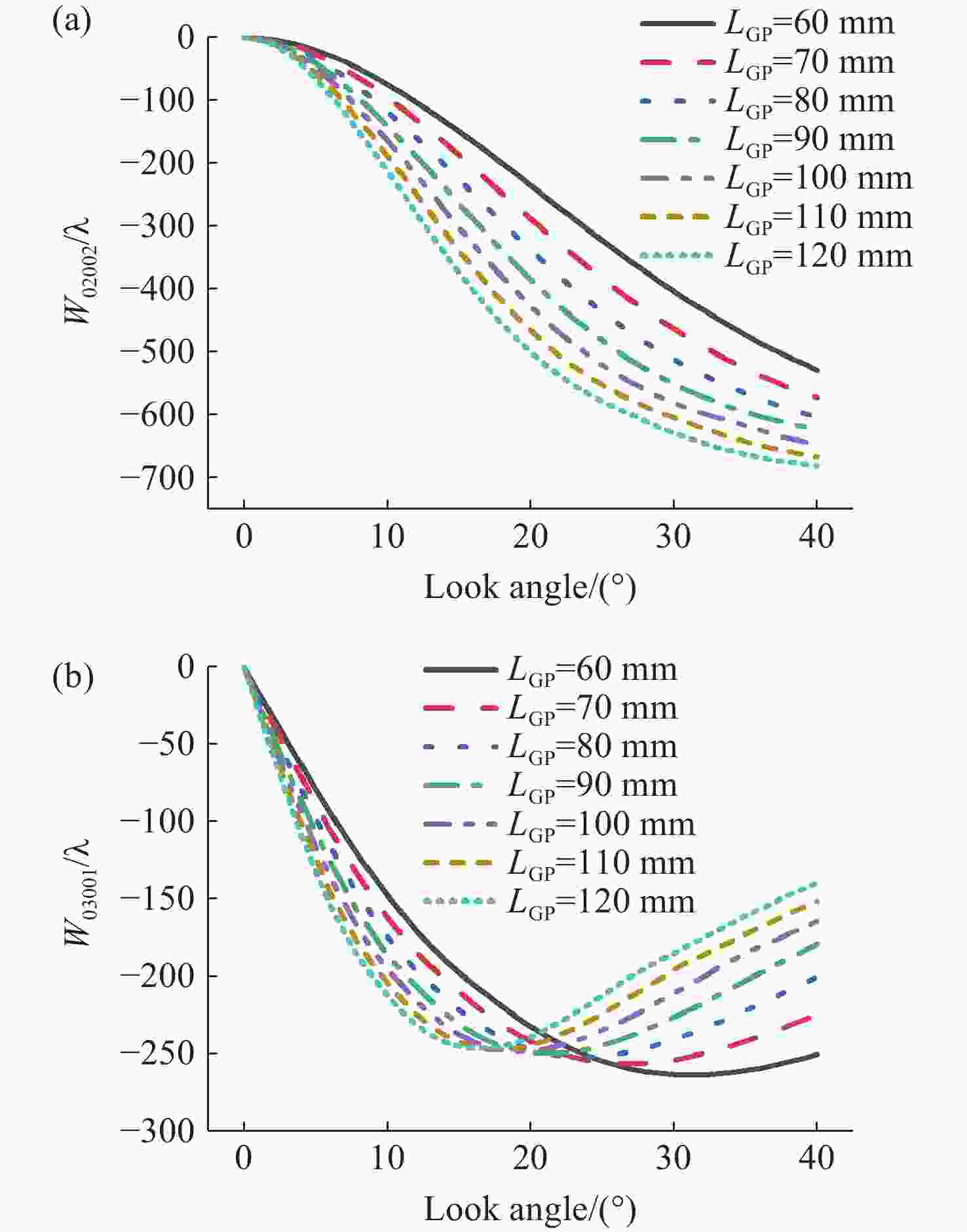
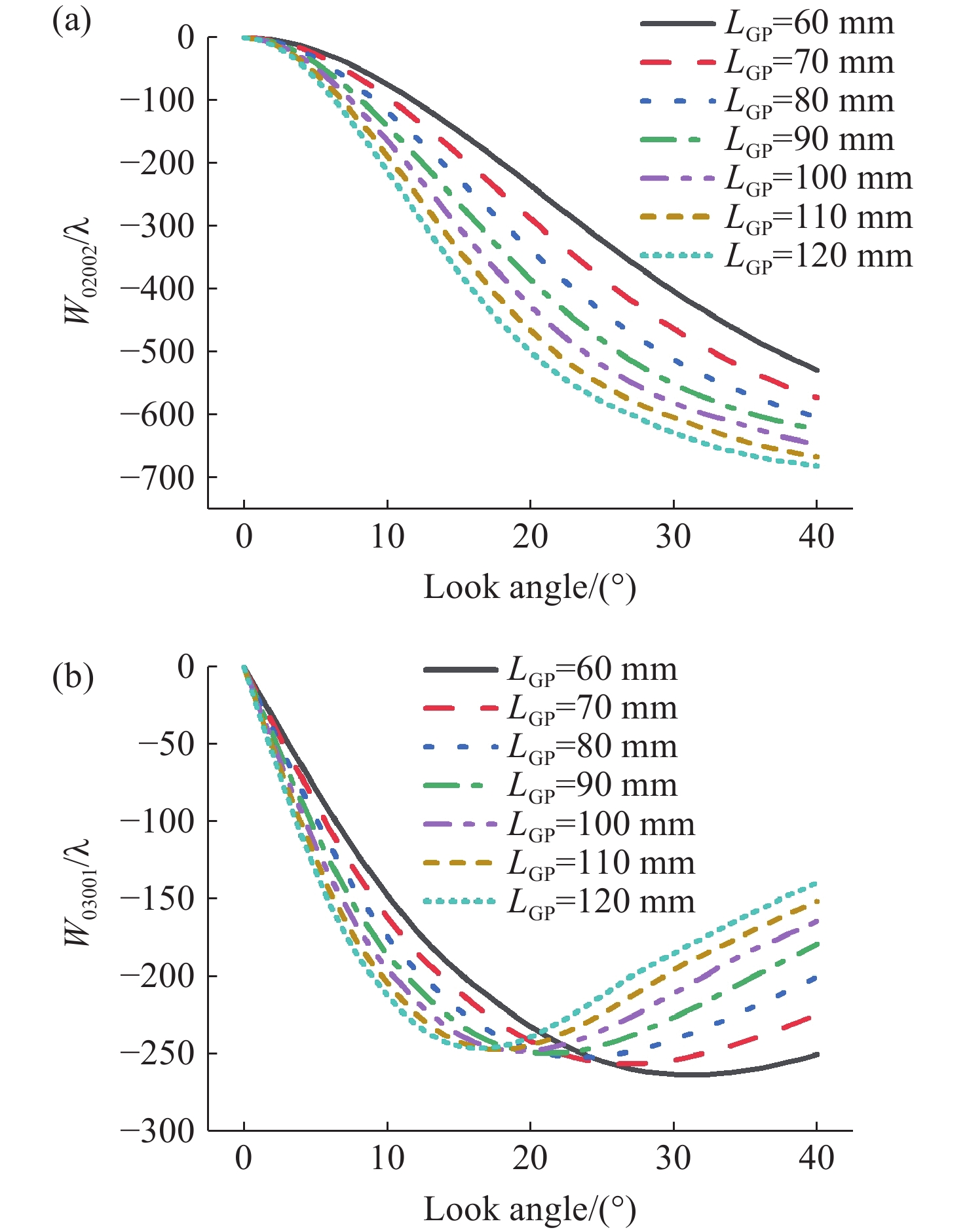
Figure 6. Variation of aberration surface contribution with gimbal position. (a)
$ {W}_{02002} $ . (b)$ {W}_{03001} $ 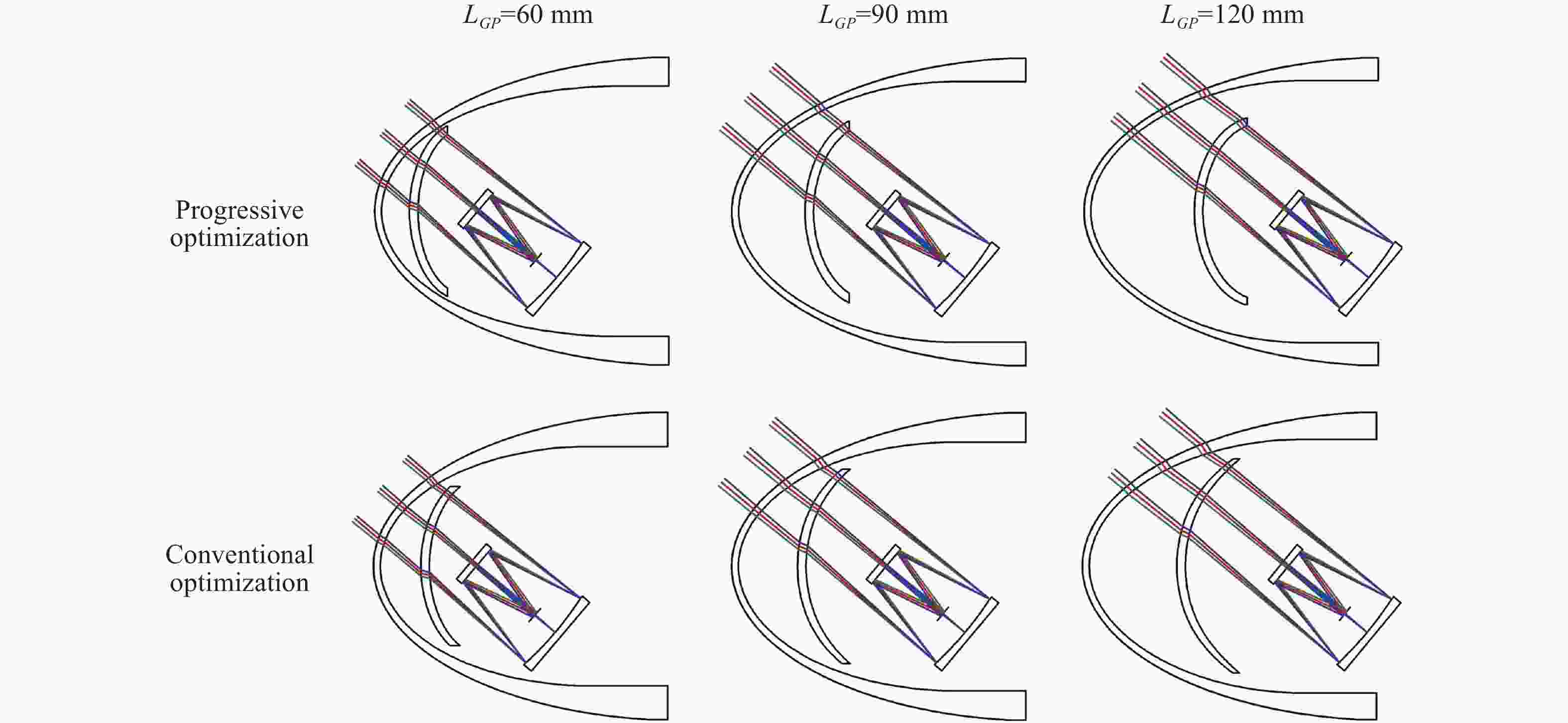
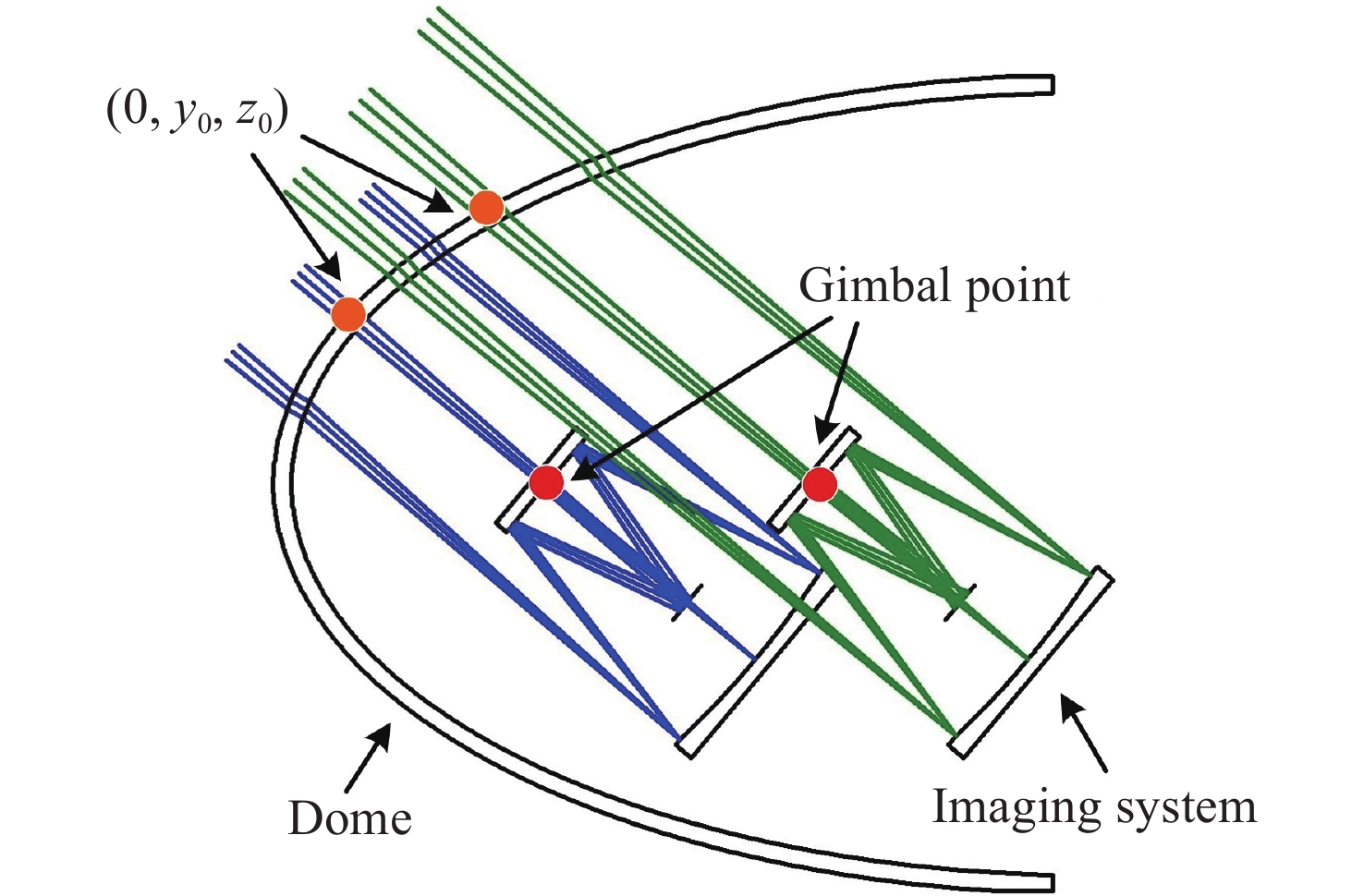
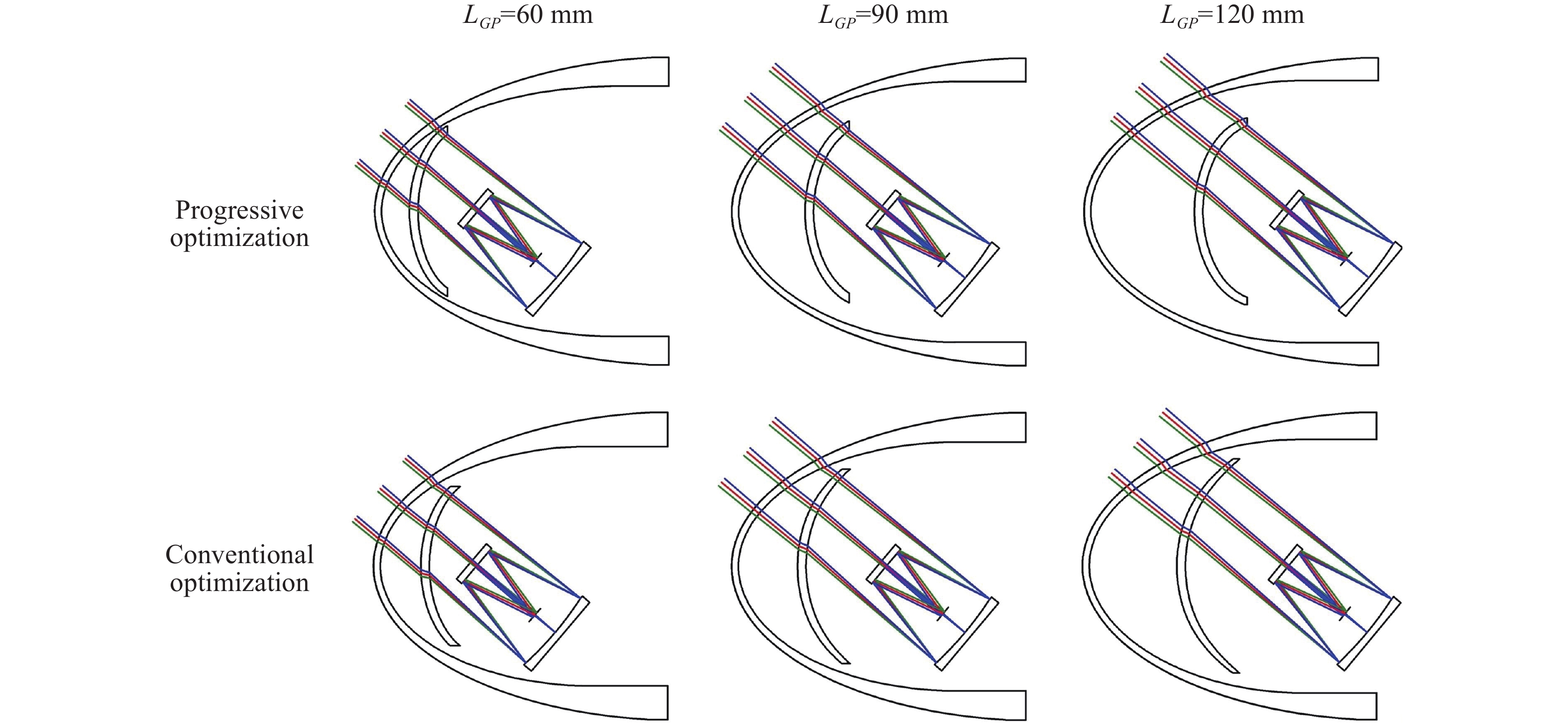
Figure 7. Conformal system layout obtained by two optimization methods at different gimbal positions
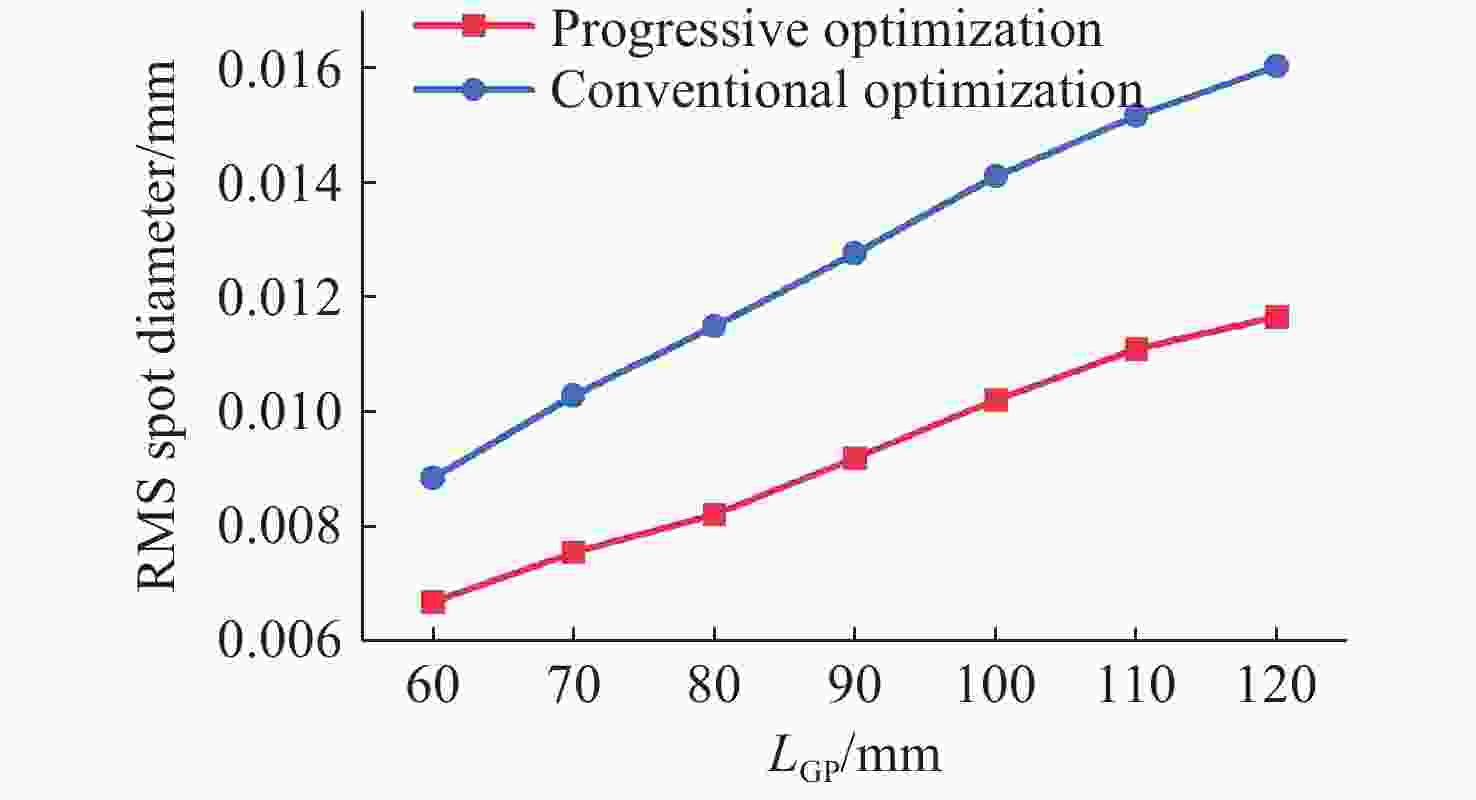
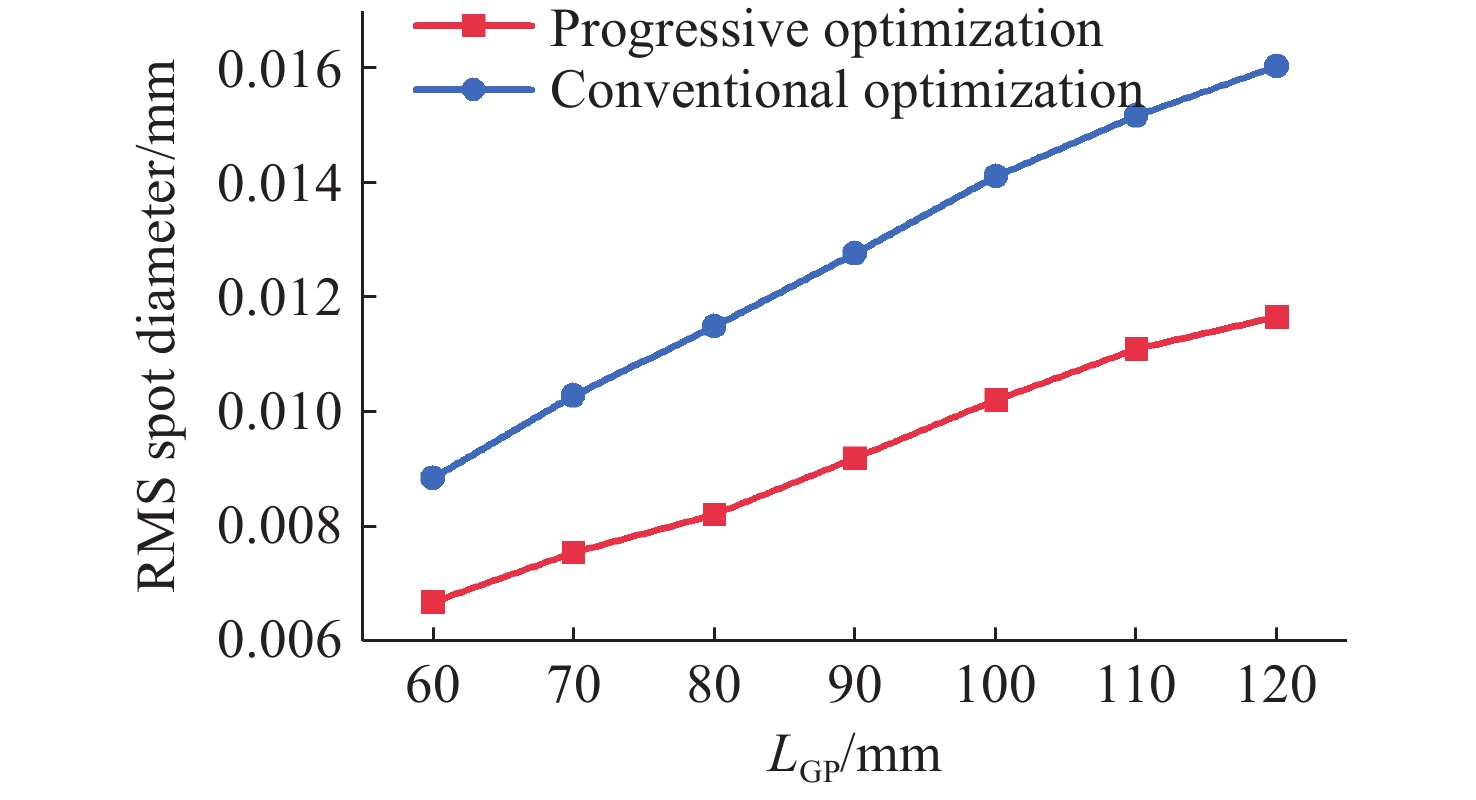
Figure 8. Average RMS spot diameter of the conformal systems obtained by two optimization methods at different LGP
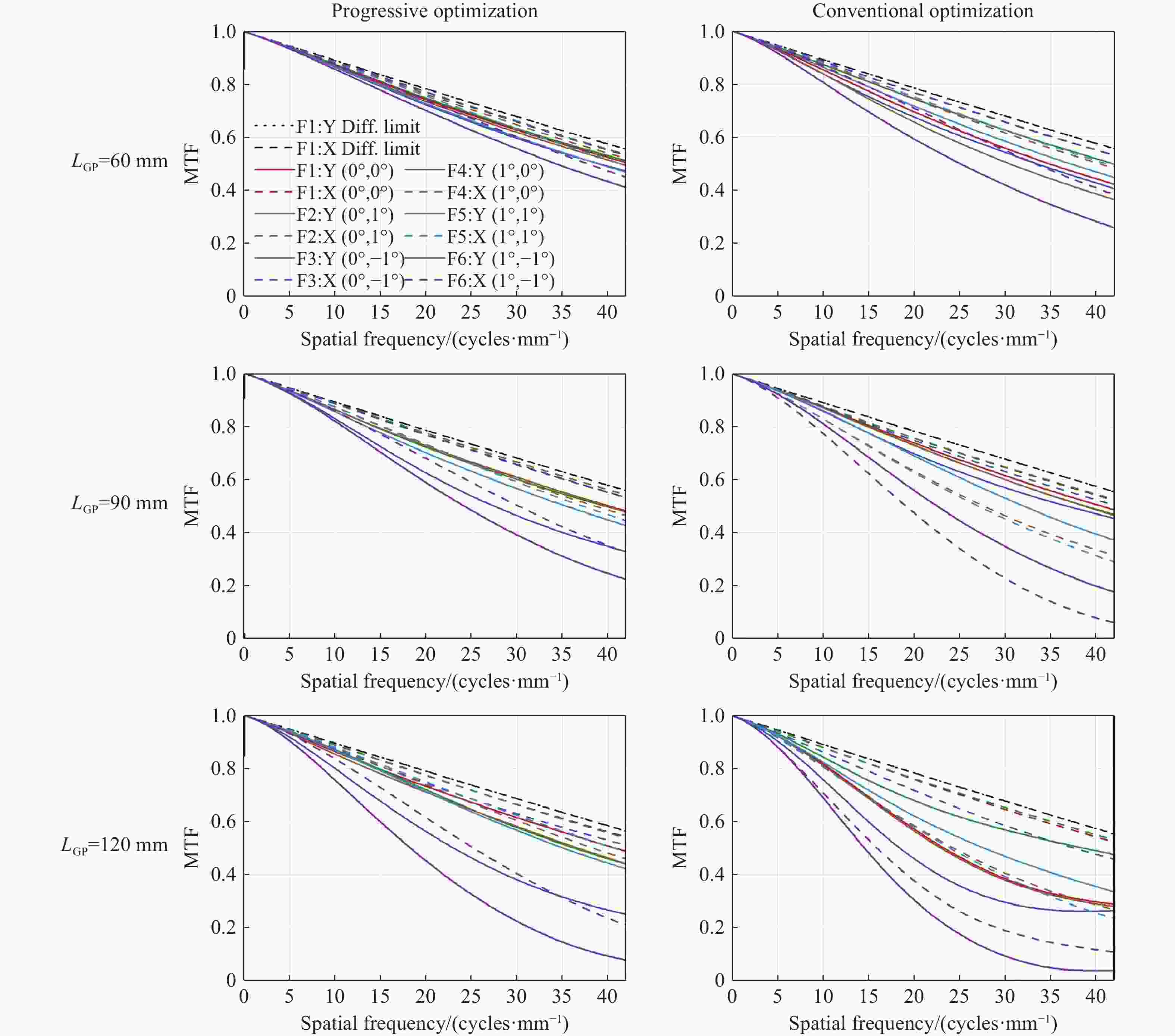
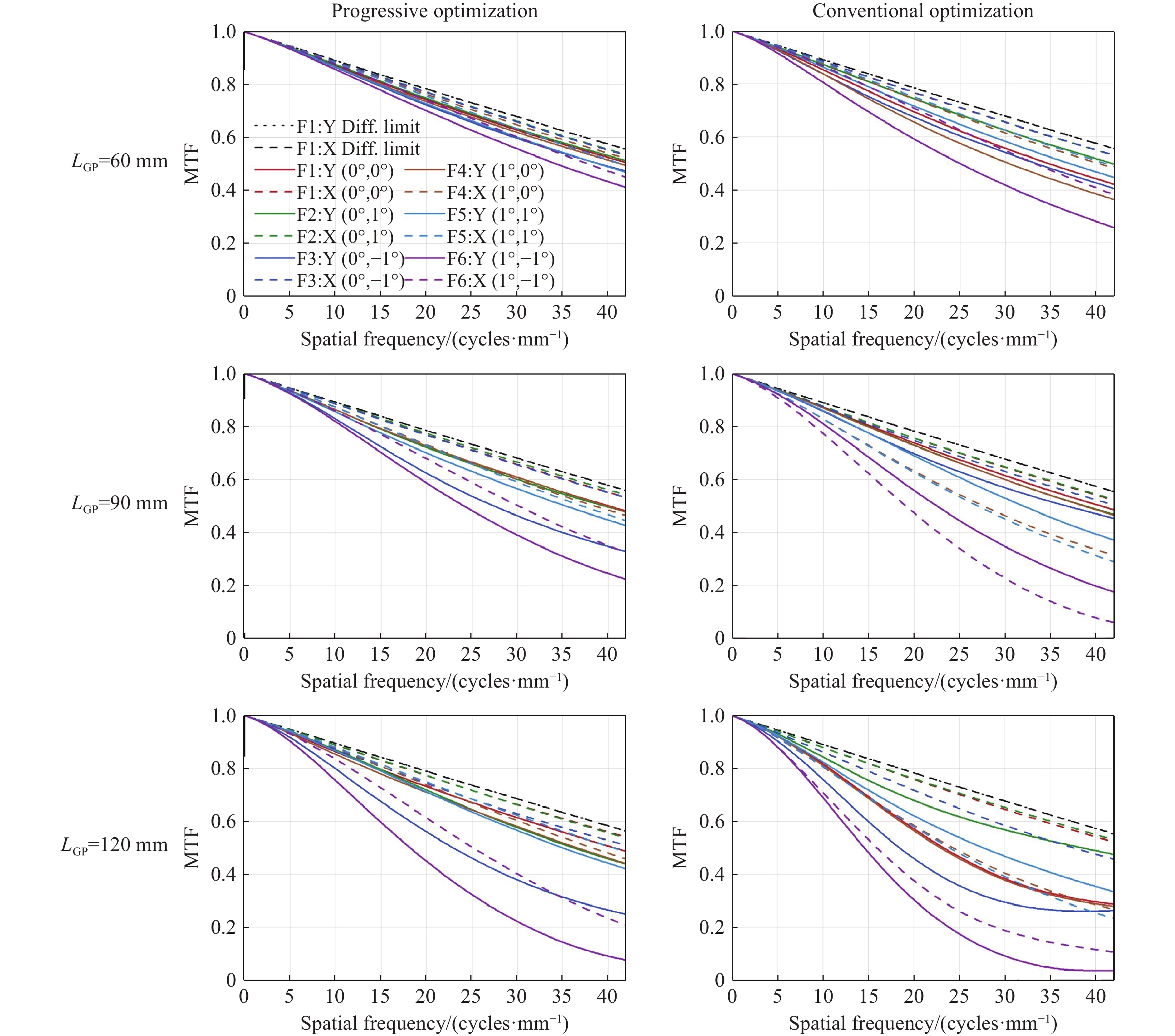
Figure 9. MTF of the conformal systems obtained by two optimization methods at different LGP when look angle is 40°
Table 1. Aberration terms in plane-symmetric systems
Group Vector form Name First group $ {W}_{00000} $ Constant piston Second group $ {W}_{01001}\left(\boldsymbol{i}\cdot \boldsymbol{\rho }\right) $ Field displacement $ {W}_{10010}\left(\boldsymbol{i}\cdot \boldsymbol{H}\right) $ Linear piston $ {W}_{02000}\left(\boldsymbol{\rho }\cdot \boldsymbol{\rho }\right) $ Defocus $ {W}_{11100}\left(\boldsymbol{H}\cdot \boldsymbol{\rho }\right) $ Magnification $ {W}_{20000}\left(\boldsymbol{H}\cdot \boldsymbol{H}\right) $ Quadratic piston Third group $ {W}_{02002}{\left(\boldsymbol{i}\cdot \boldsymbol{\rho }\right)}^{2} $ Constant astigmatism $ {W}_{11011}\left(\boldsymbol{i}\cdot \boldsymbol{H}\right)\left(\boldsymbol{i}\cdot \boldsymbol{\rho }\right) $ Anamorphism $ {W}_{20020}{\left(\boldsymbol{i}\cdot \boldsymbol{H}\right)}^{2} $ Quadratic piston $ {W}_{03001}\left(\boldsymbol{i}\cdot \boldsymbol{\rho }\right)\left(\boldsymbol{\rho }\cdot \boldsymbol{\rho }\right) $ Constant coma $ {W}_{12101}\left(\boldsymbol{i}\cdot \boldsymbol{\rho }\right)\left(\boldsymbol{H}\cdot \boldsymbol{\rho }\right) $ Linear astigmatism $ {W}_{12010}\left(\boldsymbol{i}\cdot \boldsymbol{H}\right)\left(\boldsymbol{\rho }\cdot \boldsymbol{\rho }\right) $ Field tilt $ {W}_{21001}\left(\boldsymbol{i}\cdot \boldsymbol{\rho }\right)\left(\boldsymbol{H}\cdot \boldsymbol{H}\right) $ Quadratic distortion I $ {W}_{21110}\left(\boldsymbol{i}\cdot \boldsymbol{H}\right)\left(\boldsymbol{H}\cdot \boldsymbol{\rho }\right) $ Quadratic distortion II $ {W}_{30010}\left(\boldsymbol{i}\cdot \boldsymbol{H}\right)\left(\boldsymbol{H}\cdot \boldsymbol{H}\right) $ Cubic piston $ {W}_{04000}{\left(\boldsymbol{\rho }\cdot \boldsymbol{\rho }\right)}^{2} $ Spherical aberration $ {W}_{13100}\left(\boldsymbol{H}\cdot \boldsymbol{\rho }\right)\left(\boldsymbol{\rho }\cdot \boldsymbol{\rho }\right) $ Linear coma $ {W}_{22200}{\left(\boldsymbol{H}\cdot \boldsymbol{\rho }\right)}^{2} $ Quadratic astigmatism $ {W}_{22000}\left(\boldsymbol{H}\cdot \boldsymbol{H}\right)\left(\boldsymbol{\rho }\cdot \boldsymbol{\rho }\right) $ Field curvature $ {W}_{31100}\left(\boldsymbol{H}\cdot \boldsymbol{H}\right)\left(\boldsymbol{H}\cdot \boldsymbol{\rho }\right) $ Cubic distortion $ {W}_{40000}{\left(\boldsymbol{H}\cdot \boldsymbol{H}\right)}^{2} $ Quartic piston  下载: 导出CSV
Table 2. Specifications of the system
Parameter Specification Material of dome ZnS Fineness ratio (L/D) 1 Diameter of dome (D) 180 mm Shape of dome Ellipsoid Thickness of dome 4 mm Wavelength 3.7–4.8 μm Field of regard (FOR) ±40° Field of view (FOV) 2°×2° Entrance pupil diameter 45 mm F-number 2 Pixel size 1.2 μm
下载: 导出CSV
-
[1] LIU Y M, MA J, MA H P, et al. Zernike aberration characteristics of precision conformal optical windows[J]. Proceedings of SPIE, 2010, 7544: 75443W. [2] SHI Y T, ZHANG W, CHEN SH Q, et al. Research of aberration characteristics of conicoidal conformal optical domes[J]. Optik, 2015, 126(23): 3582-3588. [3] DANG F Y, ZHANG W, CHEN SH Q, et al. Basic geometry and aberration characteristics of conicoidal conformal domes[J]. Applied Optics, 2016, 55(31): 8713-8721. [4] JU L, LIU Y L, MING Y, et al. Aberration characteristic correlation configuration optimization of a conformal dome based on the von Karman surface[J]. Optics Express, 2021, 29(17): 27350-27361. [5] JU L, ZHANG Y Q, MING Y, et al. Geometric characteristics and aberration characteristics of conformal dome based on von Karman surface[J]. Optics Communications, 2022, 507: 127472. [6] FAN W W, ZHANG W ZH, FAN ZH G. Research on aberration correction methods of conformal dome based on haack curve[J]. Optics Communications, 2024, 565: 130676. [7] YEŞILTEPE M, BAUER A, KARCI Ö, et al. Sigma vector calculations in nodal aberration theory and experimental validation using a Cassegrain telescope[J]. Optics Express, 2023, 31(25): 42373-42387. [8] WAN K, GU ZH Y, YAN CH X. An analytic expression for the field dependence of three-order Zernike aberrations in decentered and/or tilted optical systems[J]. Optics Communications, 2024, 565: 130696. [9] ZHANG SH, ZHAO X, LI D. Iterative paraxial tracing-based model for solving the aberration field decenter vector in aberration analysis[J]. Optics Express, 2025, 33(17): 37046-37060. [10] JIANG Y SH, WANG L J, ZENG X F, et al. Aberration field distribution characterization and tolerance analysis based on nodal aberration theory[J]. Optics Express, 2025, 33(23): 49313-49328. [11] BARION A, ANTHONISSEN M J H, TEN THIJE BOONKKAMP J H M, et al. Computing aberration coefficients for plane-symmetric reflective systems: a Lie algebraic approach[J]. Journal of the Optical Society of America A, 2023, 40(6): 1215-1224. [12] LIU Y X, STEIDLE J, ROLLAND J P. Intrinsic aberration coefficients for plane-symmetric optical systems consisting of spherical surfaces[J]. Journal of the Optical Society of America A, 2023, 40(2): 378-387. [13] LIU Y X. Analytical aberration theory for plane-symmetric optical systems and its application in the analysis of distortion in freeform spectrometers[D]. New York: University of Rochester, 2024. [14] LIU Y X, ROLLAND J P. Analytical aberration theory for plane-symmetric optical systems and its application in distortion analysis of spectrometers[J]. Journal of the Optical Society of America A, 2025, 42(3): 362-377. [15] ZHANG SH, ZHAO X, LI D, et al. High-precision analysis of aberration contribution of Zernike freeform surface terms for non-zero field of view[J]. Optics Express, 2024, 32(3): 3167-3183. [16] ZHANG J P, SHI G W, HUANG Y Q, et al. Optimization of optical system for reducing tolerance sensitivity based on the high-order nodal aberration theory[J]. Optics Express, 2024, 32(8): 14334-14355. [17] CAO Y Q. Design method of soft X-ray and vacuum ultraviolet optical system based on plane-symmetric aberration theory[J]. Optical Review, 2022, 29(3): 207-214. [18] FAN W W, ZHANG W ZH, FAN ZH G. Research on the design method of arch corrector based on Haack conformal dome[J]. Physics Letters A, 2025, 531: 130173. [19] JU Y, ZHAO C ZH, PIAO M X, et al. Dynamic aberration correction for conformal dome based on free-form lens array[J]. Acta Optica Sinica, 2021, 41(9): 0922002. (in Chinese). [20] PIAO M X, ZHANG B, WANG ZH, et al. Design of conformal optical system for aircrafts with large scanning field of view[J]. Flight Control & Detection, 2023, 6(2): 10-17. (in Chinese). [21] ZHANG Y Q, CHANG J, DANG F Y, et al. Dynamic aberrations correction of Roll-Nod conformal seeker based on the diffraction surface and anamorphic asphere surface[J]. Chinese Optics Letters, 2020, 18(7): 072201. [22] JU L, LIU B, FAN ZH G, et al. Adaptive optimization technology of a conformal infrared dome based on the Von Karman surface under hypersonic conditions[J]. Optics Express, 2023, 31(14): 22323-22342. [23] ZHAO C H, CHEN X T, NIU B Q. Design a conformal optical system based on Fermat’s principle[J]. Optics Express, 2025, 33(10): 21274-21287. [24] YU J Q, CHEN SH Q, DANG F Y, et al. The dynamic aberrations suppression of conformal optical system by wavefront coding[J]. Optics Communications, 2020, 463: 125121. [25] YU J Q, CHEN SH Q, DANG F Y, et al. The suppression of aero-optical aberration of conformal dome by wavefront coding[J]. Optics Communications, 2021, 490: 126876. [26] ZHAO J B, WANG SH, ZHANG CH Y, et al. Research status and challenges in the manufacturing of IR conformal optics[J]. Defence Technology, 2024, 40: 154-172. [27] SASIÁN J M. How to approach the design of a bilateral symmetric optical system[J]. Optical Engineering, 1994, 33(6): 2045-2061. [28] KIDGER M J. Intermediate Optical Design[M]. Bellingham: SPIE Press, 2004: 45. [29] BAUER A, SCHIESSER E M, ROLLAND J P. Starting geometry creation and design method for freeform optics[J]. Nature Communications, 2018, 9(1): 1756. [30] STURLESI D, O’SHEA D C. Global view of optical design space[J]. Optical Engineering, 1991, 30(2): 207-218. -
-

 下载:
下载:





计量
- 文章访问数: 180
- HTML全文浏览量: 71
- PDF下载量: 36
- 被引次数: 0
