



Calculation of laser interferometric quantum noise optimal squeezing angle criterion for dynamic unequal-arm heterodyne interferometers
-
摘要:
空间引力波探测任务中,干涉仪臂长受轨道动力学影响而动态演化,传统等臂零差模型难以描述外差链路下量子噪声的传递特性。针对空间引力波探测中动态不等臂外差干涉仪导致的激光口噪声与暗口涨落发生非零耦合问题,本文推导了空间引力波探测全频段量子噪声演化模型并得到了最优压缩角自适应调控判据。从含时场算符出发,利用傅里叶变换将时域因果延迟转化为频域相位旋转,导出了频域噪声混合矩阵;结合光力耦合系数描述低频辐射压噪声,推导出了空间引力波探测全频段通用最优压缩角判据。数值仿真表明,在静态相位差达到最大时,传统固定压缩角方案无法抑制混叠噪声,其归一化方差为1.0;本文提出的自适应压缩角方案具有明显的降噪效果,在压缩度
r = 0.5(4.3 dB)和r = 1.0(8.7 dB)时,可将归一化输出相位噪声方差分别压低至0.9046 和0.7483 。利用此判据动态调整压缩方向,可在空间引力波探测全频段内提高量子噪声抑制水平,为空间引力波探测器在动态不等臂环境下的量子噪声抑制提供理论参考。Abstract:In space gravitational wave detection missions, interferometer arm lengths dynamically evolve under the influence of orbital dynamics, making it difficult for traditional equal-arm homodyne models to describe the propagation characteristics of quantum noise in heterodyne links. To address the non-zero coupling between laser-port noise and dark-port fluctuations caused by dynamic unequal-arm heterodyne interferometers in space gravitational wave detection, this paper derives a full-band quantum noise evolution model and obtains an adaptive control criterion for the optimal squeezing angle. Starting from time-dependent field operators, the frequency-domain noise mixing matrix is derived by using the Fourier transform to convert time-domain causal delays into frequency-domain phase rotations. Combined with the optomechanical coupling coefficient to describe low-frequency radiation pressure noise, a universal optimal squeezing angle criterion for the full frequency band of space gravitational wave detection is established. Numerical simulations demonstrate that when the static phase difference reaches its maximum, the traditional fixed squeezing angle scheme fails to suppress the mixed noise, with its normalized variance remaining at 1.0. In contrast, the proposed adaptive squeezing angle scheme exhibits a significant noise reduction effect; at squeezing parameters
r = 0.5 (4.3 dB) andr = 1.0 (8.7 dB), it successfully reduces the normalized output phase noise variance to0.9046 and0.7483 , respectively. Utilizing this criterion to dynamically adjust the squeezing direction can enhance the level of quantum noise suppression across the full frequency band of space gravitational wave detection, providing a theoretical reference for quantum noise mitigation in space gravitational wave detectors under dynamic unequal-arm environments. -
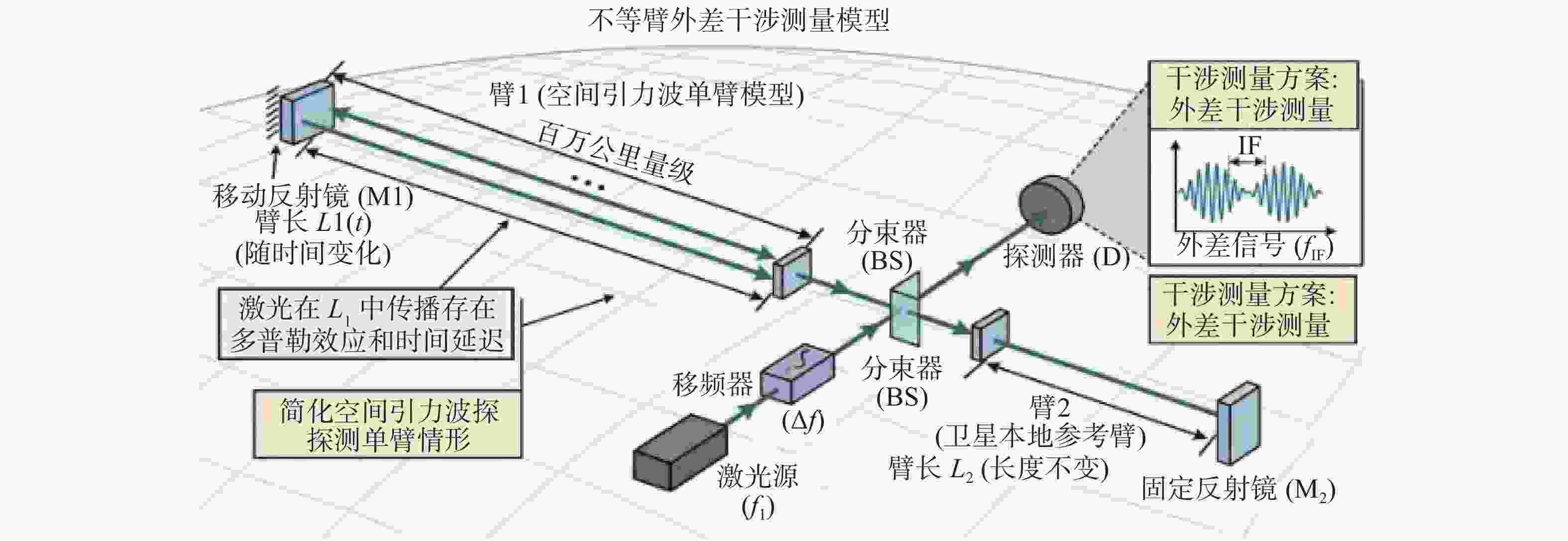
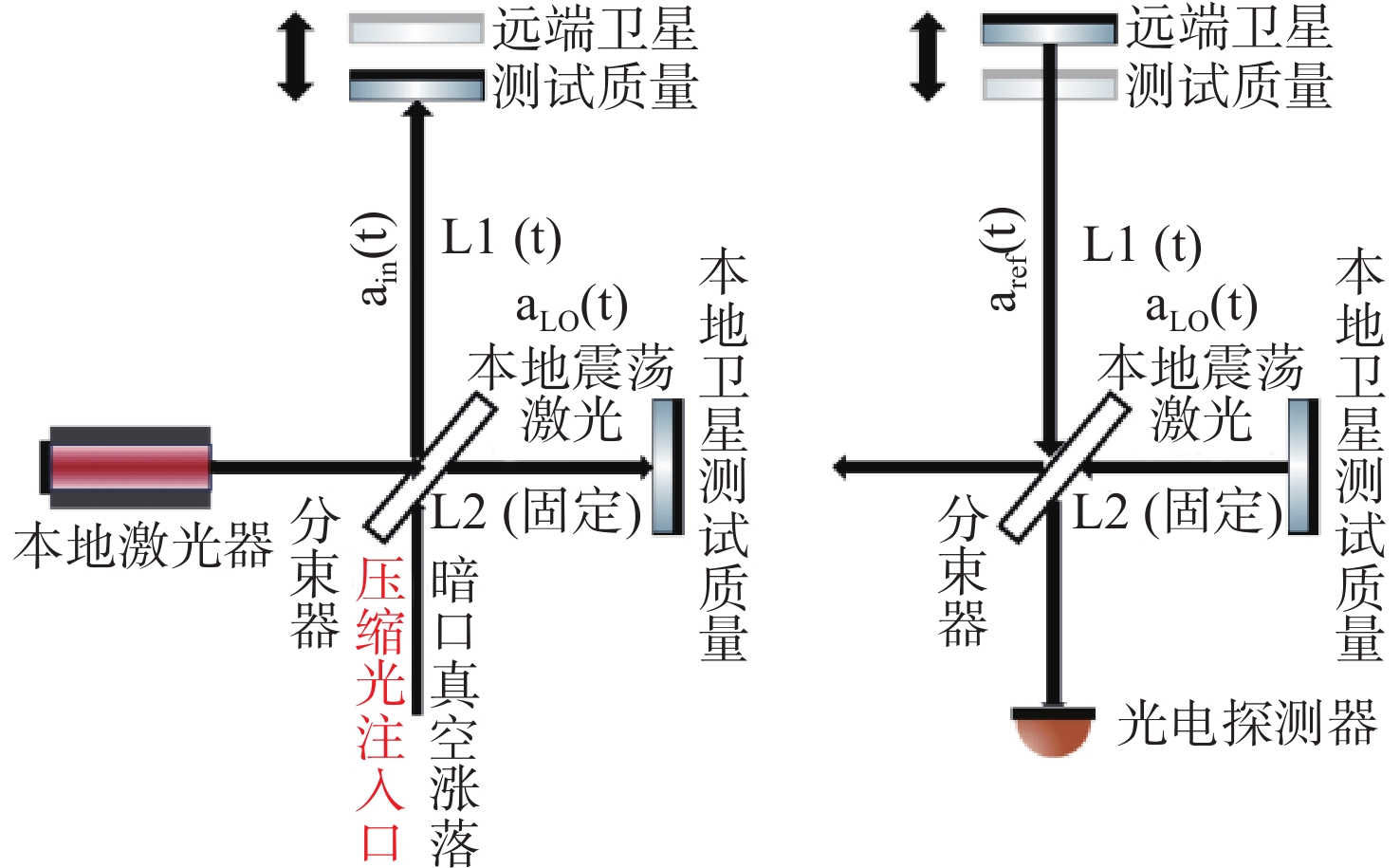
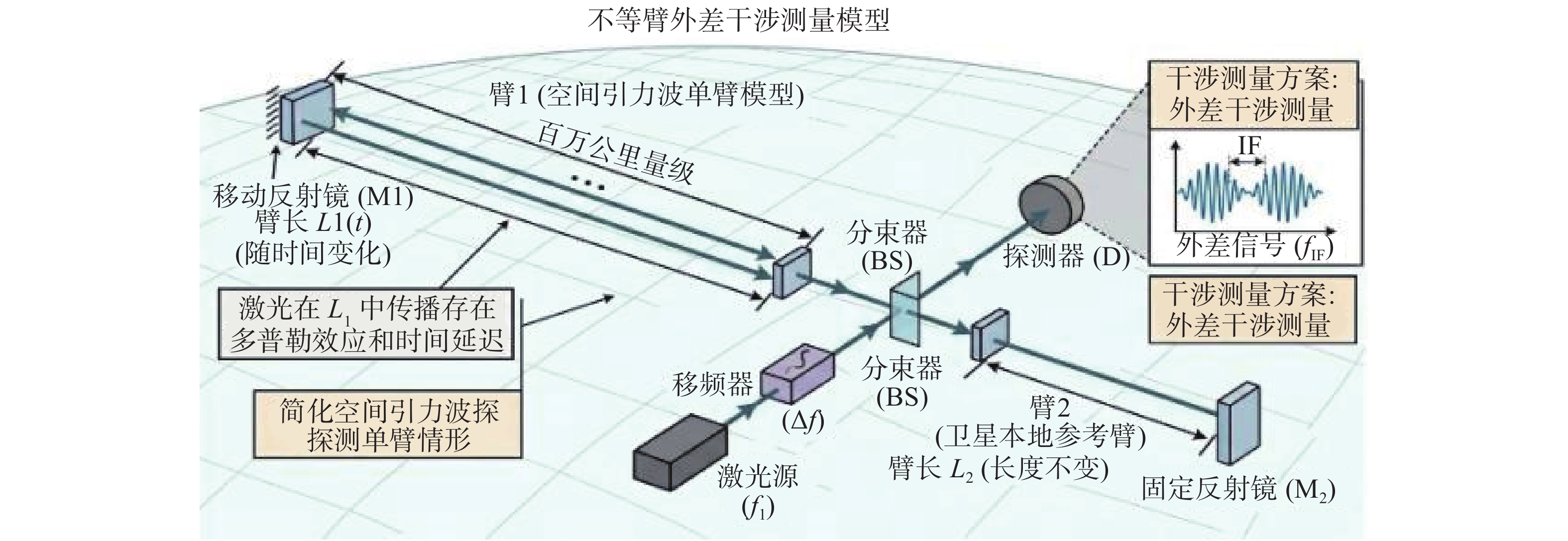
图 1 动态不等臂外差干涉测量示意图
Figure 1. Schematic of dynamic unequal-arm heterodyne interferometric measurement
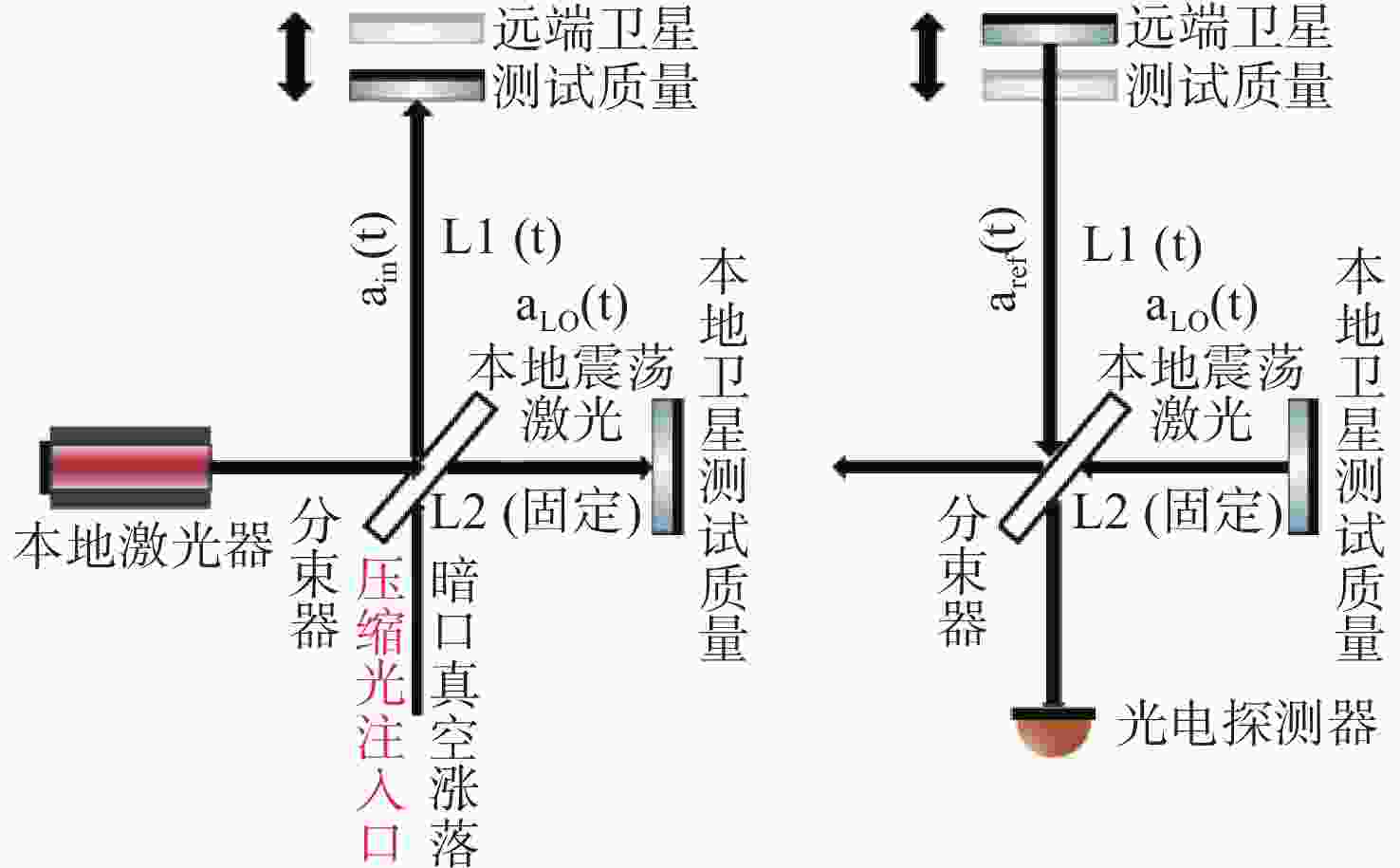
图 2 激光干涉分束与压缩态注入示意图
Figure 2. Schematic of laser beam splitting and squeezed state injection
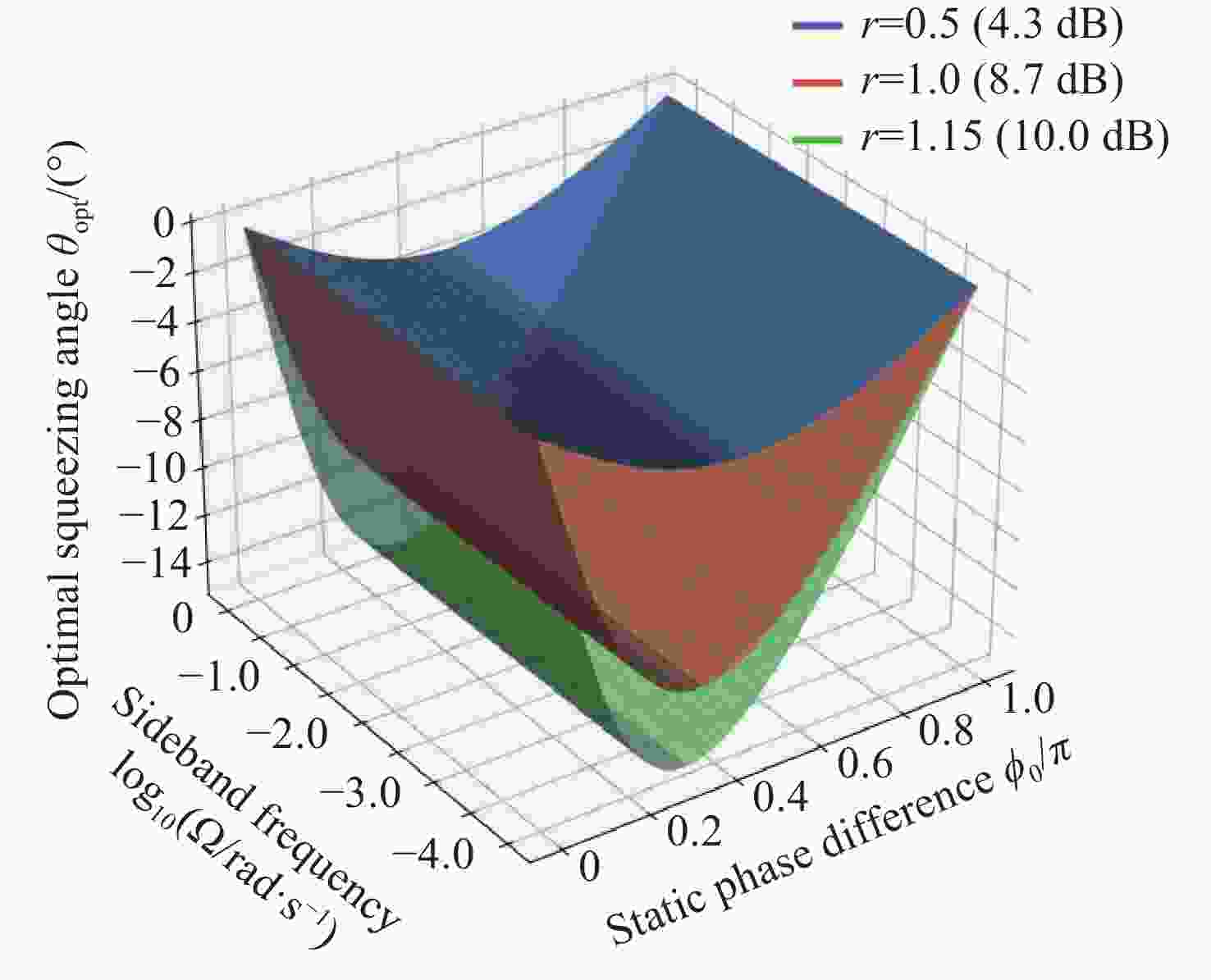
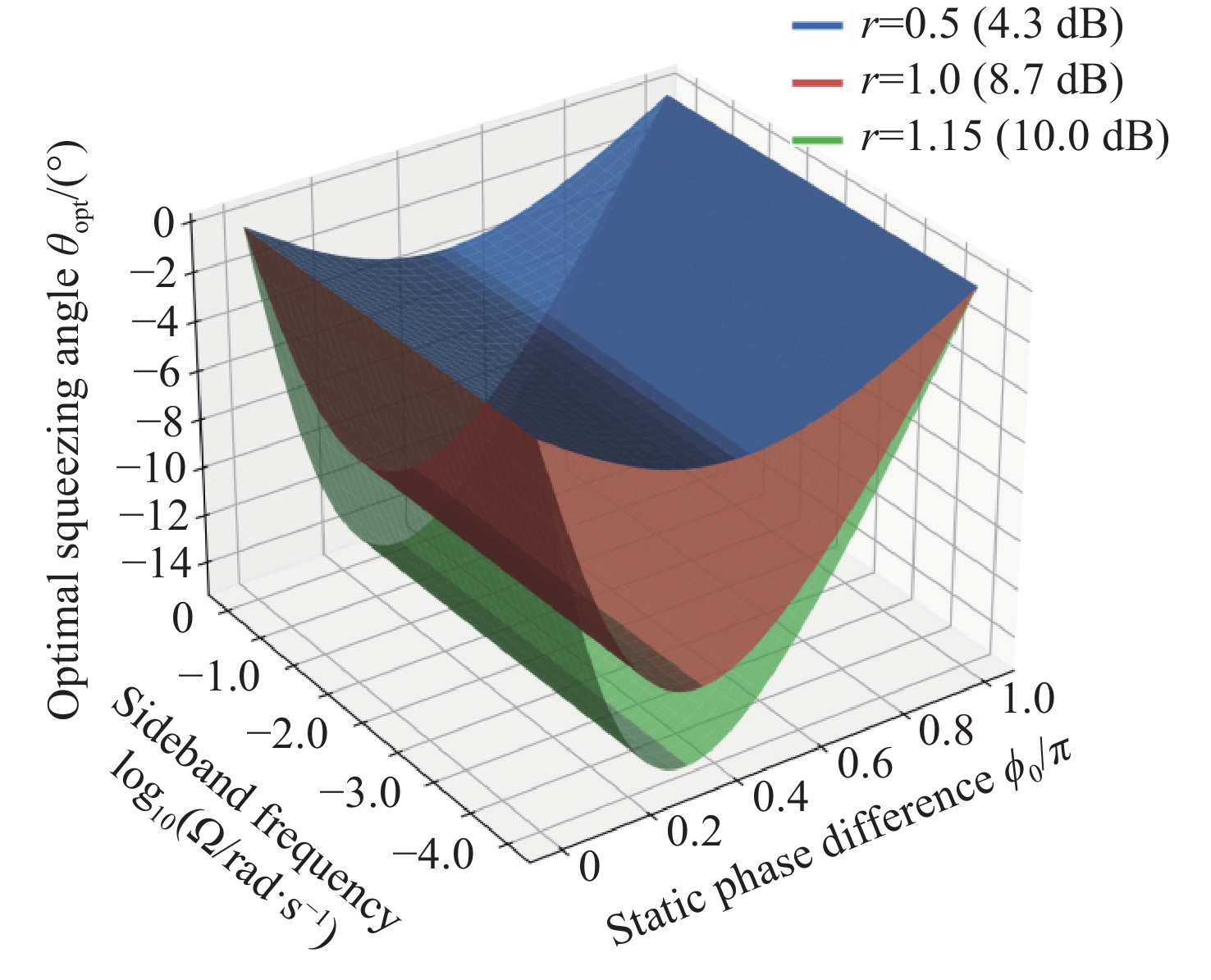
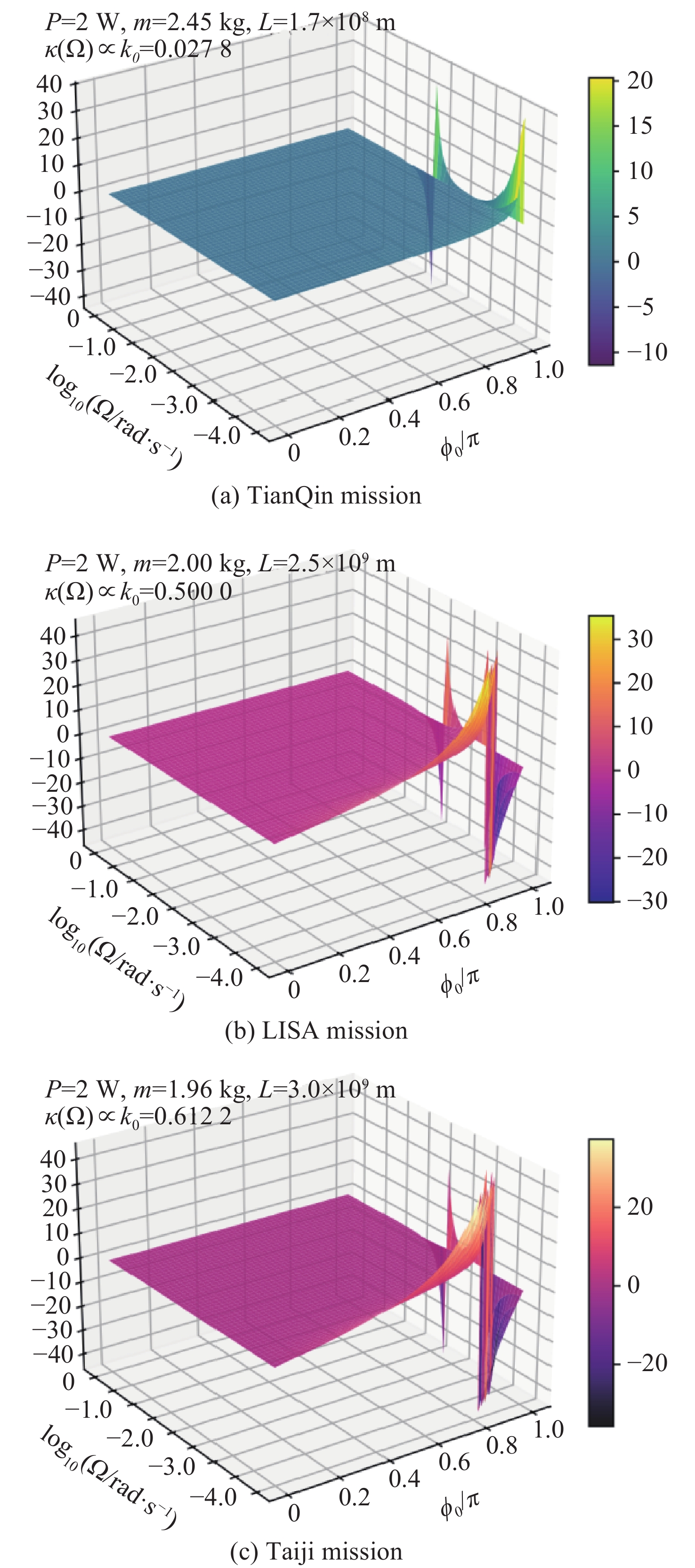
图 3 以LISA为例的最优压缩角
$ {\theta }_{opt} $ 随$ {\phi }_{0} $ 和$ \mathit{\Omega } $ 的变化曲面Figure 3. Evolution surface of optimal squeezing angle
$ {\theta }_{opt} $ versus$ {\phi }_{0} $ and$ \mathit{\Omega } $ with LISA as an example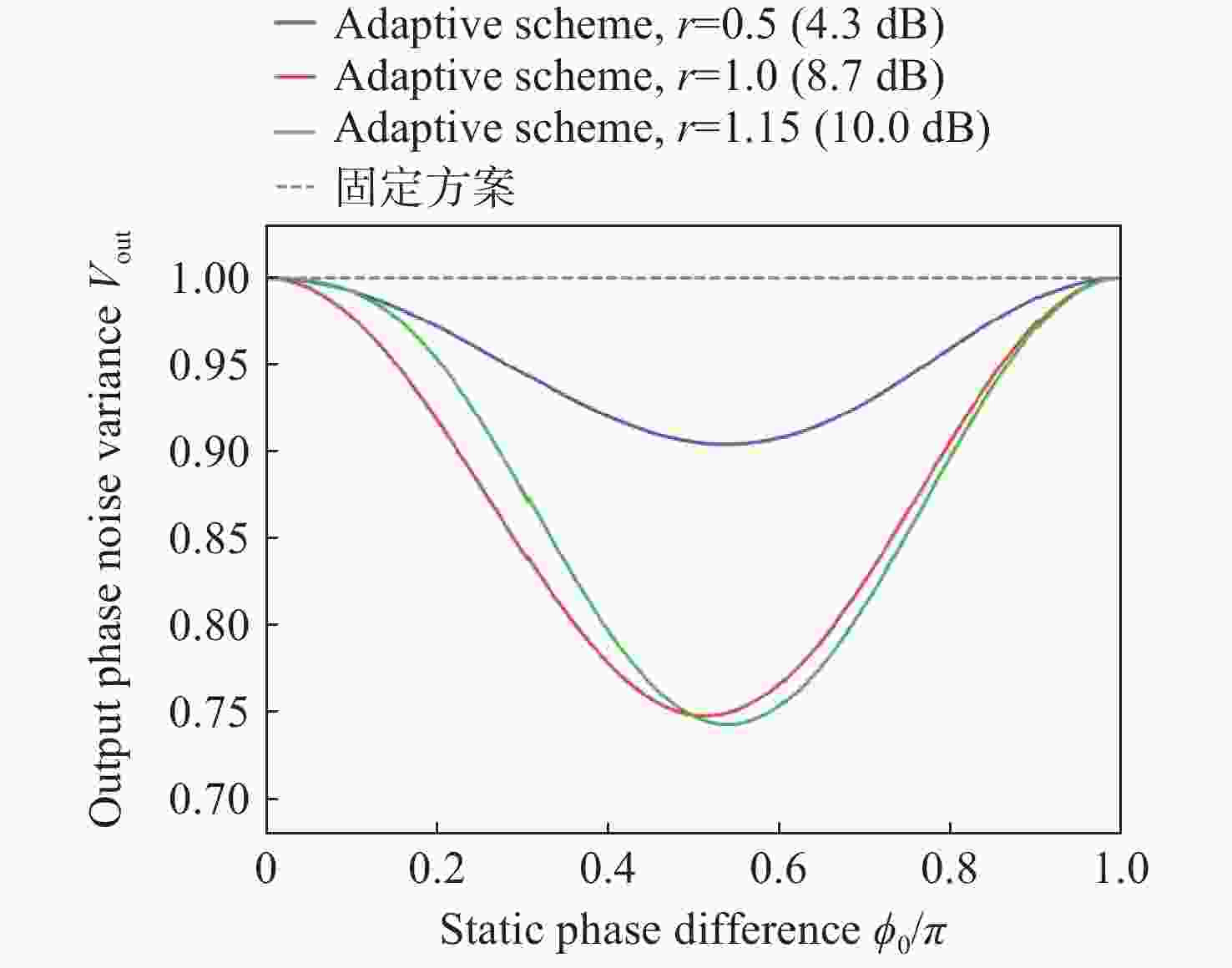
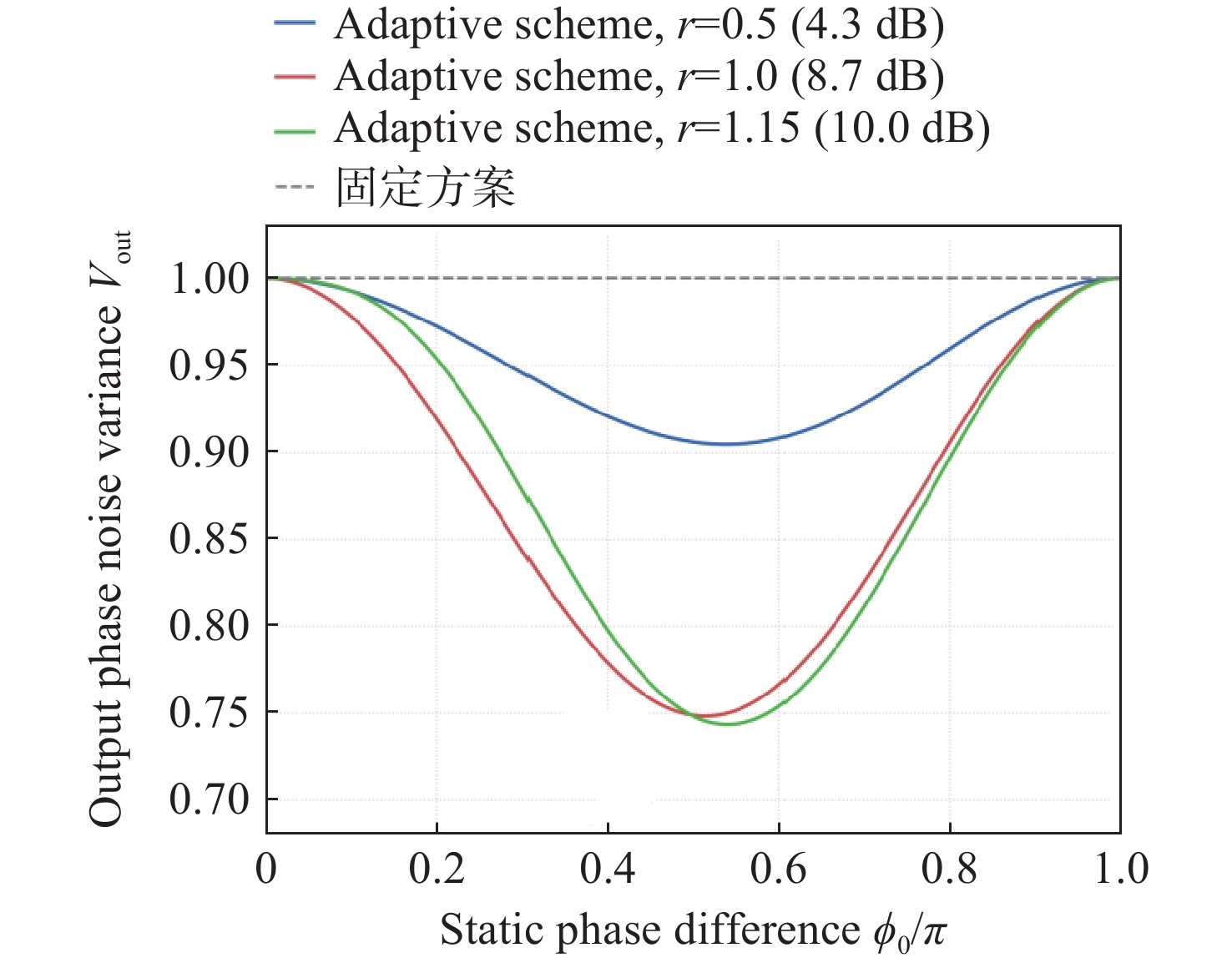
图 4 以LISA为例的固定方案与自适应方案噪声方差对比曲线 (
$ \mathit{\Omega }=1 $ Hz)Figure 4. Comparison of output phase noise variance between fixed and adaptive squeezing schemes with LISA as an example (
$ \mathit{\Omega }=1 $ Hz)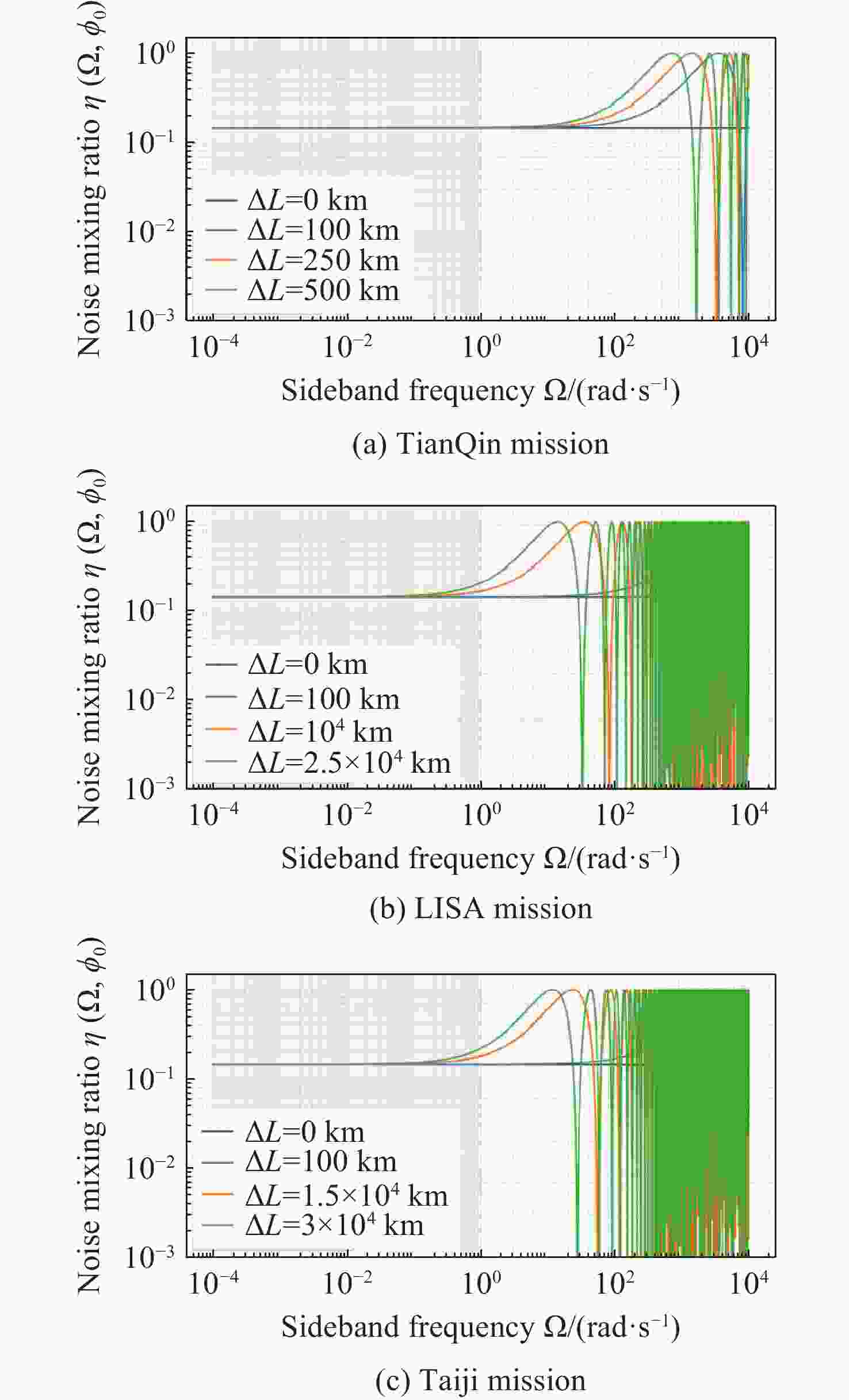
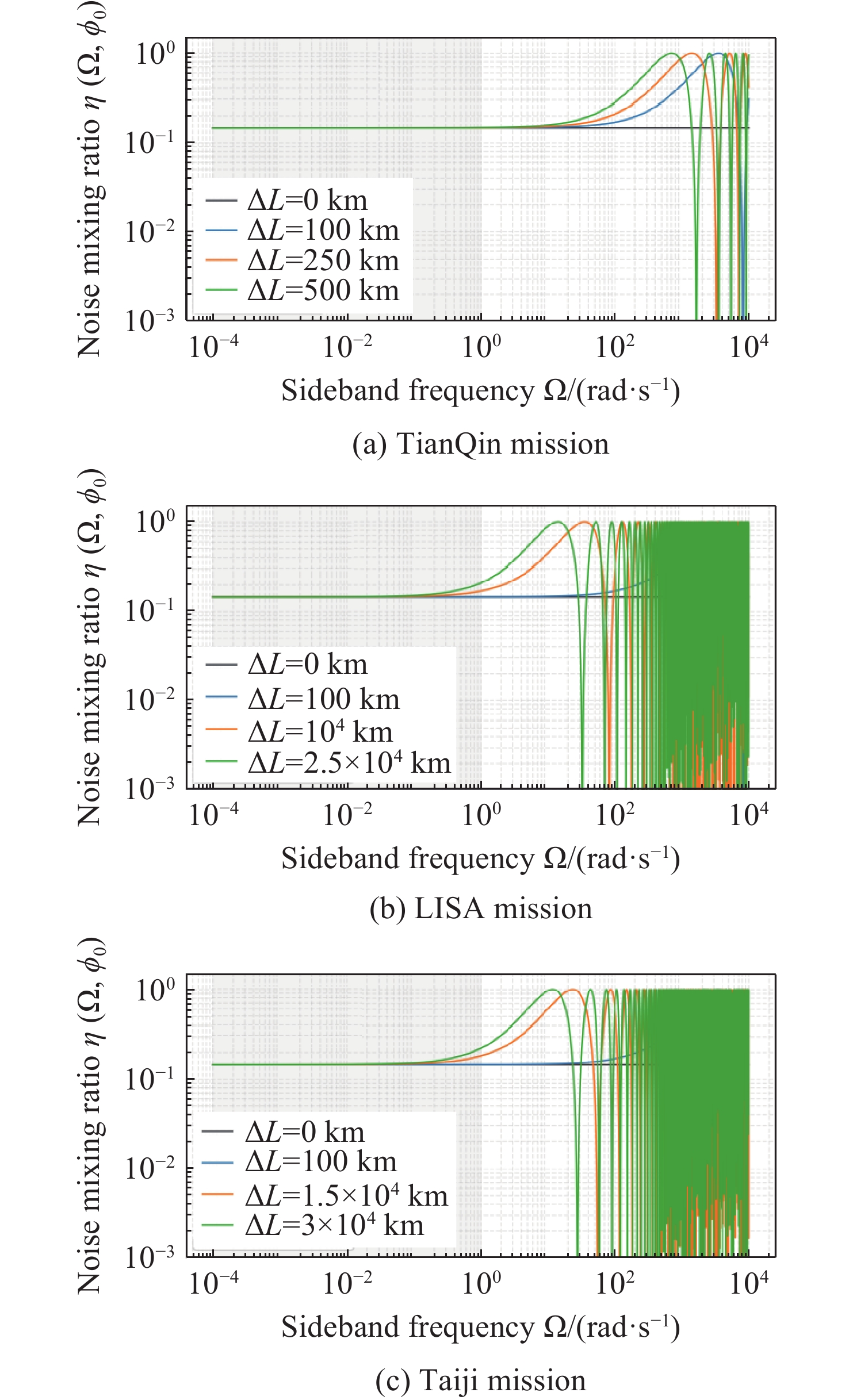
图 5 不同空间引力波探测计划绝对臂长差
$\mathit{\Delta }L$ 下的量子噪声频域响应曲线(${\phi }_{0}=\dfrac{{\text{π}} }{4}$ )Figure 5. Frequency-domain responses of quantum noise mixing ratio under arm-length mismatches
$ \mathit{\Delta }L $ corresponding to different space missions ($ {\phi }_{0}=\dfrac{{\text{π}} }{4} $ ) -
[1] AMARO-SEOANE P, AUDLEY H, BABAK S, et al. Laser interferometer space antenna[EB/OL]. (2017-02-02)[2026-06-05]. https://arxiv.org/abs/1702.00786. [2] COLPI T, DANZMANN K, HEWITSON M, et al. LISA definition study report[EB/OL]. (2024-02-12)[2026-06-05]. https://arxiv.org/abs/2402.07571. [3] HU W R, WU Y L. The Taiji program in space for gravitational wave physics and the nature of gravity[J]. National Science Review, 2017, 4(5): 685-686. doi: 10.1093/nsr/nwx116 [4] LIU H SH, WANG J, TAO W, et al. Recent development of the laser interferometer for Taiji space gravitational wave detection[J]. Research, 2026, 9: 1252. doi: 10.34133/research.1252 [5] LUO J, CHEN L SH, DUAN H Z, et al. TianQin: a space-borne gravitational wave detector[J]. Classical and Quantum Gravity, 2016, 33(3): 035010. doi: 10.1088/0264-9381/33/3/035010 [6] GANAPATHY D, JIA W, NAKANO M, et al. Broadband quantum enhancement of the LIGO detectors with frequency-dependent squeezing[J]. Physical Review X, 2023, 13(4): 041021. doi: 10.1103/PhysRevX.13.041021 [7] CAVES C M. Quantum-mechanical noise in an interferometer[J]. Physical Review D, 1981, 23(8): 1693-1708. doi: 10.1103/PhysRevD.23.1693 [8] VAHLBRUCH H, MEHMET M, CHELKOWSKI S, et al. Observation of squeezed light with 10-dB quantum-noise reduction[J]. Physical Review Letters, 2008, 100(3): 033602. doi: 10.1103/PhysRevLett.100.033602 [9] EBERLE T, STEINLECHNER S, BAUCHROWITZ J, et al. Quantum enhancement of the zero-area Sagnac interferometer topology for gravitational wave detection[J]. Physical Review Letters, 2010, 104(25): 251102. doi: 10.1103/PhysRevLett.104.251102 [10] YAMADA R, ENOMOTO Y, NISHIZAWA A, et al. Optimization of quantum noise by completing the square of multiple interferometer outputs in quantum locking for gravitational wave detectors[J]. Physics Letters A, 2020, 384(26): 126626. doi: 10.1016/j.physleta.2020.126626 [11] YAMADA R, ENOMOTO Y, WATANABE I, et al. Reduction of quantum noise using the quantum locking with an optical spring for gravitational wave detectors[J]. Physics Letters A, 2021, 402: 127365. doi: 10.1016/j.physleta.2021.127365 [12] 曾晓强, 李磐, 董鹏, 等. 引力波探测中激光干涉量子噪声计算[J]. 中国光学(中英文), 2025, 18(3): 698-703. doi: 10.37188/CO.2024-0180ZHENG X Q, LI P, DONG P, et al. Calculation of laser interferometric quantum noise in gravitational wave detection[J]. Chinese Optics, 2025, 18(3): 698-703. (in Chinese). doi: 10.37188/CO.2024-0180 [13] HARER S, STAAB M, HALLOIN H. Mitigation of the flexing-filtering effect in time-delay interferometry[J]. Classical and Quantum Gravity, 2025, 42(22): 225022. doi: 10.1088/1361-6382/ae1786 [14] 罗子人, 张敏. 空间引力波探测干涉测量中不确定度传递模型及量子噪声影响研究[J]. 物理学报, 2025, 74(8): 084201. (查阅网上资料, 未找到本条文献信息, 请确认).LUO Z R, ZHANG M. Study on uncertainty propagation model and quantum noise effect in space gravitational wave detection interferometry[J]. Acta Physica Sinica, 2025, 74(8): 084201. (in Chinese). [15] DENG Q, YE L Q, AN K, et al. Inter-spacecraft tilt-to-length noise reduction algorithm for Taiji mission[EB/OL]. (2025-09-24)[2026-06-05]. https://arxiv.org/abs/2509.20222. [16] The LIGO Scientific Collaboration. A gravitational wave observatory operating beyond the quantum shot-noise limit[J]. Nature Physics, 2011, 7(12): 962-965. doi: 10.1038/nphys2083 [17] AASI J, ABADIE J, ABBOTT B P, et al. Enhanced sensitivity of the LIGO gravitational wave detector by using squeezed states of light[J]. Nature Photonics, 2013, 7(8): 613-619. doi: 10.1038/nphoton.2013.177 [18] TSUJI K, ISHIKAWA T, KOMORI K, et al. Optimization of quantum noise in space gravitational-wave antenna DECIGO with optical-spring quantum locking considering mixture of vacuum fluctuations in homodyne detection[J]. Galaxies, 2023, 11(6): 111. doi: 10.3390/galaxies11060111 [19] ISHIKAWA T, KAWASAKI Y, TSUJI K, et al. Feasibility of loop-gain tuning for general measurement systems inspired by quantum locking for DECIGO[J]. Classical and Quantum Gravity, 2024, 41(21): 215013. doi: 10.1088/1361-6382/ad7cb6 [20] 缪海兴. 引力波探测的测量极限: 提升探测灵敏度的故事[J]. 物理, 2025, 54(11): 772-780. doi: 10.7693/wl20251104MIAO H X. Measurement limits in gravitational wave detection: the story of enhancing sensitivity[J]. Physics, 2025, 54(11): 772-780. (in Chinese). doi: 10.7693/wl20251104 [21] ASPELMEYER M, KIPPENBERG T J, MARQUARDT F. Cavity optomechanics[J]. Reviews of Modern Physics, 2014, 86(4): 1391-1452. doi: 10.1103/RevModPhys.86.1391 [22] TSUJI K, ISHIKAWA T, KOMORI K, et al. Quantum noise reduction in the space-based gravitational wave antenna DECIGO using optical springs and homodyne detection scheme[EB/OL]. (2025-09-22)[2026-06-05]. https://arxiv.org/abs/2509.17372. -

 下载:
下载:








计量
- 文章访问数: 110
- HTML全文浏览量: 41
- PDF下载量: 3
- 被引次数: 0
