



-
摘要:
在空间引力波探测中,差分波前传感(DWS)技术是激光跟瞄阶段的核心,是实现纳弧度级角度分辨的关键。为充分验证激光捕获跟瞄系统的在轨可行性,需对原理样机开展地面长距离验证实验。然而光束在大气中的传输会严重影响DWS技术的角度测量能力,亟需寻求干扰的抑制方案。本文通过数值仿真系统分析了大气对DWS的影响,首次提出通过引入自适应光学技术补偿大气对DWS信号的干扰,之后设计并搭建了基于DWS信号及波前测量的双控制回路激光跟瞄实验系统。引入了像差扰动开展实验,实验结果表明:在0.1 Hz−1 Hz频段,同频段性能可提升约10倍,充分说明了自适应光学系统可以有效提高DWS在大气环境下的测量能力,为后续的激光捕获跟瞄系统长距离大气环境地面验证奠定了基础。
Abstract:In the space gravitational wave detection program, differential wavefront sensing (DWS) technology is the core of laser tracking and pointing stage, and it is the key to achieve nanoradian angle resolution. In order to fully verify the on-orbit feasibility of the laser capture and tracking system, it is necessary to carry out long-distance ground verification experiments on the principle prototype. However, the transmission of light in the atmosphere will seriously affect the angle measurement ability of DWS technology, and it is urgent to find a scheme to suppress the interference. Therefore, we systematically analyze the influence of atmosphere on DWS by numerical simulation, and introduce the adaptive optics technology to compensate the interference of atmosphere on DWS signal for the first time. Then, a laser tracking and pointing experimental system with dual control loops based on DWS signal and wavefront measurement is designed and built. The experimental results show that in the 0.1 Hz−1 Hz frequency band, the performance of the same frequency band can be improved by about 10 times, which fully demonstrates that the adaptive optics system can effectively improve the measurement ability of DWS in the atmospheric environment, laying a foundation for the subsequent long-distance ground verification of laser capture and pointing system in atmospheric environment.
-
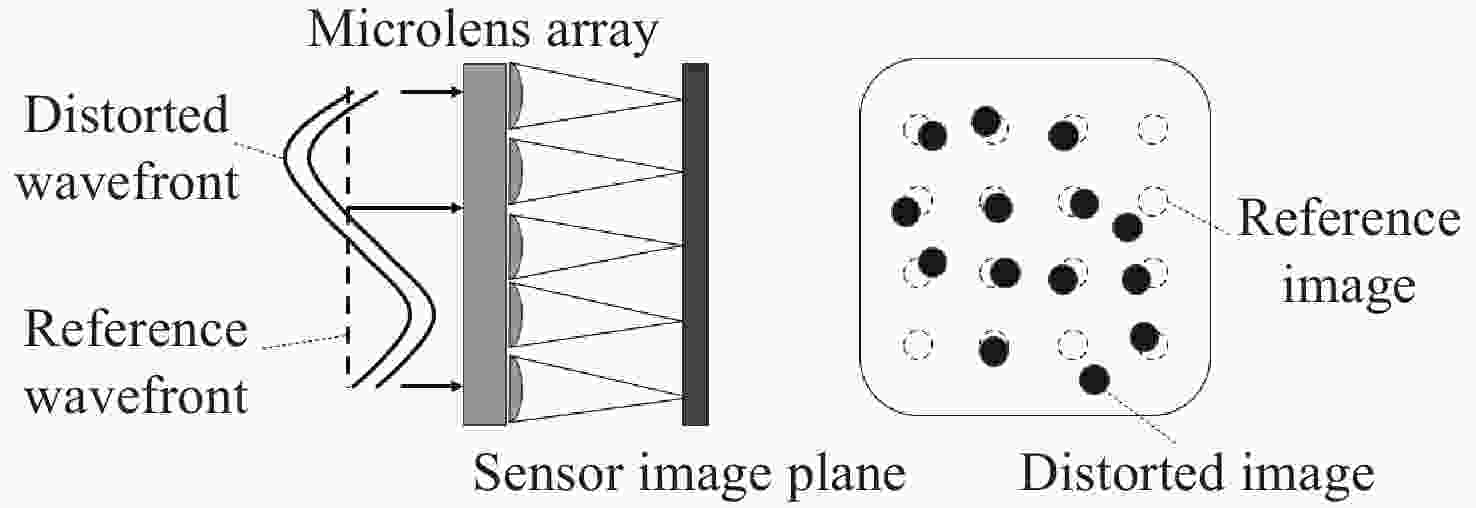
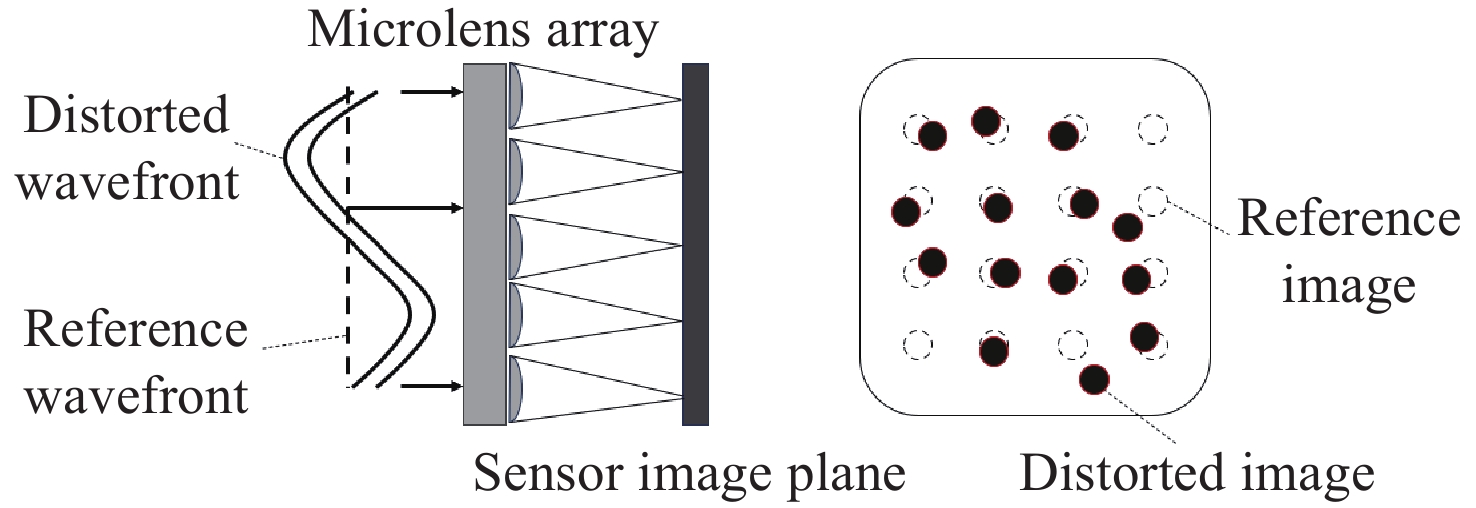
图 3 Shack-Hartmann波前传感器原理图
Figure 3. Schematic diagram of Shack-Hartmann wavefront sensor
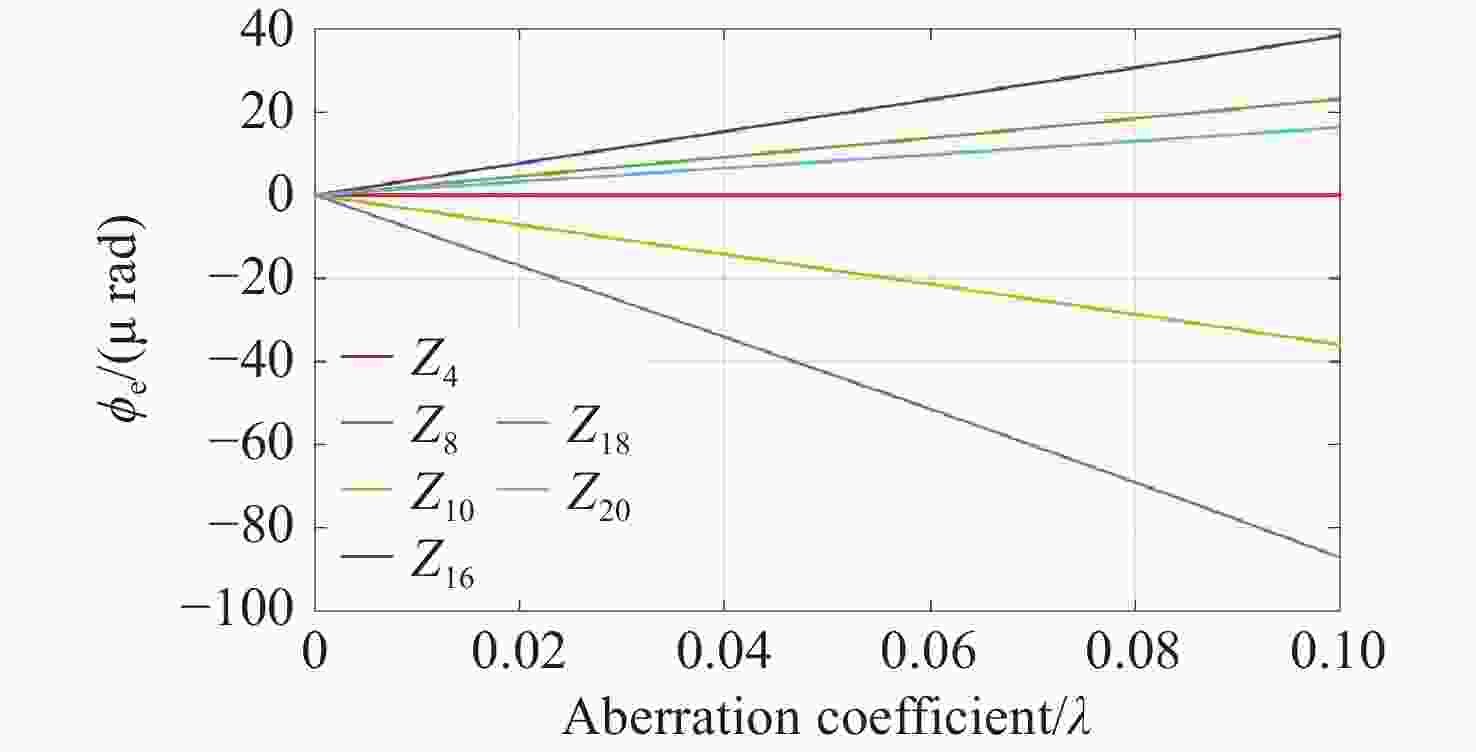
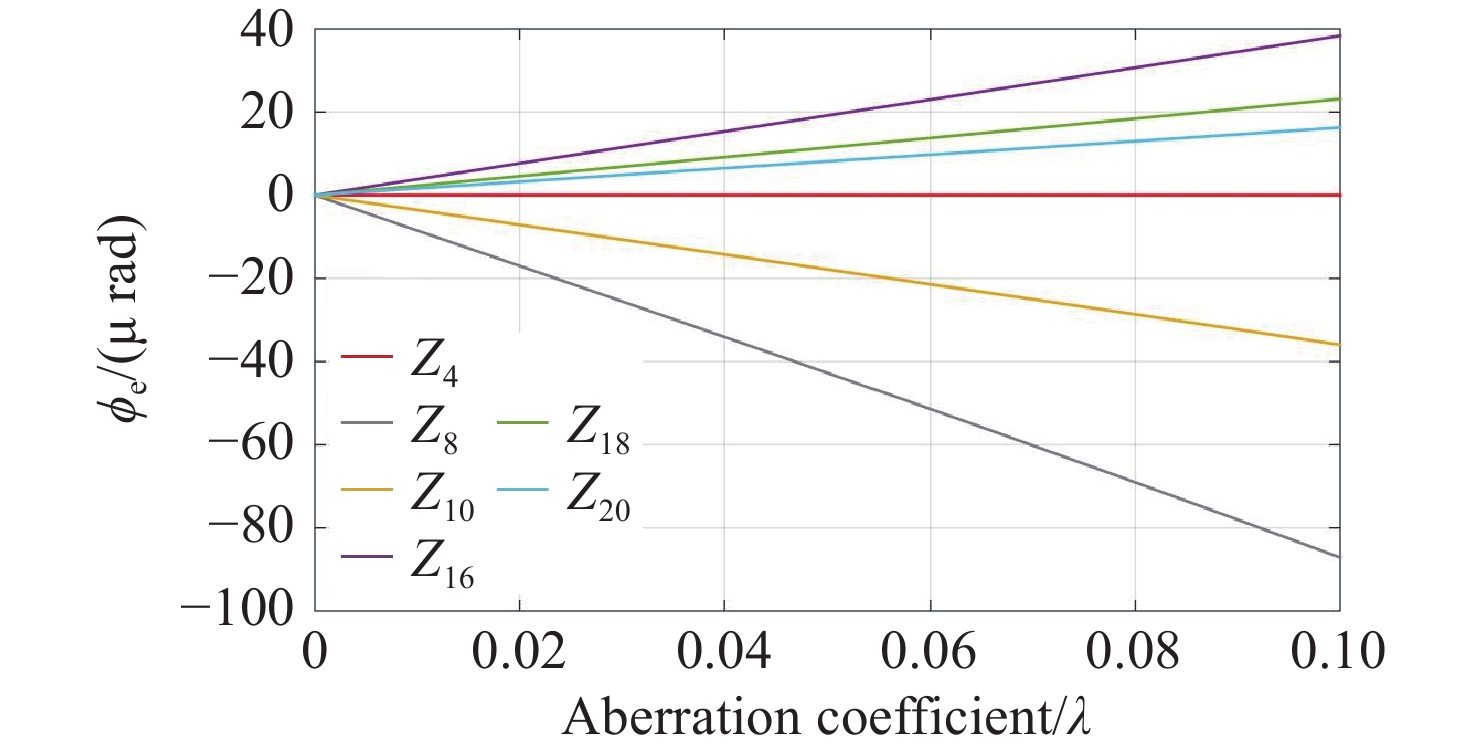
图 4 测角误差与像差系数的关系
Figure 4. Relationship between angular error and aberration coefficient
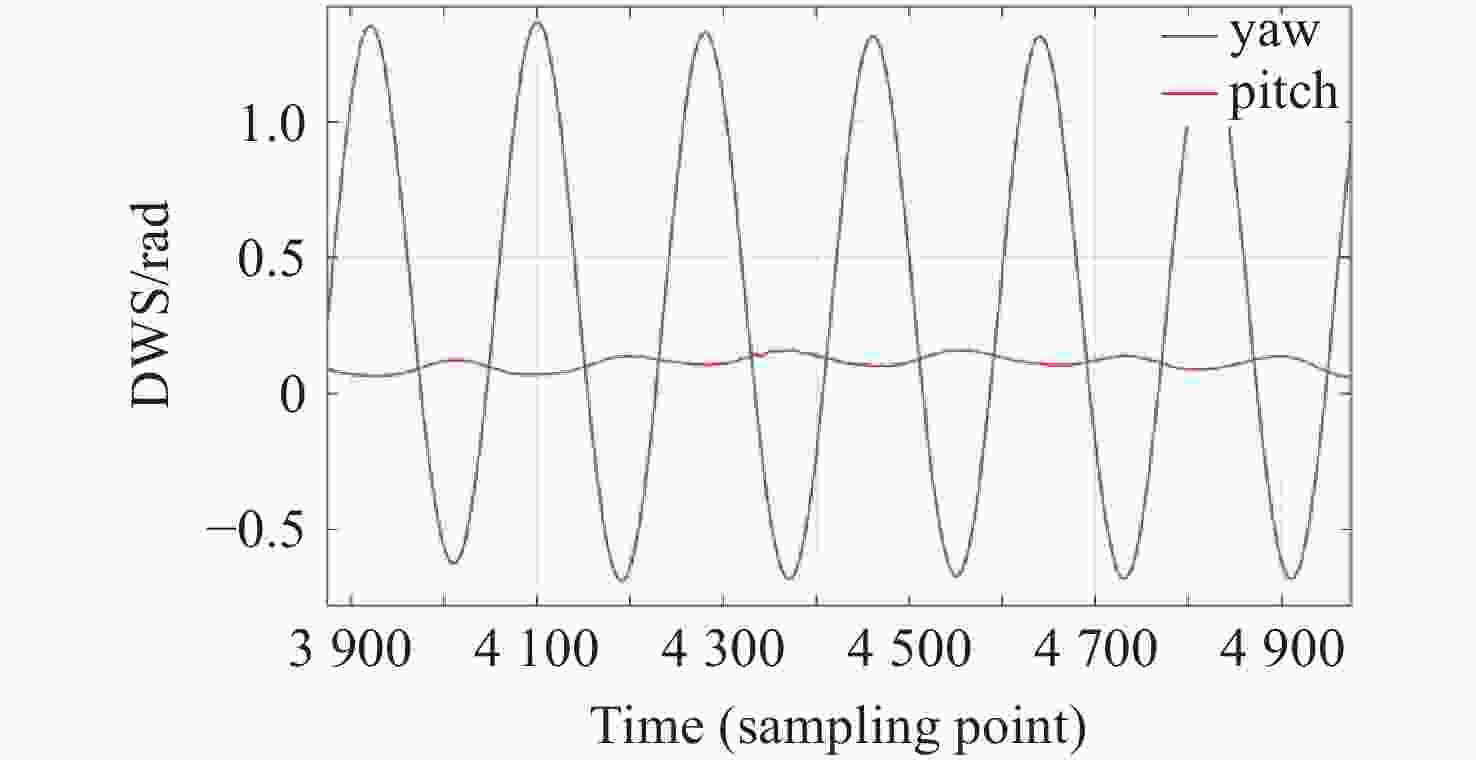
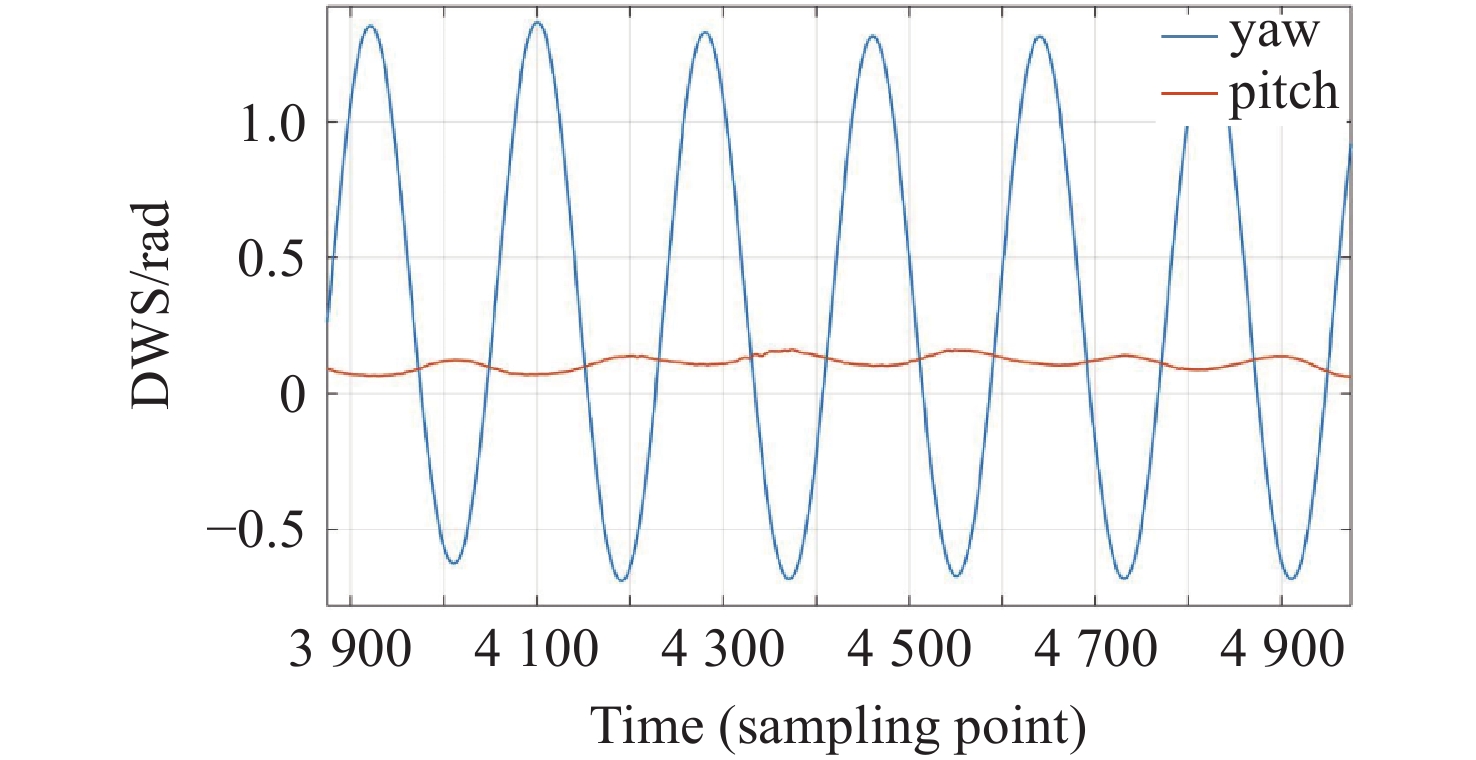
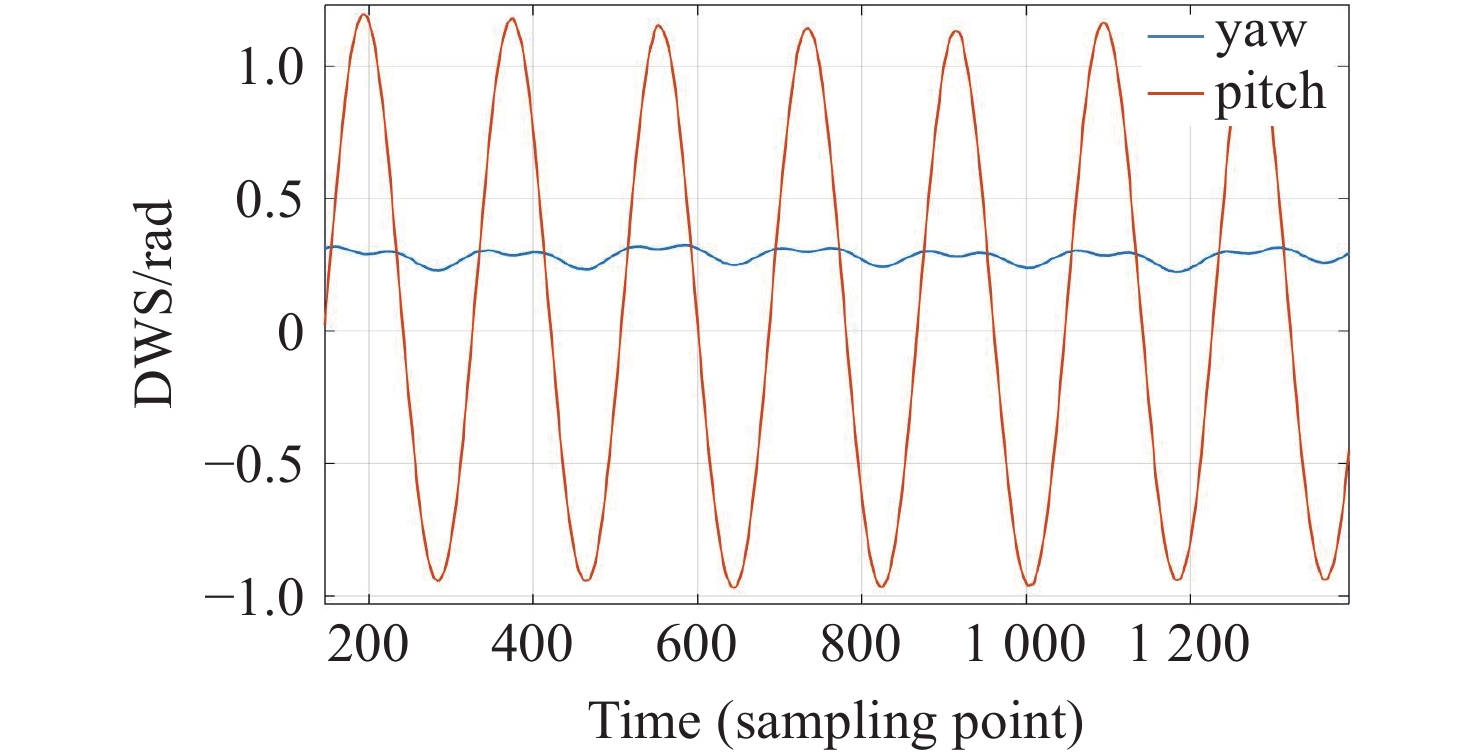
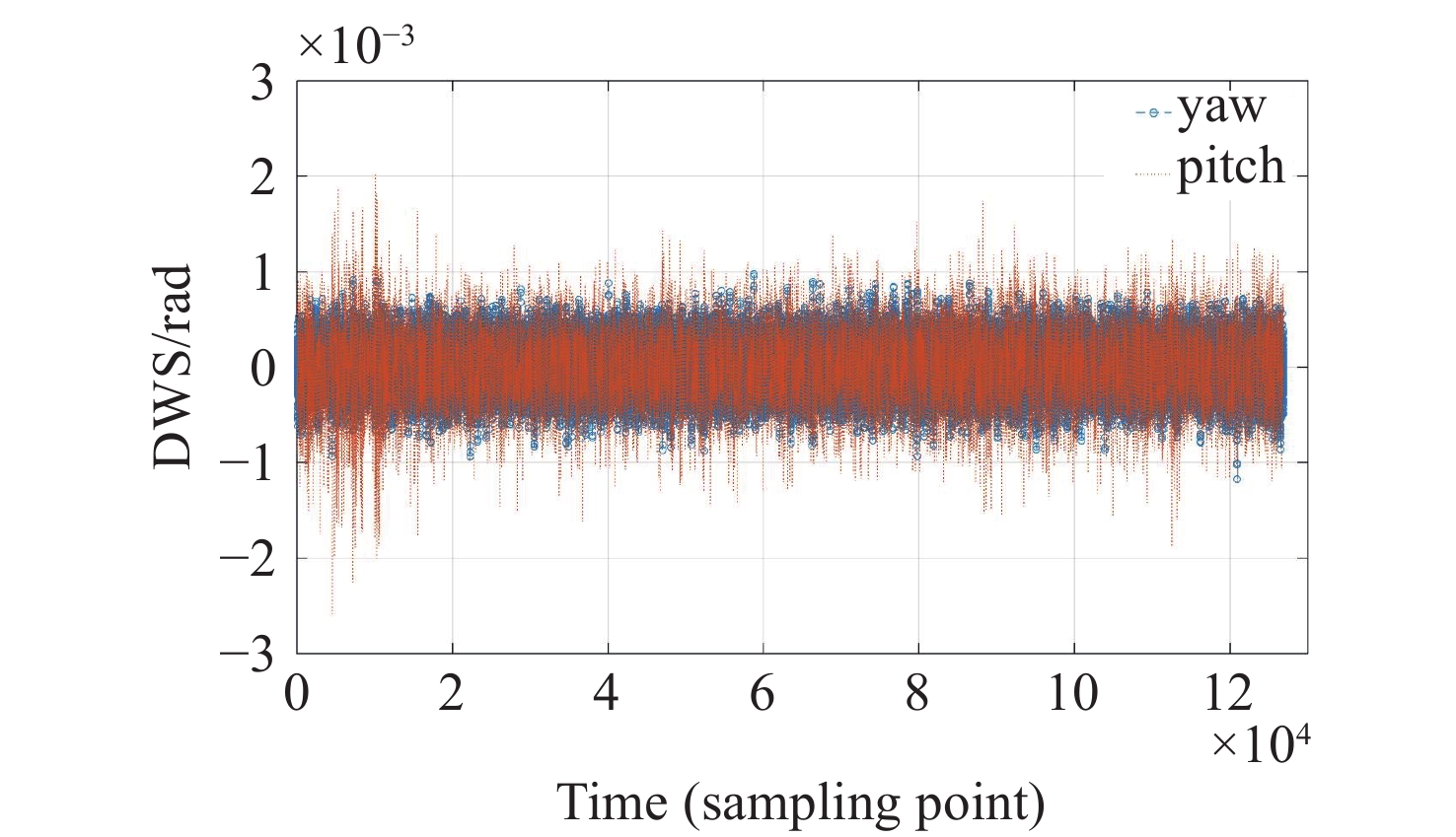
图 9 yaw方向相角转化系数标定
Figure 9. Calibration of phase angle conversion coefficient in yaw direction
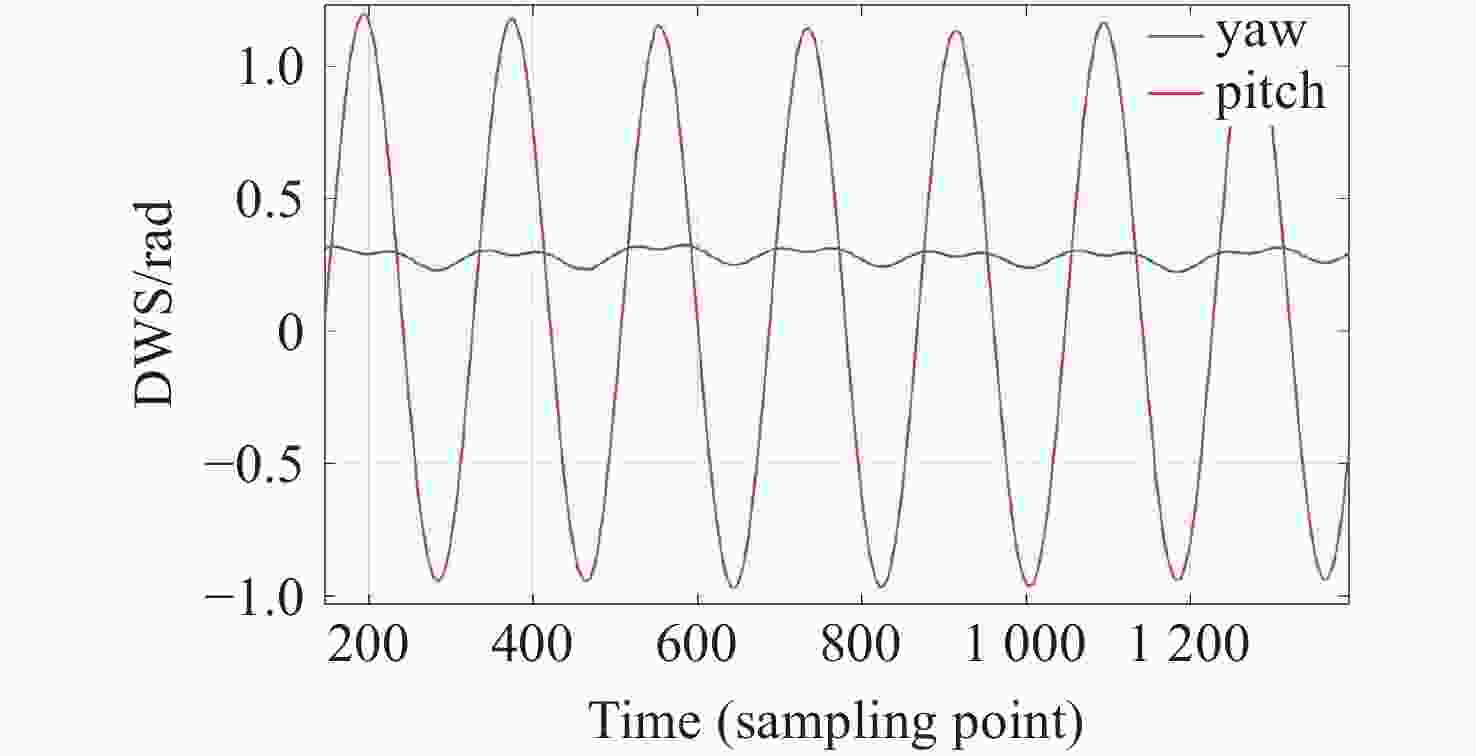
图 10 pitch方向相角转化系数标定
Figure 10. Calibration of phase angle conversion coefficient in pitch direction
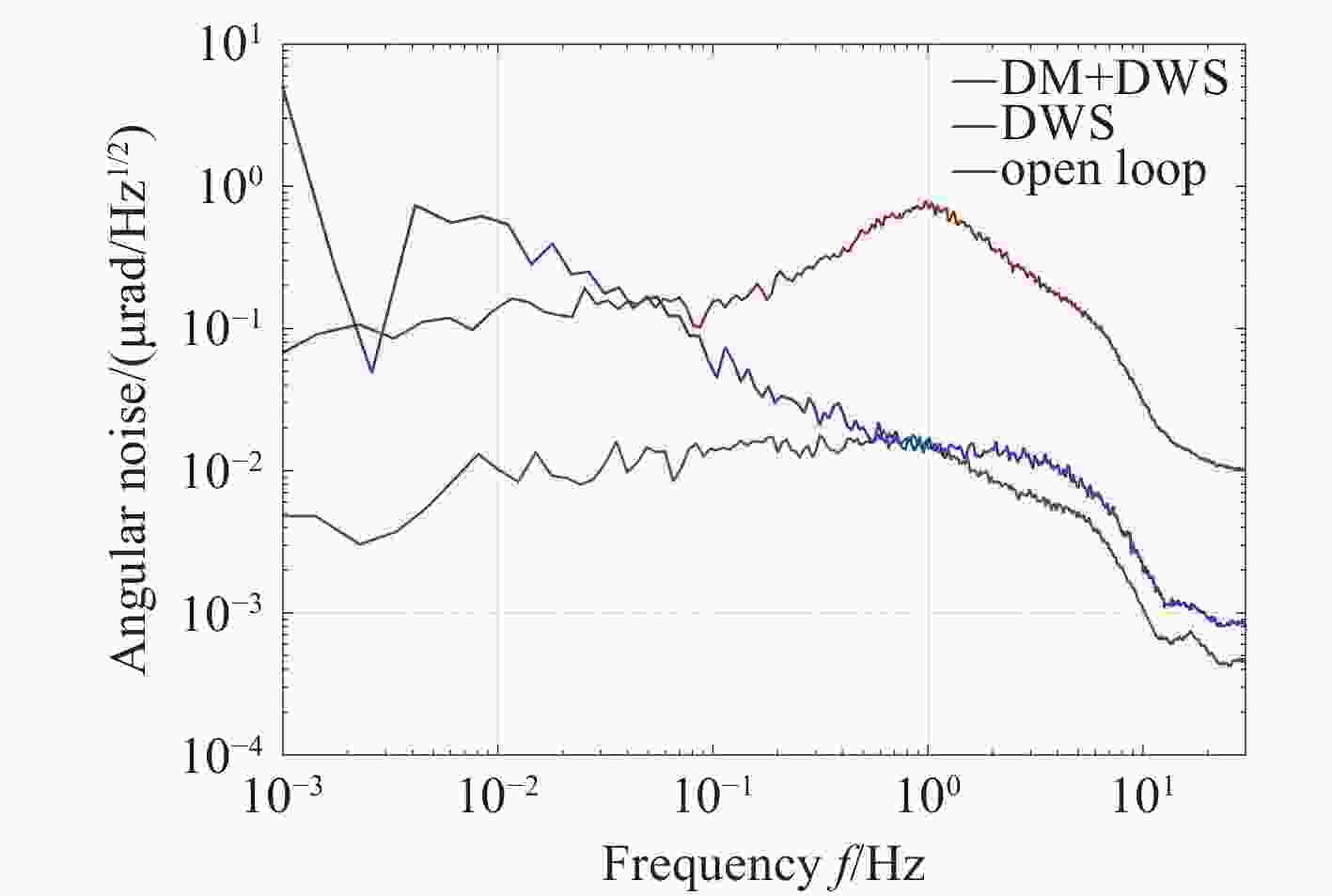
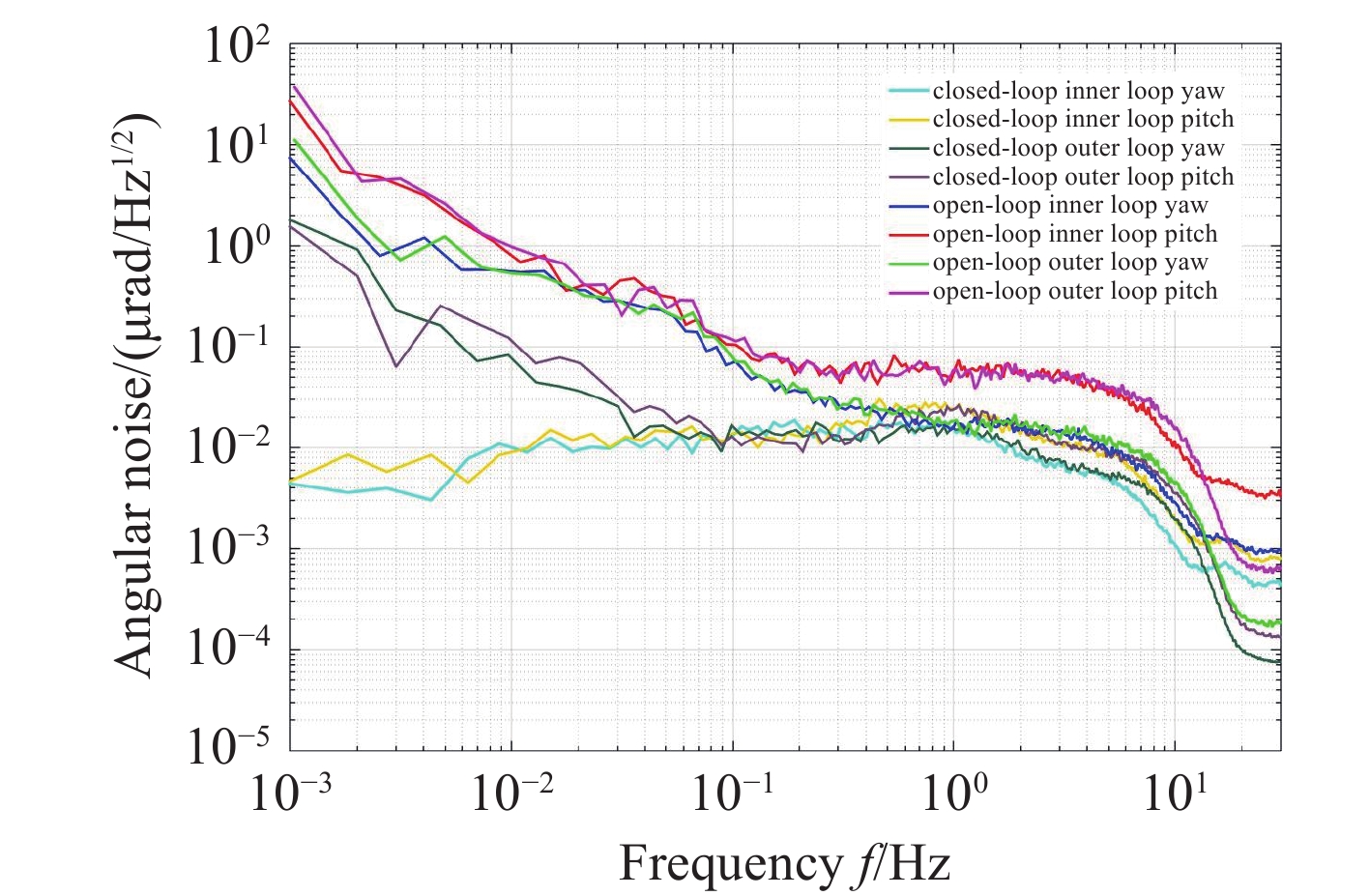
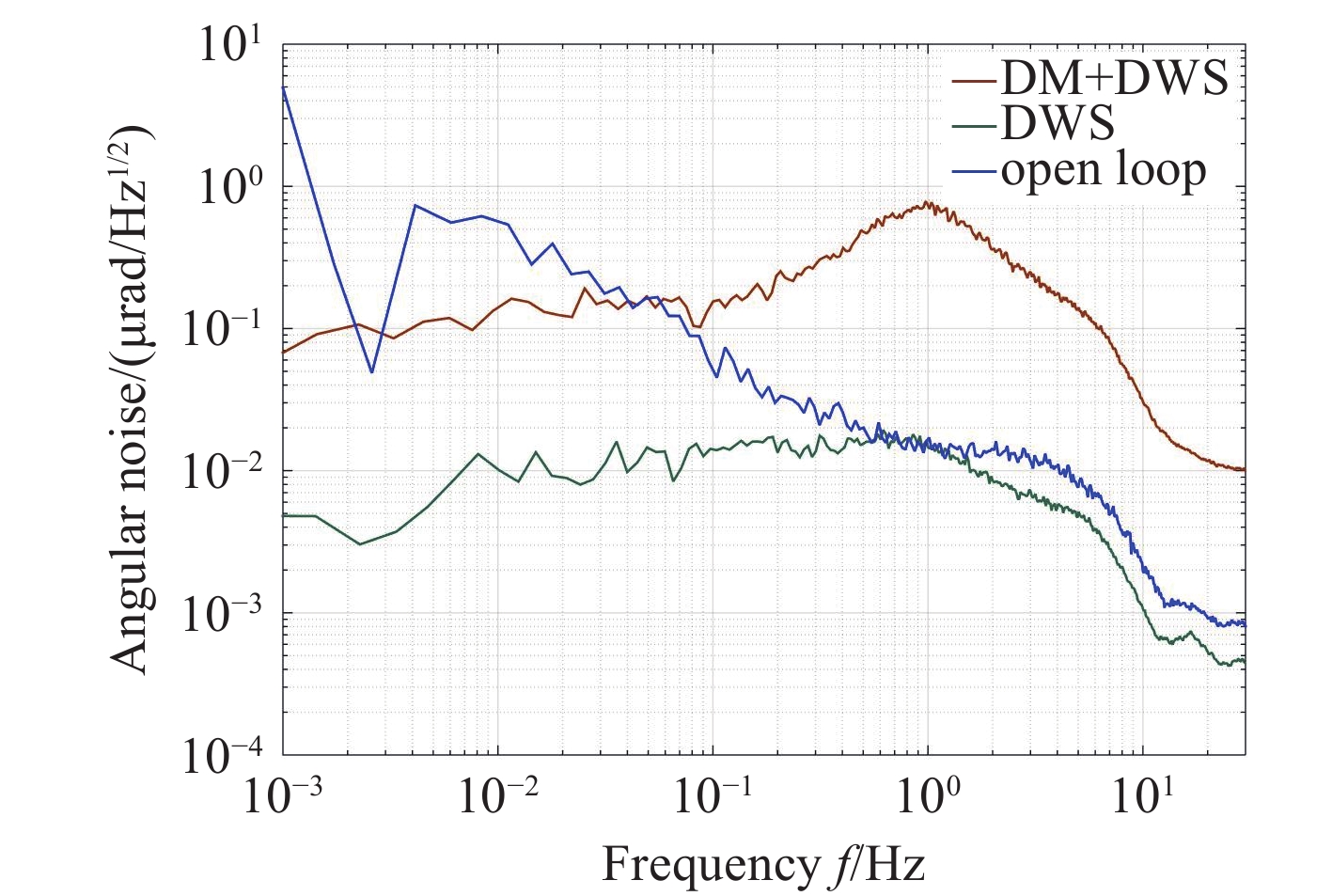
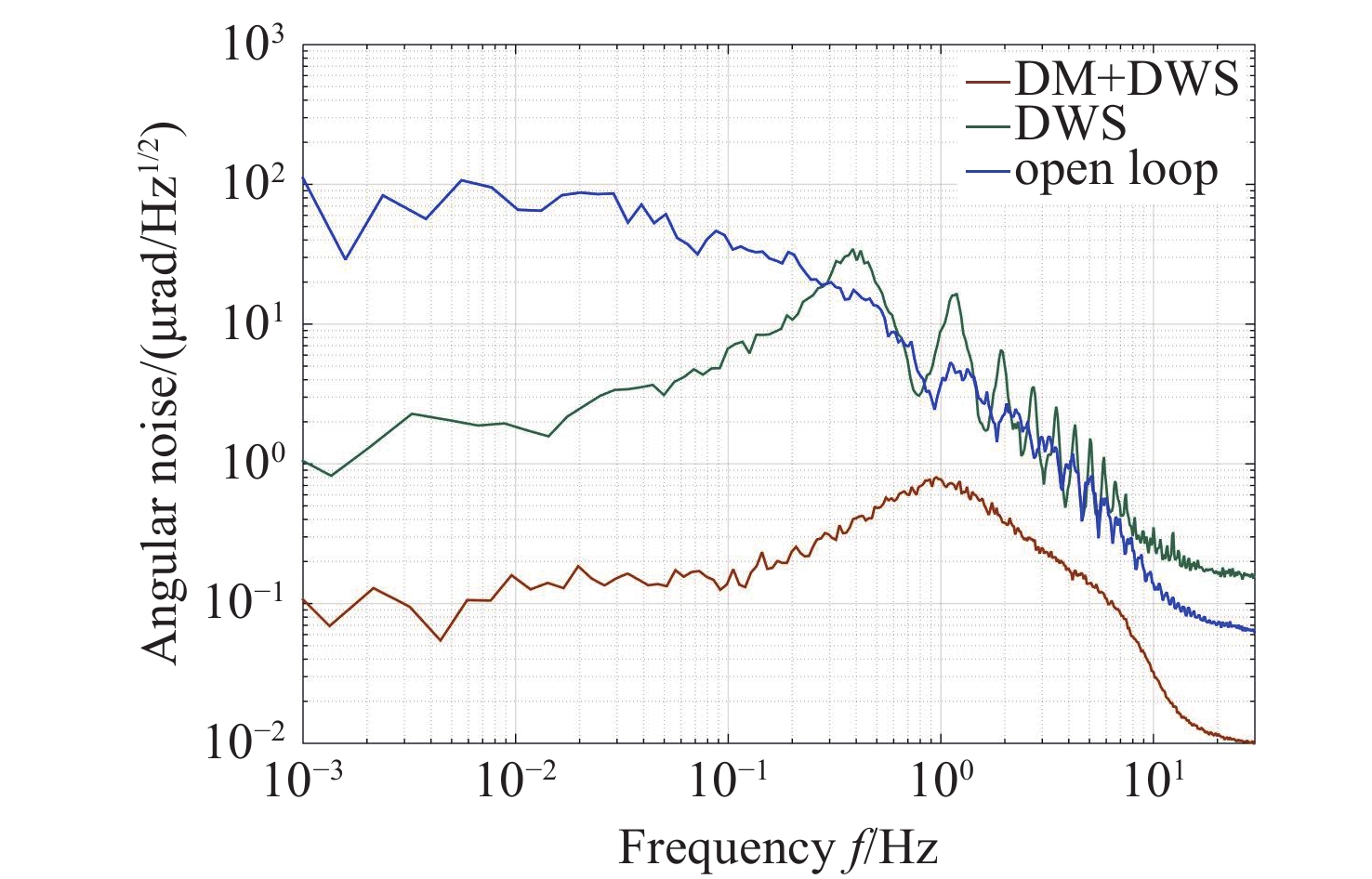
图 16 无干扰内环频谱对比图
Figure 16. Comparison of spectra in the inner loop without interference
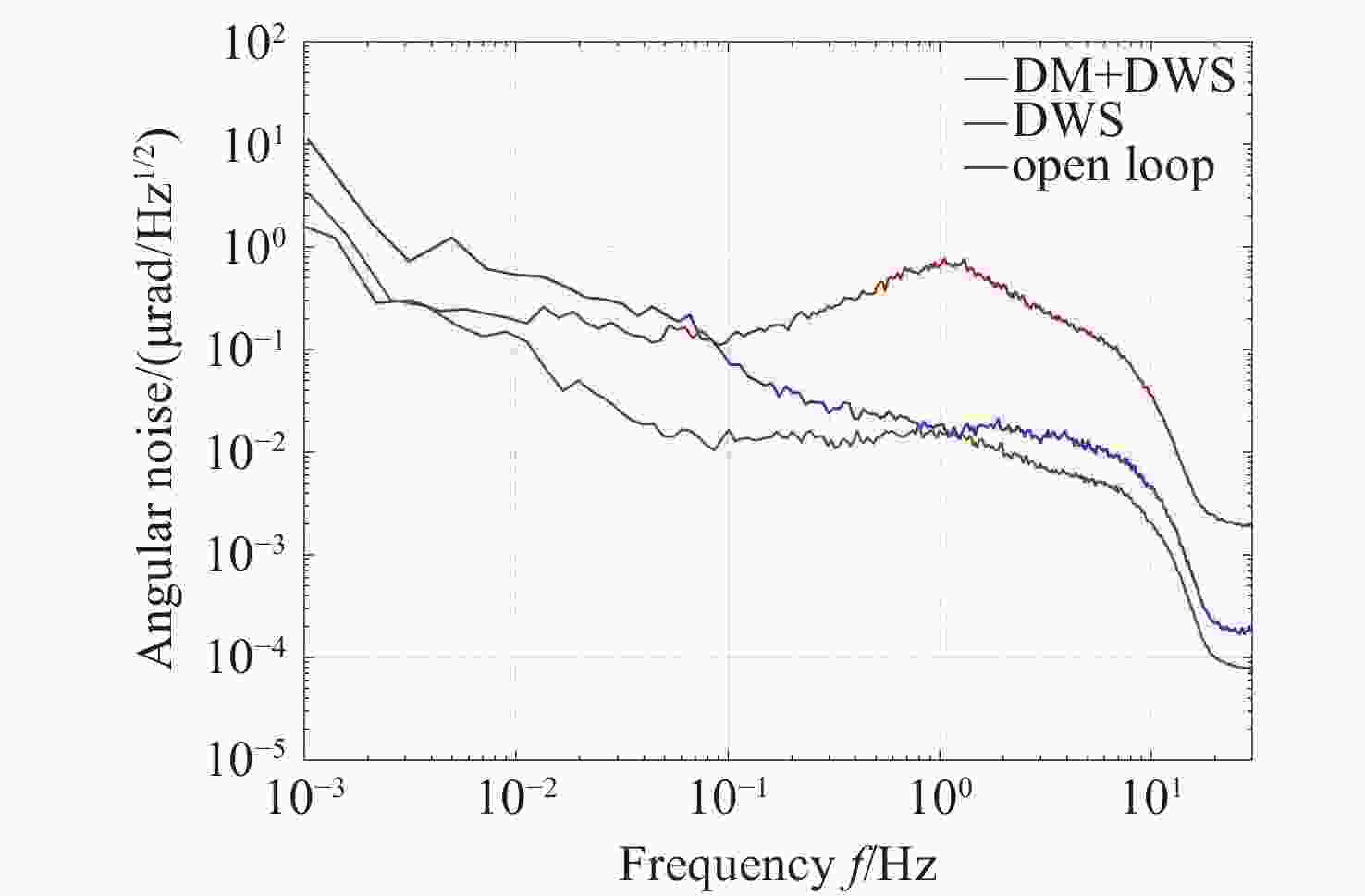
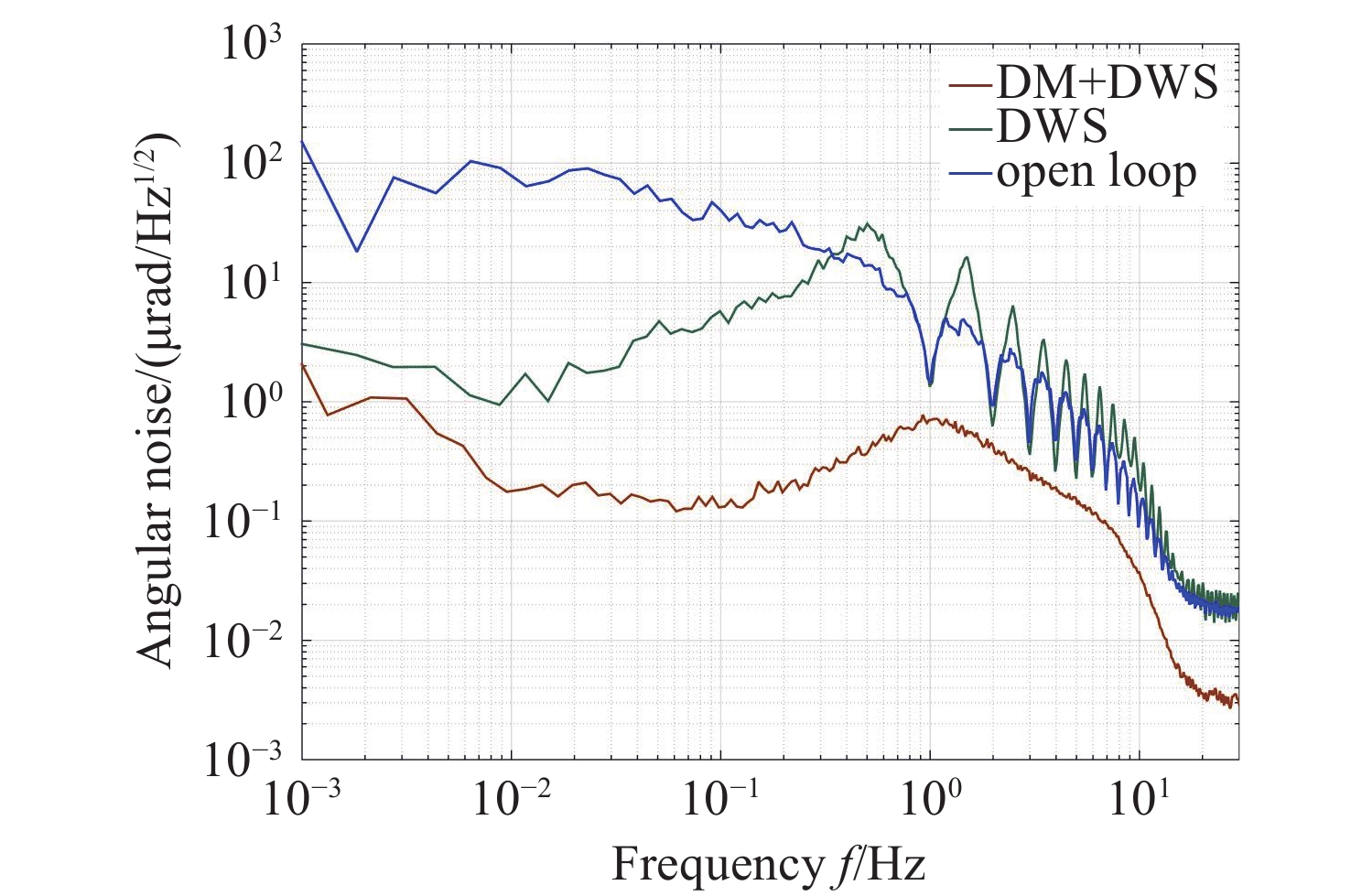
图 17 无干扰外环频谱对比图
Figure 17. Comparison of spectra of the outer loop without interference
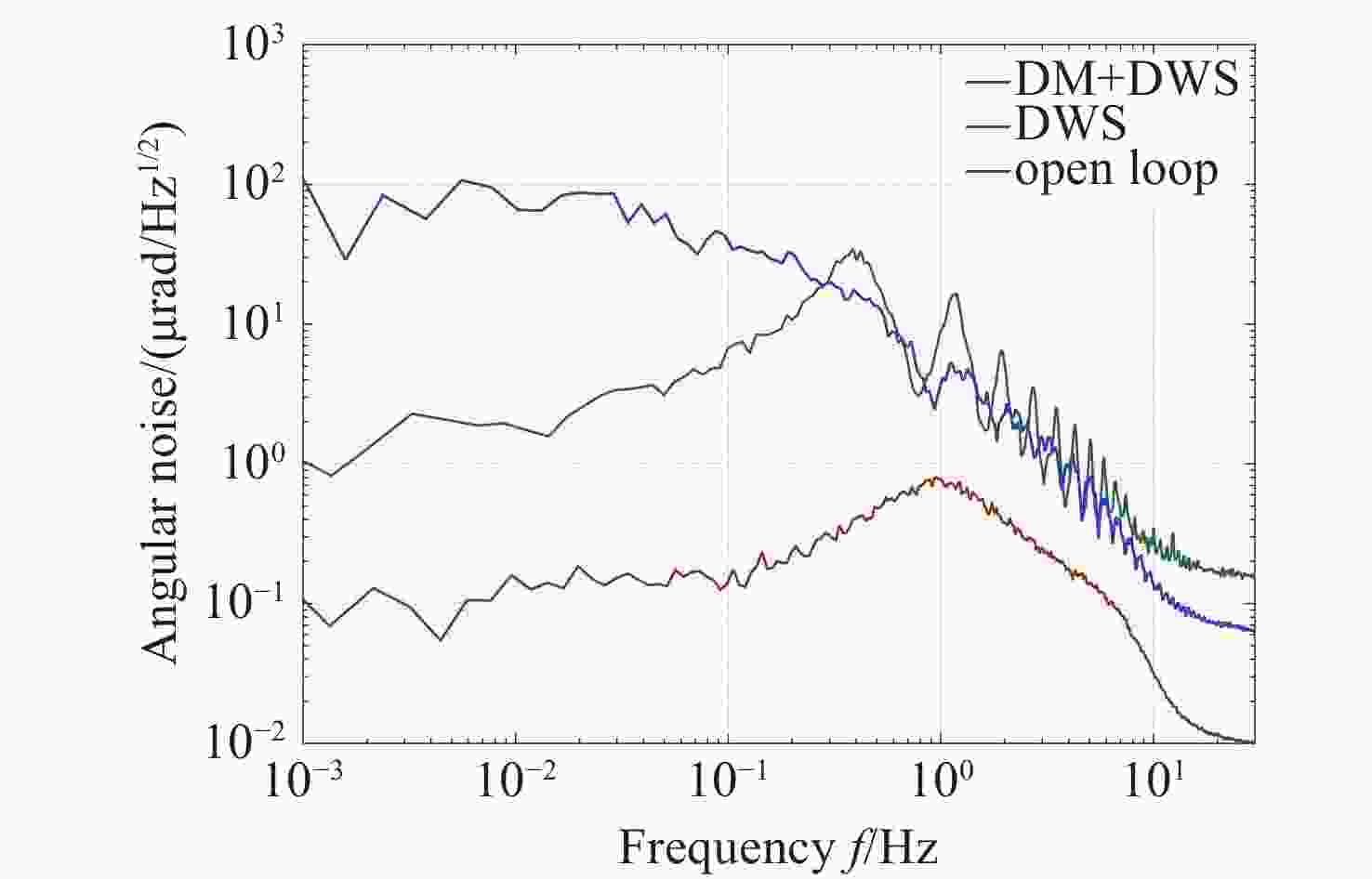
图 18 有干扰内环频谱对比图
Figure 18. Comparison of spectra in the inner loop under strong interference
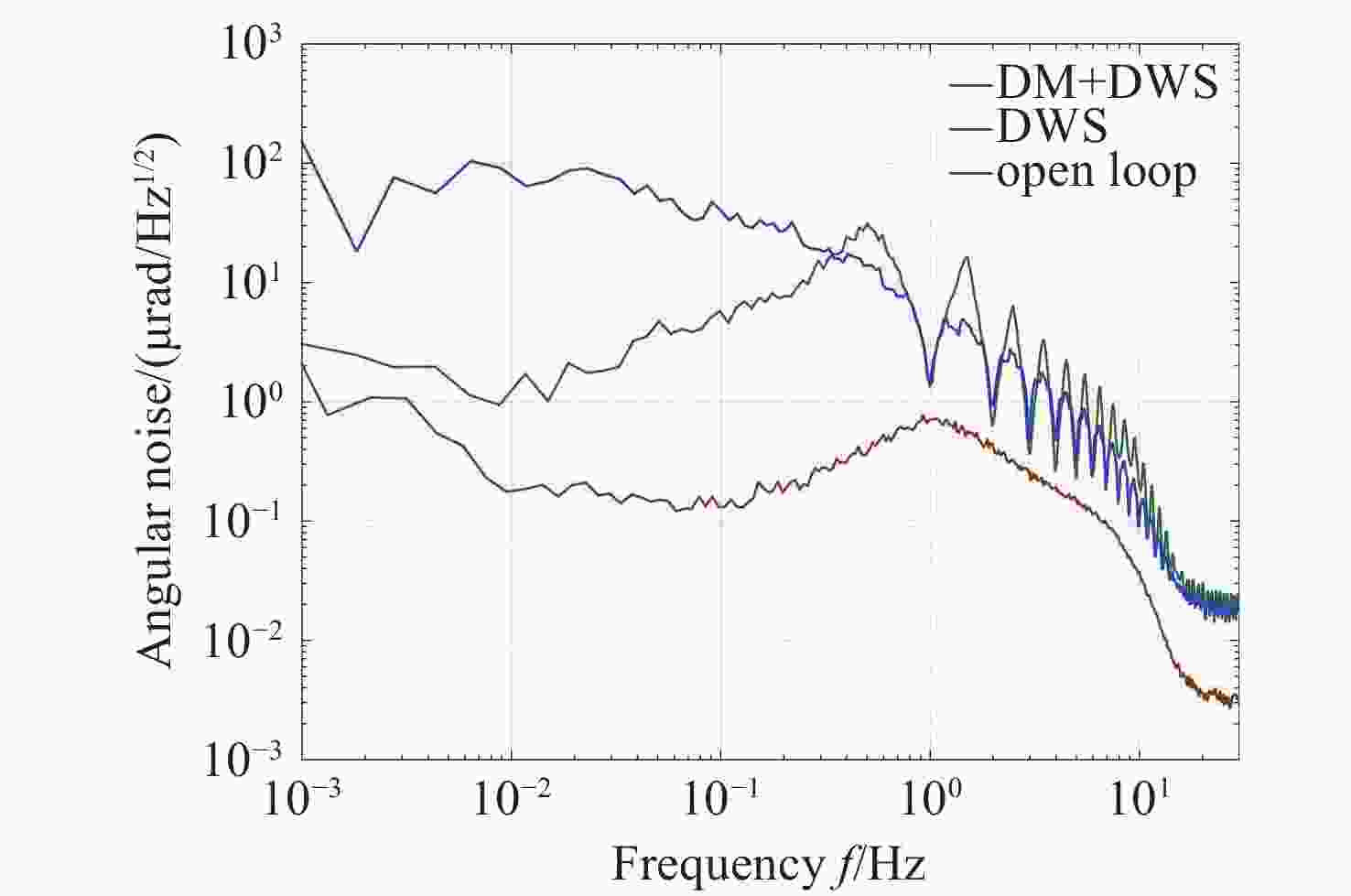
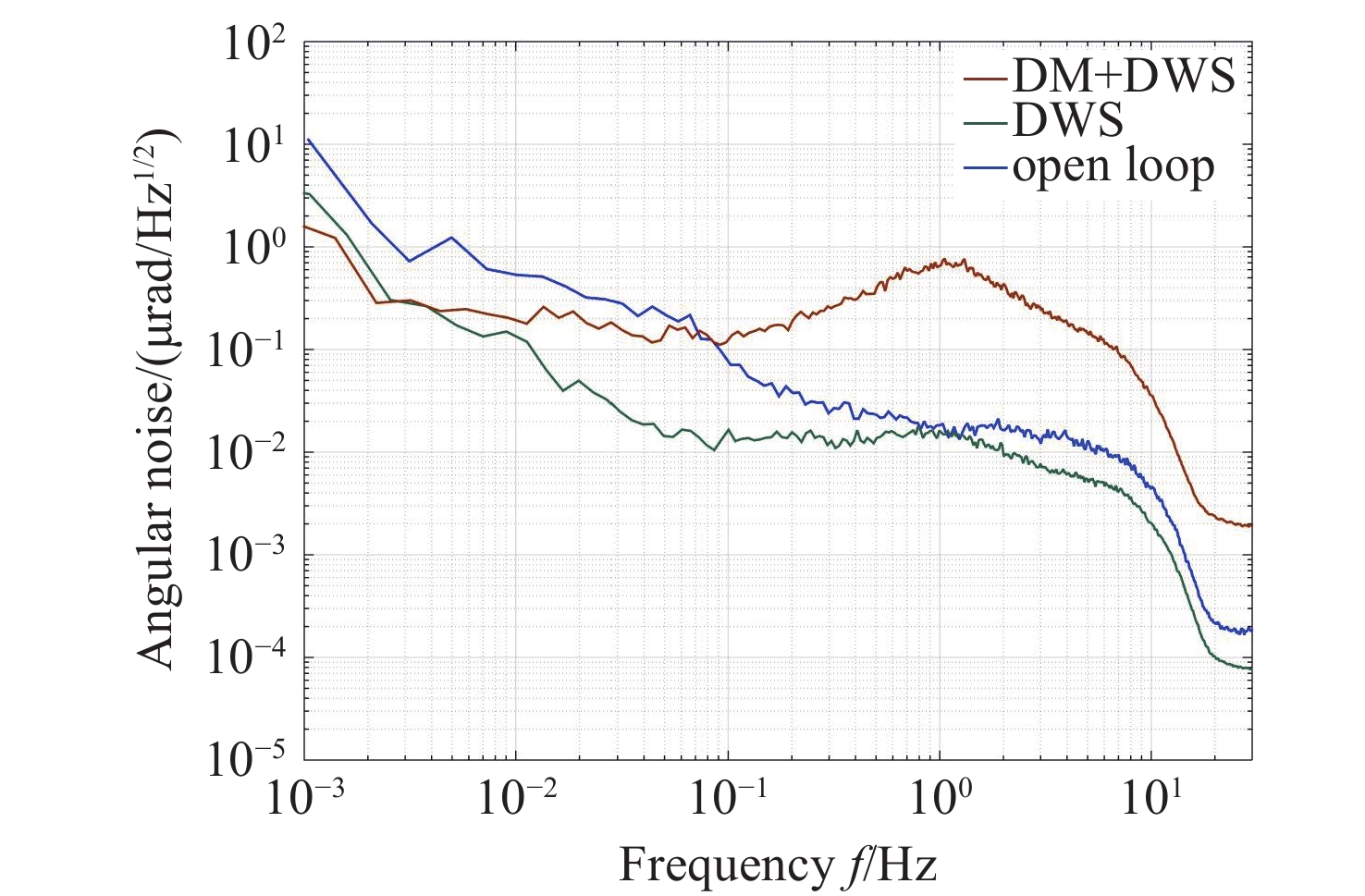
图 19 有干扰外环频谱对比图
Figure 19. Comparison of spectra in the outer loop under strong interference
表 1 前15项Zernike多项式的表达式
Table 1. The expressions of the first 15 Zernike polynomials
j n m Zj(ρ,θ) 1 0 0 1 2 1 1 $ 2\rho \text{cos}\theta $ 3 1 1 $ 2\rho \text{sin}\theta $ 4 2 0 $ \sqrt{3}(2{\rho }^{2}-1) $ 5 2 2 $ \sqrt{6}{\rho }^{2}\sin 2\theta $ 6 2 2 $ \sqrt{6}{\rho }^{2}\cos 2\theta $ 7 3 1 $ \sqrt{8}(3{\rho }^{3}-2\rho )\text{sin}\theta $ 8 3 1 $ \sqrt{8}(3{\rho }^{3}-2\rho )\text{cos}\theta $ 9 3 3 $ \sqrt{8}{\rho }^{3}\sin 3\theta $ 10 3 3 $ \sqrt{8}{\rho }^{3}\cos 3\theta $ 11 4 0 $ \sqrt{5}(6{\rho }^{4}-6{\rho }^{2}+1) $ 12 4 2 $ \sqrt{10}(4{\rho }^{4}-3{\rho }^{2})\cos 2\theta $ 13 4 2 $ \sqrt{10}(4{\rho }^{4}-3{\rho }^{2})\sin 2\theta $ 14 4 4 $ \sqrt{10}{\rho }^{4}\cos 4\theta $ 15 4 4 $ \sqrt{10}{\rho }^{4}\sin 4\theta $  下载: 导出CSV
表 2 实验系统基本参数
Table 2. Key parameters of the experimental system
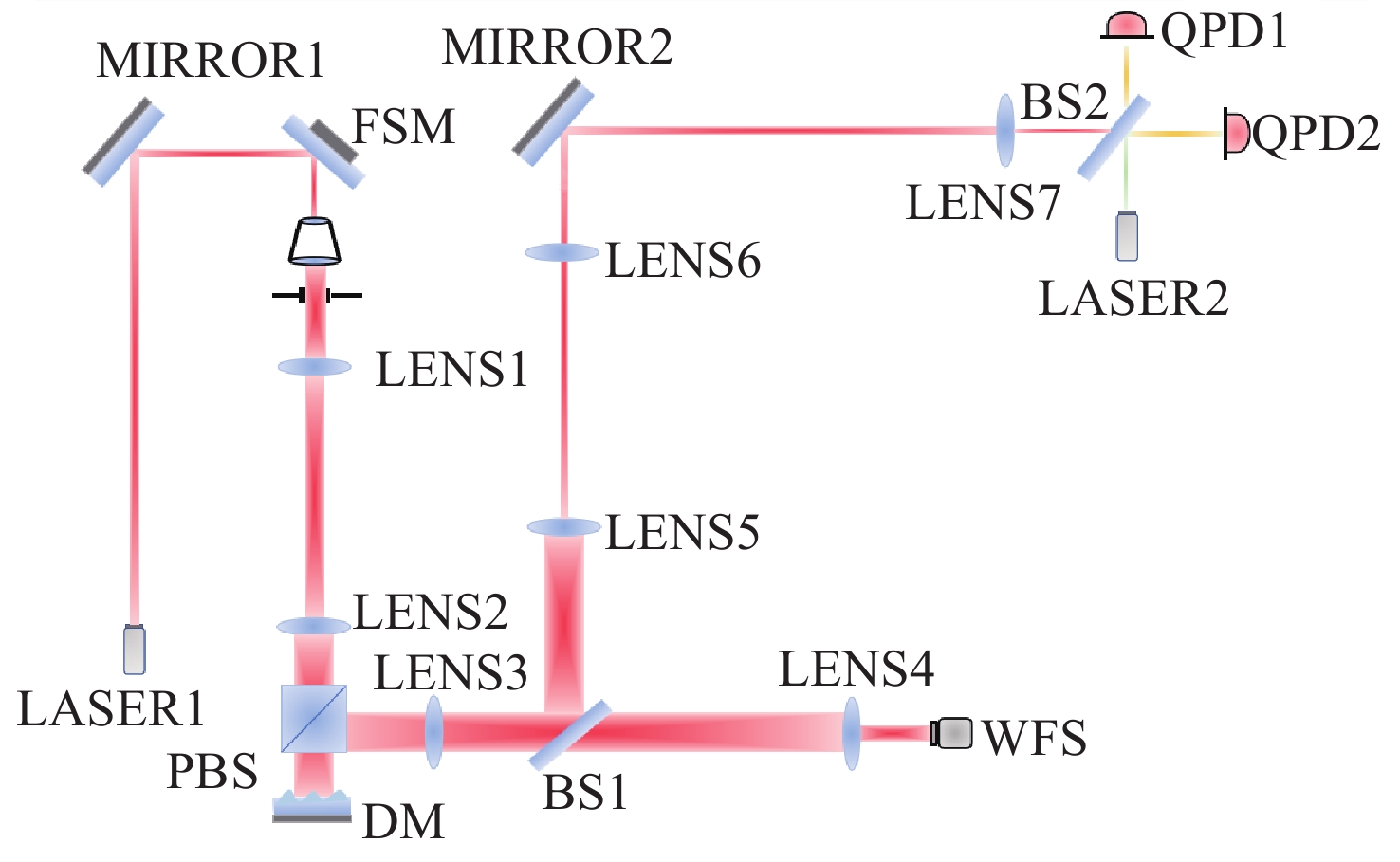
参数 数值 激光波长(λ) 1064 nm测量光扩束倍数 3 扩束后光斑大小 7.8 mm 光阑大小 5 mm WFS光斑大小 3.3 mm QPD光斑大小 1.5 mm DM光斑大小 10 mm
下载: 导出CSV
表 3 哈特曼波前传感器基本参数
Table 3. Hartmann wavefront sensor's parameters
参数 数值 RMS值(波前敏感性) l/100 rms @ 633 nm 子孔径数目 47×35 CCD的分辨率 1440 Pixel×1080 Pixel像元尺寸 5.0 µm×5.0 µm 通光孔径 9 mm 每个微透镜对应的子孔径大小 7.20 mm×5.40 mm 微透镜阵列间距 150 µm 微透镜阵列焦距 5.6 mm 微透镜阵列的几何形状 圆形 最高采样率 880 fps
下载: 导出CSV
表 4 变形镜基本参数
Table 4. Deformable mirror's parameters
参数 数值 口径大小及形状 圆形,直径为14 mm 镜面分段数 一共40个,24个在瞳孔内,16个在瞳孔外 镜面涂层 银 驱动电压 0~300 V 平均反射率
450 nm~2 µm
2~20 µm
>97.5%
>96.0%相对于参考球面初始均方值 200 nm 初始主要畸变 直径为18 mm的凹球面 最大冲程 24.5 µm
下载: 导出CSV
表 5 快速反射镜基本参数
Table 5. Basic parameters of the fast mirror
参数 数值 角度变化范围 2 mrad 分辨率 0.05 μrad 重复精度(10%偏摆角) 0.15 μrad 重复精度(100%偏摆角) 1.5 μrad
下载: 导出CSV
-
[1] ABBOTT B P, ABBOTT R, ABBOTT T D, et al. Observation of gravitational waves from a binary black hole merger[J]. Physical Review Letters, 2016, 116(6): 061102. doi: 10.1103/PhysRevLett.116.061102 [2] DANZMANN K, The LISA Study Team. LISA: laser interferometer space antenna for gravitational wave measurements[J]. Classical and Quantum Gravity, 1996, 13(11A): A247-A250. doi: 10.1088/0264-9381/13/11a/033 [3] LUO J, CHEN L, DUAN H, et al. TianQin: a space-borne gravitational wave detector[J]. Classical Quantum Gravity, 2016, 33(3): 035010. doi: 10.1088/0264-9381/33/3/035010 [4] 徐欣, 谈宜东, 穆衡霖, 等. 空间引力波探测中的激光干涉多自由度测量技术[J]. 激光与光电子学进展, 2023, 60(3): 0312006. doi: 10.3788/LOP222694XU X, TAN Y D, MU H L, et al. Laser interferometric multi-degree-of-freedom measurement technology in space gravitational-wave detection[J]. Laser & Optoelectronics Progress, 2023, 60(3): 0312006. (in Chinese). doi: 10.3788/LOP222694 [5] LUO Z R, WANG Y, WU Y L, et al. The Taiji program: a concise overview[J]. Progress of Theoretical and Experimental Physics, 2021, 2021(5): 05A108. doi: 10.1093/ptep/ptaa083 [6] 王娟, 齐克奇, 王少鑫, 等. 面向空间引力波探测的激光干涉技术研究进展及展望[J]. 中国科学: 物理学 力学 天文学, 2024, 54(7): 109-127.WANG J, QI K Q, WANG SH X, et al. Advance and prospect in the study of laser interferometry technology for space gravitational wave detection[J]. Scientia Sinica (Physica, Mechanica & Astronomica), 2024, 54(7): 109-127. (in Chinese). [7] 闫昊昱. 空间引力波探测望远镜杂散光抑制技术研究[D]. 西安: 中国科学院大学(中国科学院西安光学精密机械研究所), 2025.YAN H Y. Research on technology for suppressing stray light in space gravitational wave detection telescopes[D]. Xi’an: Xi'an Institute of Optical & Precision Machinery, Chinese Academy of Sciences, 2025. (in Chinese). [8] CHEN Q SH, ZHU F, DONG J X, et al. Comprehensive optimization approach for telescope optical parameters targeting minimal tilt-to-length coupling coefficient with required wavefront aberration in intersatellite laser interferometer for gravitational wave detection[J]. Results in Engineering, 2026, 29: 109637. doi: 10.1016/J.RINENG.2026.109637 [9] 赵云, 王汉, 董滨滨, 等. 星地激光通信研究现状与前沿技术[J]. 空间科学学报, 2025, 45(2): 612-628.ZHAO Y, WANG H, DONG B B, et al. Research progress and fronts in satellite-to-ground laser communication[J]. Chinese Journal of Space Science, 2025, 45(2): 612-628. (in Chinese). [10] 刘立人. 卫星激光通信Ⅰ: 链路和终端技术[J]. 中国激光, 2007, 34(1): 3-20.LIU L R. Laser communications in space Ⅰ: optical link and terminal technology[J]. Chinese Journal of Lasers, 2007, 34(1): 3-20. (in Chinese). [11] HEINZEL G, SHEARD B, BRAUSE N, et al. Laser ranging interferometer for GRACE follow-on[J]. Proceedings of SPIE, 2017, 10564: 1056420. doi: 10.5194/egusphere-egu2020-10566 [12] HECHENBLAIKNER G, DELCHAMBRE S, ZIEGLER T. Optical link acquisition for the LISA mission with in-field pointing architecture[J]. Optics & Laser Technology, 2023, 161: 109213. doi: 10.1016/j.optlastec.2023.109213 [13] CHARPIGNY N. An executable system model for behavioural analyses of the LISA mission[D]. Stockholm: KTH Royal Institute of Technology, 2019. [14] HYDE T T, MAGHAMI P G, MERKOWITZ S M. Pointing acquisition and performance for the laser interferometry space antenna mission[J]. Classical and Quantum Gravity, 2004, 21(5): S635-S640. doi: 10.1088/0264-9381/21/5/036 [15] GOMEZ A R, AHDAB M A. Momentum-based learning of Nash equilibria for LISA pointing acquisition[J]. IFAC-PapersOnLine, 2023, 56(2): 6012-6017. doi: 10.1016/j.ifacol.2023.10.646 [16] HYDE T T, MAGHAMI P G. Precision pointing for the Laser Interferometer Space Antenna (LISA) mission[C]. AAS Guidance and Control Conference, 2003. [17] CIRILLO F, GATH P F. Control system design for the constellation acquisition phase of the LISA mission[J]. Journal of Physics: Conference Series, 2009, 154: 012014. doi: 10.1088/1742-6596/154/1/012014 [18] KOCH A. Link acquisition and optimization for intersatellite laser interferometry[D]. Hannover: Gottfried Wilhelm Leibniz Universität Hannover, 2020. [19] ABICH K, ABRAMOVICI A, AMPARAN B, et al. In-orbit performance of the GRACE follow-on laser ranging interferometer[J]. Physical Review Letters, 2019, 123(3): 031101. doi: 10.1103/PhysRevLett.123.031101 [20] GAO R H, LIU H SH, ZHAO Y, et al. Laser acquisition experimental demonstration for space gravitational wave detection missions[J]. Optics Express, 2021, 29(5): 6368-6383. doi: 10.1364/OE.414741 [21] GAO R H, WANG Y K, CUI Z, et al. On-ground demonstration of laser-link construction for space-based detection of gravitational waves[J]. Optics and Lasers in Engineering, 2023, 160: 107287. doi: 10.1016/j.optlaseng.2022.107287 [22] HU Q L, ZHANG J Y, NIE R L, et al. Ground-based simulation of laser link acquisition for inter-satellite laser interferometry[J]. Optics Express, 2024, 32(18): 31006-31022. doi: 10.1364/OE.530639 [23] YU X Z, GILLMER S R, ELLIS J D. Beam geometry, alignment, and wavefront aberration effects on interferometric differential wavefront sensing[J]. Measurement Science and Technology, 2015, 26(12): 125203-125203. doi: 10.1088/0957-0233/26/12/125203 [24] 张强涛, 刘河山, 罗子人. 面向空间激光干涉的多通道相位测量系统[J]. 中国光学(中英文), 2023, 16(5): 1089-1099.ZHANG Q T, LIU H SH, LUO Z R. Multi-channel phase measurement system for the space laser interferometry[J]. Chinese Optics, 2023, 16(5): 1089-1099. (in Chinese). [25] 江强, 董鹏, 刘河山, 等. 太极计划时钟噪声传递的地面原理验证[J]. 中国光学(中英文), 2023, 16(6): 1394-1403.JIANG Q, DONG P, LIU H SH, et al. Ground-based principle verification of clock noise transfer for the Taiji program[J]. Chinese Optics, 2023, 16(6): 1394-1403. (in Chinese). [26] 胡鸣, 张琪, 王红燕, 等. 基于P-U-net的角锥波前探测器的波前校正方法[J]. 液晶与显示, 2024, 39(9): 1174-1181.HU M, ZHANG Q, WANG H Y, et al. Wavefront correction method based on P-U-net for pyramid wavefront detector[J]. Chinese Journal of Liquid Crystals and Displays, 2024, 39(9): 1174-1181. (in Chinese). [27] 欧阳朴秀, 陈凯余, 郭友明, 等. 基于哈特曼波前传感器的白天天光背景时空特性分析[J]. 光学 精密工程, 2025, 33(21): 3431-3440.OUYANG P X, CHEN K Y, GUO Y M, et al. Daytime sky background spatio-temporal analysis using Hartmann wavefront sensor[J]. Optics and Precision Engineering, 2025, 33(21): 3431-3440. (in Chinese). [28] 王文宇. 自适应光学的波前校正器与闭环控制系统建模仿真研究[D]. 长春: 中国科学院大学(中国科学院长春光学精密机械与物理研究所), 2025.WANG W Y. Research on modeling and simulation of wavefront corrector and closed-loop control system in adaptive optics[D]. Changchun: Changchun Institute of Optics, Fine Mechanics and Physics, Chinese Academy of Sciences, 2025. (in Chinese). -

 下载:
下载:

计量
- 文章访问数: 596
- HTML全文浏览量: 206
- PDF下载量: 50
- 被引次数: 0
