



Principle analysis of laser interferometry systems for space-borne gravitational wave antennas integrating high-precision optical clocks
-
摘要:
为了解决毫赫兹频段天基引力波探测中激光频率噪声和时钟噪声的抑制难题,并克服传统基于第二代时间延迟干涉(Time-Delay Interferometry,TDI)方案的复杂性与局限性,本研究提出了一种基于空间光钟(Space-borne Optical Clock,SOC)的探测器载荷设计与噪声抑制新方案
。 本文首先阐述了该方案的核心载荷设计,即在每颗航天器上配置星载光钟系统以替代传统的超稳晶振(Ultra-Stable Oscillator,USO)。接着,介绍了两种噪声同步抑制的实现机制,即通过将激光锁定在原子跃迁频率上,并利用光学频率梳将光钟频率下变频产生微波时钟信号。最后,基于最新研究中星载光钟的稳定度,采用理论分析与数值模拟相结合的方法,在0.1mHz到1Hz的目标频段内对系统的噪声抑制性能进行了验证。理论与仿真结果表明:该方案在毫赫兹频段内将激光频率噪声和时钟噪声分别降低了两个和三个数量级;在全目标频段内,残余的激光和时钟噪声均远低于探测任务要求的本底噪声水平。此外,该设计使得第一代TDI技术即可满足任务要求,且无需加入额外的时钟噪声消除步骤。该方案在保证探测灵敏度的同时,显著提高了数据处理的简洁性与鲁棒性,并有效降低了对星间测距和时钟同步的精度要求。随着光钟小型化的发展,该方案在天基引力波探测任务中具有重要的应用前景。Abstract:To overcome the formidable challenges of suppressing laser frequency noise and clock noise in millihertz-band space-borne gravitational wave detection, as well as the inherent complexity and limitations of conventional second-generation Time-Delay Interferometry (TDI) schemes, this study proposes an innovative payload architecture and noise suppression strategy based on Space-borne Optical Clocks (SOCs). We first detail the core payload design, which replaces the traditional Ultra-Stable Oscillator (USO) on each spacecraft with an advanced SOC system. Subsequently, we introduce two synergistic noise suppression mechanisms: locking the laser strictly to atomic transition frequencies, and employing optical frequency combs (OFCs) to down-convert the optical clock frequency into a highly stable microwave clock signal. Drawing upon the stability parameters of state-of-the-art SOCs, the system's noise suppression performance across the target frequency band of 0.1 mHz to 1 Hz is comprehensively verified through both theoretical analysis and numerical simulations. The results demonstrate that the proposed scheme suppresses laser frequency noise and clock noise by two and three orders of magnitude in the millihertz band, respectively, ensuring that the residual noises remain well below the stringent noise floor required for the mission. Remarkably, this architecture enables the first-generation TDI technology to fully satisfy the mission requirements, thereby eliminating the need for additional complex clock-noise-removal algorithms. Consequently, while preserving high detection sensitivity, this scheme drastically enhances the simplicity and robustness of the data processing pipeline, and significantly relaxes the rigorous precision constraints typically imposed on inter-spacecraft ranging and clock synchronization. As SOC technology continues toward miniaturization, the proposed framework exhibits substantial application potential for future space-borne gravitational wave observatories.
-
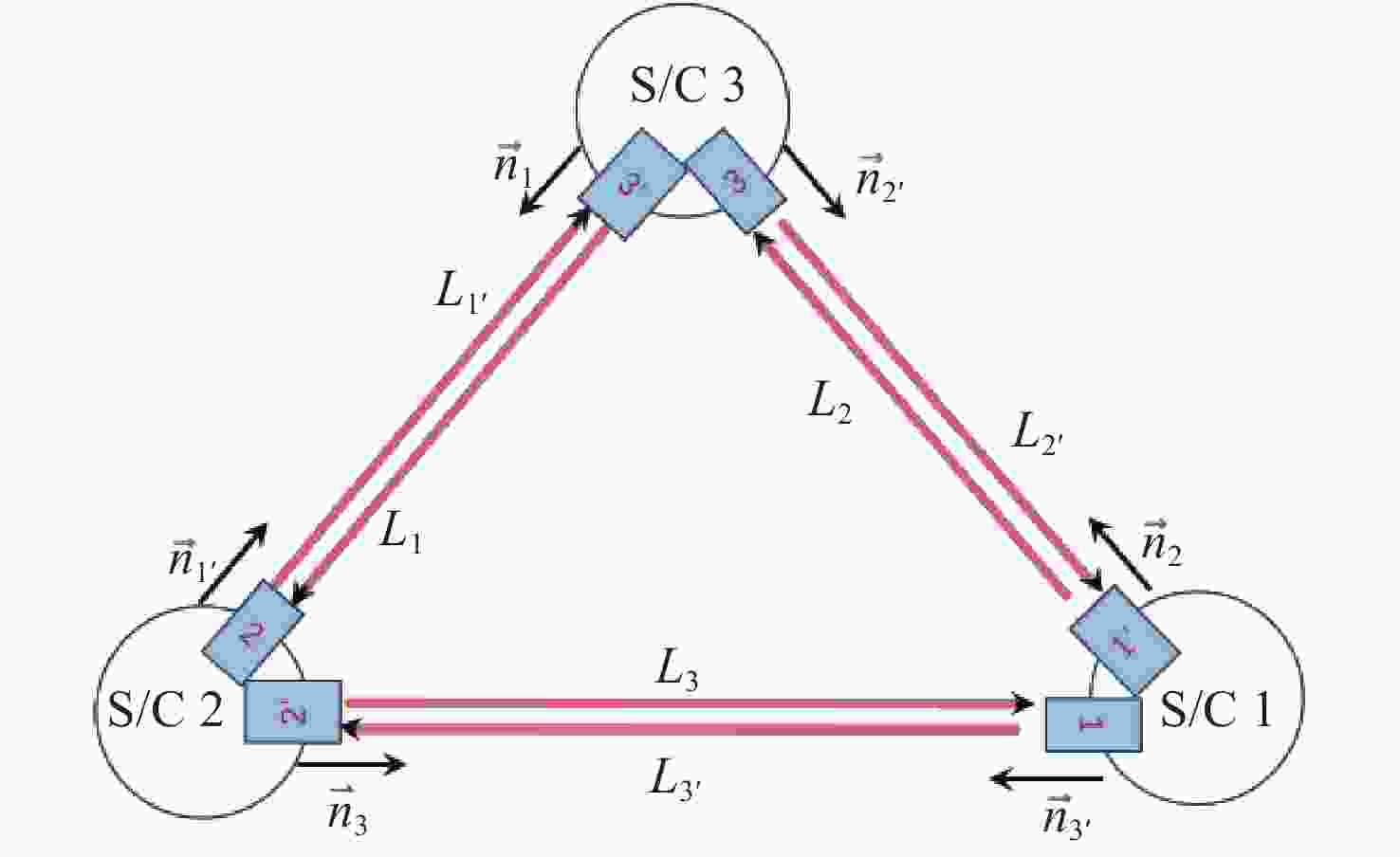
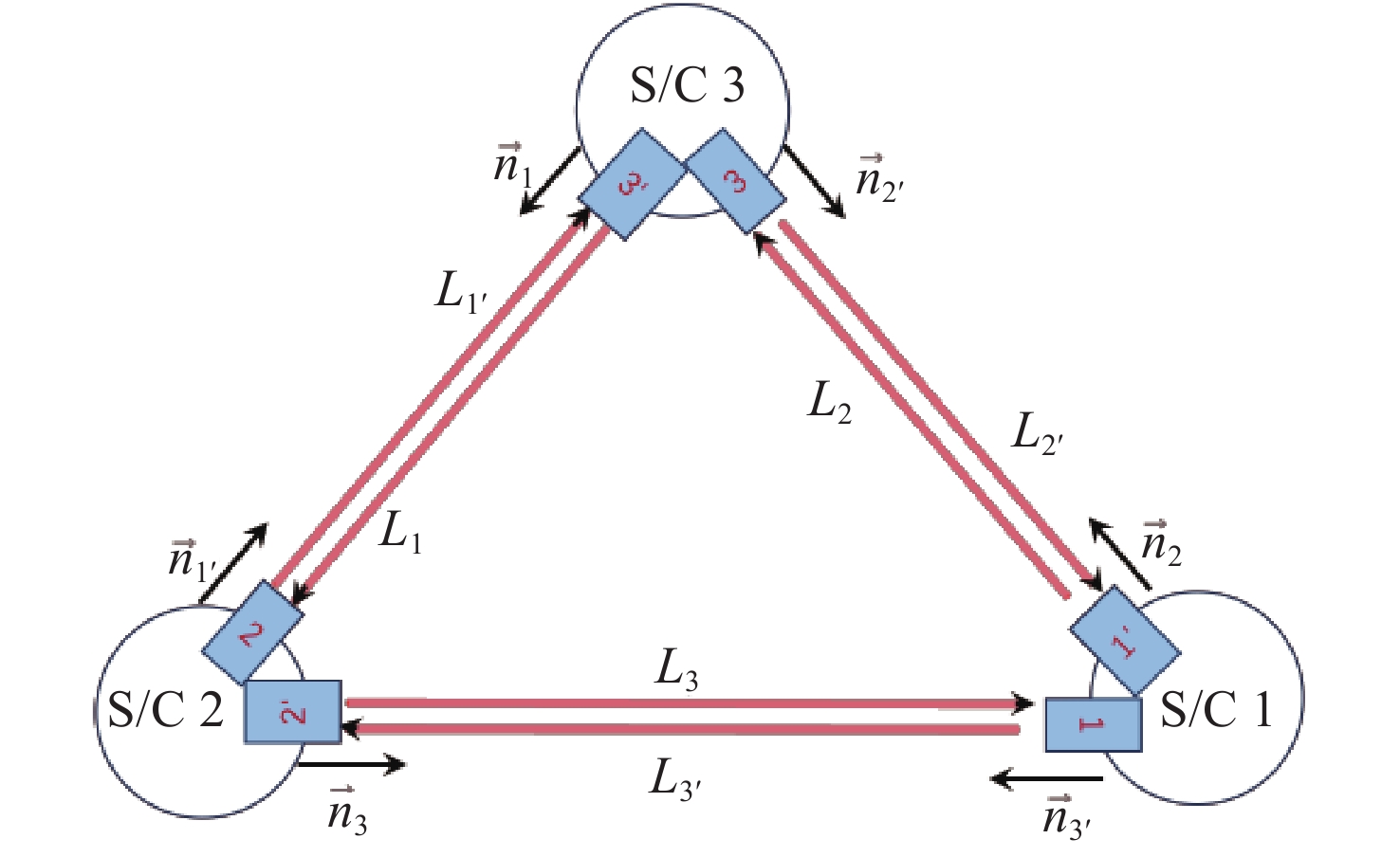
图 1 类LISA任务的星座构型与光路示意图
Figure 1. Schematic of the LISA-like detector constellation and optical paths
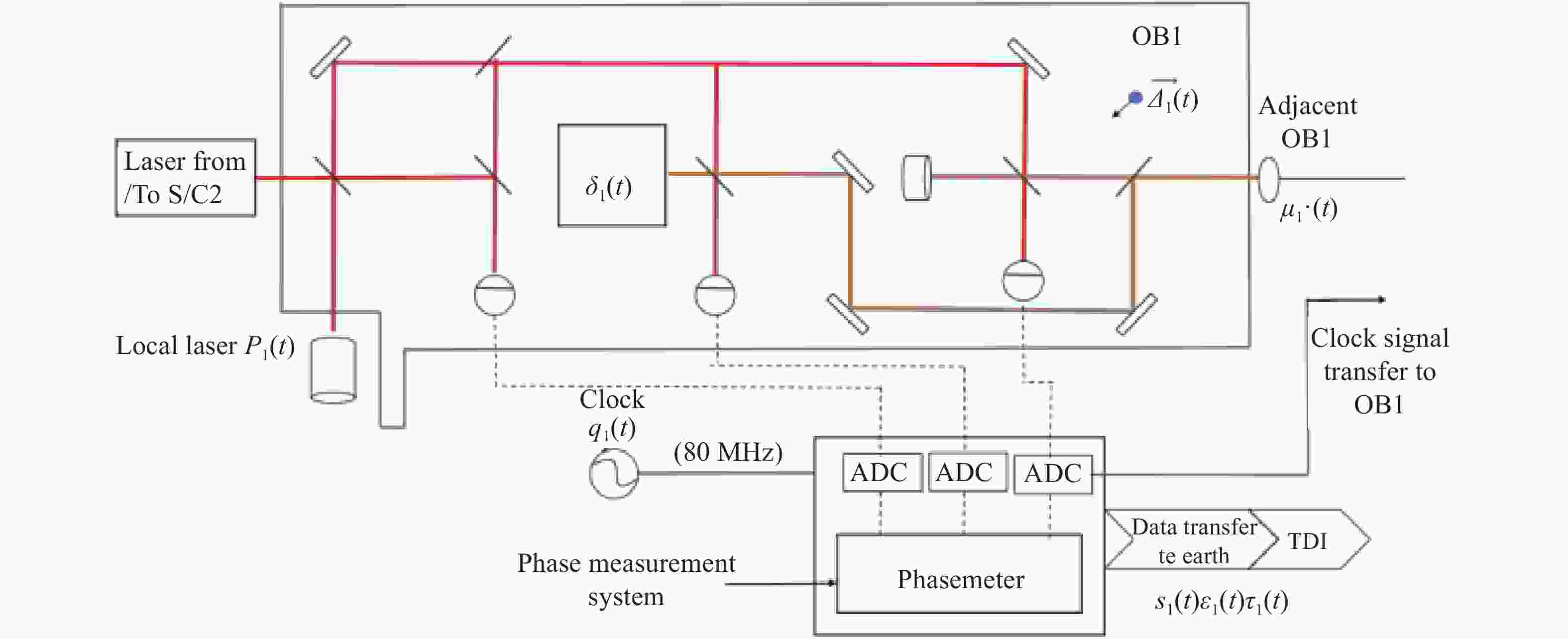
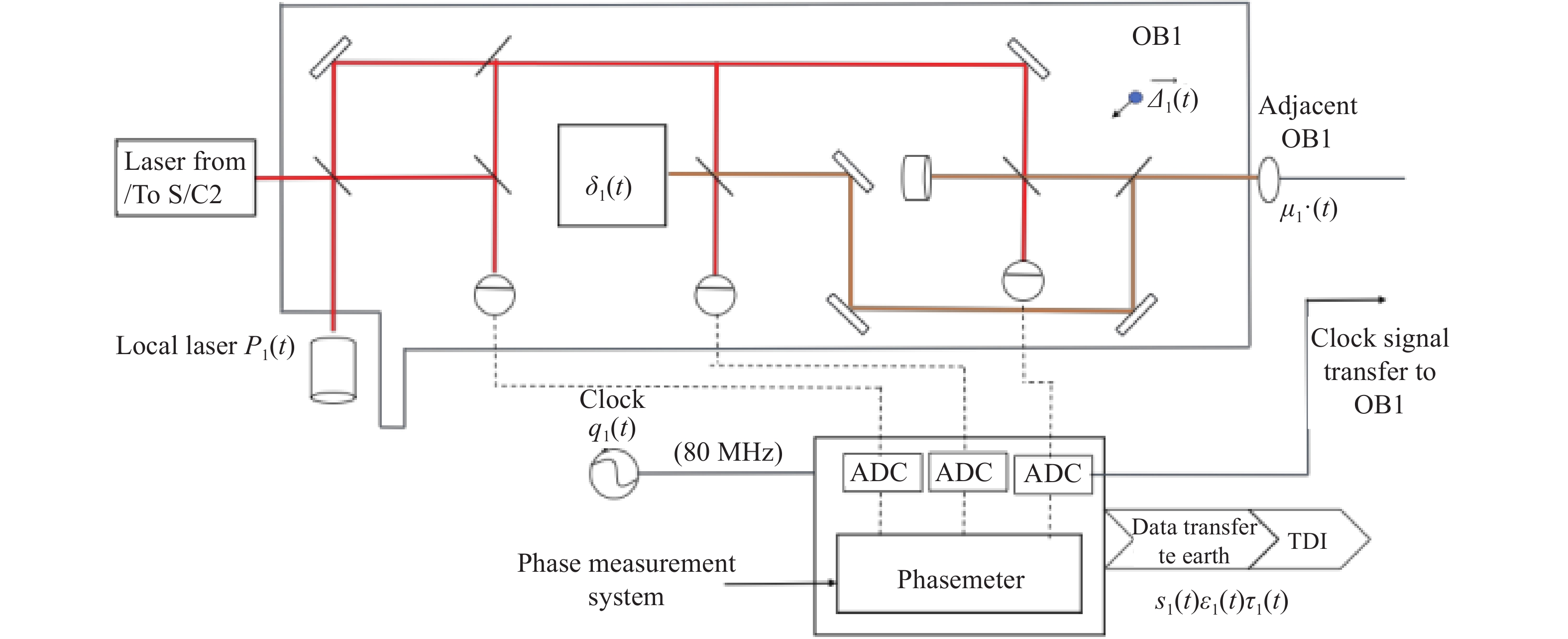
图 2 类LISA任务的传统光学平台设计图
Figure 2. Conventional optical bench architecture for LISA-like missions
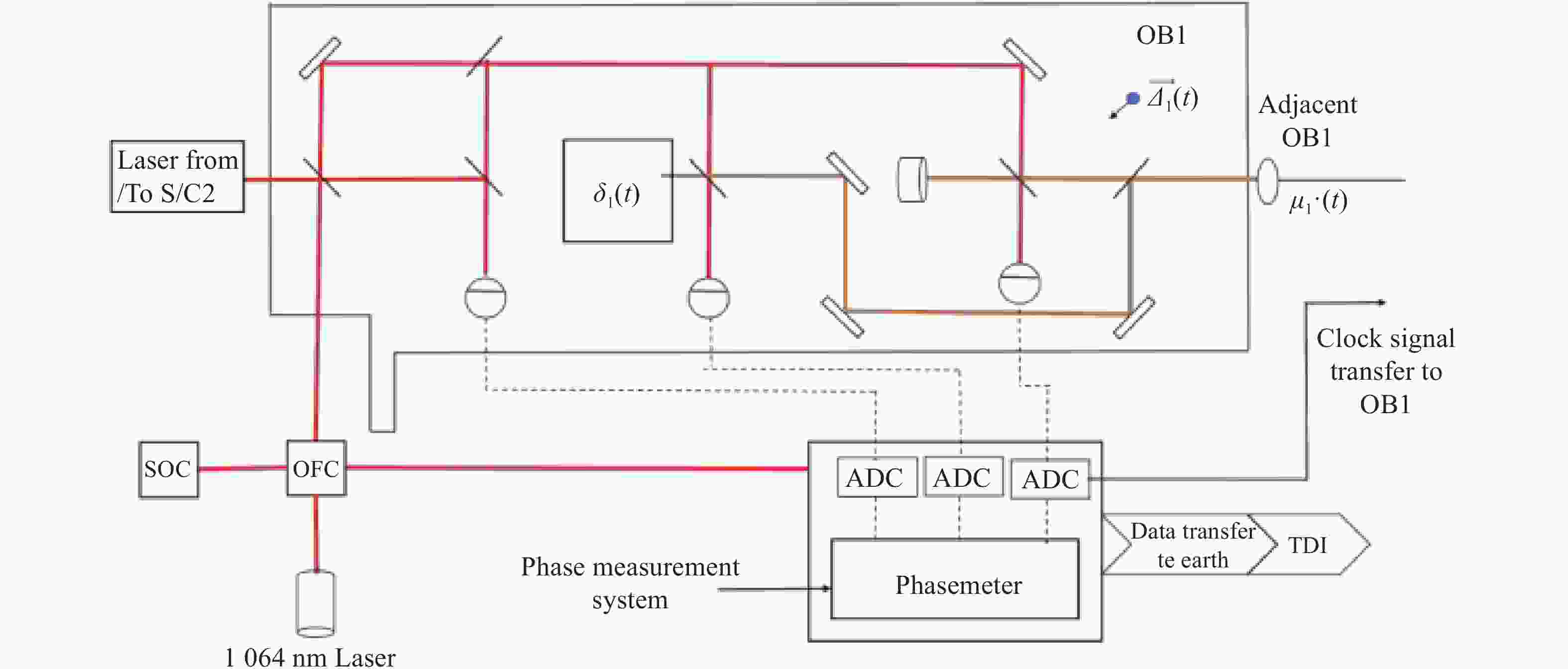
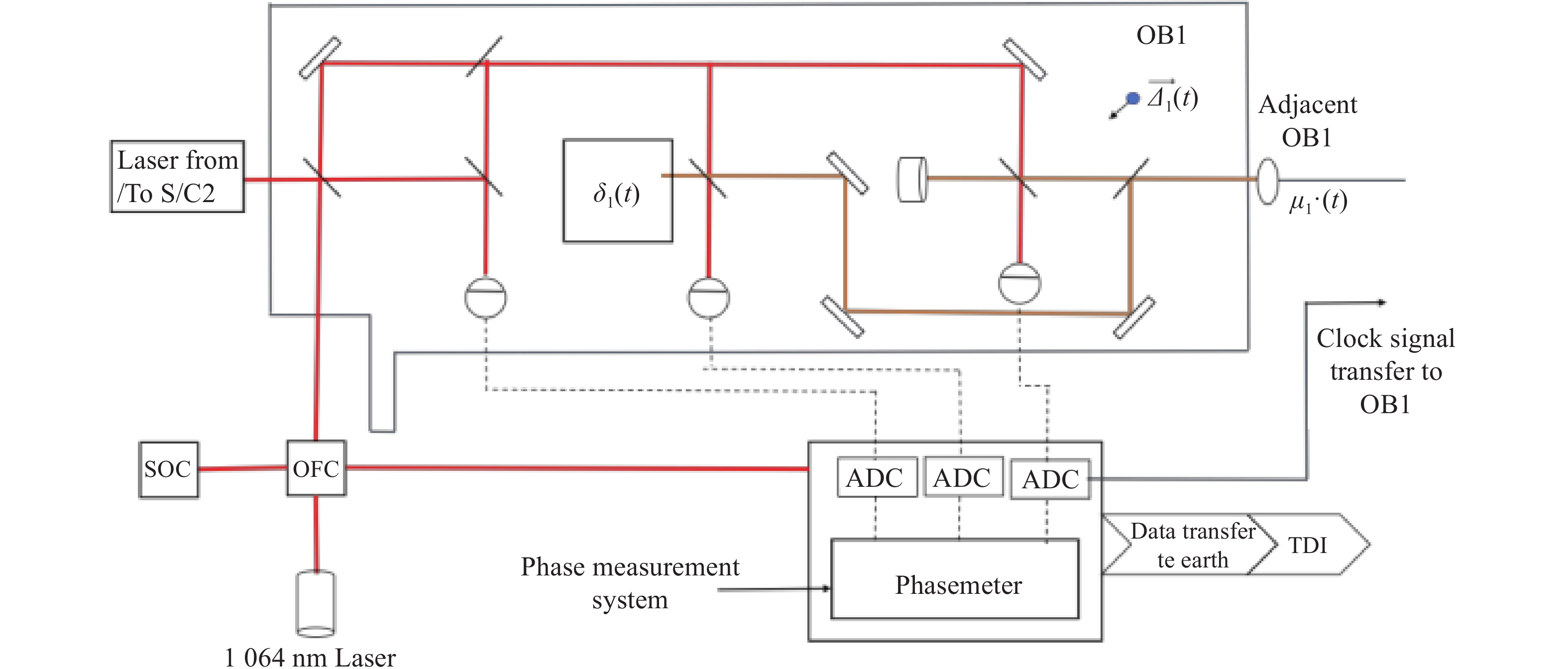
图 3 集成SOC系统的升级光学平台设计图
Figure 3. Upgraded optical bench architecture integrating the SOC system
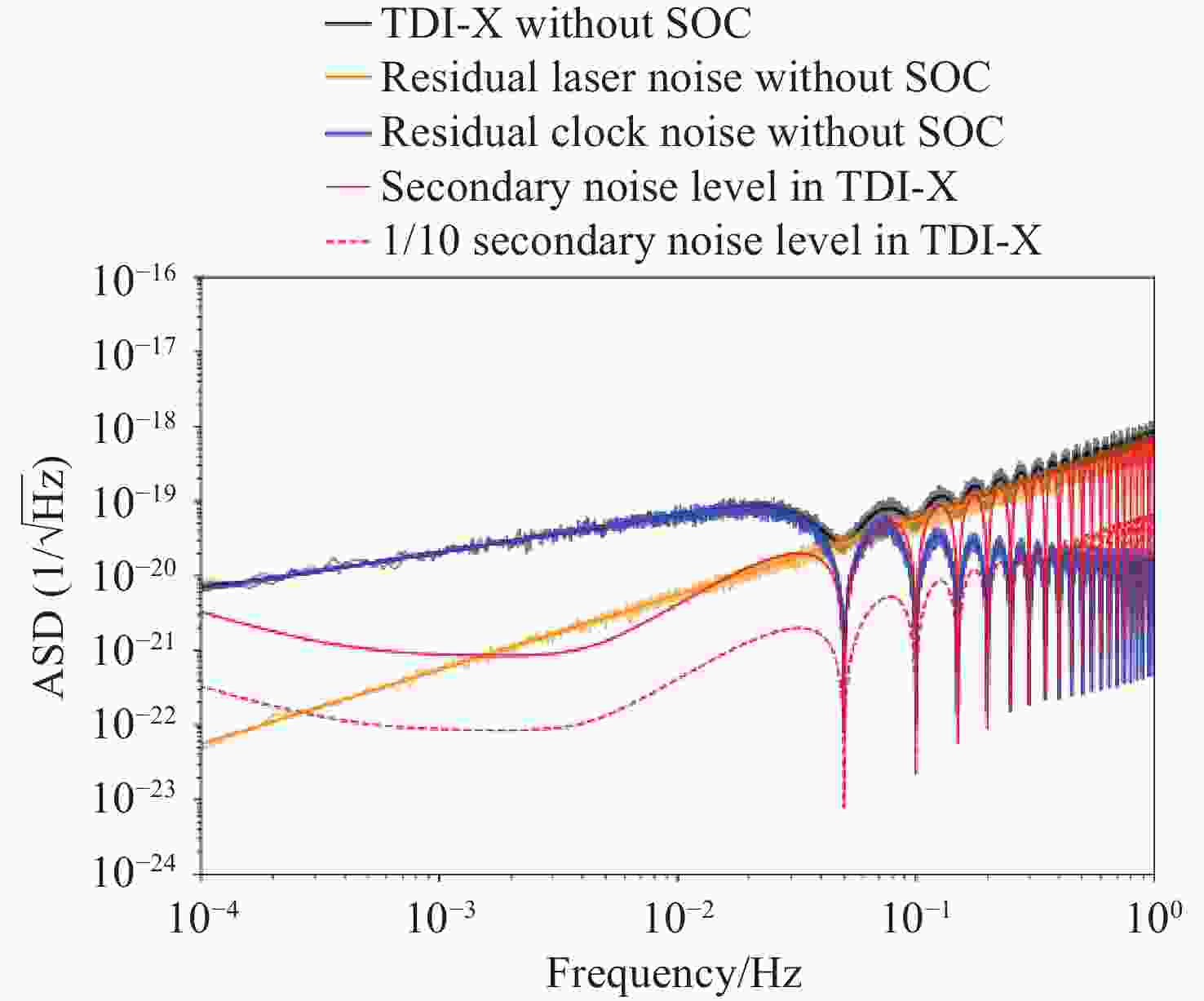
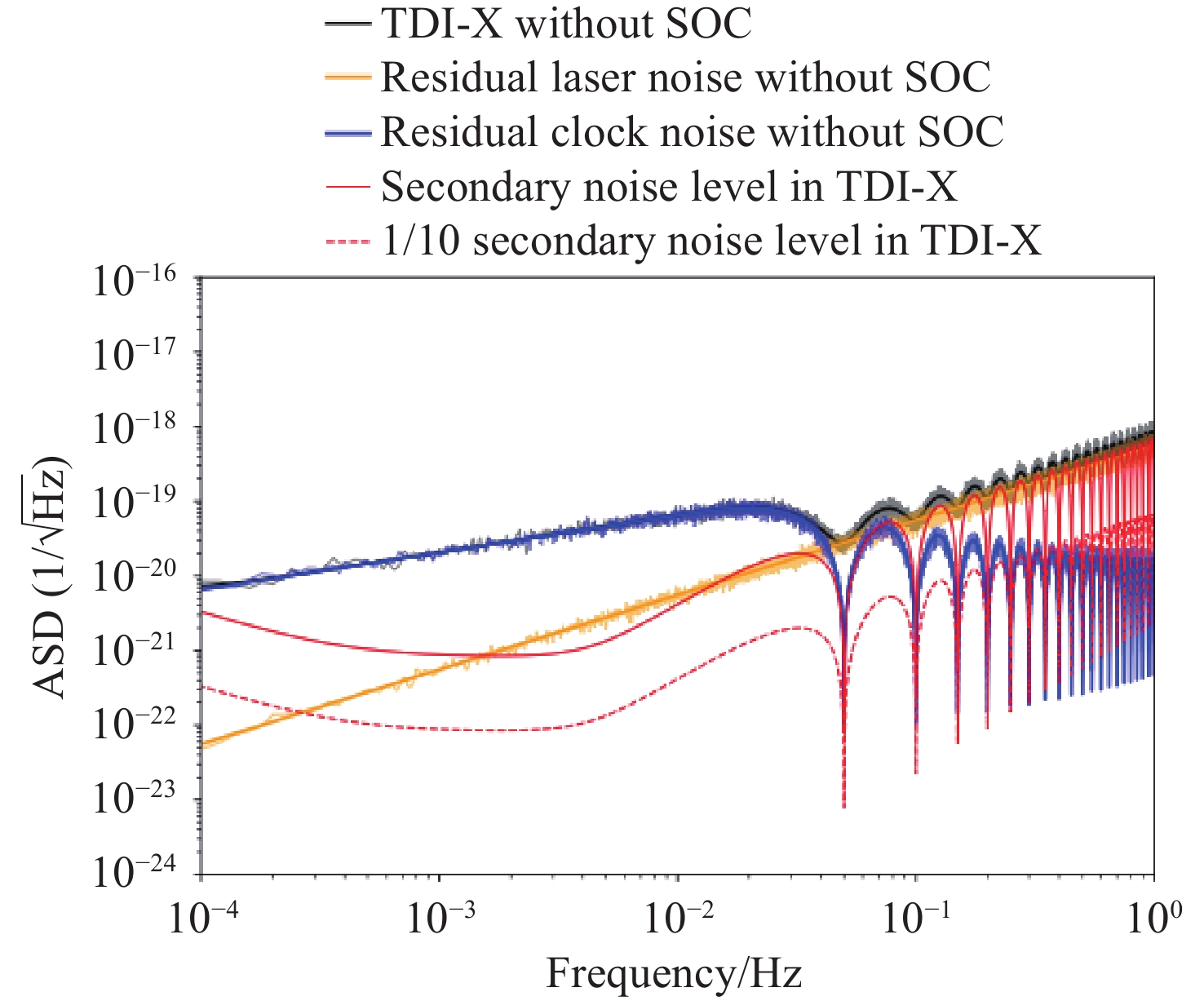
图 4 传统的第一代TDI(Michelson-X组合)数据处理后的残余噪声功率谱图
Figure 4. ASD of residual noise following conventional first-generation TDI (Michelson-X configuration) processing
-
[1] DANZMANN K, RÜDIGER A. LISA technology—concept, status, prospects[J]. Classical and Quantum Gravity, 2003, 20(10): S1-S9. [2] BARAUSSE E, BERTI E, HERTOG T, et al. Prospects for fundamental physics with LISA[J]. General Relativity and Gravitation, 2020, 52(8): 81. [3] JENNRICH O. LISA technology and instrumentation[J]. Classical and Quantum Gravity, 2009, 26(15): 153001. doi: 10.1088/0264-9381/26/15/153001 [4] DANZMANN K. LISA mission overview[J]. Advances in Space Research, 2000, 25(6): 1129-1136. [5] LUO J, CHEN L S, DUAN H Z, et al. Tianqin: a space-borne gravitational wave detector[J]. Classical and Quantum Gravity, 2016, 33(3): 035010. [6] HU W R, WU Y L. The Taiji Program in Space for gravitational wave physics and the nature of gravity[J]. National Science Review, 2017, 4(5): 685-686. [7] COLPI M, DANZMANN K, HEWITSON M, et al. LISA definition study report[J]. arXiv preprint arXiv: 2402.07571, 2024. (查阅网上资料, 不确定本文献类型是否正确, 请确认). [8] LUO Z R, GUO Z K, JIN G, et al. A brief analysis to Taiji: science and technology[J]. Results in Physics, 2020, 16: 102918. [9] OTTO M. Time-delay interferometry simulations for the laser interferometer space antenna[D]. Hannover: Gottfried Wilhelm Leibniz Universität Hannover, 2015. [10] 叶磊巧, 杜明辉, 徐鹏, 等. 空间引力波探测“太极计划”星间姿态-光程耦合噪声迭代拟合与高精度抑制方法[J]. 中国光学(中英文), 2025, 18(3): 583-595.YE L Q, DU M H, XU P, et al. Iterative estimation and precision suppression of inter-spacecraft tilt-to-length coupling noise for the Taiji space gravitational wave detection mission[J]. Chinese Optics, 2025, 18(3): 583-595. (in Chinese). [11] 王雷刚, 云恩学, 罗鑫, 等. 空间引力波探测中超低附加相噪频综研究[J]. 中国光学(中英文), 2025, 18(3): 661-671.WANG L G, YUN E X, LUO X, et al. Ultralow residual phase noise frequency synthesizer for space gravitational wave detection[J]. Chinese Optics, 2025, 18(3): 661-671. (in Chinese). [12] CANDELIER V, CANZIAN P, LAMBOLEY J, et al. Space qualified 5 MHz ultra stable oscillators[C]. IEEE International Frequency Control Symposium and PDA Exhibition Jointly with the 17th European Frequency and Time Forum, 2003. Proceedings of the 2003, IEEE, 2003: 575-582. [13] TINTO M, HARTWIG O. Time-delay interferometry and clock-noise calibration[J]. Physical Review D, 2018, 98(4): 042003. [14] HARTWIG O, BAYLE J B. Clock-jitter reduction in LISA time-delay interferometry combinations[J]. Physical Review D, 2021, 103(12): 123027. [15] NI W T, SHY J M, TSENG S M, et al. Progress in mission concept study and laboratory development for the astrodynamical space test of relativity using optical devices (ASTROD)[J]. Proceedings of SPIE, 1997, 3116: 105-116. [16] ARMSTRONG J W, ESTABROOK F B, TINTO M. Time-delay interferometry for space-based gravitational wave searches[J]. The Astrophysical Journal, 1999, 527(2): 814-826. [17] TINTO M, ESTABROOK F B, ARMSTRONG J W. Time-delay interferometry for LISA[J]. Physical Review D, 2002, 65(8): 082003. [18] TINTO M, DHURANDHAR S V. Time-delay interferometry[J]. Living Reviews in Relativity, 2005, 8(1): 4. [19] TINTO M, DHURANDHAR S, MALAKAR D. Second-generation time-delay interferometry[J]. Physical Review D, 2023, 107(8): 082001. [20] OTTO M, HEINZEL G, DANZMANN K. TDI and clock noise removal for the split interferometry configuration of LISA[J]. Classical and Quantum Gravity, 2012, 29(20): 205003. [21] TINTO M, YU N. Time-delay interferometry with optical frequency comb[J]. Physical Review D, 2015, 92(4): 042002. [22] VINCKIER Q, TINTO M, GRUDININ I, et al. Experimental demonstration of time-delay interferometry with optical frequency comb[J]. Physical Review D, 2020, 102(6): 062002. [23] TAN Y J, XU M Y, WANG P P, et al. Modified time-delay interferometry with an optical frequency comb[J]. Physical Review D, 2022, 106(4): 044010. [24] WU H ZH, WANG P P, HAO P, et al. Time delay interferometry using laser frequency comb as the direct signal source[J]. Optics and Lasers in Engineering, 2022, 151: 106938. [25] DE VINE G, WARE B, MCKENZIE K, et al. Experimental demonstration of time-delay interferometry for the Laser Interferometer Space Antenna[J]. Physical Review Letters, 2010, 104(21): 211103. [26] YAMAMOTO K, BYKOV I, REINHARDT J N, et al. Experimental end-to-end demonstration of intersatellite absolute ranging for the Laser Interferometer Space Antenna[J]. Physical Review Applied, 2024, 22(5): 054020. [27] LI X K, LIU H SH, WU P ZH, et al. Proof-of-principle experimental demonstration of time-delay-interferometry for Chinese space-borne gravitational wave detection missions[J]. Microgravity Science and Technology, 2022, 34(4): 64. [28] XU M Y, TAN Y J, LIANG Y R, et al. Experimental demonstration of sub-100 picometer level signal extraction with time-delay interferometry technique[J]. Results in Physics, 2024, 56: 107221. [29] WANG G. Time delay interferometry with minimal null frequencies[J]. Physical Review D, 2024, 110(4): 042005. [30] WANG G. Time delay interferometry with minimal null frequencies and shortened time span[J]. Science China Physics, Mechanics & Astronomy, 2026, 69(2): 220411. [31] CASTELLI E, BAGHI Q, BAKER J G, et al. Extracting gravitational wave signals from LISA data in the presence of artifacts[J]. Classical and Quantum Gravity, 2025, 42(6): 065018. [32] REINHARDT J N, EURINGER P, HARTWIG O, et al. Time-delay interferometry with onboard optical delays[J]. Physical Review D, 2024, 110(8): 082005. [33] ORIGLIA S, PRAMOD M S, SCHILLER S, et al. Towards an optical clock for space: Compact, high-performance optical lattice clock based on bosonic atoms[J]. Physical Review A, 2018, 98(5): 053443. [34] WANG Y B, YIN M J, REN J, et al. Strontium optical lattice clock at the National Time Service Center[J]. Chinese Physics B, 2018, 27(2): 023701. [35] KONG D H, WANG ZH H, GUO F, et al. A transportable optical lattice clock at the National Time Service Center[J]. Chinese Physics B, 2020, 29(7): 070602. [36] LI J, CUI X Y, JIA ZH P, et al. A strontium lattice clock with both stability and uncertainty below $ 5\times {10}^{-18} $ [J]. Metrologia, 2024, 61(1): 015006.[37] KOLKOWITZ S, PIKOVSKI I, LANGELLIER N, et al. Gravitational wave detection with optical lattice atomic clocks[J]. Physical Review D, 2016, 94(12): 124043. [38] WANG B, LI B CH, XIAO Q Q, et al. Space-based optical lattice clocks as gravitational wave detectors in search for new physics[J]. Science China Physics, Mechanics & Astronomy, 2025, 68(4): 249512. [39] WANG P P, TAN Y J, QIAN W L, et al. Refined clock-jitter reduction in the Sagnac-type time-delay interferometry combinations[J]. Physical Review D, 2021, 104(8): 082002. [40] WANG G. Time-delay interferometry for ASTROD-GW[D]. Nanjing: Purple Mountain Observatory, 2011. [41] GHOSH S, SANJUAN J, MUELLER G. Arm locking performance with the new LISA design[J]. Classical and Quantum Gravity, 2022, 39(11): 115009. [42] TAMM C, HUNTEMANN N, LIPPHARDT B, et al. Cs-based optical frequency measurement using cross-linked optical and microwave oscillators[J]. Physical Review A, 2014, 89(2): 023820. [43] BARWOOD G P, HUANG G, KLEIN H A, et al. Agreement between two 88 $ \mathrm{S}{\mathrm{r}}^{+} $ optical clocks to 4 parts in$ {10}^{17} $ [J]. Physical Review A, 2014, 89(5): 050501.[44] BARWOOD G P, EDWARDS C S, PILL G, et al. Observation of the 5s2S1/2−4d2D5/2 transition in a single laser-cooled trapped Sr+ ion by using an all-solid-state system of lasers[J]. Optics Letters, 1993, 18(9): 732-734. [45] BARWOOD G, GILL P, HUANG G, et al. Characterization of a 88Sr+ optical frequency standard at 445 THz by two-trap comparison[C]. 2012 Conference on Precision Electromagnetic Measurements, IEEE, 2012: 270-271. [46] TAKAMOTO M, HONG F L, HIGASHI R, et al. An optical lattice clock[J]. Nature, 2005, 435(7040): 321-324. [47] AL-MASOUDI A, DÖRSCHER S, HÄFNER S, et al. Noise and instability of an optical lattice clock[J]. Physical Review A, 2015, 92(6): 063814. [48] RILEY W, HOWE D A. Handbook of frequency stability analysis[R]. 2008. (查阅网上资料, 未找到本条文献出版信息, 请确认). [49] KIPPENBERG T J, HOLZWARTH R, DIDDAMS S A. Microresonator-based optical frequency combs[J]. Science, 2011, 332(6029): 555-559. [50] DIDDAMS S A. The evolving optical frequency comb [invited][J]. Journal of the Optical Society of America B, 2010, 27(11): B51-B62. [51] CHANG L, LIU S T, BOWERS J E. Integrated optical frequency comb technologies[J]. Nature Photonics, 2022, 16(2): 95-108. [52] FORTIER T, BAUMANN E. 20 years of developments in optical frequency comb technology and applications[J]. Communications Physics, 2019, 2(1): 153. [53] JONES D J, DIDDAMS S A, RANKA J K, et al. Carrier-envelope phase control of femtosecond mode-locked lasers and direct optical frequency synthesis[J]. Science, 2000, 288(5466): 635-639. [54] MA L SH, BI ZH Y, BARTELS A, et al. Optical frequency synthesis and comparison with uncertainty at the $ {10}^{-19} $ level[J]. Science, 2004, 303(5665): 1843-1845.[55] LUO Z R, GUO Z K, JIN G, et al. A brief analysis to Taiji: science and technology[J]. Results in Physics, 2020, 16: 102918. (查阅网上资料, 本条文献与第8条文献重复, 请确认). [56] SCHMIDT T D, SCHLÜTER S, SCHULDT T, et al. COMPASSO: in-orbit verification of optical key technologies for future GNSS[C]. Proceedings of the 53rd Annual Precise Time and Time Interval Systems and Applications Meeting, The Institute of Navigation, 2022: 158-182. [57] PRÖBSTER B J, LEZIUS M, MANDEL O, et al. FOKUS II—Space flight of a compact and vacuum compatible dual frequency comb system[J]. Journal of the Optical Society of America B, 2021, 38(3): 932-939. [58] BAGHI Q, THORPE J I, SLUTSKY J, et al. Gravitational-wave parameter estimation with gaps in LISA: A Bayesian data augmentation method[J]. Physical Review D, 2019, 100(2): 022003. [59] BURKE O, MARSAT S, GAIR J R, et al. Addressing data gaps and assessing noise mismodeling in LISA[J]. Physical Review D, 2025, 111(12): 124053. [60] XU Y X, DU M H, XU P, et al. Gravitational wave signal extraction against non-stationary instrumental noises with deep neural network[J]. Physics Letters B, 2024, 858: 139016. [61] DU M H, WANG P CH, LUO Z R, et al. Towards realistic detection pipelines of Taiji: New challenges in data analysis and high-fidelity simulations of space-based gravitational wave antenna[J]. Science China Physics, Mechanics & Astronomy, 2026, 69(4): 249501. [62] HEINZEL G, ÁLVAREZ-VIZOSO J, DOVALE-ÁLVAREZ M, et al. Frequency planning for LISA[J]. Physical Review D, 2024, 110(4): 042002. [63] PIREAUX S. Time scales in LISA[J]. Classical and Quantum Gravity, 2007, 24(9): 2271-2281. [64] TINTO M, DHURANDHAR S V. Time-delay interferometry[J]. Living Reviews in Relativity, 2005, 8(1): 4. (查阅网上资料, 本条文献与第18条文献重复, 请确认). [65] WANG Y, HEINZEL G, DANZMANN K. First stage of LISA data processing: Clock synchronization and arm-length determination via a hybrid-extended Kalman filter[J]. Physical Review D, 2014, 90(6): 064016. [66] NIKLAS REINHARDT J, HARTWIG O, HEINZEL G. Clock synchronization and light-travel-time estimation for space-based gravitational-wave detectors[J]. Classical and Quantum Gravity, 2025, 42(5): 055014. [67] 陈沛权, 邓汝杰, 张艺斌, 等. 太极计划星间激光通信测距的伪随机码选取[J]. 中国光学(中英文), 2025, 18(3): 547-556.CHEN P Q, DENG R J, ZHANG Y B, et al. Pseudo-random code selection for inter-satellite laser ranging and data communication in the Taiji program[J]. Chinese Optics, 2025, 18(3): 547-556. (in Chinese). [68] 方子若, 朱振才, 蔡志鸣, 等. 空间引力波探测航天器光学测距噪声链路指标优化[J]. 中国光学(中英文), 2025, 18(3): 568-582.FANG Z R, ZHU ZH C, CAI ZH M, et al. Optimization of optical metrology noise link metrics for space-based gravitational wave detection spacecraft[J]. Chinese Optics, 2025, 18(3): 568-582. (in Chinese). [69] DIMARCQ N, GERTSVOLF M, MILETI G, et al. Roadmap towards the redefinition of the second[J]. Metrologia, 2024, 61(1): 012001. [70] LU X T, GUO F, LIU Y Y, et al. NTSC SrII optical lattice clock with uncertainty of 2 × 10⁻¹⁸[J]. Metrologia, 2025, 62(3): 035007. -

 下载:
下载:


计量
- 文章访问数: 260
- HTML全文浏览量: 103
- PDF下载量: 8
- 被引次数: 0
