



Research progress of dispersion scan techniques in ultrashort pulse characterization
-
摘要:
色散扫描(Dispersion scan, D-scan)是一种基于色散调制与非线性频谱响应的超短激光脉冲表征技术,凭借其极简的光路设计和对宽带频谱及相位演化特征的高灵敏响应,已发展成为超短激光脉冲表征领域的重要工具。本文以D-scan技术持续适应激光脉冲表征实时性、鲁棒性等需求,以及向单周期、深紫外等极端参数拓展为核心主线,系统综述了D-scan技术在优化反演算法及实验方案拓展等方面的关键进展。首先,本文梳理了D-scan反演算法的发展过程,从早期的Nelder–Mead与差分进化算法,到目前作为标准的通用脉冲反演算法,再到实现毫秒级实时重构的深度学习技术。重点分析了各类算法在计算速度、鲁棒性及抗噪性能方面的提升。在实验技术方面,首先回顾了基于二阶非线性的二次谐波D-scan技术,详细讨论了其从传统扫描式方案向实时单发测量的技术跨越,同时介绍了基于二次谐波产生的D-scan在矢量光场表征中的最新进展。随后,针对二阶非线性在跨倍频程光谱重叠及深紫外波段相位匹配方面的物理限制,本文进一步探讨了基于三阶非线性效应及其衍生的D-scan技术,系统阐明了这些方法在拓展D-scan应用边界、实现单周期极限与深紫外波段表征方面的关键作用。最后,本文总结了当前D-scan技术在外部元件依赖性、长波长拓展及长脉宽测量方面面临的挑战,并对其在强场物理及阿秒科学中的未来发展方向进行了展望。
Abstract:Dispersion scan (D-scan) is an ultrashort laser pulse characterization technique based on dispersion modulation and nonlinear spectral response, and, owing to its extremely simple optical configuration and high sensitivity to broadband spectra and phase evolution, it has developed into an important tool in the field of ultrashort pulse characterization. Focusing on the ability of D-scan to meet the demands of real-time operation and robustness, as well as its extension toward extreme parameters such as single-cycle pulses and the deep-ultraviolet region, this paper systematically reviews the key progress of D-scan technology in terms of retrieval algorithm optimization and experimental scheme expansion. First, the evolution of D-scan retrieval algorithms is summarized. This progression traces the shift from early Nelder–Mead and differential evolution algorithms to the current standard generalized pulse retrieval algorithm, and ultimately to deep-learning-based techniques that enable millisecond-level, real-time reconstruction. Particular emphasis is placed on the improvements in computational speed, algorithmic robustness, and noise immunity achieved across these diverse approaches. Regarding experimental techniques, the paper examines second-harmonic-generation (SHG) D-scans based on second-order nonlinearities. It details the technological transition from conventional scanning methods to real-time, single-shot measurements, and highlights recent progress in applying SHG D-scans to vectorial optical field characterization. Subsequently, to circumvent the physical limitations of second-order nonlinearities—specifically concerning multi-octave spectral overlap and phase matching in the DUV region—this review further explores D-scan techniques leveraging third-order nonlinear effects and their derivatives. It elucidates how these methodologies push the application boundaries of D-scan toward the single-cycle limit and into the DUV regime. Finally, current challenges confronting D-scan technology are outlined, including its reliance on external components and its extension to longer wavelengths and longer pulse durations. The paper concludes with an outlook on the future trajectory of D-scan technology within strong-field physics and attosecond science.
-
Key words:
- dispersion scan /
- ultra-short pulse characterization /
- phase retrieval /
- nonlinear optics
-
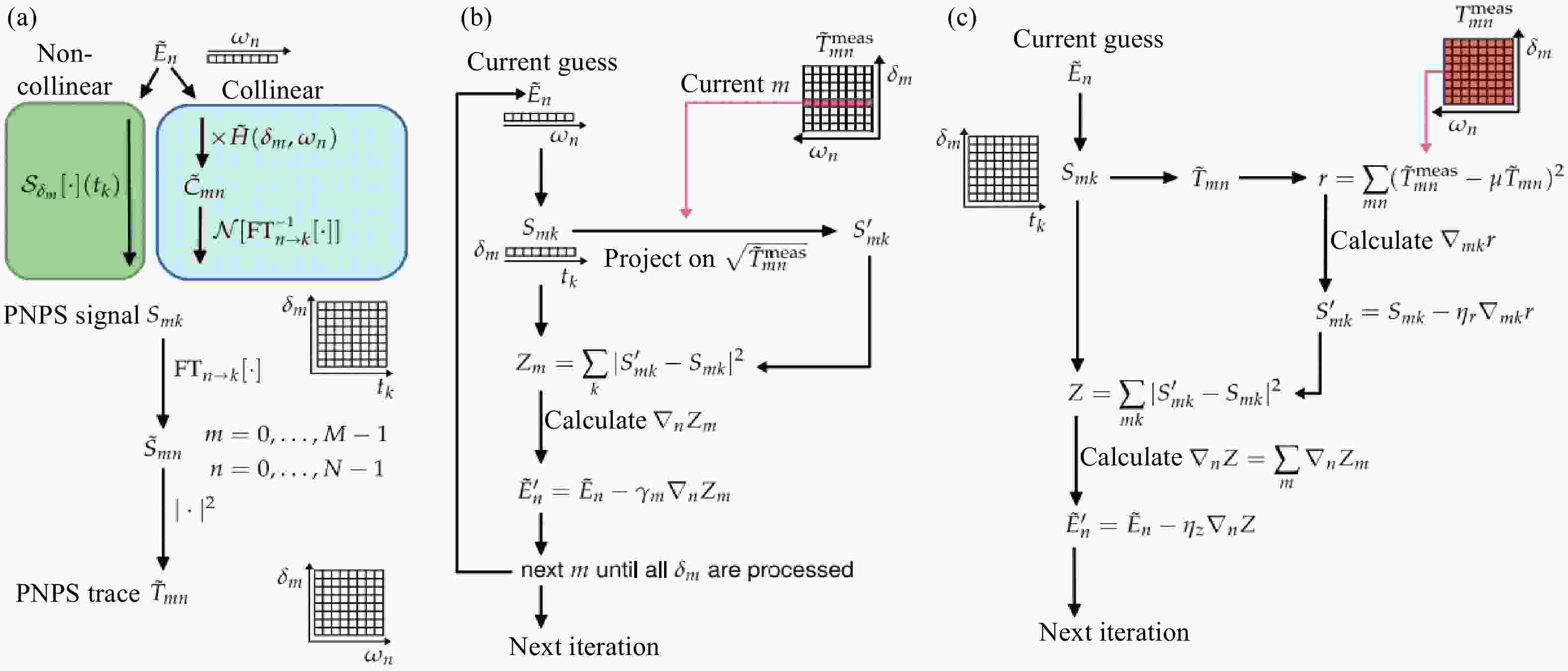
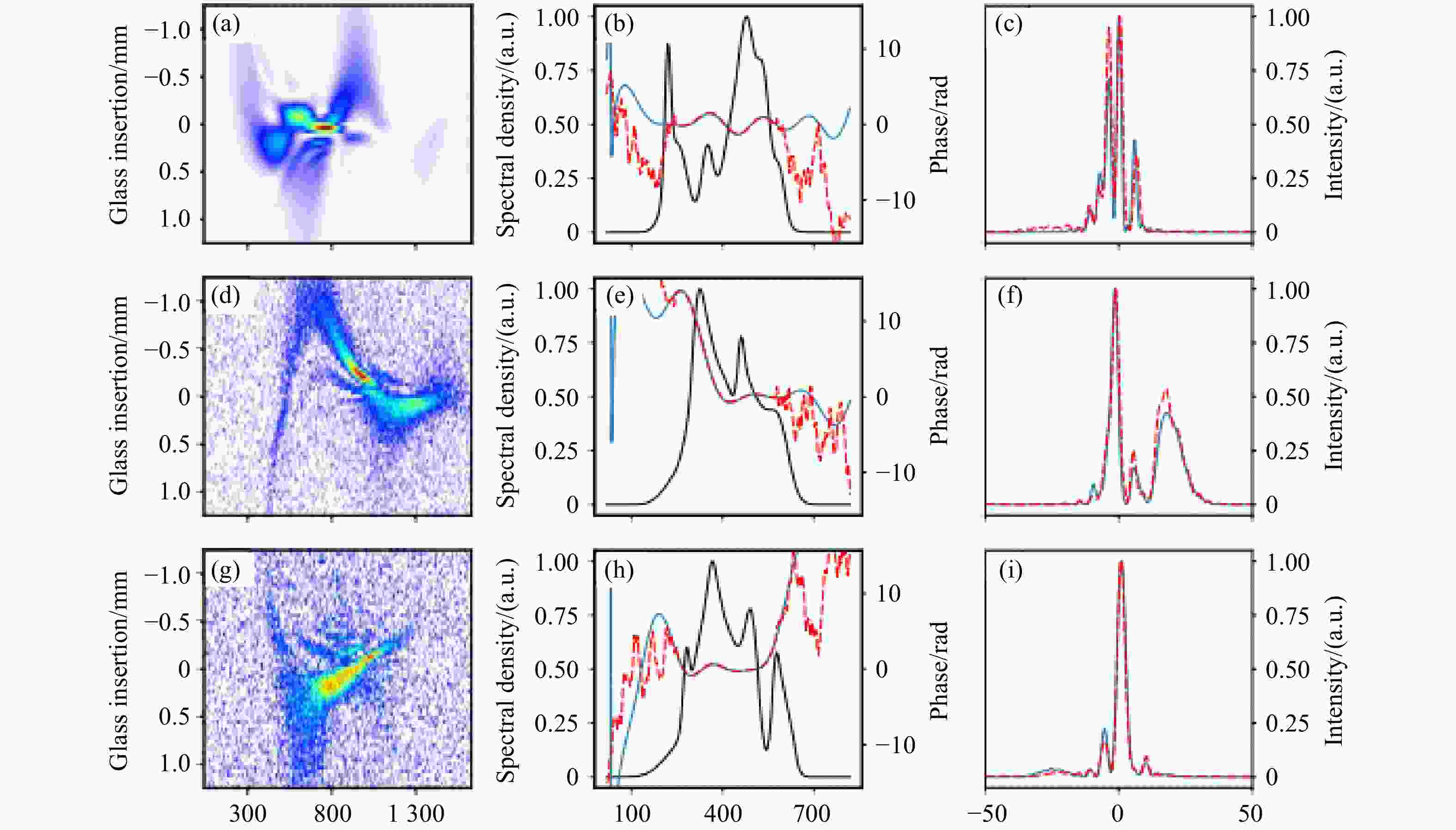
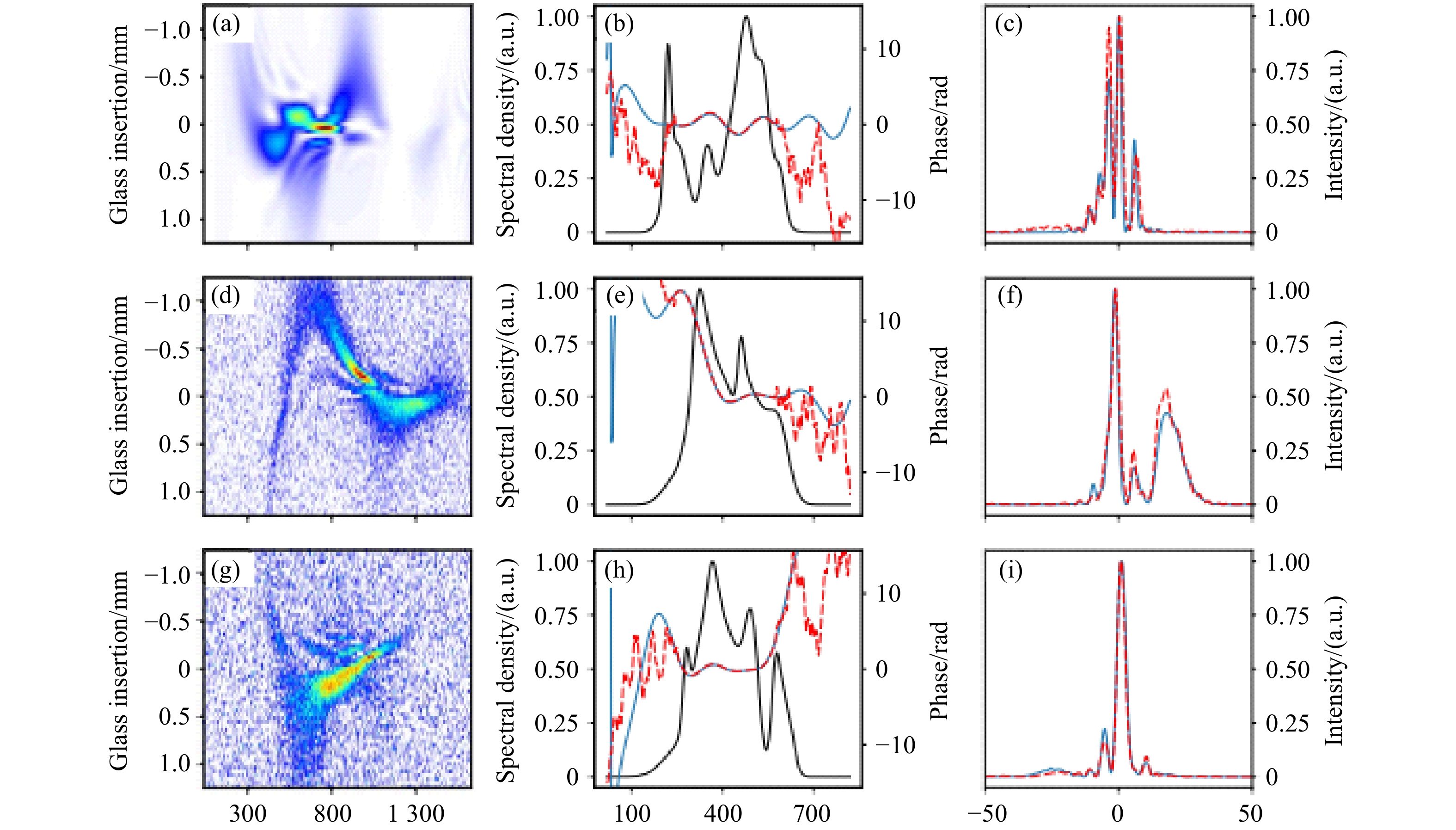
图 2 不同噪声水平下的模拟SHG D-scan测量结果:(a)、(d)、(g)分别展示了随机生成的相位、强度、频谱响应函数加0%、5%、10%白高斯噪声(WGN)的模拟SHG D-scan轨迹;(b)、(e)、(h)对应时间带宽积分别为3.4、7.1和5.3的频谱强度(黑色曲线)、原始信号(蓝色曲线)及恢复相位(红色虚线曲线);(c)、(f)、(i)为最优玻璃插入点处原始(蓝色曲线)与恢复(红色虚线曲线)脉冲波形[24]
Figure 2. Simulated SHG d-scan measurements for different noise levels. (a), (d), (g) Simulated SHG d-scan traces with randomly generated phases, intensities, spectral response functions, and additive WGN of 0%, 5%, and 10%, respectively. (b), (e), (h) Spectral intensities (black curves) together with the original (blue curves) and the retrieved phases (dashed red curves), corresponding to time-bandwidth products of 3.4, 7.1, and 5.3, respectively. (c), (f), (i) Original (blue curves) and retrieved (dashed red curves) pulse shapes in time domain at the optimum glass insertion points[24]
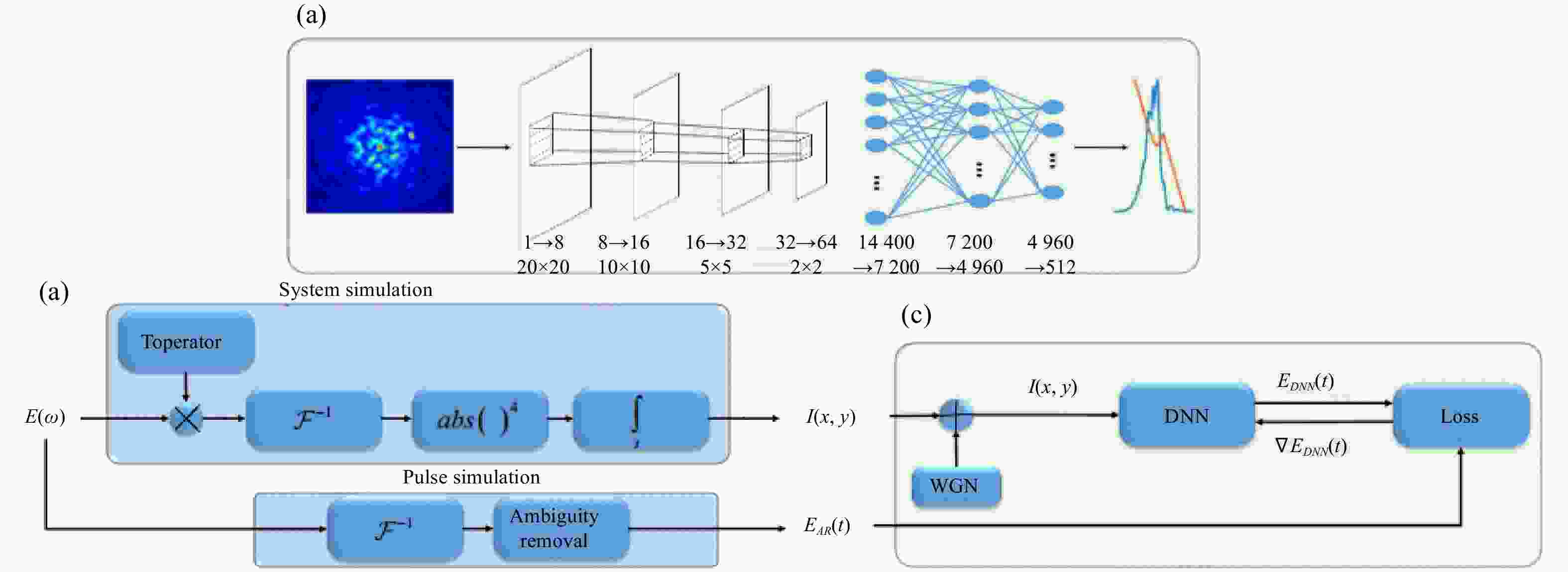
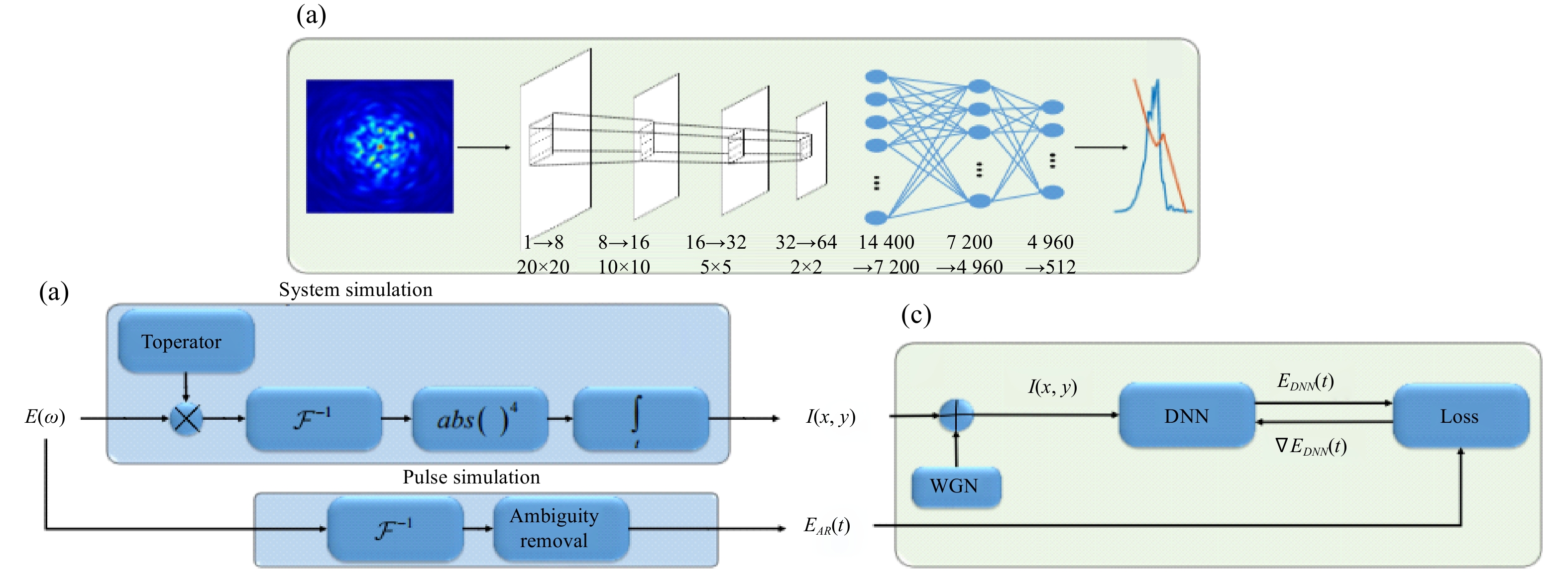
图 3 (A)回归网络架构:包含四个卷积神经网络层,后接三个全连接层。输入信号为总频干扰模式,经计算层处理后,最终输出为时域电场实部与虚部的矢量形式;(B)总频干扰测量及输入频谱脉冲标签生成的框图,模拟输入信号被送入回归网络;(C) 回归网络的监督训练过程。每个干扰模式通过网络进行重建,重建脉冲与真实脉冲波形的误差值通过反向传播和梯度下降算法进行网络训练,从而优化网络参数[25]
Figure 3. (A) Regression network architecture: four CNN layers followed by three fully connected layers. The input to this network is a sum frequency interference pattern, which is passed through the computational layers, until a final output is produced in the form of a vector of the real and imaginary parts of the temporal electric field. (B) Block diagram of sum frequency interference measurement and of the label generation from an input spectral pulse. The input of the simulation is passed on to the regression network. (C) Supervised training of the regression network. Each interference pattern is passed through the network to create a reconstruction. The error between a reconstructed pulse and its ground truth pulse shape is used in back propagation and gradient descent to train the network and improve the network parameters[25]
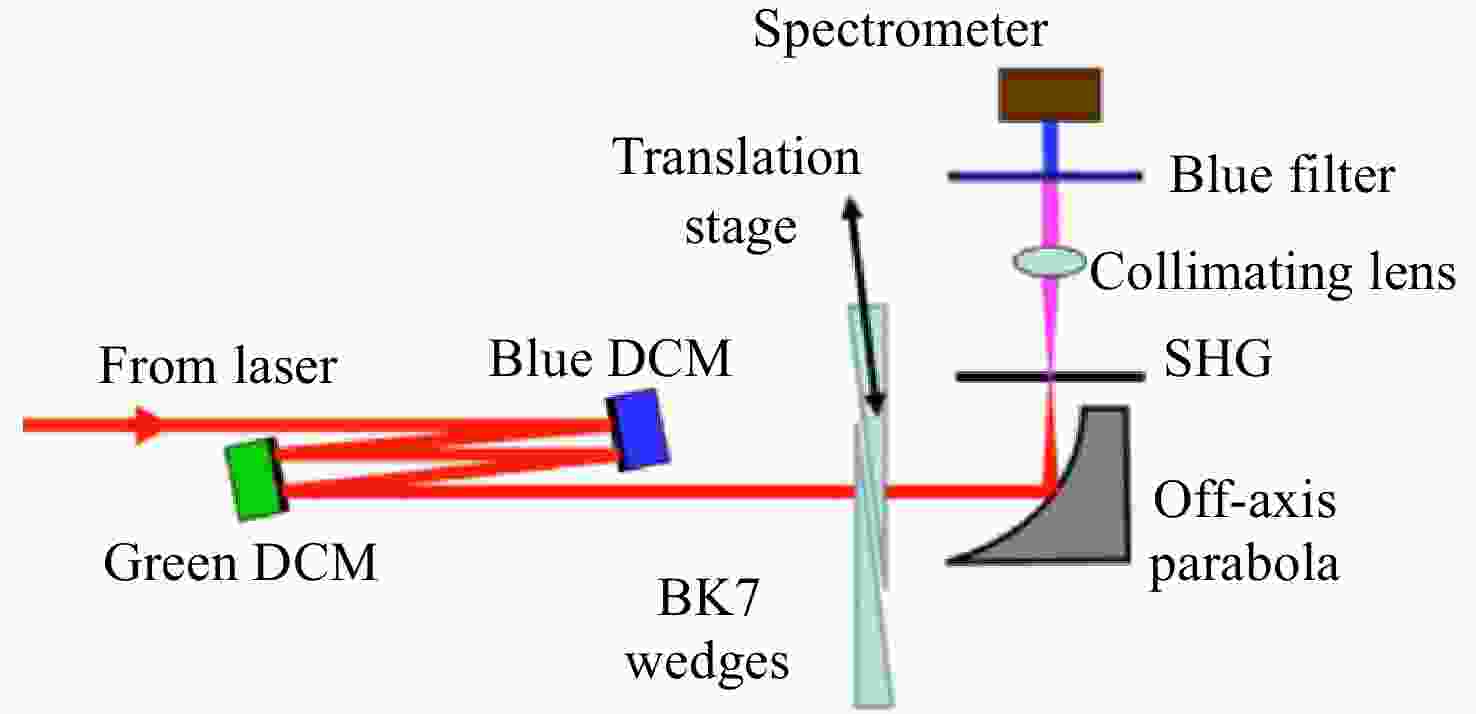
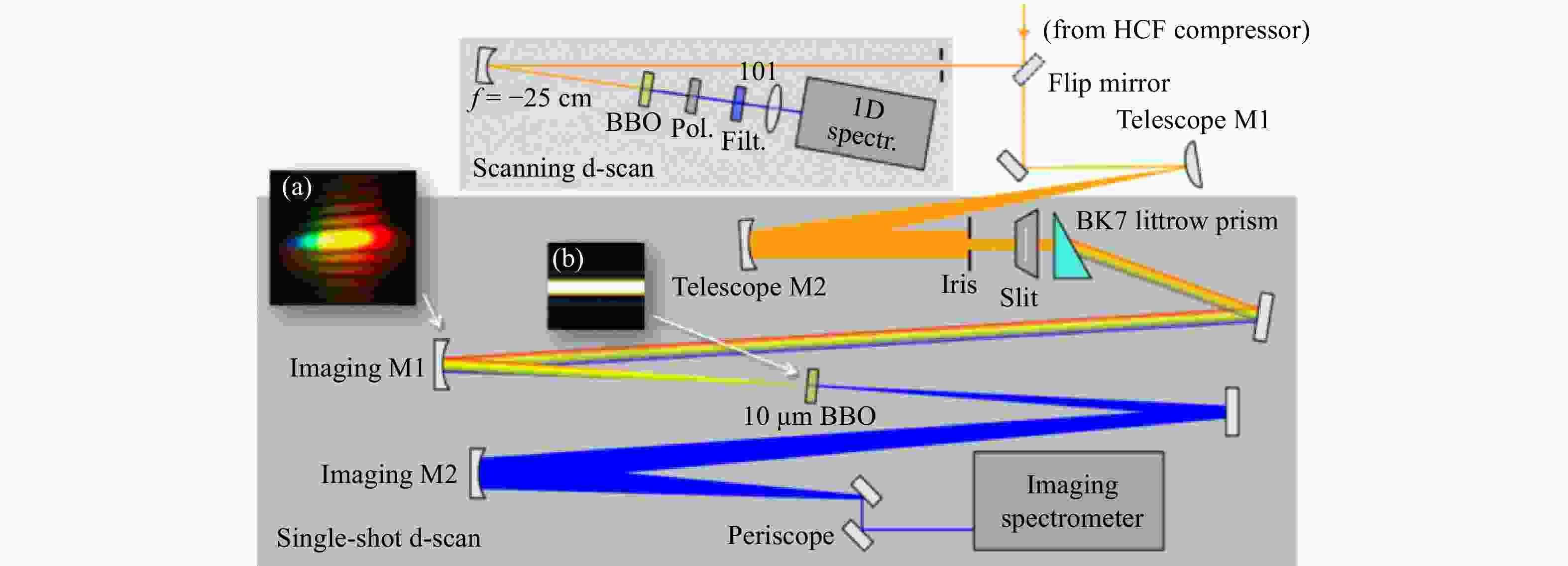
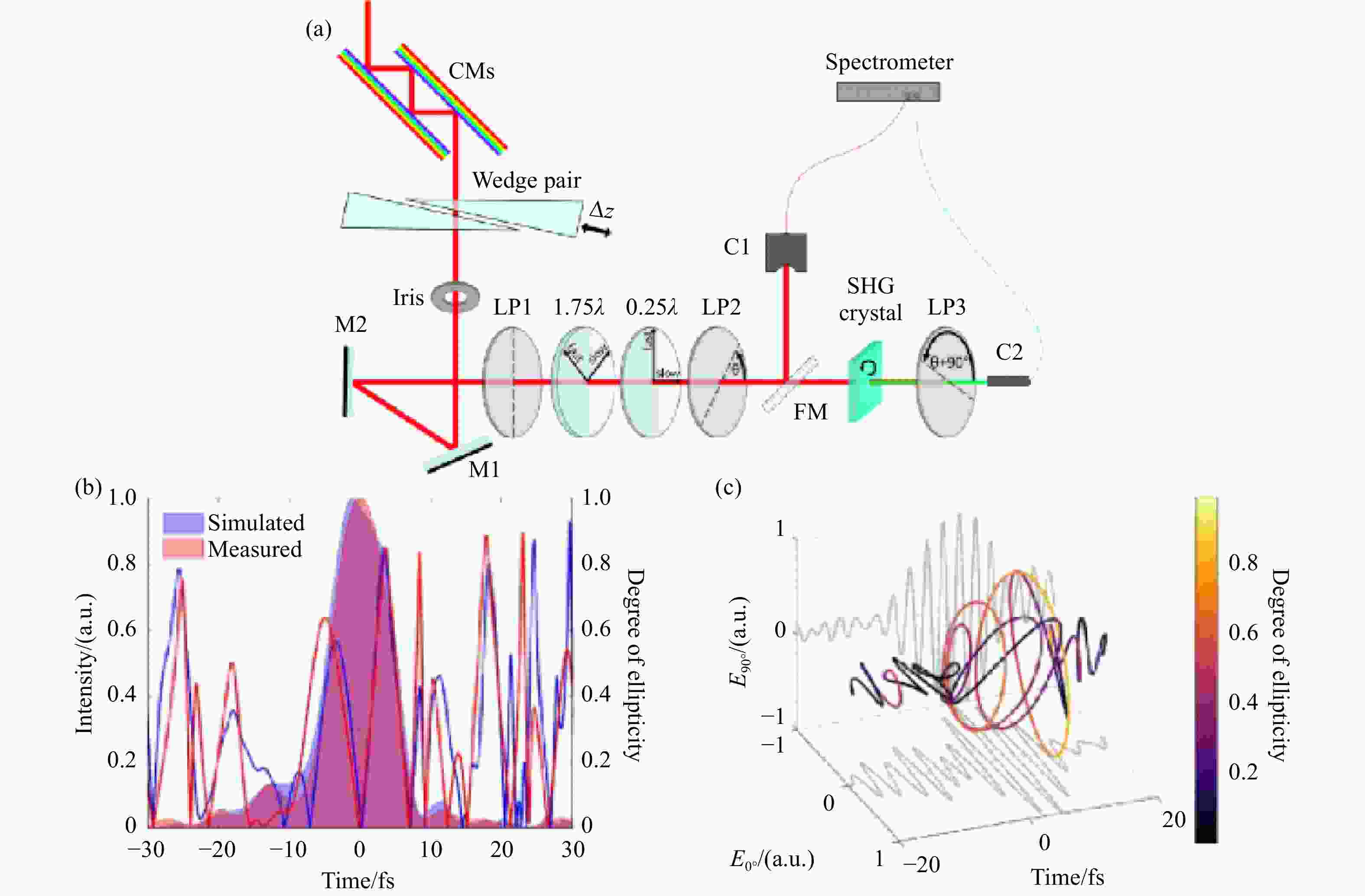
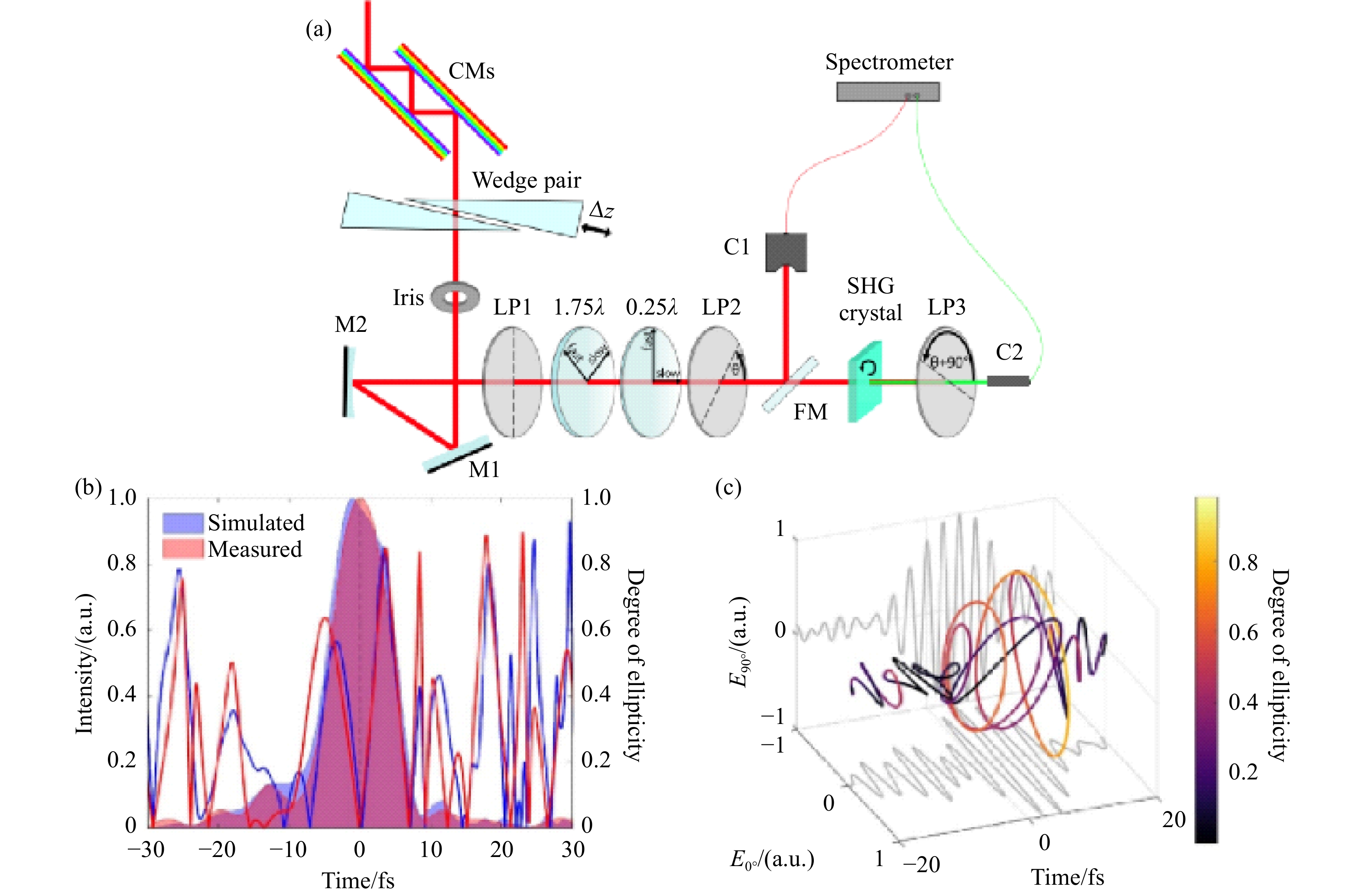
图 7 (a)偏振D-scan装置示意图:M代表金属镜,FM代表翻转镜,LP代表线性偏振器,C代表光收集器;(b)蓝色与红色阴影区域分别对应偏振的模拟与实测包络曲线,(b)蓝色与红色阴影区域分别对应偏振的模拟与实测包络曲线,蓝色与红色线条分别代表模拟与实测偏振门的椭圆度;(c)彩色曲线展示了电场端点随时间的演变过程,颜色深浅对应偏振态椭圆度的变化,底部及背景中的线条分别表示电场的水平与垂直分量[33]
Figure 7. (a) Schematic diagram of the polarization d-scan setup. ‘M’ denotes Metallic Mirror, ‘FM’ for Flip Mirror, ‘LP’ for Linear Polarizer, and ‘C’ for Light Collector. (b) The shaded blue and red areas represent the simulated and measured envelopes of the polarization gate, respectively. The blue and red lines represent the degree of ellipticity for the simulated and measured polarization gate, respectively. (c) The colored line depicts the electric field endpoint’s evolution over time, with the color indicating the polarization state’s degree of ellipticity. The lines on the bottom and in the background represent the electric field’s horizontal and vertical projections, respectively[33]
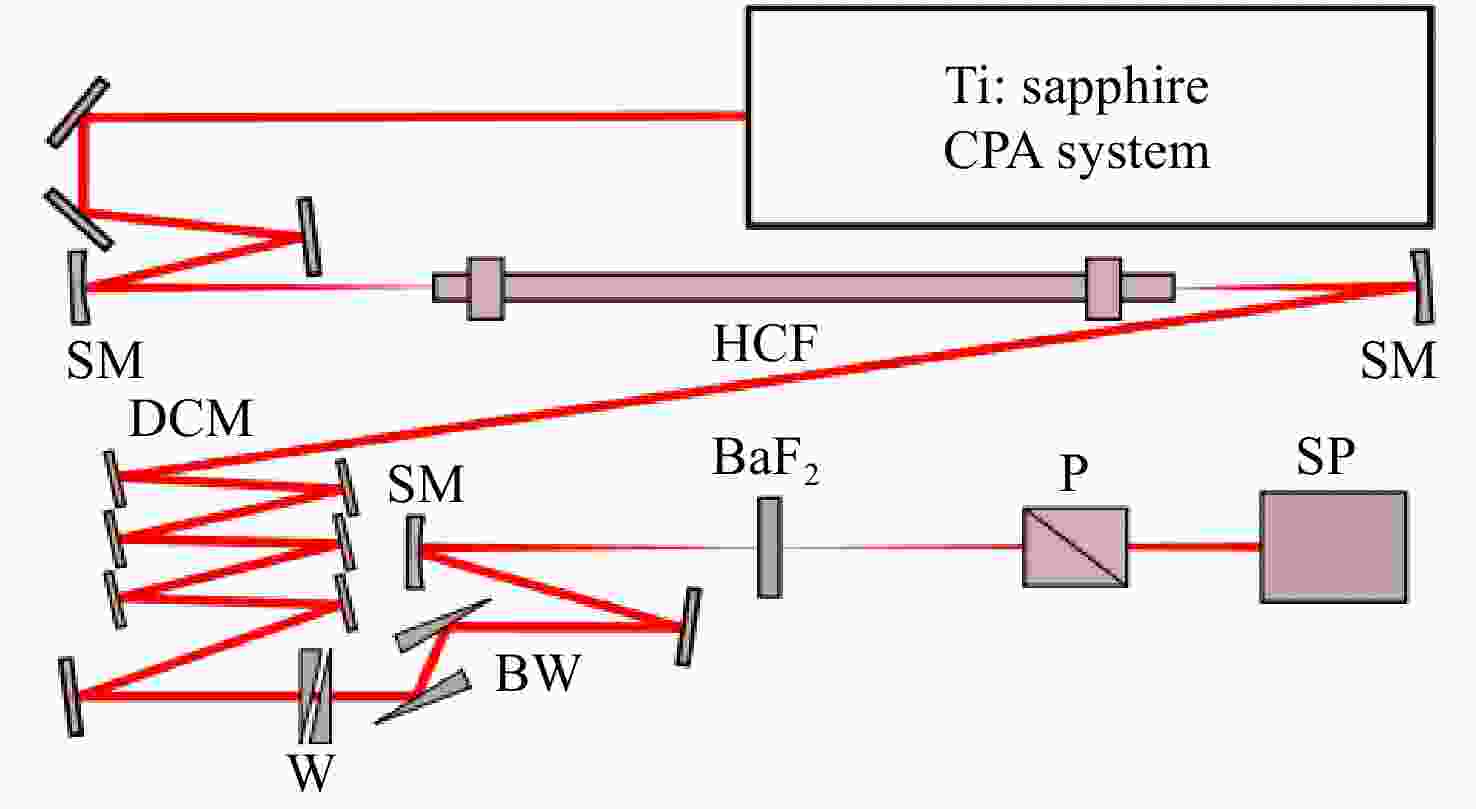
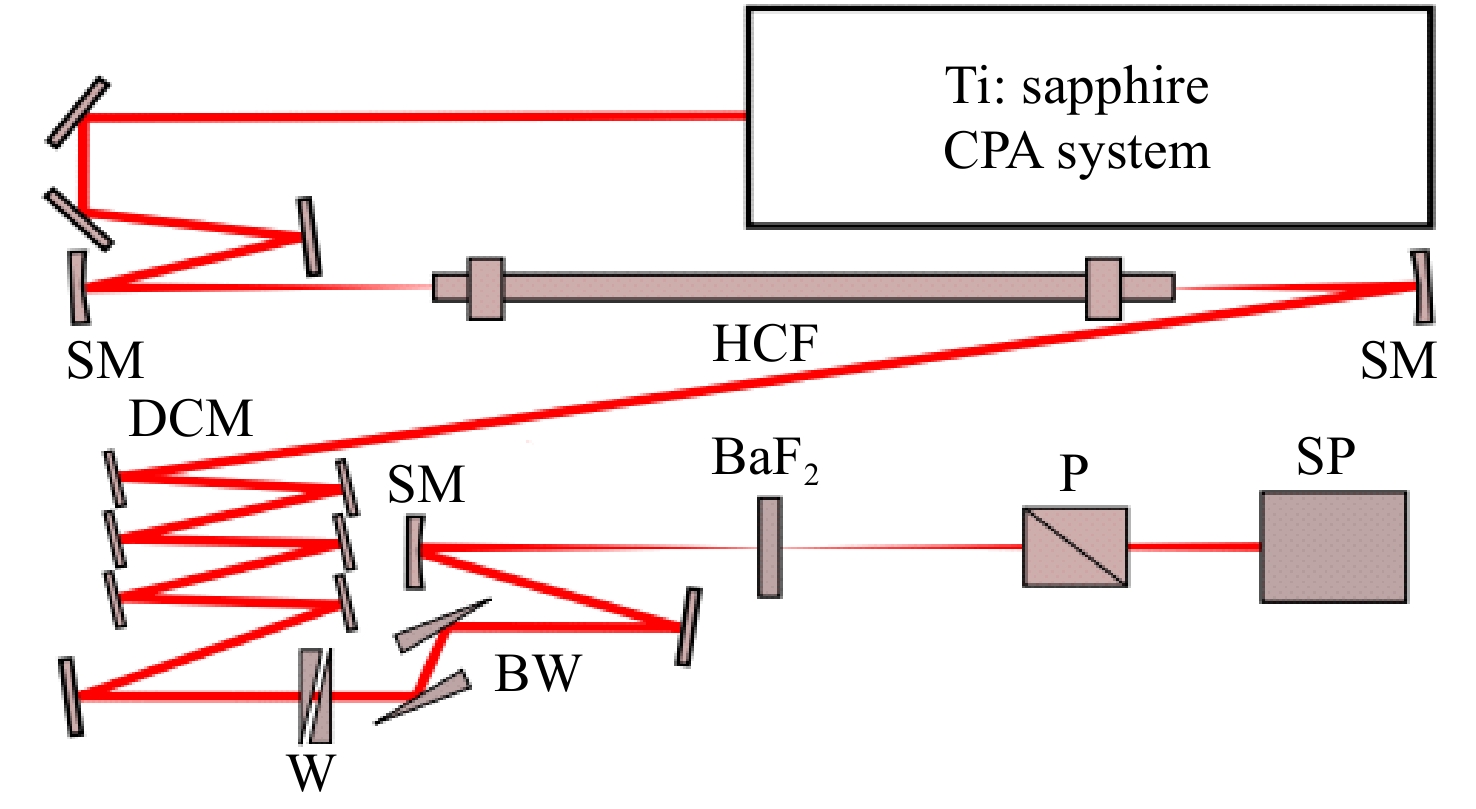
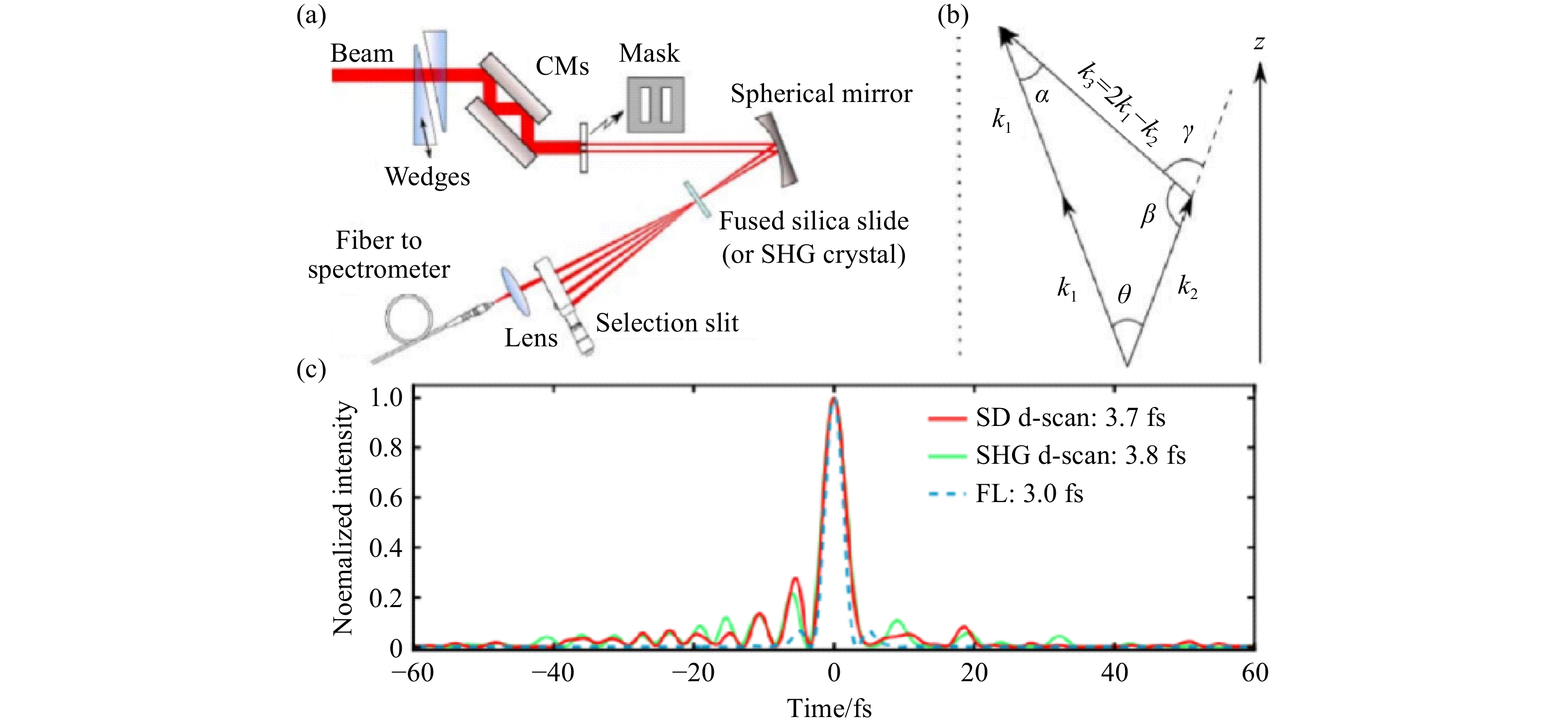
图 9 XPW D-scan实验装置;SM:球面镜;HCF:空芯光纤;W:楔形镜;BW:布儒斯特角楔形镜;DCM:双啁啾镜;P:宽带Glan-Taylor偏振器;SP:光谱仪[44]
Figure 9. Experimental setup of XPW d-scan. SM, spherical mirror; HCF, hollow-core fiber; W, wedge; BW, Brewster-angled wedge; DCM, double-chirped mirror; P, broadband Glan–Taylor polarizer; and SP, spectrometer[44]
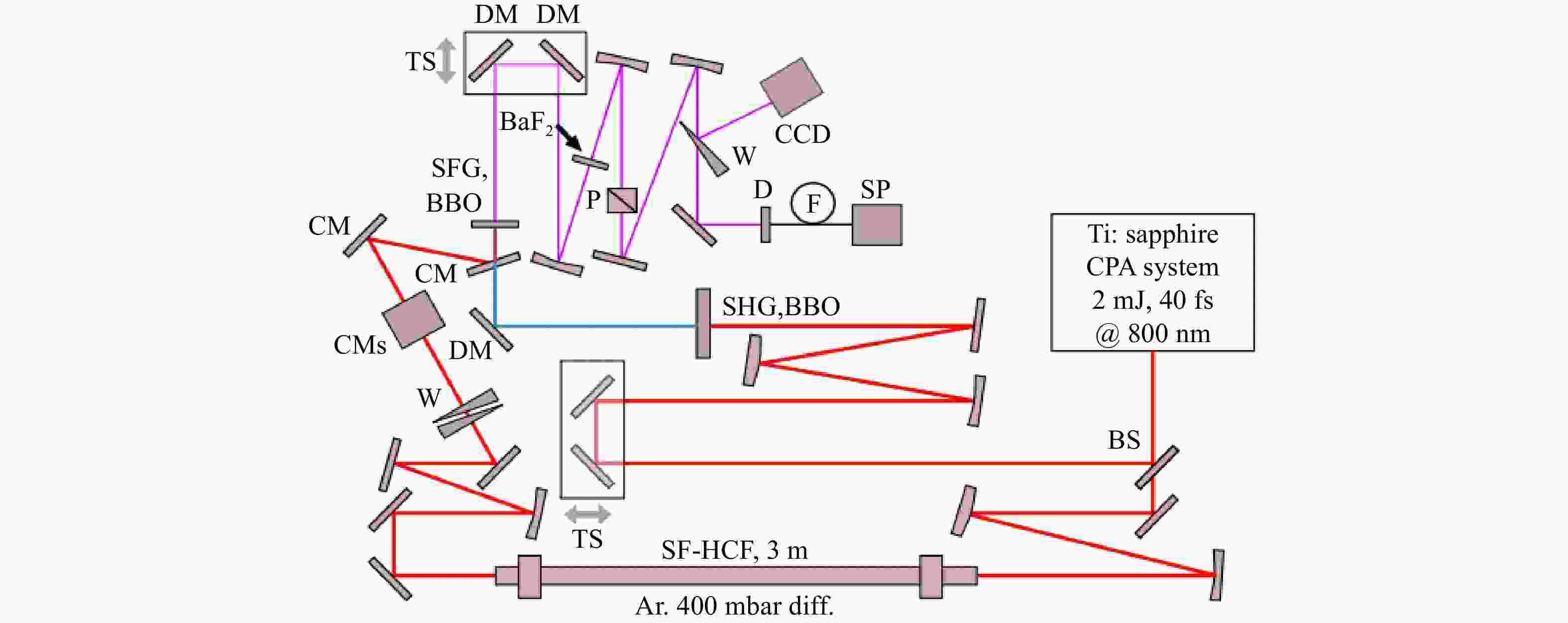
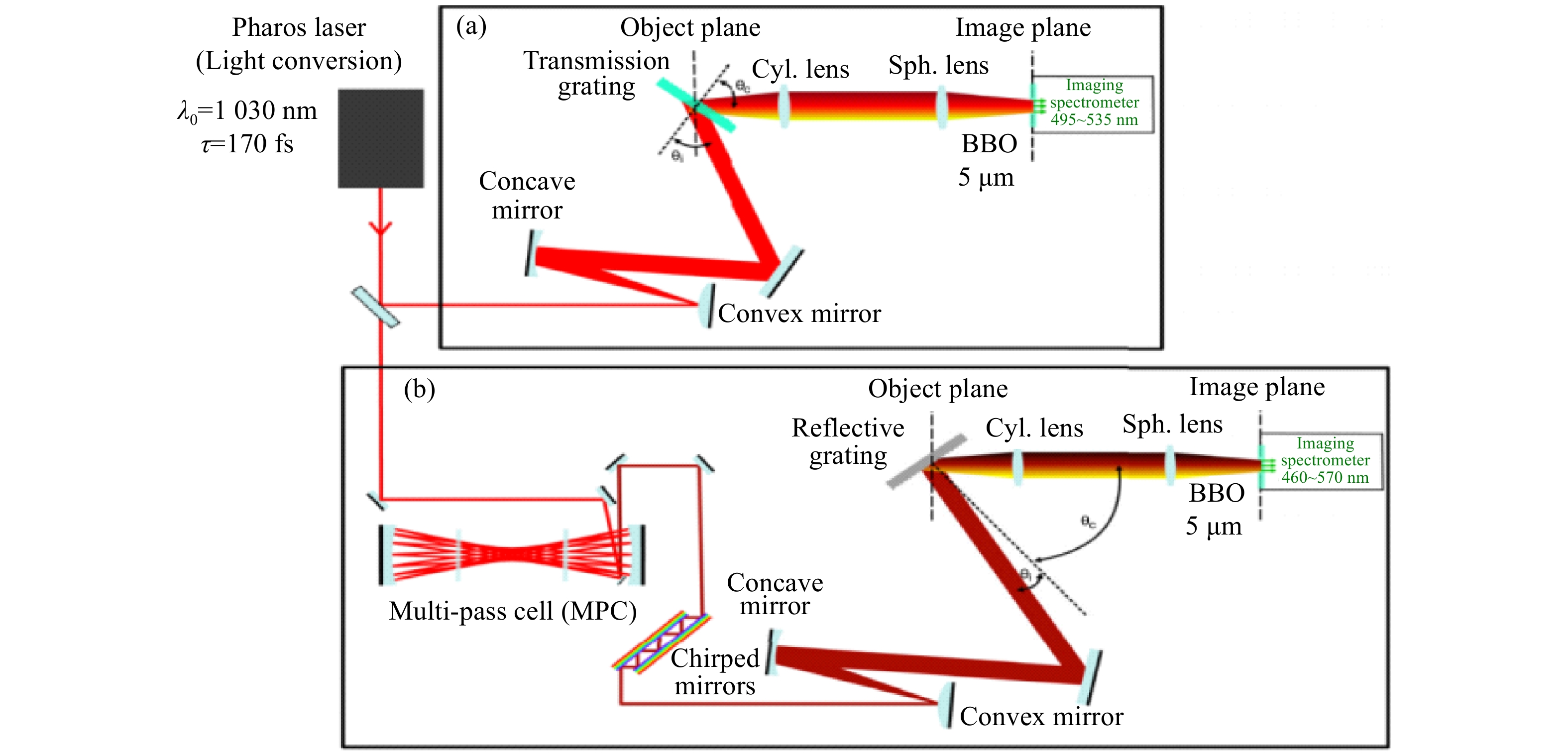
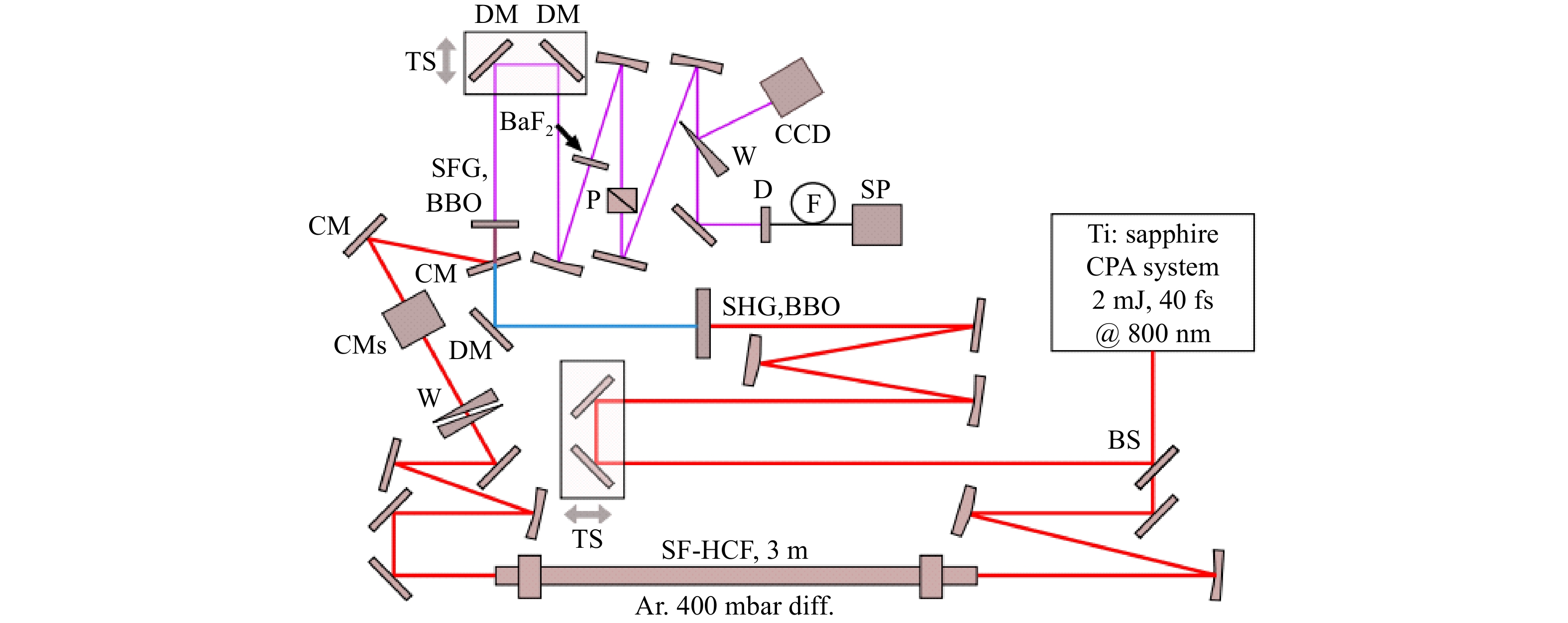
图 10 基于800 nm脉冲与其对应SHG的和频产生亚10 fs紫外脉冲的实验装置示意图,以及XPW D-scan脉冲表征装置;BS:分束器;TS:平移台;SP:光谱仪;DM:二向色镜;CM:啁啾镜;W:熔融石英楔;P:宽带Glan-Taylor偏振器;CCD:电荷耦合器件;SF-HCF:拉伸柔性空心光纤;F:光纤;D:熔融石英扩散器[46]
Figure 10. Schematic of the experimental setup for generation of sub- 10 fs UV pulses via sum frequency mixing of 800 nm pulses and their corresponding second harmonic and the XPW d-scan pulse characterization device. BS, beam splitter; TS, translation stage; SP, spectrometer; DM, dichroic mirror; CM, chirped mirror; W, fused silica wedges; P, broadband Glan-laser polarizer; CCD, charge-coupled detector; SF-HCF, stretched flexible hollow-core fiber; F, fiber; and D, fused silica diffuser[46]
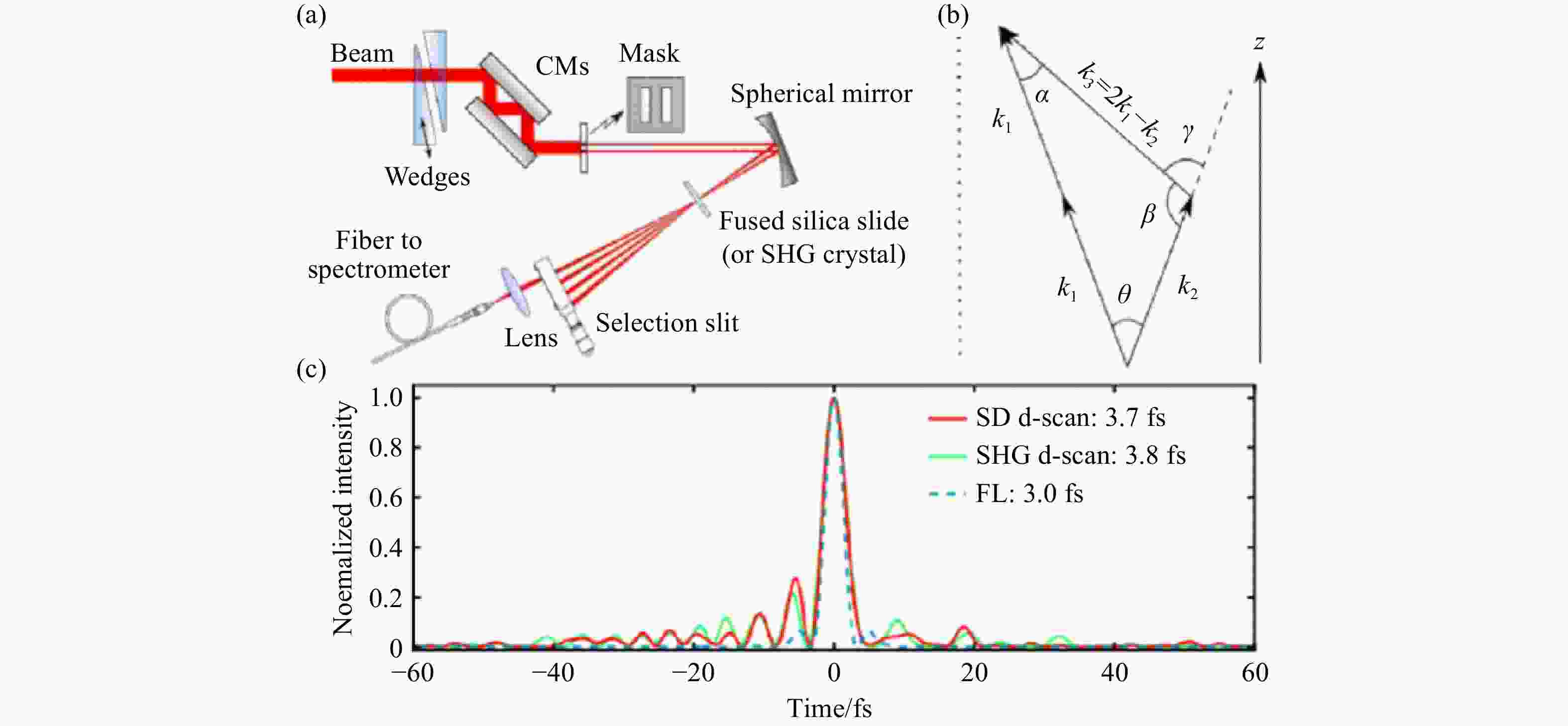
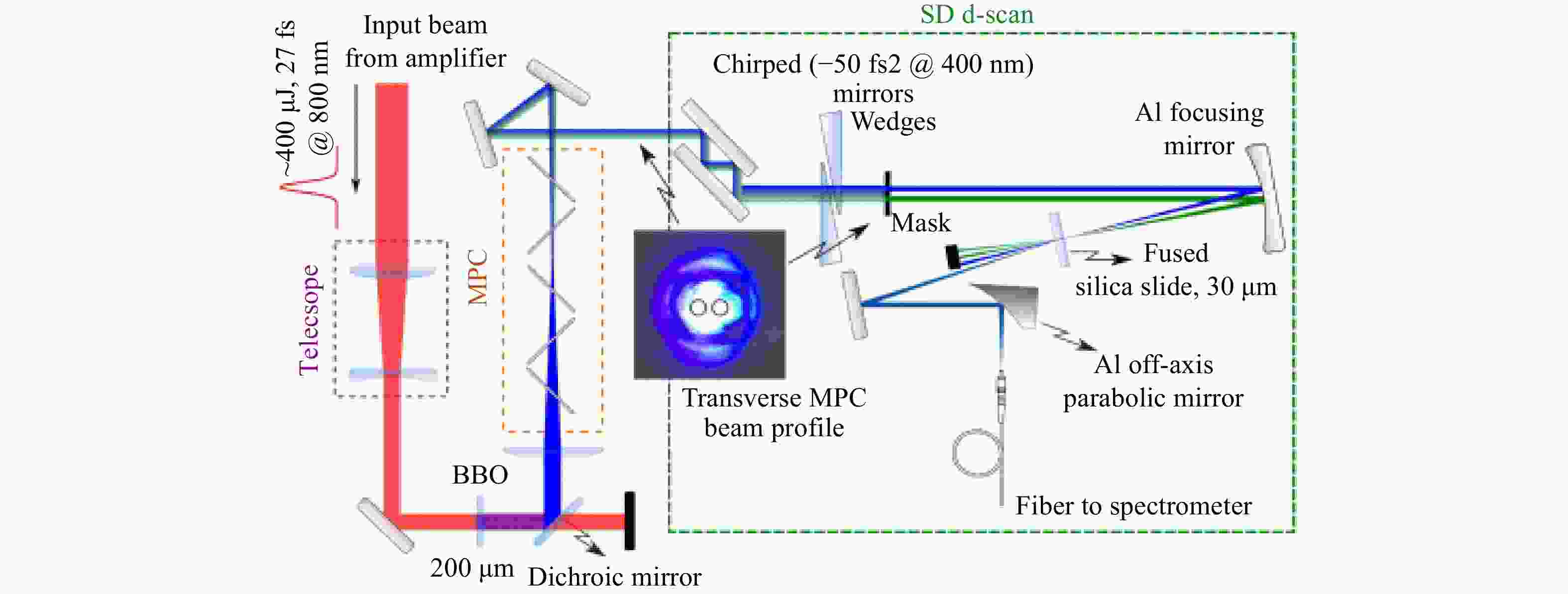
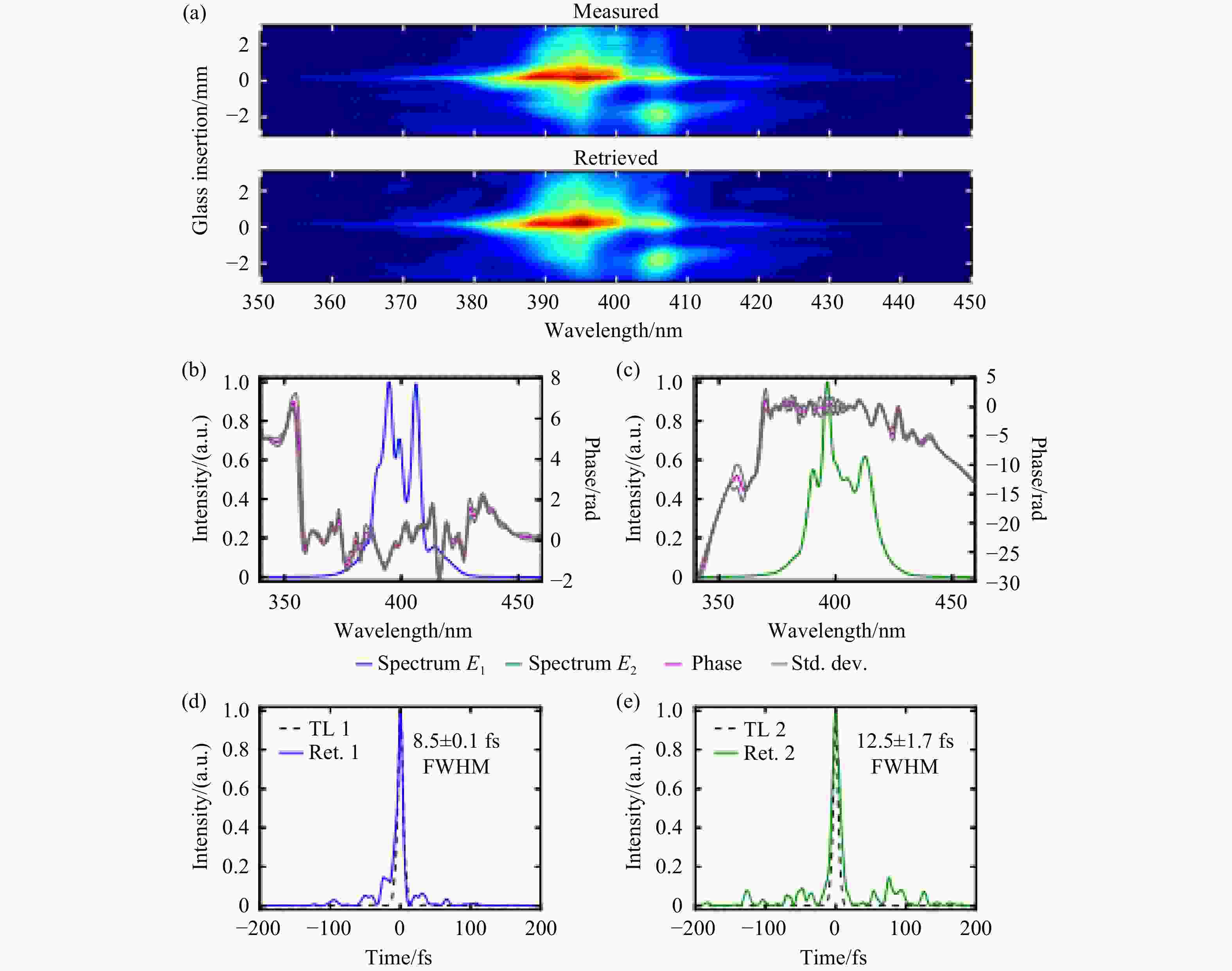
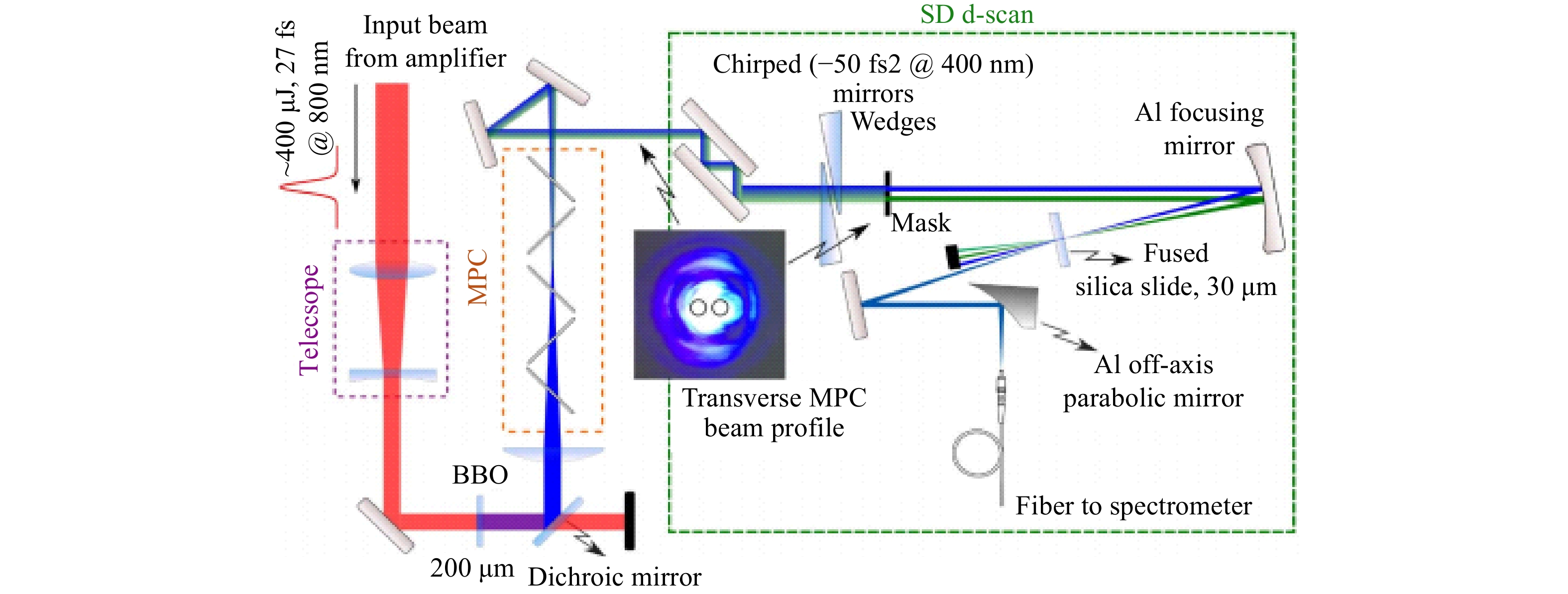
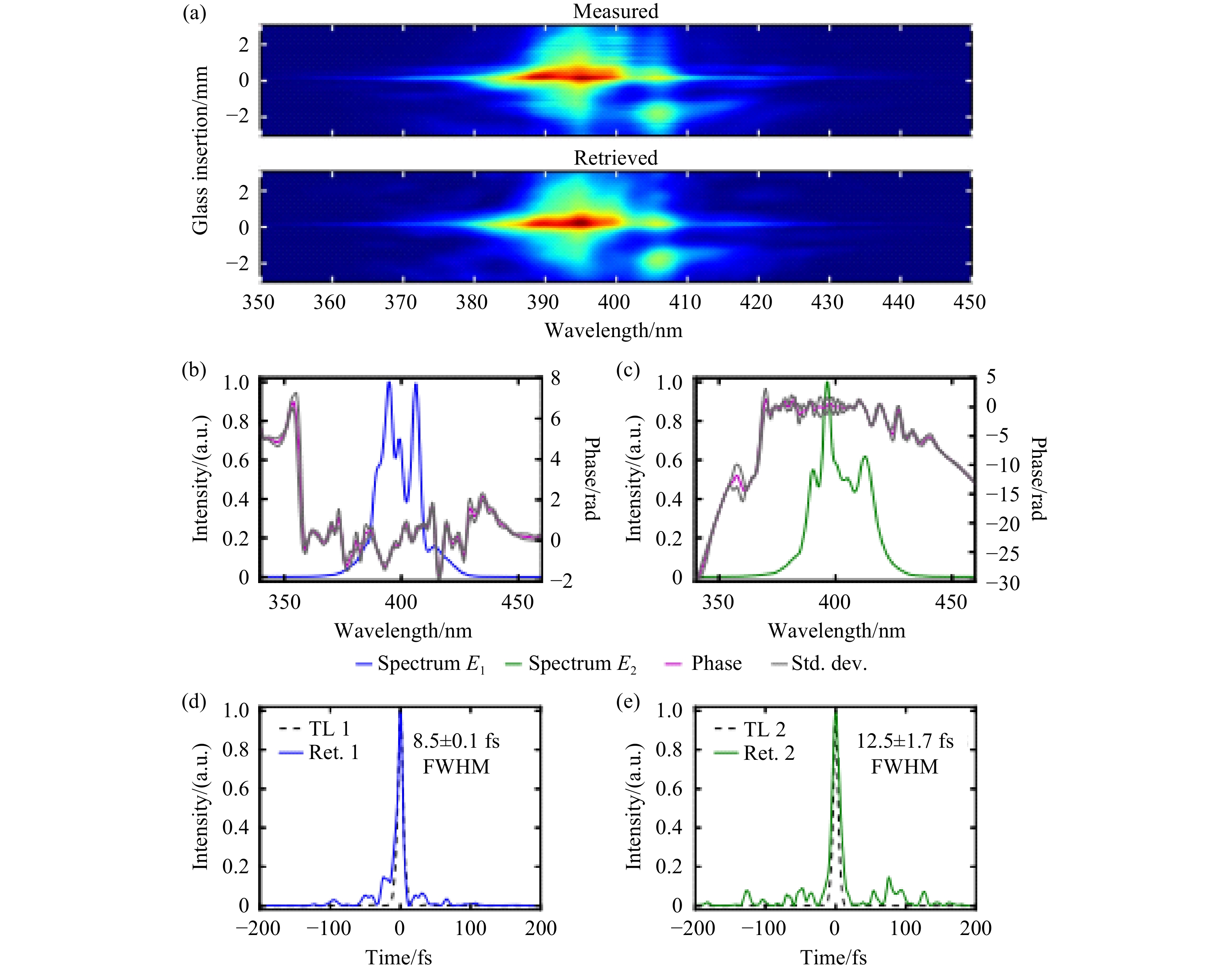
图 13 信号ENL1的Dual SD D-scan结果分析:(a)测量与恢复的D-scan轨迹;(b)、(c) 脉冲E1和E2的测量光谱及恢复的光谱相位(标准偏差取自20次独立恢复);(d)、(e)恢复的脉冲E1和E2脉宽曲线及对应的TL曲线[49]
Figure 13. Dual SD d-scan analysis of signal ENL1. (a) Measured and retrieved d-scan traces. (b), (c) Measured spectra of pulses E1 and E2 and retrieved spectral phases (standard deviations obtained from 20 independent retrievals). (d), (e) Retrieved temporal intensity profiles of pulses E1 and E2 and corresponding transform-limited (TL) pulses[49]
表 1 常用超短脉冲表征技术的比较
Table 1. Comparison of commonly used ultrashort pulse characterization techniques
技术 可获取信息 测量方式 光路复杂度 脉冲形状 主要优点 主要局限 自相关 脉宽 扫描 低 需假设 光路简单,容易实现 无法获取相位 FROG 时域强度与相位 扫描 中 无需假设 信息完整、适用复杂脉冲 光路复杂难对准,反演耗时 SPIDER 光谱相位(可重构时域) 单次 中-高 无需假设 测量速度快、直接反演 对实验稳定性和色散匹配敏感 MIIPS 光谱相位(可色散补偿) 扫描 中 无需假设 可同步实现相位测量与色散补偿 依赖脉冲整形器,带宽受限 D-scan 相位与强度(可重构时域) 扫描/单次 低-中 无需假设 实验设置简单,可与脉冲压缩器集成,
反演算法鲁棒性强窄带长脉冲测量存在限制  下载: 导出CSV
-
[1] HOUARD A, WALCH P, PRODUIT T, et al. Laser guides lightning[J]. Nature Photonics, 2023, 17(3): 231-235. [2] YOGO A, ARIKAWA Y, ABE Y, et al. Advances in laser-driven neutron sources and applications[J]. The European Physical Journal A, 2023, 59(8): 191. doi: 10.1140/epja/s10050-023-01083-8 [3] SCHOENLEIN R, ELSAESSER T, HOLLDACK K, et al. Recent advances in ultrafast X-ray sources[J]. Philosophical Transactions of the Royal Society A: Mathematical, Physical and Engineering Sciences, 2019, 377(2145): 20180384. doi: 10.1098/rsta.2018.0384 [4] ZHANG Y F, XU SH, CUI E N, et al. Research and application progress of laser-processing technology in diamond micro-fabrication[J]. Micromachines, 2024, 15(4): 547. doi: 10.3390/mi15040547 [5] LI J, REN X M, YIN Y CN, et al. 53-attosecond X-ray pulses reach the carbon K-edge[J]. Nature Communications, 2017, 8(1): 186. doi: 10.1038/s41467-017-00321-0 [6] 王钰, 张一鸣, 谢群, 等. 飞秒激光赋能液晶光子学[J]. 液晶与显示, 2024, 39(12): 1612-1635.WANG Y, ZHANG Y M, XIE Q, et al. Femtosecond laser-empowered liquid crystal photonics[J]. Chinese Journal of Liquid Crystals and Displays, 2024, 39(12): 1612-1635. (in Chinese). [7] YIN J B, LUO H, CAO T, et al. Polarization-independent surface nanostructuring by femtosecond laser irradiation via microsphere in far field and ambient air[J]. Light: Science & Applications, 2026, 15(1): 114. [8] DU SH J, ZHANG F T, MA L. Advances in femtosecond laser synthesis and micromachining of halide perovskites[J]. Light: Advanced Manufacturing, 2024, 5(3): 452-474. [9] WANG SH J, QIN W T, GUAN T Y, et al. Flexible generation of structured terahertz fields via programmable exchange-biased spintronic emitters[J]. eLight, 2024, 4(1): 11. doi: 10.1186/s43593-024-00069-3 [10] BRADLEY D J, NEW G H C. Ultrashort pulse measurements[J]. Proceedings of the IEEE, 1974, 62(3): 313-345. doi: 10.1036/1097-8542.yb120394 [11] GU X, AKTURK S, SHREENATH A, et al. The measurement of ultrashort light pulses - simple devices, complex pulses[J]. Optical Review, 2004, 11(3): 141-152. doi: 10.1007/s10-043-0041-8 [12] KANE D J, TREBINO R. Characterization of arbitrary femtosecond pulses using frequency-resolved optical gating[J]. IEEE Journal of Quantum Electronics, 1993, 29(2): 571-579. doi: 10.1109/3.199311 [13] TREBINO R, DELONG K W, FITTINGHOFF D N, et al. Measuring ultrashort laser pulses in the time-frequency domain using frequency-resolved optical gating[J]. Review of Scientific Instruments, 1997, 68(9): 3277-3295. doi: 10.1063/1.1148286 [14] FINCHEIRA F M C. Frequency resolved optical gating setup for characterizing amplitude and phase of ultrafast optical pulses[D]. Quebec: University of Quebec, 2013. [15] SHUMAN T M, ANDERSON M E, BROMAGE J, et al. Real-time SPIDER: ultrashort pulse characterization at 20 Hz[J]. Optics Express, 1999, 5(6): 134-143. doi: 10.1364/OE.5.000134 [16] KOSIK E M, ANDERSON M E, DE ARAUJO L E E, et al. Precision and accuracy of ultrashort optical pulse measurement using SPIDER[C]. Proceedings of the 12th International Conference on Ultrafast Phenomena XII, Springer, 2000: 120-122. [17] LONDERO P, ANDERSON M E, RADZEWICZ C, et al. Measuring ultrafast pulses in the near-ultraviolet using spectral phase interferometry for direct electric field reconstruction[J]. Journal of Modern Optics, 2003, 50(2): 179-184. doi: 10.1080/09500340308235168 [18] WILLIAMS E M K, DORRER C, RADUNSKY A S, et al. Characterizing space-time coupling of the electric field of ultrashort pulses using the SPIDER technique[J]. Proceedings of SPIE, 2005, 5714: 173-185. doi: 10.1117/12.602115 [19] LOZOVOY V V, PASTIRK I, DANTUS M. Multiphoton intrapulse interference. IV. Ultrashort laser pulse spectral phase characterization and compensation[J]. Optics Letters, 2004, 29(7): 775-777. doi: 10.1364/OL.29.000775 [20] XU B W, GUNN J M, DELA CRUZ J M, et al. Quantitative investigation of the multiphoton intrapulse interference phase scan method for simultaneous phase measurement and compensation of femtosecond laser pulses[J]. Journal of the Optical Society of America B, 2006, 23(4): 750-759. doi: 10.1364/JOSAB.23.000750 [21] MIRANDA M, FORDELL T, ARNOLD C, et al. Simultaneous compression and characterization of ultrashort laser pulses using chirped mirrors and glass wedges[J]. Optics Express, 2012, 20(1): 688-697. doi: 10.1364/OE.20.000688 [22] ESCOTO E, TAJALLI A, NAGY T, et al. Advanced phase retrieval for dispersion scan: a comparative study[J]. Journal of the Optical Society of America B, 2018, 35(1): 8-19. doi: 10.1364/JOSAB.35.000008 [23] STORN R, PRICE K. Differential evolution–a simple and efficient heuristic for global optimization over continuous spaces[J]. Journal of Global Optimization, 1997, 11(4): 341-359. doi: 10.1023/A:1008202821328 [24] LEVENBERG K. A method for the solution of certain non-linear problems in least squares[J]. Quarterly of Applied Mathematics, 1944, 2(2): 164-168. doi: 10.1090/qam/10666 [25] MARQUARDT D W. An algorithm for least-squares estimation of nonlinear parameters[J]. Journal of the Society for Industrial and Applied Mathematics, 1963, 11(2): 431-441. doi: 10.1137/0111030 [26] GEIB N C, ZILK M, PERTSCH T, et al. Common pulse retrieval algorithm: a fast and universal method to retrieve ultrashort pulses[J]. Optica, 2019, 6(4): 495-505. doi: 10.1364/OPTICA.6.000495 [27] ZAHAVY T, DIKOPOLTSEV A, MOSS D, et al. Deep learning reconstruction of ultrashort pulses[J]. Optica, 2018, 5(5): 666-673. doi: 10.1364/OPTICA.5.000666 [28] KLEINERT S, TAJALLI A, NAGY T, et al. Rapid phase retrieval of ultrashort pulses from dispersion scan traces using deep neural networks[J]. Optics Letters, 2019, 44(4): 979-982. doi: 10.1364/OL.44.000979 [29] ZIV R, DIKOPOLTSEV A, ZAHAVY T, et al. Deep learning reconstruction of ultrashort pulses from 2D spatial intensity patterns recorded by an all-in-line system in a single-shot[J]. Optics Express, 2020, 28(5): 7528-7538. doi: 10.1364/OE.383217 [30] SYTCEVICH I, GUO CH, MIKAELSSON S, et al. Characterizing ultrashort laser pulses with second harmonic dispersion scans[J]. Journal of the Optical Society of America B, 2021, 38(5): 1546-1555. doi: 10.1364/JOSAB.412535 [31] MIRANDA M, ARNOLD C L, FORDELL T, et al. Characterization of broadband few-cycle laser pulses with the d-scan technique[J]. Optics Express, 2012, 20(17): 18732-18743. doi: 10.1364/OE.20.018732 [32] FABRIS D, HOLGADO W, SILVA F, et al. Single-shot implementation of dispersion-scan for the characterization of ultrashort laser pulses[J]. Optics Express, 2015, 23(25): 32803-32808. doi: 10.1364/OE.23.032803 [33] SALGADO-REMACHA F J, ALONSO B, CRESPO H, et al. Single-shot d-scan technique for ultrashort laser pulse characterization using transverse second-harmonic generation in random nonlinear crystals[J]. Optics Letters, 2020, 45(14): 3925-3928. doi: 10.1364/OL.397033 [34] CAPDEVILLE F, VILLANUEVA F, HIDALGO-ROJAS D, et al. Multiple-reflections single-shot dispersion scan for fast ultrashort-pulse measurements[J]. Optics Express, 2024, 32(16): 28742-28752. doi: 10.1364/OE.529440 [35] DÍAZ RIVAS D, SYTCEVICH I, CANHOTA M, et al. Single-shot dispersion-scan using a combination of prism and grating[J]. Applied Optics, 2025, 64(31): 9476-9480. doi: 10.1364/AO.571287 [36] DÍAZ RIVAS D, BARBERO C, GUO CH, et al. Spatially dependent group delay dispersion from a diffraction grating and its application to the single-shot d-scan technique[J]. Optica, 2025, 12(12): 1923-1930. doi: 10.1364/OPTICA.572768 [37] DÍAZ RIVAS D, RAAB A K, GUO CH, et al. Measurement of ultrashort laser pulses with a time-dependent polarization state using the d-scan technique[J]. Journal of Physics: Photonics, 2024, 6(1): 015003. doi: 10.1088/2515-7647/ad1c6c [38] PÉREZ-BENITO Ó, WEIGAND R. Characterization of the polarization state of few-cycle laser pulses using d-scan: D-TURTLE[J]. Optics & Laser Technology, 2024, 179: 111273. doi: 10.1016/j.optlastec.2024.111273 [39] HOFFMANN M, NAGY T, WILLEMSEN T, et al. Pulse characterization by THG d-scan in absorbing nonlinear media[J]. Optics Express, 2014, 22(5): 5234-5240. doi: 10.1364/OE.22.005234 [40] SILVA F, MIRANDA M, TEICHMANN S, et al. Near to mid-IR ultra-broadband third harmonic generation in multilayer graphene: few-cycle pulse measurement using THG dispersion-scan[C]. Proceedings of CLEO: 2013, IEEE, 2013: 1-2. [41] GOMES T. Temporal measurement of few-cycle laser pulses by third-harmonic[C]. Proceedings of the GRAPHENE and 2DM INDUSTRIAL FORUM, GIF, 2020. [42] GOMES T, CANHOTA M, KULYK B, et al. Ultrafast laser pulse characterization by THG d-scan using optically enhanced graphene coatings[J]. arXiv preprint arXiv, 2022, 2206.01676. (查阅网上资料, 不确定本条文献类型与格式, 请确认). [43] WYATT A S, JOHNSON A S, MATÍA-HERNANDO, et al. Complete characterization of shortwavelength infrared fewcycle pulses via third harmonic generation dispersion scan[C]. Proceedings of the Super Intense Laser-Atom Physics XI, 2015: 27980. . [44] GOMES T, CANHOTA M, CRESPO H. Temporal characterization of broadband femtosecond laser pulses by surface third-harmonic dispersion scan with ptychographic retrieval[J]. Optics Letters, 2022, 47(15): 3660-3663. doi: 10.1364/OL.460069 [45] CRESPO H M, WITTING T, CANHOTA M, et al. In situ temporal measurement of ultrashort laser pulses at full power during high-intensity laser-matter interactions[J]. Optica, 2020, 7(8): 995-1002. [46] CRESPO H, CANHOTA M, WITTING T, et al. Direct measurement of intense sub-4-fs pulses in a gas target by 3rd-harmonic dispersion-scan[J]. EPJ Web of Conferences, 2019, 205: 01026. doi: 10.1051/epjconf/201920501026 [47] TAJALLI A, CHANTEAU B, KRETSCHMAR M, et al. Full characterization of few-cycle pulses using cross-polarized wave generation d-scan technique[C]. Proceedings of the CLEO: QELS_Fundamental Science 2016, Optica Publishing Group, 2016. [48] TAJALLI A, CHANTEAU B, KRETSCHMAR M, et al. Few-cycle optical pulse characterization via cross-polarized wave generation dispersion scan technique[J]. Optics Letters, 2016, 41(22): 5246-5249. doi: 10.1364/OL.41.005246 [49] TAJALLI A, OUILLÉ M, VERNIER A, et al. XPW and SHG d-scan characterization of sub-1.5-cycle pulses[C]. Proceedings of the High Intensity Lasers and High Field Phenomena 2018, Optica Publishing Group, 2018: 978. [50] TAJALLI A, KALOUSDIAN T K, KRETSCHMAR M, et al. Full characterization of 8 fs deep UV pulses via a dispersion scan[J]. Optics Letters, 2019, 44(10): 2498-2501. doi: 10.1364/OL.44.002498 [51] TAJALLI A, OUILLÉ M, VERNIER A, et al. Propagation effects in the characterization of 1.5-cycle pulses by XPW dispersion scan[J]. IEEE Journal of Selected Topics in Quantum Electronics, 2019, 25(4): 5120407. [52] CANHOTA M, SILVA F, WEIGAND R, et al. Inline self-diffraction dispersion-scan of over octave-spanning pulses in the single-cycle regime[J]. Optics Letters, 2017, 42(15): 3048-3051. doi: 10.1364/OL.42.003048 [53] CANHOTA M, WEIGAND R, CRESPO H M. Simultaneous measurement of two ultrashort near-ultraviolet pulses produced by a multiplate continuum using dual self-diffraction dispersion-scan[J]. Optics Letters, 2019, 44(4): 1015-1018. doi: 10.1364/OL.44.001015 [54] CODERE J, PEARSON B J, KAUFMAN B, et al. Spectral broadening and pulse shaping in the deep ultraviolet[J]. Optics Letters, 2026, 51(2): 269-272. doi: 10.1364/OL.583535 [55] SHARBA A B, CHEKHLOV O, WYATT A S, et al. Characterization of ultrashort laser pulses employing self-phase modulation dispersion-scan technique[J]. Journal of Optics, 2018, 20(3): 035502. doi: 10.1088/2040-8986/aaa9e9 [56] SHARBA A B, SARRI G. Single shot complete characterization of femtosecond laser pulses employing self-phase modulation[J]. Laser Physics, 2019, 29(8): 085001. doi: 10.1088/1555-6611/ab23eb -

 下载:
下载:

计量
- 文章访问数: 227
- HTML全文浏览量: 91
- PDF下载量: 10
- 被引次数: 0
