



High-precision beam pointing control based on global non-singular attitude estimation
doi: 10.37188/CO.EN-2026-0004
-
摘要:
针对空间引力波探测航天器的星间建链任务,研究了基于多源信息融合的光束精密指向控制问题。结合引力波探测航天器的结构和载荷特性,建立包含移动光学组件运动的全系统状态方程,利用误差四元数将非独立变量描述的非线性测量方程转化为独立变量描述的线性方程,并融合惯性传感器的测量信息进行滤波估计以提高卫星平台的定姿精度。此外,针对超远距离星间激光传输时间和两星之间高速相对运动导致的超前指向问题,推导了随时间变化的超前角解析表达式,并仿真分析了轨道周期内超前角的变化趋势,为星间链路建立与维持过程的超前角伺服补偿提供了理论依据。通过三星系统的闭环仿真验证了所设计的高精度指向估计算法在稳定性和估计精度方面的优越性,结合鲁棒抗扰控制器实现了光束的精密指向,为我国引力波探测计划的顺利实施提供必要的技术支撑。
Abstract:Focusing on the key problem of establishing inter-spacecraft laser links for space-borne gravitational wave (GW) detection, this paper presents a high-precision beam pointing control scheme founded on multi-source information fusion. A detailed state-space model is constructed by integrating the coupled dynamics of moving optical sub-assemblies. Using error quaternions, the nonlinear measurement equations are linearized, thereby enhancing the accuracy of filter-based attitude determination via inertial sensor fusion. Furthermore, a time-varying analytical formulation of the point-ahead angle (PAA) is derived, supplying a theoretical basis for servo compensation. Closed-loop simulations of a three-spacecraft configuration validate the stability and accuracy of the proposed estimation algorithm. In combination with robust disturbance-rejection control, the method enables highly accurate beam pointing, providing essential technical support for GW detection missions.
-
Table 1. Parameters of Simulation System
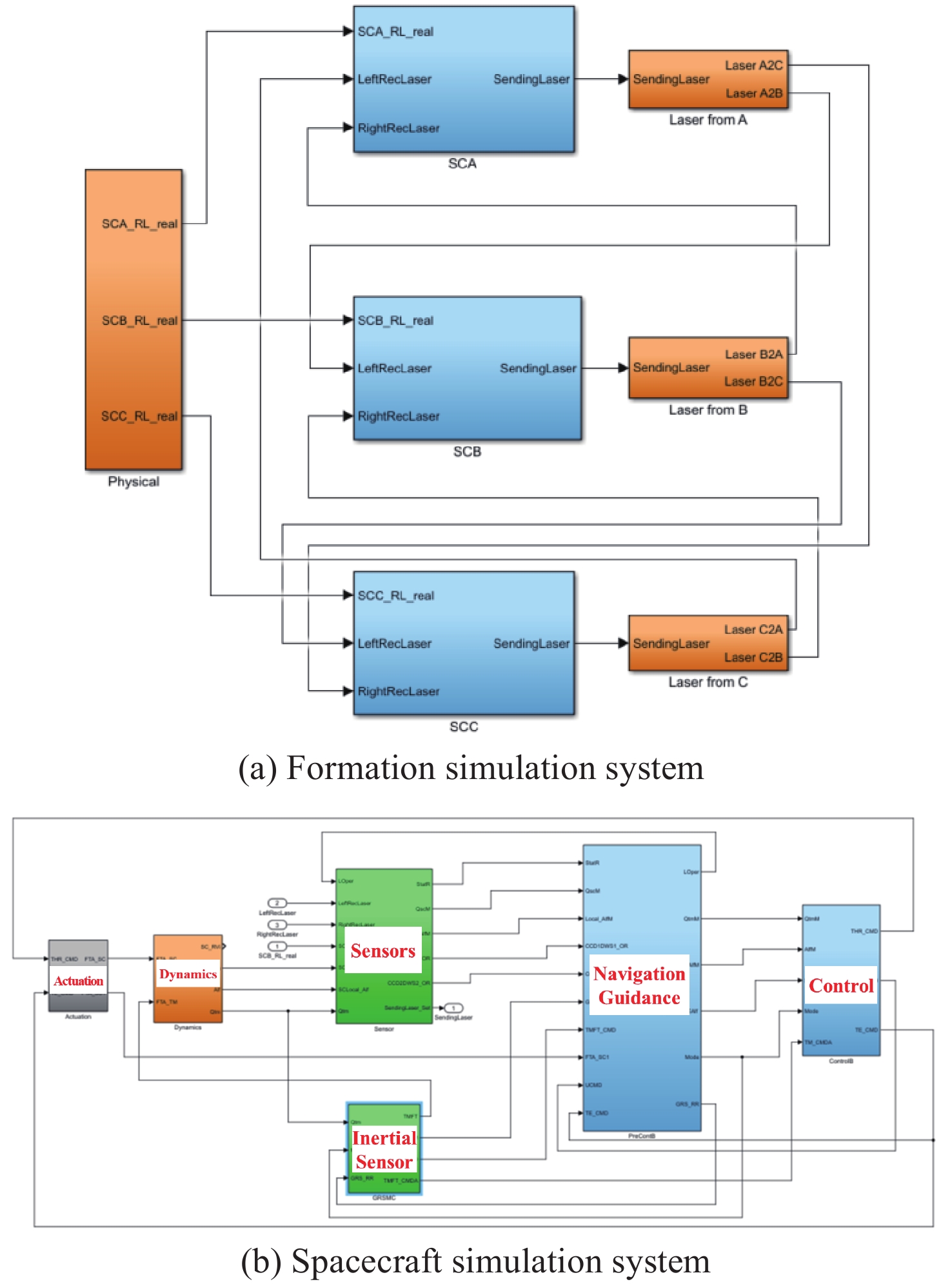
Item Value Duration 4000s Step-size 0.1s Environmental Noise solar radiation pressure noise Gravitational Perturbations the sun and the eight planets Sensor Configuration Star Tracker: FoV:17.5°×13.5°
Accuracy:15μradInertial Sensor Noise:Fig.3 Actuator Configuration Thruster Range:1~100μN
Resolution:0.1μN
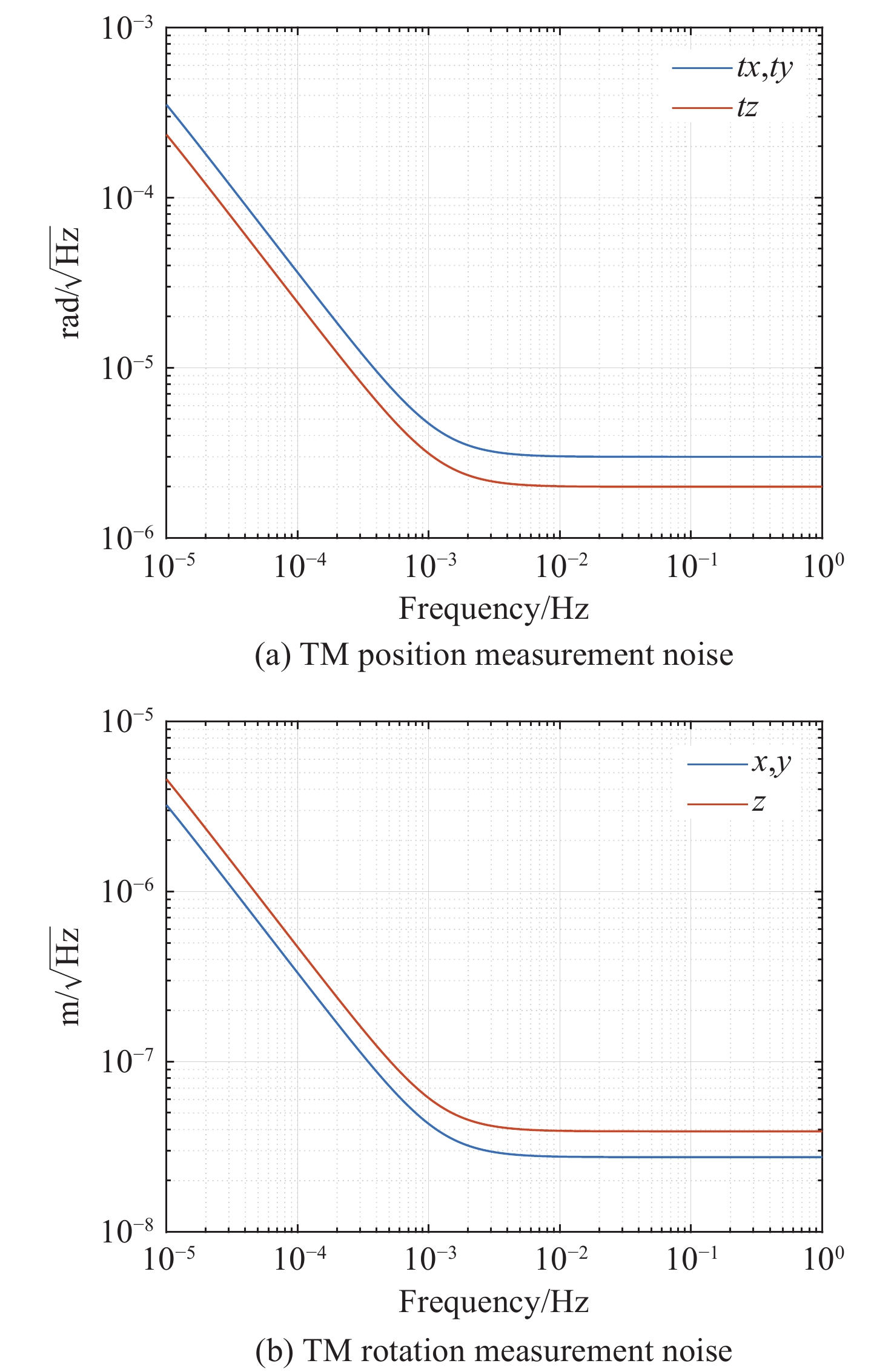
Noise:0.1μN/Hz1/2Inertial Sensor Noise:1×10⁻¹⁴ N/Hz1/2 Spacecraft Parameters Spacecraft Mass 700kg Spacecraft Moment of Inertia $ \left[\begin{matrix}450 & & \\ & 450 & \\ & & 450\end{matrix}\right]kg\cdot {m}^{2} $ TM mass 1.96kg TM Moment of Inertia $ \left[\begin{matrix}6.9 & & \\ & 6.9 & \\ & & 6.9\end{matrix}\right]{10}^{-4}kg\cdot {m}^{2} $  下载: 导出CSV
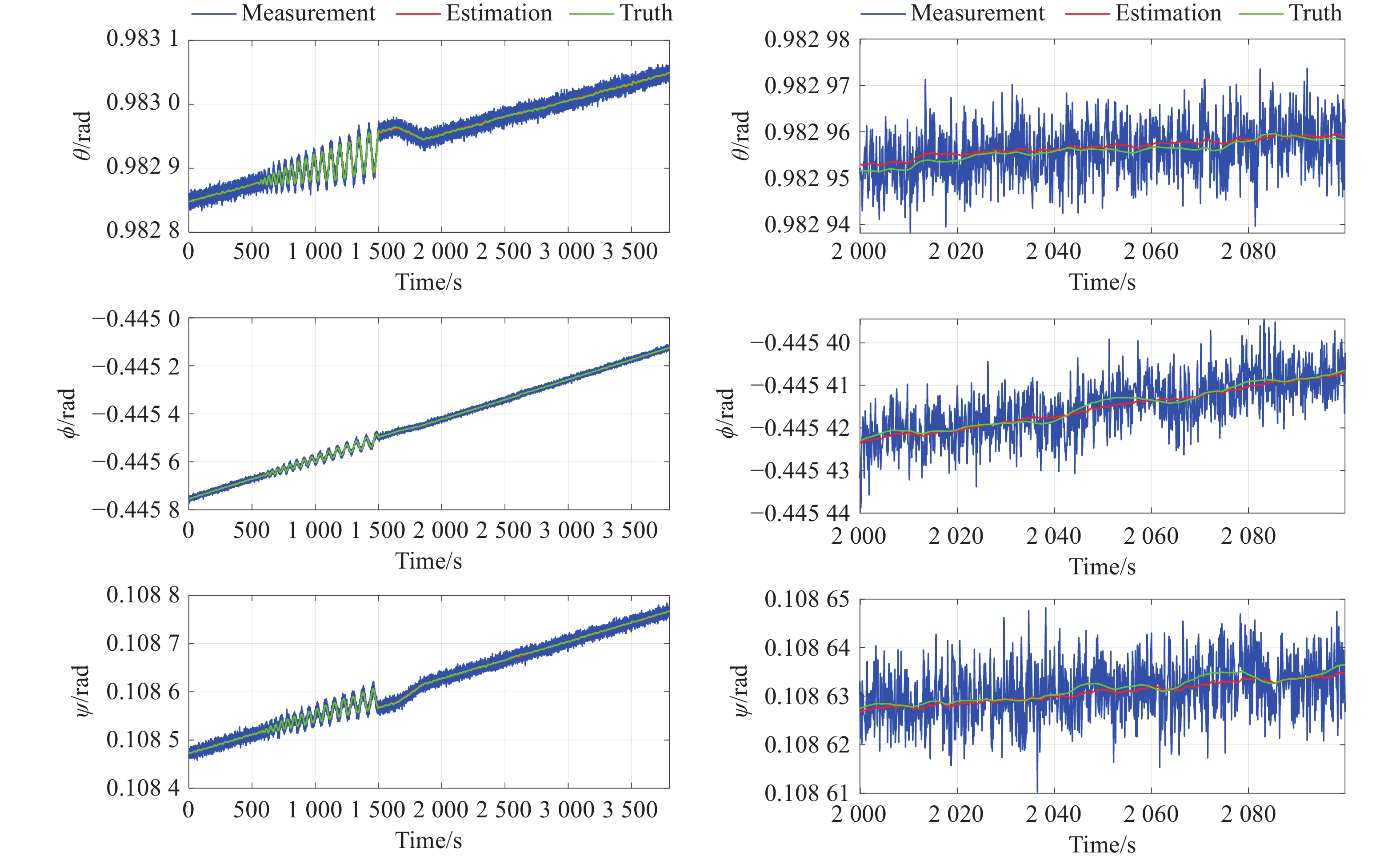
Table 2. Performance of the estimator for SC attitude
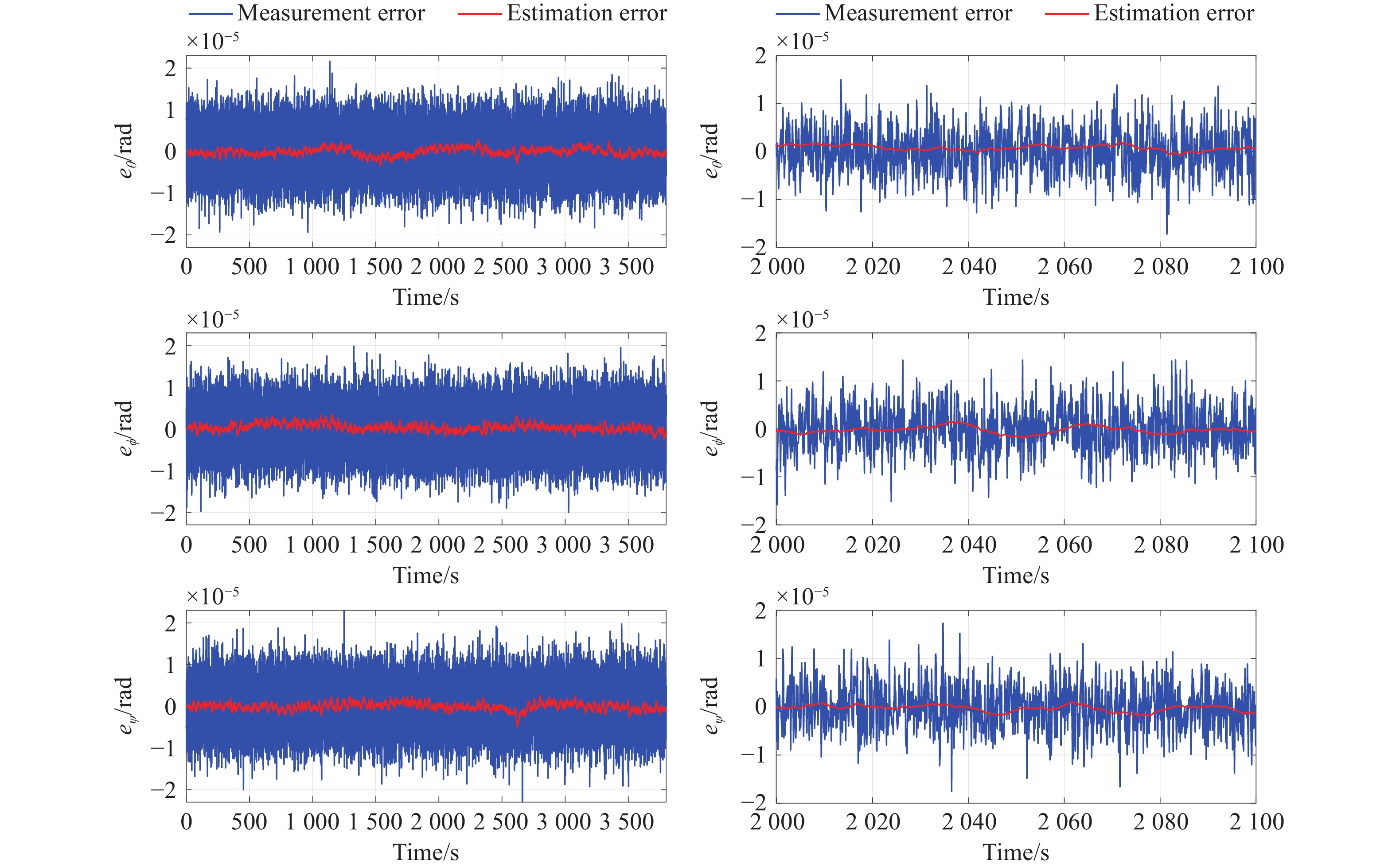
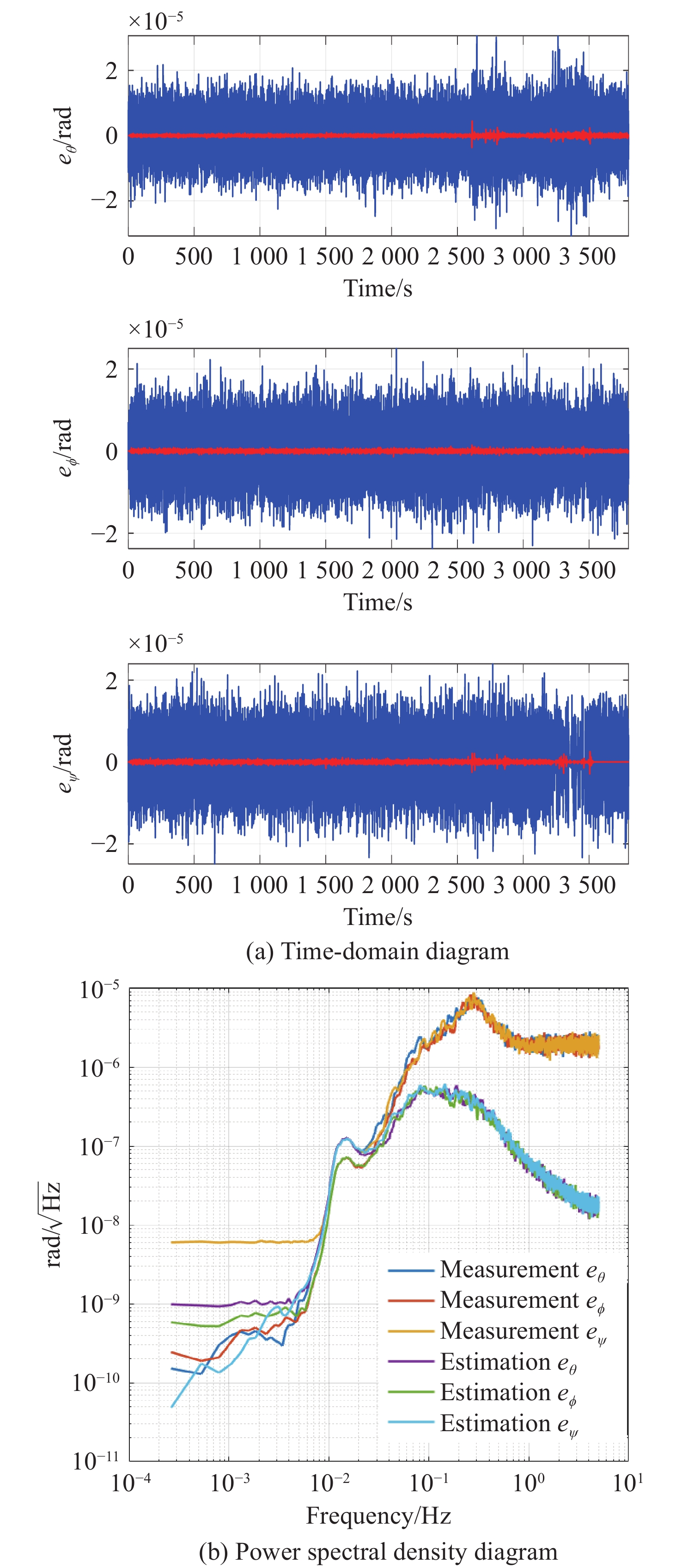
State Variables x/rad y/rad $\textit{z} $/rad $ {\overline{e}}_{m} $ $ 4.99\times {10}^{-6} $ $ 5.02\times {10}^{-6} $ $ 5.01\times {10}^{-6} $ $ {\overline{e}}_{e} $ $ 8.96\times {10}^{-7} $ $ 9.57\times {10}^{-7} $ $ 9.17\times {10}^{-7} $ ERR 82.04% 80.94% 81.70%
下载: 导出CSV
-
[1] CHEN P Q, DENG R J, ZHANG Y B, et al. Pseudo-random code selection for inter-satellite laser ranging and data communication in the Taiji program[J]. Chinese Optics, 2025, 18(3): 547-556. (in Chinese). doi: 10.37188/CO.2024-0033 [2] HU Y X, ZHANG L H, GAO Y, et al. Analysis of key technologies of spacecraft for gravitational waves detection in space[J]. Spacecraft Engineering, 2022, 31(4): 1-7. (in Chinese). doi: 10.3969/j.issn.1673-8748.2022.04.001 [3] The Taiji Scientific Collaboration. China’s first step towards probing the expanding universe and the nature of gravity using a space borne gravitational wave antenna[J]. Communications Physics, 2021, 4(1): 34. doi: 10.1038/s42005-021-00529-z [4] LUO Z R, ZHANG M, JIN G, et al. Introduction of Chinese space-borne gravitational wave detection program “Taiji” and “Taiji-1” satellite mission[J]. Journal of Deep Space Exploration, 2020, 7(1): 3-10. (in Chinese). doi: 10.15982/j.issn.2095-7777.2020.20191230001 [5] LUO J, CHEN L SH, DUAN H Z, et al. TianQin: a space-borne gravitational wave detector[J]. Classical and Quantum Gravity, 2016, 33(3): 035010. doi: 10.1088/0264-9381/33/3/035010 [6] WANG S, LIU H S, ZHOU Z B, et al. In-orbit performance of the inertial sensor on TianQin-1 satellite[J]. Measurement Science and Technology, 2022, 33(3): 035012. (查阅网上资料, 未找到本条文献信息, 请确认). [7] WU SH F, WANG N, GONG D R. Key technologies for space science gravitational wave detection[J]. Journal of Deep Space Exploration, 2020, 7(2): 118-127. (in Chinese). doi: 10.15982/j.issn.2095-7777.2020.20190402001 [8] JIAO B H, LIU Q F, DANG ZH H, et al. A review on DFACS (I): System design and dynamics modeling[J]. Chinese Journal of Aeronautics, 2024, 37(5): 92-119. doi: 10.1016/j.cja.2024.01.031 [9] FANG Z R, ZHU ZH C, CAI ZH M, et al. Optimization of optical metrology noise link metrics for space-based gravitational wave detection spacecraft[J]. Chinese Optics, 2025, 18(3): 568-582. doi: 10.37188/CO.2024-0185 [10] HEISENBERG L, INCHAUSPÉ H, NAM D Q, et al. LISA dynamics and control: closed-loop simulation and numerical demonstration of time delay interferometry[J]. Physical Review D, 2023, 108(12): 122007. doi: 10.1103/PhysRevD.108.122007 [11] YE L Q, DU M H, XU P, et al. Iterative estimation and precision suppression of inter-spacecraft tilt-to-length coupling noise for the Taiji space gravitational wave detection mission[J]. Chinese Optics, 2025, 18(3): 583-595. (in Chinese). doi: 10.37188/CO.2025-0042 [12] ZHANG D L, CAO Y F, DUAN ZH SH, et al. High precision state estimation method design for space-based gravitational wave detection spacecraft[J]. Journal of Deep Space Exploration, 2023, 10(5): 557-564. (in Chinese). doi: 10.15982/j.issn.2096-9287.2023.20230035 [13] JIAO Y Y, ZHOU H Y, WANG J Q, et al. Linearization error's measure and its influence on the accuracy of MEKF based attitude determination method[J]. Aerospace Science and Technology, 2012, 16(1): 61-69. doi: 10.1016/j.ast.2011.05.004 [14] HOUBA N, DELCHAMBRE S, ZIEGLER T, et al. LISA point-ahead angle control for optimal tilt-to-length noise estimation[J]. arXiv preprint arXiv: 2208.11033, 2022. (查阅网上资料, 不确定本文献类型是否正确, 请确认). [15] WANG D ZH, ZHANG X F, DUAN H Z. On point-ahead angle control strategies for TianQin[J]. Classical and Quantum Gravity, 2024, 41(11): 117003. doi: 10.1088/1361-6382/ad42fb [16] FAN Y D, WANG P CH, LU W, et al. Robust controller design for drag-free satellites with two test masses[J]. Journal of Deep Space Exploration, 2023, 10(3): 310-321. (in Chinese). doi: 10.15982/j.issn.2096-9287.2023.20230037 -

 下载:
下载:

计量
- 文章访问数: 8
- HTML全文浏览量: 4
- PDF下载量: 0
- 被引次数: 0
