



Reconstruction of torsion pendulum ground vibration response via fourier feature network
-
摘要:
针对空间引力波探测地面验证中普通实验室环境下高Q值扭摆系统的信号重建问题,提出了一种课程学习驱动的傅里叶特征网络方法(FouCLNet)。现有硬件隔振策略对场地与经费要求严苛,难以在普通地面实验室实施。传统物理信息神经网络在高Q值振荡系统中存在谱偏置、梯度冲突及输出衰减至接近零等固有局限。本文采用对数间距傅里叶特征映射,将频率参数均匀分布于0.003–0.02 Hz区间,以匹配扭摆0.007 Hz固有频率;构建4层全连接网络,设计硬振幅约束损失函数防止微弧度量级信号衰减;通过三阶段课程学习策略渐进引入弱物理约束,将偏微分方程残差权重退火至1e-8量级。以地震噪声激励下的扭摆时序响应为研究对象,以四阶Runge-Kutta积分结果为真值标签,随机抽取80%时间点训练,20%时间点做同分布验证。实验结果显示:训练集相关系数达
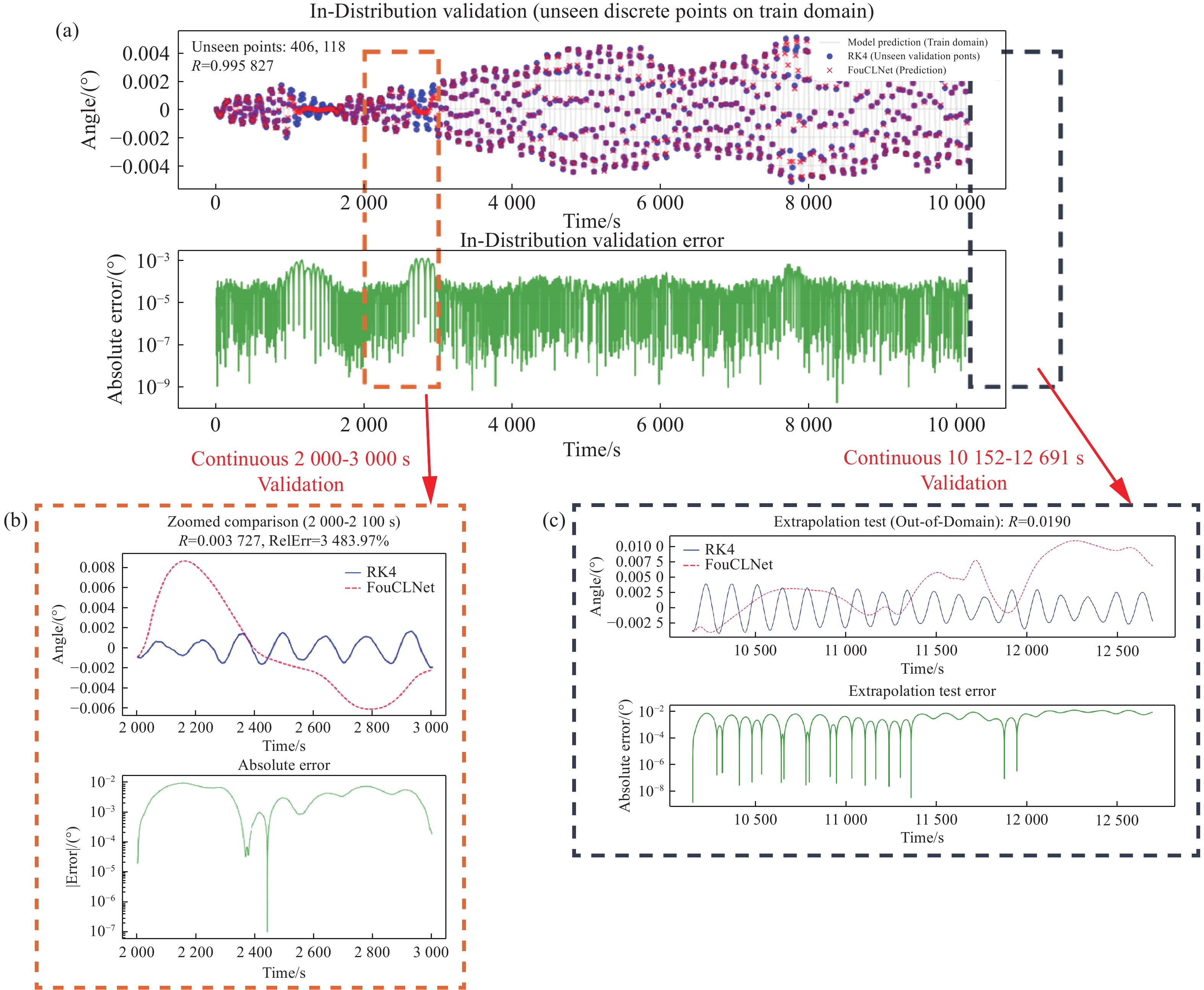
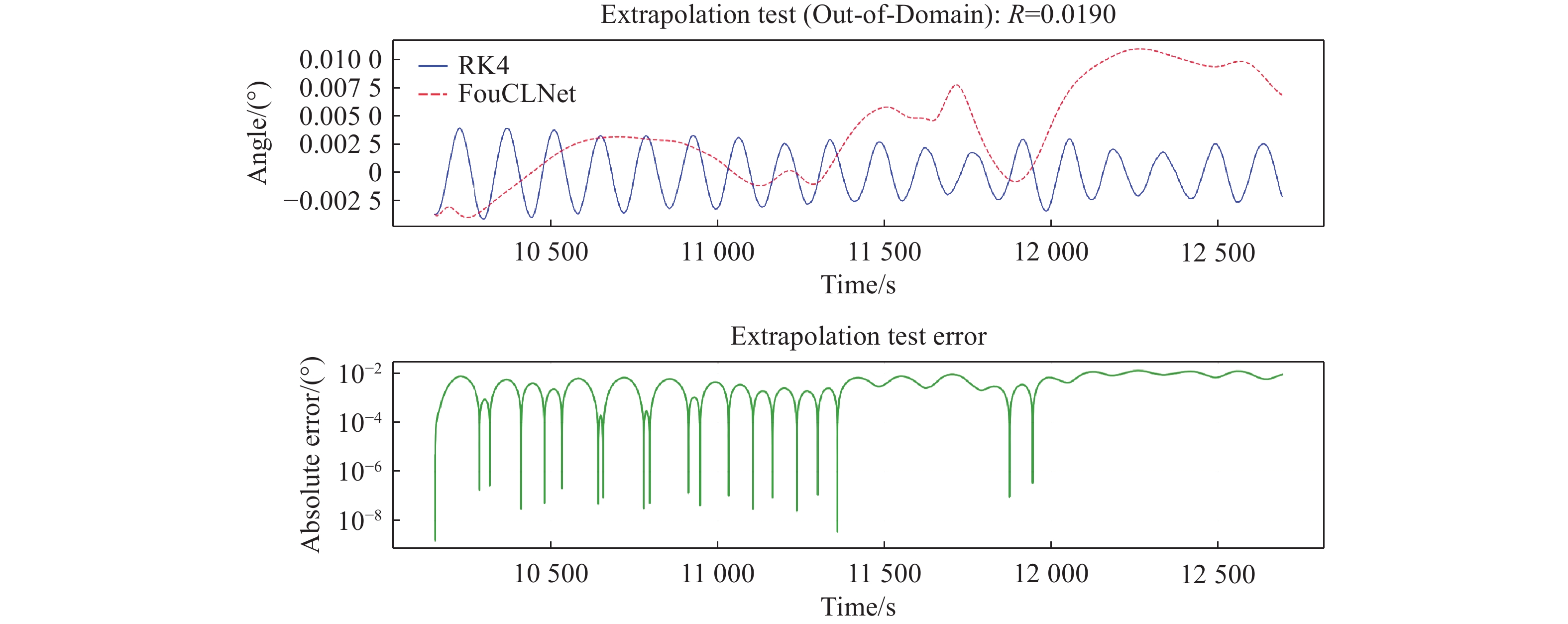
0.9988 ,峰值误差小于0.4%满量程,振幅匹配度100%,功率谱密度在0.007 Hz共振峰处与参考解重合;同分布离散验证集相关系数为0.9958 ,单点推理延迟仅0.524 ms。消融实验反映,去除傅里叶特征或硬振幅约束将引起模型性能严重退化;纯数据驱动配置在离散验证集上精度良好,但在连续时段重建中相关系数降至0.511,而完整方法保持0.986,表明弱物理约束对连续时序一致性具有稳定作用。时序外推实验提示,超出训练域后相关系数降至 0.019,出现虚假低频漂移;且对于训练域内未参与训练的连续时段,模型同样失效(R≈0.029)。本方法不适用于超出训练时间范围的外推预测,使用时须严格限定于训练域内的插值场景。此方法可为普通实验室环境下的扭摆系统提供训练分布内的高精度插值重建参考,并为开发因果性实时振动抑制算法提供参考。Abstract:To address the signal reconstruction problem of high-Q torsion pendulum systems under ground seismic excitation in ordinary laboratory environments—pertinent to ground testing for space gravitational wave detection—a curriculum learning-driven Fourier feature network (FouCLNet) is proposed. Existing hardware isolation strategies impose stringent environmental requirements that are difficult to meet in ordinary ground laboratories. Traditional physics-informed neural networks suffer from spectral bias, gradient conflict, and an inherent tendency for outputs to decay toward zero in high-Q oscillatory systems. Log-spaced Fourier feature mapping is employed with frequency parameters uniformly distributed over the 0.003–0.02 Hz band to match the 0.007 Hz natural frequency of the pendulum. A four-layer fully connected network is constructed, and a hard amplitude constraint loss function is designed to prevent attenuation of micro-radian-scale signals. Through a three-stage curriculum learning strategy, weak physical constraints are progressively introduced with PDE residual weights annealed to the order of 1e-8. Using the torsional response under seismic noise excitation as the target physical quantity and fourth-order Runge-Kutta integration results as ground-truth labels, we randomly sample 80% of time points for training and 20% for in-distribution validation. Experimental results demonstrate that the proposed method achieves a correlation coefficient of
0.9988 on the training set, peak error below 0.4% full scale, 100% amplitude matching, and power spectral density agreement at the 0.007 Hz resonance peak. The in-distribution discrete validation set achieves a correlation coefficient of0.9958 , and the single-point inference latency is merely 0.524 ms. Ablation studies indicate that removing Fourier features or hard amplitude constraints leads to severe model degradation. The pure data-driven configuration achieves good accuracy on the discrete validation set, yet its correlation coefficient drops sharply to 0.511 in continuous-segment reconstruction, whereas the full method maintains 0.986, indicating that weak physical constraints stabilize continuous temporal consistency. Temporal extrapolation beyond the training domain yields a correlation coefficient of merely 0.019, accompanied by spurious low-frequency drift. Furthermore, the model fails to generalize to continuous unseen periods within the training domain (R ≈ 0.029). Consequently, the proposed method is unsuitable for predictive extrapolation beyond the temporal scope of the training data and should be strictly confined to interpolation scenarios within the established training domain. The method provides a high-fidelity in-distribution interpolation reconstruction reference for torsion pendulum systems in ordinary laboratory environments and offers guidance for developing causal real-time vibration suppression algorithms. -
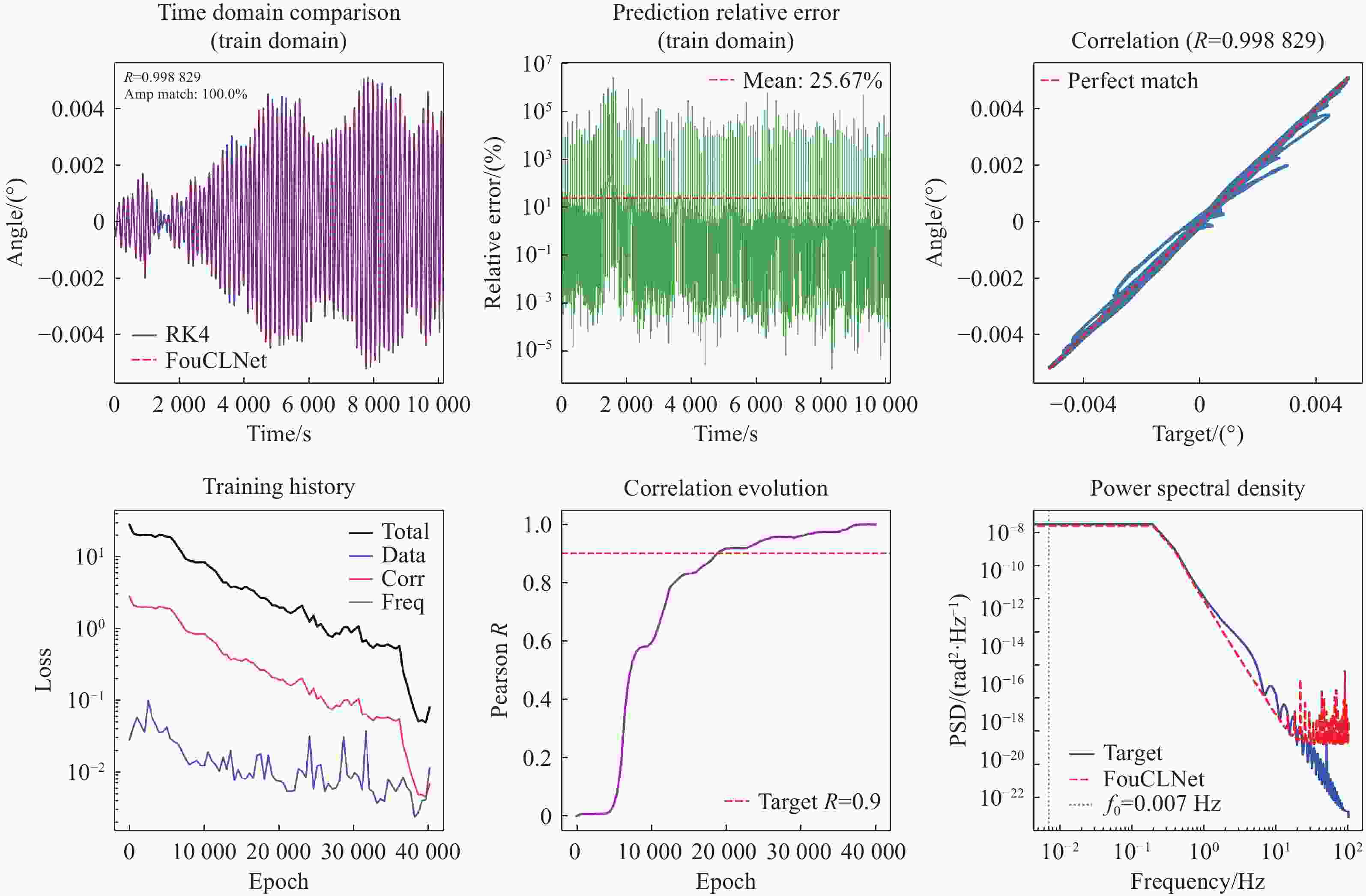
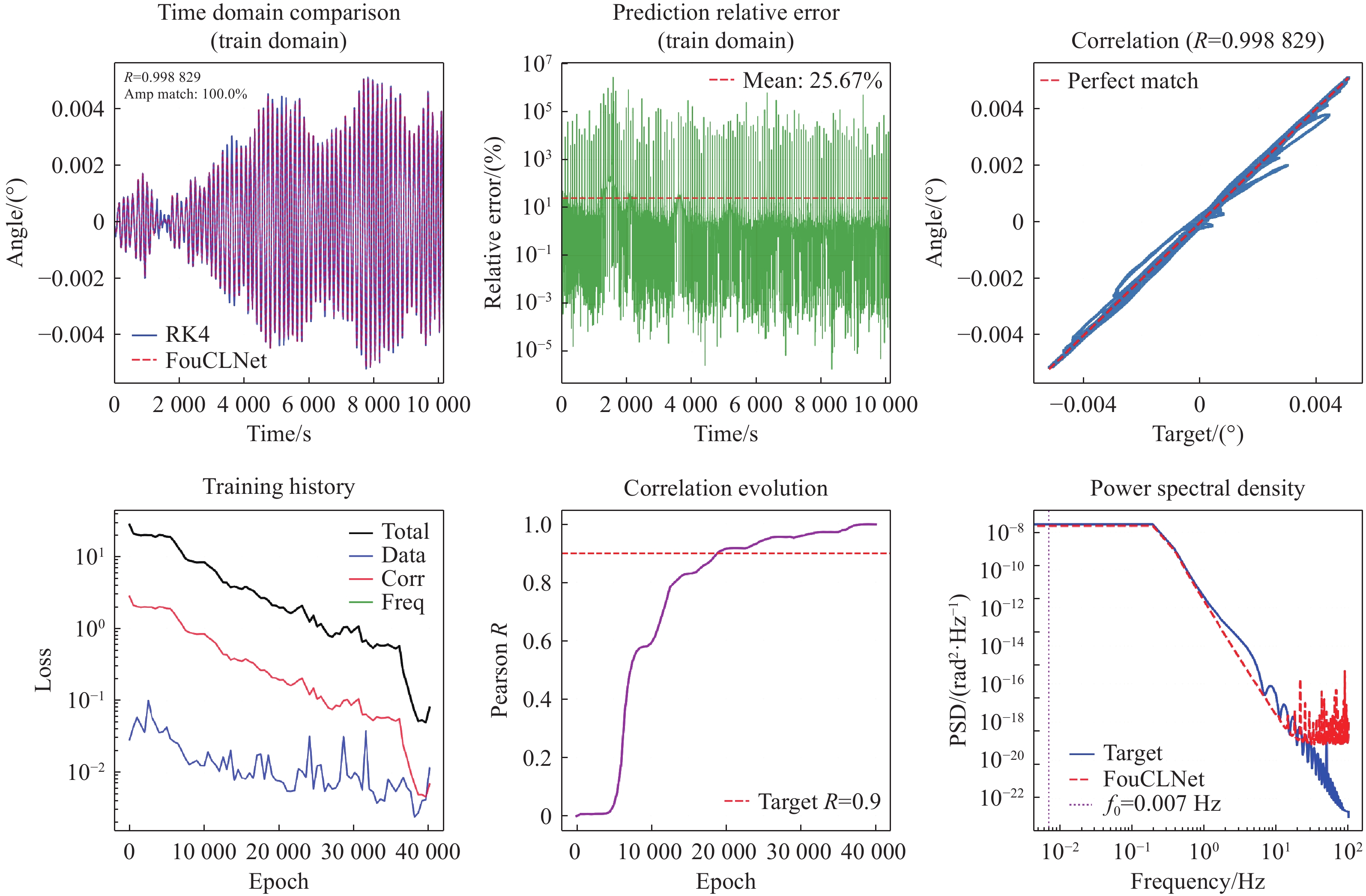
图 2 训练集时域对比与频域功率谱密度图
注:功率谱密度估计采用Welch法(段长131 072点,50%重叠,汉宁窗,线性去趋势);高频段(>0.02 Hz)能量占比详见第4.1节。
Figure 2. Time-domain comparison and power spectral density of the training set
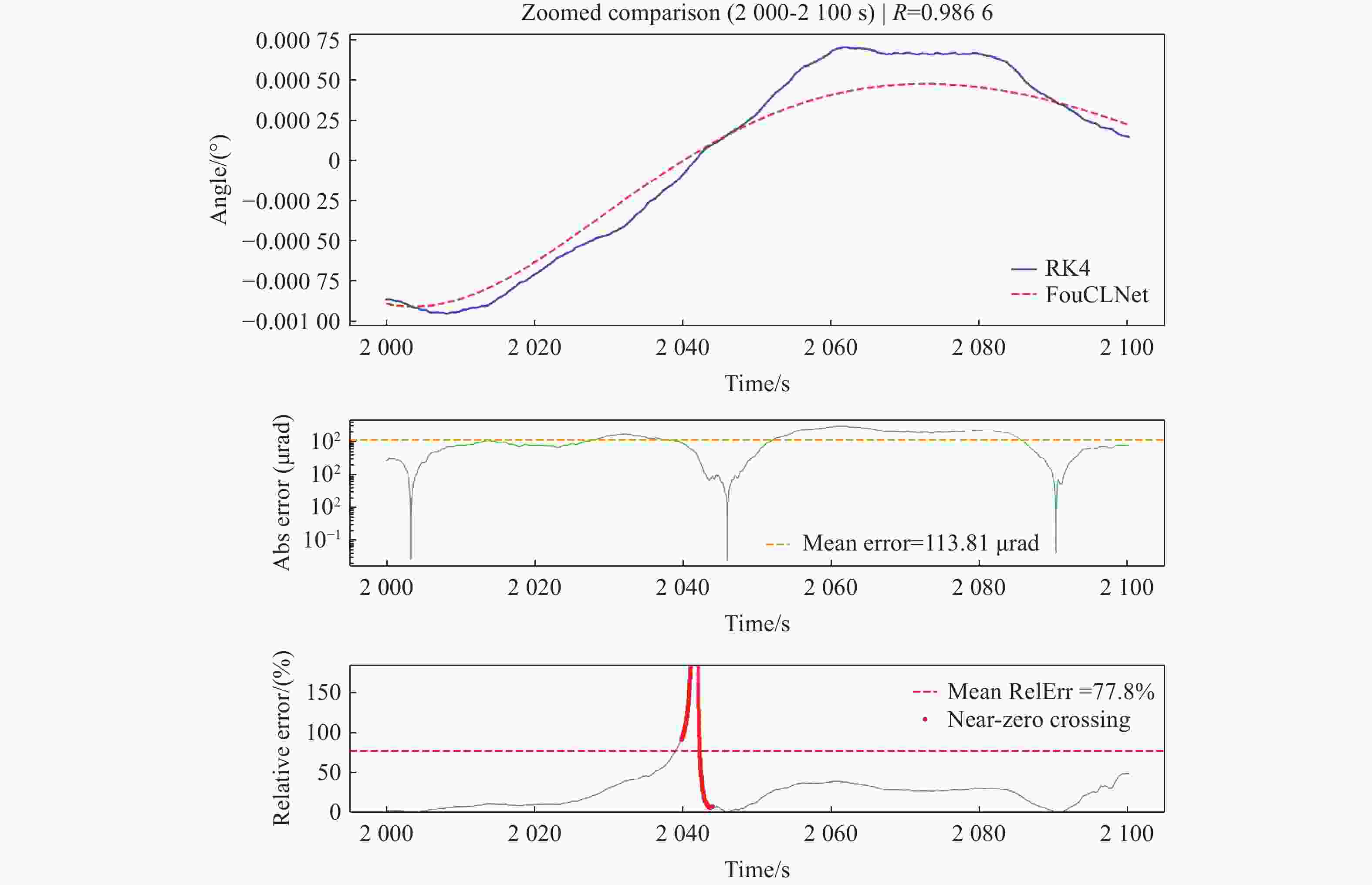
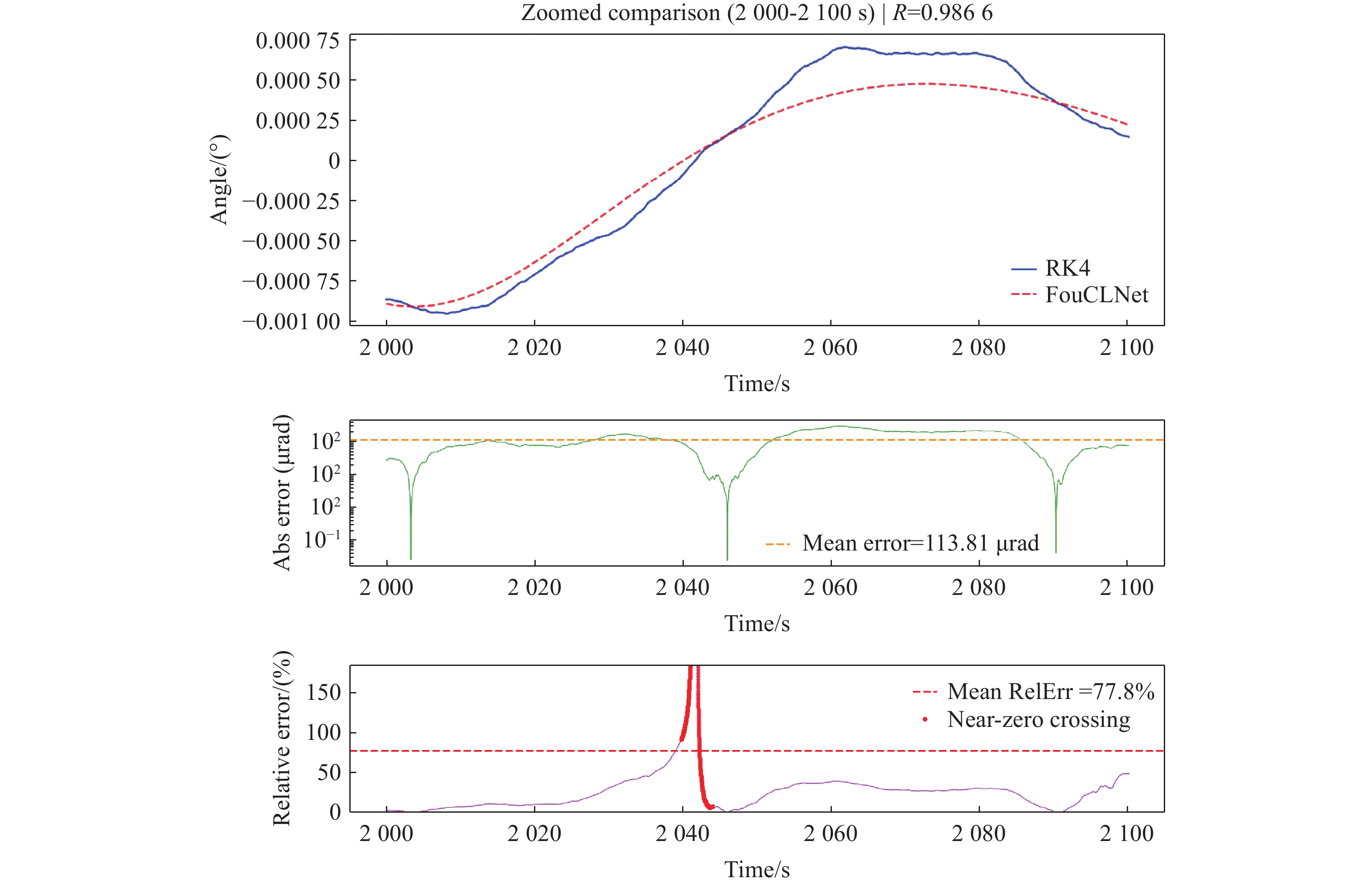
图 3 局部放大时域对比图(
2000 –2100 s)Figure 3. Zoomed-in view of the time-domain comparison (
2000 –2100 s)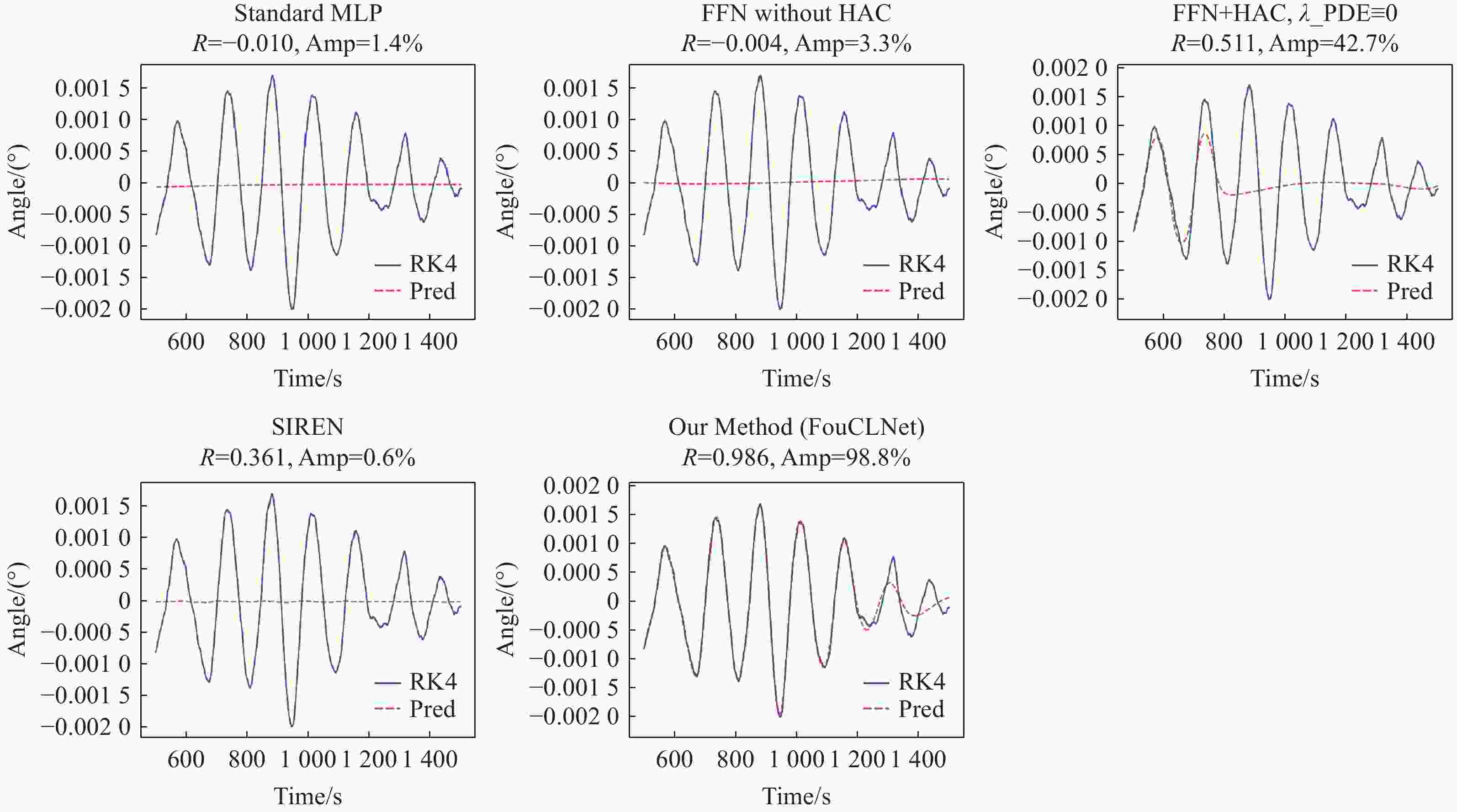
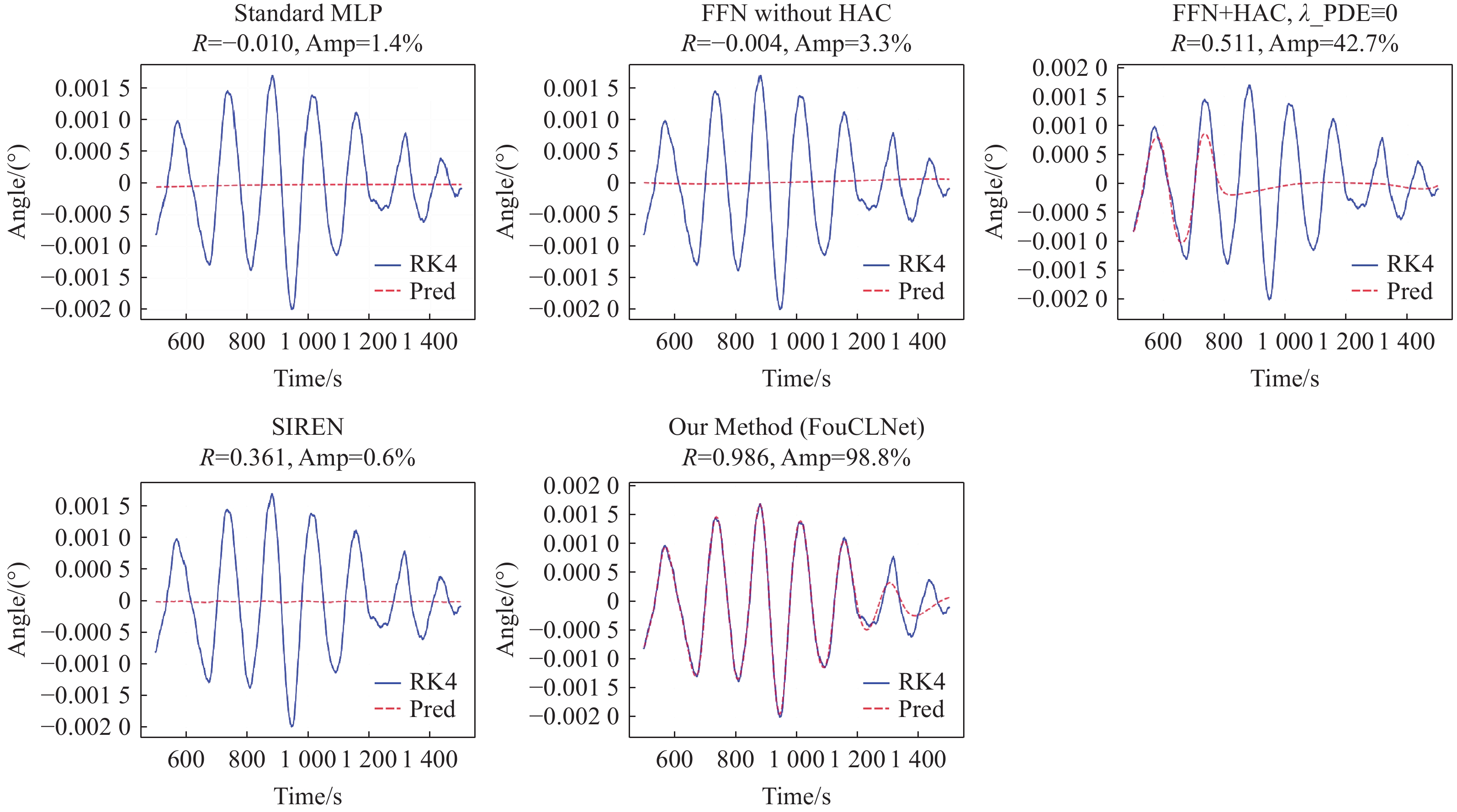
图 7 消融实验连续时段时域对比(500–
1500 s)注:本组连续时段验证(500–
1500 s)均基于完整训练集所训练出的模型,邻近训练点的插值记忆可能对连续性有贡献。Figure 7. Time-domain prediction comparison of ablation groups on a continuous segment (500–
1500 s) within the training domain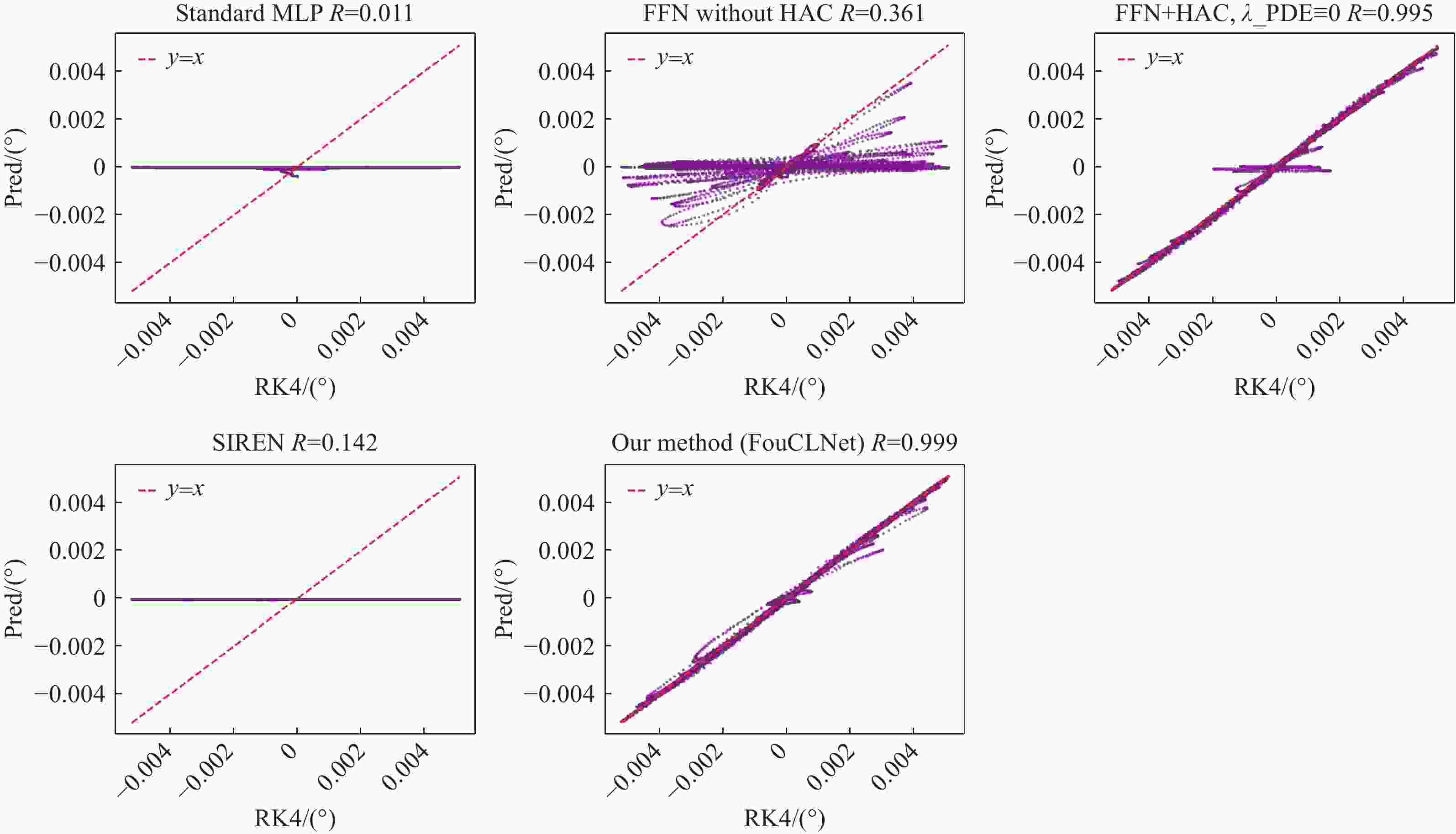
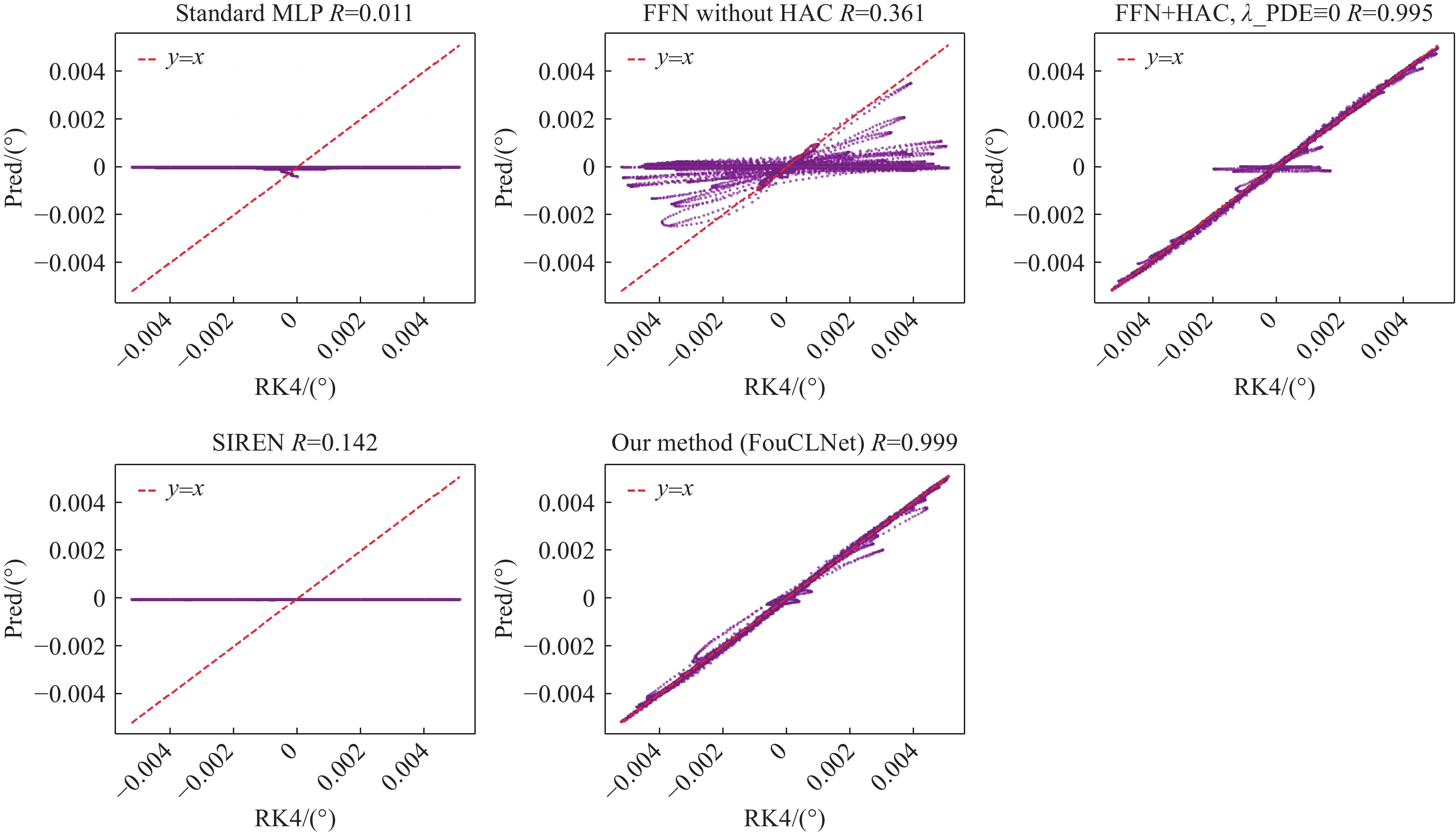
图 6 消融实验离散验证集散点图
Figure 6. Scatter plots of predicted versus reference values for ablation groups on the discrete validation set
表 1 训练集性能指标(40 000轮)
Table 1. Performance metrics on the training set (40,000 epochs)
评价指标 数值 备注 相关系数R 0.998829 预测值与RK4参考解 振幅匹配度 100.0% 预测与参考峰值比值 峰值误差 <0.4% F.S. 满量程百分比 平均相对误差 25.67% 归一化累计误差 注:平均相对误差采用归一化累计误差定义,该指标对微小相位偏差敏感,其绝对值较大并不否定模型在波形与振幅层面的高保真度。  下载: 导出CSV
表 3 多尺度计算效率对比
Table 3. Multi-scale computational efficiency comparison
方法 104点 105点 106点 随机访问延迟 RK4 <0.01 s 0.03 s 0.14 s > 1000 s本文方法 0.24 0.35 1.43 0.524 ms 注:RK4随机访问延迟为从t=0积分至目标时刻的累计时间;本文方法批量计算为逐点推理累加,未采用并行优化。
下载: 导出CSV
表 4 离散验证集上消融实验结果对比
Table 4. Comparison of Ablation Study Results on the Discrete Validation Set
组别 配置 相关系数R 振幅匹配度 主要现象 A 标准MLP 0.011 1.0% 显著谱偏置,无法捕捉0.007 Hz共振 B FFN无HAC 0.361 18.2% 输出幅值衰减至接近零,零输出现象 C 本文方法 0.999 100.0% 波形与振幅均与参考解吻合 D SIREN 0.142 0.2% 训练不稳定,多次训练中方差值较大 E FFN+HAC无PDE损失 0.995 100.0% 纯数据驱动,充分训练后精度良好
下载: 导出CSV
表 5 C组与E组统计稳健性对比(15次独立训练)
Table 5. Comparison of Statistical Robustness between Group C and Group E (Five Independent Training Runs)
组别 验证集R(mean±std) 方差 最小值 最大值 C 0.9986 ±0.0023 5.34×10^-6 0.9936 0.9981 E 0.9953 ±0.0110 1.20×10^-4 0.9703 0.9993 注:表5为15次独立训练的统计稳健性测试,反映平均表现;表4为单次充分训练的最优结果。配对 t 检验:t = 1.09, p = 0.294;Wilcoxon 检验:p = 0.599;Cohen's d = 0.28;贝叶斯因子 BF10 = 0.435(BF01 = 2.30,轶事级支持 H0);Bartlett 方差齐性检验:K2 = 24.56, p = 7.2×10⁻⁷。
下载: 导出CSV
-
[1] HU W R, WU Y L. The Taiji program in space for gravitational wave physics and the nature of gravity[J]. National Science Review, 2017, 4(5): 685-686. doi: 10.1093/nsr/nwx116 [2] DANZMANN K. LISA - an ESA cornerstone mission for the detection and observation of gravitational waves[J]. Advances in Space Research, 2003, 32(7): 1233-1242. doi: 10.1016/s0273-1177(03)90323-1 [3] 罗子人, 白姗, 边星, 等. 空间激光干涉引力波探测[J]. 力学进展, 2013, 43(4): 415-447.LUO Z R, BAI SH, BIAN X, et al. Gravitational wave detection by space laser interferometry[J]. Advances in Mechanics, 2013, 43(4): 415-447. (in Chinese). [4] LUO J, CHEN L SH, DUAN H Z, et al. TianQin: a space-borne gravitational wave detector[J]. Classical and Quantum Gravity, 2016, 33(3): 035010. doi: 10.1088/0264-9381/33/3/035010 [5] 李华东, 高志勇, 王智. 引力参考传感器地面测试扭摆研究进展[J]. 中国科学: 物理学 力学 天文学, 2024, 54(7): 270406.LI H D, GAO ZH Y, WANG ZH. Research progress on torsion pendulum in ground testing of gravitational reference sensor: a review[J]. Scientia Sinica Physica, Mechanica & Astronomica, 2024, 54(7): 270406. (in Chinese). [6] HUELLER M, CAVALLERI A, DOLESI R, et al. Torsion pendulum facility for ground testing of gravitational sensors for LISA[J]. Classical and Quantum Gravity, 2002, 19(7): 1757-1765. doi: 10.1088/0264-9381/19/7/372 [7] ZHOU Z B, LIU L, TU H B, et al. Seismic noise limit for ground-based performance measurements of an inertial sensor using a torsion balance[J]. Classical and Quantum Gravity, 2010, 27(17): 175012. doi: 10.1088/0264-9381/27/17/175012 [8] TAN D Y, YIN H, ZHOU Z B. Seismic noise suppression for ground-based investigation of an inertial sensor by suspending the electrode cage[J]. Chinese Physics Letters, 2015, 32(9): 090401. doi: 10.1088/0256-307X/32/9/090401 [9] TAN D Y, LIU L, HU M, et al. Seismic noise effect reduction improvement for ground-based investigation of space inertial sensor by suspending the electrode housing with an individual pendulum[J]. Classical and Quantum Gravity, 2022, 39(7): 075029. doi: 10.1088/1361-6382/ac5a12 [10] TU H B, BAI Y Z, ZHOU Z B, et al. Performance measurements of an inertial sensor with a two-stage controlled torsion pendulum[J]. Classical and Quantum Gravity, 2010, 27(20): 205016. doi: 10.1088/0264-9381/27/20/205016 [11] 王继河, 孟云鹤, 宋佳凝, 等. 空间引力波探测系统数值与半物理仿真技术综述[J]. 中山大学学报(自然科学版), 2021, 60(S1): 233-238. doi: 10.13471/j.cnki.acta.snus.2020.11.10.2020B124WANG J H, MENG Y H, SONG J N, et al. Review of numerical and hardware-in-the-loop simulation technology of space-borne gravitational wave detection system[J]. Acta Scientiarum Naturalium Universitatis Sunyatseni, 2021, 60(S1): 233-238. doi: 10.13471/j.cnki.acta.snus.2020.11.10.2020B124 [12] KELLY I. LIGO seismic state characterization using machine learning techniques[R]. Pasadena: LIGO Technical Report, 2023. [13] REISSEL C, LAI D, DWIVEDI S, et al. Microseismic noise mitigation with machine learning for advanced LIGO[EB/OL]. (2025-11-24)[2026-05-30]. https://arxiv.org/abs/2511.19682. (查阅网上资料,不确定文献类型及格式是否正确,请确认). [14] RAISSI M, PERDIKARIS P, KARNIADAKIS G E. Physics-informed neural networks: a deep learning framework for solving forward and inverse problems involving nonlinear partial differential equations[J]. Journal of Computational Physics, 2019, 378: 686-707. doi: 10.1016/j.jcp.2018.10.045 [15] KARNIADAKIS G E, KEVREKIDIS I G, LU L, et al. Physics-informed machine learning[J]. Nature Reviews Physics, 2021, 3(6): 422-440. doi: 10.1038/s42254-021-00314-5 [16] KRISHNAPRIYAN A S, GHOLAMI A, ZHE SH D, et al. Characterizing possible failure modes in physics-informed neural networks[C]. Proceedings of the 35th International Conference on Neural Information Processing Systems, Curran Associates Inc. , 2021: 2033. [17] WANG S F, WANG H W, PERDIKARIS P. On the eigenvector bias of Fourier feature networks: from regression to solving multi-scale PDEs with physics-informed neural networks[J]. Computer Methods in Applied Mechanics and Engineering, 2021, 384: 113938. doi: 10.1016/j.cma.2021.113938 [18] WANG S F, YU X L, PERDIKARIS P. When and why PINNs fail to train: a neural tangent kernel perspective[J]. Journal of Computational Physics, 2022, 449: 110768. doi: 10.1016/j.jcp.2021.110768 [19] KHODAKARAMI S, OOMMEN V, DARYAKENARI N A, et al. Spectral bias in physics-informed and operator learning: analysis and mitigation guidelines[J]. Computer Methods in Applied Mechanics and Engineering, 2026, 461: 119156. doi: 10.1016/j.cma.2026.119156 [20] RAHAMAN N, BARATIN A, ARPIT D, et al. On the spectral bias of neural networks[C]. Proceedings of the 36th International Conference on Machine Learning, PMLR, 2019: 5301-5310. [21] TANCIK M, SRINIVASAN P P, MILDENHALL B, et al. Fourier features let networks learn high frequency functions in low dimensional domains[C]. Proceedings of the 34th International Conference on Neural Information Processing Systems, Curran Associates Inc. , 2020: 632. [22] SITZMANN V, MARTEL J N P, BERGMAN A W, et al. Implicit neural representations with periodic activation functions[C]. Proceedings of the 34th International Conference on Neural Information Processing Systems, Curran Associates Inc. , 2020: 626. [23] MILDENHALL B, SRINIVASAN P P, TANCIK M, et al. NeRF: representing scenes as neural radiance fields for view synthesis[J]. Communications of the ACM, 2022, 65(1): 99-106. doi: 10.1145/3503250 [24] CHEN H L, HUANG L ZH, LIU T R, et al. Fourier Imager Network (FIN): a deep neural network for hologram reconstruction with superior external generalization[J]. Light: Science & Applications, 2022, 11(1): 254, doi: 10.1038/s41377-022-00949-8. [25] 曾晓强, 李磐, 董鹏, 等. 引力波探测中激光干涉量子噪声计算[J]. 中国光学(中英文), 2025, 18(3): 698-703. doi: 10.37188/CO.2024-0180ZENG X Q, LI P, DONG P, et al. Calculation of laser interferometric quantum noise in gravitational wave detection[J]. Chinese Optics, 2025, 18(3): 698-703. doi: 10.37188/CO.2024-0180 [26] 叶磊巧, 杜明辉, 徐鹏, 等. 空间引力波探测“太极计划”星间姿态-光程耦合噪声迭代拟合与高精度抑制方法[J]. 中国光学(中英文), 2025, 18(3): 583-595. doi: 10.37188/CO.2025-0042YE L Q, DU M H, XU P, et al. Iterative estimation and precision suppression of inter-spacecraft tilt-to-length coupling noise for the Taiji space gravitational wave detection mission[J]. Chinese Optics, 2025, 18(3): 583-595. doi: 10.37188/CO.2025-0042 [27] 方子若, 朱振才, 蔡志鸣, 等. 空间引力波探测航天器光学测距噪声链路指标优化[J]. 中国光学(中英文), 2025, 18(3): 568-582. doi: 10.37188/CO.2024-0185FANG Z R, ZHU ZH C, CAI ZH M, et al. Optimization of optical metrology noise link metrics for space-based gravitational wave detection spacecraft[J]. Chinese Optics, 2025, 18(3): 568-582. doi: 10.37188/CO.2024-0185 [28] 王雷刚, 云恩学, 罗鑫, 等. 空间引力波探测中超低附加相噪频综研究[J]. 中国光学(中英文), 2025, 18(3): 661-671. doi: 10.37188/CO.2025-0015WANG L G, YUN E X, LUO X, et al. Ultralow residual phase noise frequency synthesizer for space gravitational wave detection[J]. Chinese Optics, 2025, 18(3): 661-671. doi: 10.37188/CO.2025-0015 -

 下载:
下载:

计量
- 文章访问数: 6
- HTML全文浏览量: 5
- PDF下载量: 0
- 被引次数: 0
